Table of Contents
- The Night the Sea Refused Its Boundaries
- Low Countries Before the Deluge: Life on the Edge of Water
- Warnings in the Wind: Omens, Weather, and Medieval Belief
- December 14, 1287: The Hours Before the Break
- When the Dikes Gave Way: Anatomy of a Medieval Catastrophe
- Drowned Villages and Vanished Parishes: The Human Toll
- Mothers, Merchants, and Monks: Personal Stories From the Flood
- From Inland Lake to Inland Sea: The Birth of the Zuiderzee
- Power in the Wake of Disaster: Frisians, Counts, and City-States
- Faith Amid the Waters: Religious Explanations and Ritual Responses
- Trade Routes Rewritten: Hanseatic Ports and the New Maritime Map
- Law, Dikes, and Collective Memory: How the Flood Changed Governance
- Archaeology of a Lost Coastline: Traces Beneath the Polders
- St. Lucia’s Flood in Chronicles, Legends, and Later Imagination
- Echoes in Modern Climate Fears: Reading 1287 From the 21st Century
- Conclusion
- FAQs
- External Resource
- Internal Link
Article Summary: On the winter night of December 14, 1287, the North Sea tore through fragile dikes and reshaped the coastline of the Netherlands and northern Germany in what history remembers as the st lucias flood 1287. This article follows that catastrophe from the quiet hours before the storm to the centuries-long aftershocks it set in motion. It explores the medieval world of farmers, traders, and monks who lived hard by the sea, then suddenly found their land swallowed and their families scattered. We trace how the flood turned an inland lake into the vast Zuiderzee, opening new trade routes while erasing entire communities. Political powers rose and fell in the wake of the disaster, as cities like Amsterdam seized the opportunities left behind by submerged rivals. At the same time, priests, chroniclers, and later historians struggled to explain how such destruction could fit into a divine plan. By following both intimate stories and grand historical shifts, the article shows how the st lucias flood 1287 was not only a single night of terror, but a turning point in the history of the Low Countries. It also asks what this medieval storm surge can teach us today, as modern societies confront rising seas and increasingly violent weather.
The Night the Sea Refused Its Boundaries
On the night of December 14, 1287, the people of the Low Countries went to sleep trusting something that had always been unreliable: the sea. The North Sea had been both enemy and benefactor for as long as anyone could remember, but there was a fragile pact in place, sealed not with ink but with clay and sweat. Dikes, raised over generations by peasants and monks, promised that the water would stay on one side and the fields, homes, and churches on the other. That night, somewhere in the darkness offshore, the pact was silently broken.
The storm had been building through the day, but storms were not uncommon in December. Winds howled over winter fields, rattled crude glass in church windows, and sent fishermen hurrying back to shelter. In Friesland, West Frisia, East Frisia, and along the coasts of what is now the Netherlands and northern Germany, people tightened shutters, brought animals indoors, and stoked fires higher. They prayed to familiar saints—St. Nicholas for sailors, St. Lucia for light in the darkest season—without knowing that, by morning, many of their prayers would be recorded only as names in parish death lists, if they were recorded at all.
In later centuries, the catastrophe would be named the st lucias flood 1287, tying it forever to the feast day of Saint Lucia, the martyr of light remembered each December 13. The juxtaposition is almost cruel. Lucia, celebrated across medieval Europe as a symbol of brightness piercing winter gloom, would become the patron of one of the darkest nights in the history of the North Sea coast. Chroniclers writing decades later would date the water’s rise to “the night after the blessed Lucia,” as if even in their words they struggled to attach the horror to something holy.
The survivors did not speak in neat historical labels or carefully drawn lines on maps. They spoke of screams in the wind, of church bells ringing wildly as towers shook, of torches snuffed out by walls of black water. They spoke of animals crying in barns that became traps, of mothers clutching babies in freezing mud, of neighbors disappearing between one wave and the next. In villages that had stood for centuries on low-lying marshland and reclaimed polder, the difference between safety and death was sometimes only the height of a doorstep or the chance location of a slight rise in the ground.
Yet this was more than a terrible storm. It was a geographical event, a political turning point, and a social revolution packed into one single terrifying night. When the sea finally retreated, it did not simply leave devastation; it left a new coastline, a ripped-open interior sea, and a rearranged balance of power. The st lucias flood 1287 would become one of the foundational traumas of the Dutch and Frisian relationship with water—a trauma that, paradoxically, helped forge the extraordinary water management culture for which the region is now known.
But that outcome—organized dike boards, famous engineers, and global admiration—was centuries away. In 1287, all people saw was ruin. To understand how this night could be so transformative, we have to return to the world that existed just before the sea broke through, to a landscape that feels at once fragile and indomitable, human and precariously borrowed from nature.
Low Countries Before the Deluge: Life on the Edge of Water
Long before 1287, the Low Countries were defined by a simple fact: most of the land barely rose above sea level, and much of it did not rise above it at all. Marshes, peat bogs, tidal flats, and shallow inland lakes stretched behind the dunes that fringed the North Sea. Human life clung to slightly raised ridges of sand or artificial mounds known as terps and wierden—man-made islands built up over generations with layers of clay, dung, and refuse. Here and there, more ambitious communities had pushed back the water with modest dikes and drainage ditches, knitting together these islands into patchwork fields.
By the late thirteenth century, this watery world was already under pressure. Population across Europe had been rising during the so-called High Middle Ages, and the coastal regions of what are now the Netherlands and northern Germany were no exception. More mouths to feed meant more land to cultivate. Peatlands were drained for agriculture and cut for fuel; their loss of volume made the ground sink even further below sea level. Families moved into areas that older generations had considered too risky or too marshy. Lords and monastic orders financed drainage projects, knowing that more arable land meant more income. The boundary between “land” and “sea” was not a fixed line but a breathing, shifting frontier.
Daily life along this frontier was hard but surprisingly prosperous. Coastal Frisians had a reputation for independence, stubbornness, and skill at trading. Their flat-bottomed boats plied estuaries and shallow coastal waters, carrying wool, salt, grain, and fish between small harbors that sometimes were little more than widened creeks. In Western Friesland and the County of Holland, farmers raised cattle on rich, damp pastures. Villages clustered around churches built just high enough that their towers could serve as waymarks for travelers on land and sea.
Dikes stitched this world together. These were not the monumental barriers of modern engineering but earthen banks reinforced with wicker, brushwood, and sometimes stone. Their height and strength varied dramatically. Some were carefully maintained by cooperatives of local landowners bound together in early forms of water boards. Others were neglected when wars, bad harvests, or disputes over responsibility diverted attention. Even the best dikes were vulnerable to storm surges that rose above their crests and gnawed at their foundations.
Still, people had faith in them—practical faith, not blind trust. They had seen storms before, and they had rebuilt. Floods in the eleventh and twelfth centuries had taken lives and fields, but they had also led to stronger dikes, new drainage canals, and more sophisticated local institutions. In a way, the landscape had been training its inhabitants to be resilient. That training, however, had its limits, and the st lucias flood 1287 would expose them brutally.
Socially, these coastal communities straddled a line between feudal hierarchy and local autonomy. In the County of Holland, counts were consolidating their power, drawing once-independent villages into a princely orbit. In Friesland, local elites resisted external lords, clinging to a tradition of so-called “Frisian freedom” under which small landholders and regional chieftains governed themselves. Eastward, in what is now Lower Saxony, various princes and bishops controlled fragmented territories interlaced by waterways. The sea, however, was the one overlord no charter could tame.
Religion shaped how people saw their precarious world. Churches dedicated to saints who had braved fire, blindness, or martyrdom stood within a day’s walk of each other. The feast of Saint Lucia, celebrated on December 13, marked a turning point in the winter calendar—a reminder that even the longest nights would give way to light. The faithful gathered with candles, chanted antiphons, and listened to sermons about steadfastness in darkness. No one imagined that, on the very next night, darkness would take on a chillingly literal form as storm clouds choked the sky and the sea eclipsed the land.
To understand how so many lives could be lost so quickly, we must look not only at dikes and dunes but also at atmosphere and ocean. The medieval climate, while generally milder than in the “Little Ice Age” that followed, was capable of violent swings. Storm surges in the North Sea could be driven far inland if they coincided with high tides and specific wind patterns. In 1287, all these factors aligned with dreadful precision.
Warnings in the Wind: Omens, Weather, and Medieval Belief
In a rational, data-rich age, it is tempting to imagine that disasters arrive with clear, measurable warnings. Pressure drops, satellite images, forecast models: these are our omens now. In the thirteenth century, the warnings were more ambiguous, and often wrapped in stories and superstition. People of the Low Countries watched the sky, the behavior of animals, and the rhythm of tides with attentive eyes, but they interpreted what they saw through a spiritual lens.
As the st lucias flood 1287 approached, chronicles tell of strong winds sweeping in from the northwest and west, whipping up the sea into “great mountains of water.” In some accounts, the storm developed over several days, with increasingly severe gales battering the coast. Fishermen, seasoned observers of weather, grew uneasy. They knew the signs of a bad storm: long, heavy swells arriving before the main winds, eerie calm between squalls, strange cloud formations low on the horizon. Some likely chose to keep their boats moored, a decision that would save their lives but not necessarily their homes.
Ordinary people did not speak the language of barometric pressure or meteorological fronts. They spoke the language of portents. A blood-red sunset might be taken as a warning of divine displeasure. An unusually high tide, a dead whale washed ashore, or even a persistent flock of birds fleeing inland could spark whispered conversations about God’s anger. Priests might connect such phenomena to recent sins: disputes left unresolved, tithes unpaid, oaths broken, or simply the general wickedness of the age.
Yet not all omens were grim. On December 13, many communities marked Saint Lucia’s Day with early morning services, candles, and processions. In some regions, Lucia, whose name is linked to “light,” was honored as a bearer of hope in the winter darkness. The night following her feast—when the st lucias flood 1287 struck—was therefore framed by liturgy and devotion. That made the disaster, to those who survived it, feel less like an isolated storm and more like a direct commentary from Heaven.
It is astonishing, isn’t it, how people facing the same physical forces can interpret them in such different ways? A modern meteorologist would likely explain the flood as the result of a powerful storm depression passing over the North Sea, driving a surge of water into shallow coastal areas at precisely the wrong moment in the tidal cycle. But the medieval world did not separate natural and supernatural causes. God worked through wind and wave, and when water rose beyond its ordinary bounds, the question was not merely “how?” but “why?”
Some chronicles, such as those preserved in monastic libraries centuries later, speak of a “great and fearsome flood in the regions of Frisia and Holland” that drowned men and cattle without number. One later writer, based on now-lost sources, estimated that tens of thousands perished—a figure which, even if imperfect, conveys the sense of overwhelming loss. These writers did not dwell on pressure systems; they dwelt on moral lessons. Floods were warnings, punishments, or tests.
And yet, beneath the sermons and the symbolism, practical anxieties thrummed. Local water boards debated the condition of dikes. Villagers grumbled about neighbors who had failed to send their full share of labor to repair embankments. Landowners questioned whether it was wise to have drained so much peatland, watching the ground sink year by year. When the storm finally came, it struck a coastline already buffeted by human choices as much as by nature.
December 14, 1287: The Hours Before the Break
As December 14 wore on, the storm gathered its strength like a predator outside a door. By late afternoon, sky and sea had blurred into a single roiling mass of gray. In towns along the Zuiderzee’s predecessor—the shallow lake and marsh complex that would be violently expanded by the st lucias flood 1287—the water level was already rising uncomfortably high. River mouths choked with incoming waves and heavy outflows from inland rains. Ships peeled away from exposed anchorages to seek shelter in creeks and behind spits of land.
Inside houses built of timber and clay, people responded as they always had. They lashed shutters, added extra beams to brace doors, and brought vulnerable items up to lofts or rafters. In some places, parish priests ordered bells to be rung in intercessory prayer, a low, insistent sound competing with the wind’s howl. Children, excited and frightened, asked their parents whether the dikes would hold. Parents answered with more confidence than they felt.
The geography of risk varied from place to place. Along the North Sea coast proper—on the Wadden islands, the Frisian mainland, and the marshlands of East Frisia and Oldenburg—the first line of defense was the dunes and sea dikes facing the open water. Inland, along what would become the Zuiderzee, the defenses were more complex and, in some areas, weaker. Here, dikes had been built and rebuilt piecemeal over decades, enclosing former tidal inlets and shallow lakes to create polders. Some sections of the barrier separating the inner waters from the coastal sea were low or poorly maintained. These weaknesses would prove fatal.
As darkness fell, the wind shifted further to the northwest and increased in violence. It drove the sea hard against the coastline, forcing water into every estuary and bay. Inlets funneled the surge inward, raising water levels higher than many living people had ever witnessed. Sometime that evening, small overflows began: water slopping over dike crests, planks rattling on floodgates, seepage oozing through old earthen banks. In a few places, alarm was raised, and men were sent out with shovels and carts of clay to reinforce weak spots by torchlight.
But human strength and speed have limits, and the sea that night had none. In house after house, the conversation must have gone the same way: someone peered outside, saw water creeping into yards or lanes, and muttered that it looked “higher than last time.” Others answered that the dike had held through worse. Somewhere, a weary father tried to calm his family by pointing to the church tower still standing firm on its mound, silhouetted against racing clouds. Even then, he may have felt a chill he could not name.
Midnight approached. The feast day had long since ended. Lucian candles were burned to stubs; hearths glowed low. In many villages, people went to bed with uneasy hearts, trusting that the walls that had always protected them would do so again. But this was only the beginning.
When the Dikes Gave Way: Anatomy of a Medieval Catastrophe
At some point in the deep night—chroniclers disagree on the exact hour—the first critical dikes failed. We do not know the name of the first embankment to break, or the faces of the men who heard the dreadful snap and crack of its collapse. We can only imagine it: a low roar building in the darkness, a sudden shudder through the earth, then the sound of water rushing with a force that no planks or earth could resist.
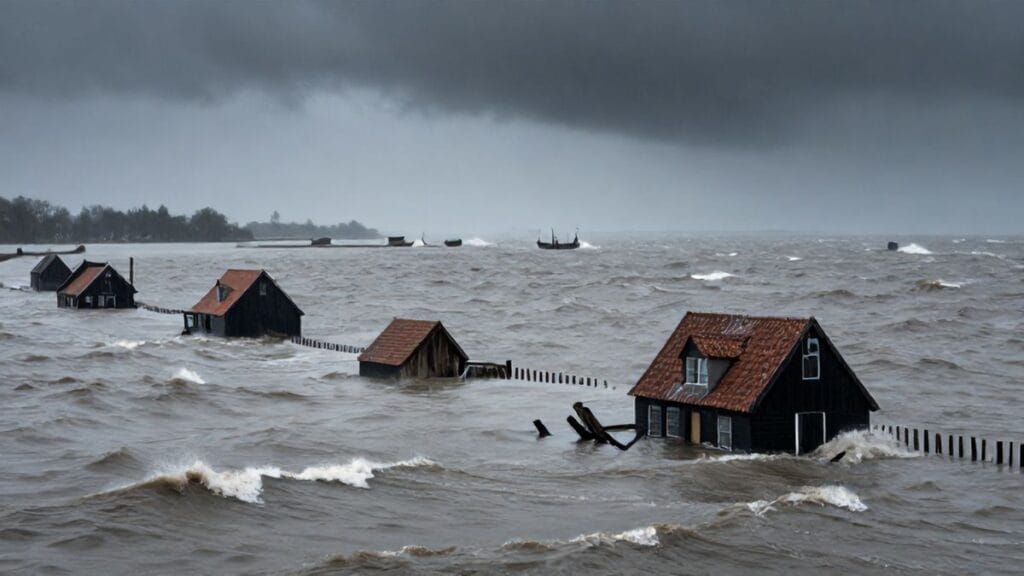
The st lucias flood 1287 was not a single wave but a sustained, battering surge driven inland by furious winds. When a section of dike failed, the water did not pour through gently; it hurled itself forward like a released dam. It gouged at the edges of the breach, widening it with every moment. Houses and barns close to the embankment were smashed or lifted whole and carried away. People awoke to the sound of raging water or to the shock of icy surf hammering their doors.
In the northern Netherlands, the consequences were especially dramatic. The storm surge forced massive amounts of North Sea water into the former freshwater lake and peatland region known as the Almere and its surroundings. Weak points in the barrier separating this basin from the open sea collapsed. The lake, already enlarged by earlier floods, suddenly became a wide, salty inland sea: the Zuiderzee. Villages that had once sat comfortably behind protective dunes found themselves on exposed shorelines or drowned entirely.
Contemporary estimates of the dead vary wildly, ranging from tens of thousands to more than fifty thousand. Modern historians, wary of medieval exaggeration, still acknowledge that the death toll was immense. A quote often attributed to later Dutch sources speaks of “a countless multitude of men and beasts” perishing. Although exact records are impossible, the impression is clear: this was not just a disastrous local event, but one of the deadliest floods in European history.
The water moved with terrifying speed. In low-lying areas of Friesland and Groningen, entire terps were inundated. People who had once trusted their mound’s height found that the new waves overtopped even these ancient refuges. In some places, church towers remained visible above the water, their bells ringing wildly as frantic priests and villagers pulled ropes in what was both warning and prayer. In other places, towers themselves collapsed as their foundations were scoured away.
The flood did not respect political or linguistic borders. In the German regions of East Frisia, Oldenburg, and around the lower Weser and Elbe rivers, dikes gave way as well. Along the Jadebusen and Dollart bays, land vanished that would never fully return. Farms and small settlements, never again recorded in surviving documents, disappeared beneath the newly expanded reaches of the sea. A harsh morning would dawn over a coastline that no one recognized.
For hours, the water rose and churned, driven onward by wind that screamed like a living thing. In the darkness, families clung to whatever floated: roof beams, hayricks, overturned boats. Those who reached church roofs or the top of dikes huddled together, lashed by spray and sleet, listening helplessly to the cries of those still trapped below. When the tide finally turned and the winds eased, just before dawn, it was not mercy they saw but a ghastly stillness settling over an unfamiliar, drowned world.
Drowned Villages and Vanished Parishes: The Human Toll
At daybreak on December 15, the full horror emerged. Where roads had been, there were now channels. Where fields had lain, there were churning, debris-strewn shallows. And where villages had once sent up smoke from their chimneys, only the very tips of roofs, or nothing at all, marked their former presence.
The st lucias flood 1287 extinguished communities that had been living, working, and praying for generations. Parish lists compiled in subsequent years record “parochia desolata”—parish deserted—or note quietly that no priest was appointed because the church had been washed away. In some areas around what would become the Zuiderzee, perhaps dozens of settlements disappeared, their names preserved only in later memory or submerged archaeological finds. It is as if pages were torn out of the map.
Survivors staggered across a landscape transformed into a patchwork of muddy islands. Livestock lay drowned in ditches or tangled in hedges. Horses and cows that did survive wandered, lowing in confusion, looking for their barns and caretakers. Children cried for parents who would never answer; parents searched the waterlines and tangled drifts of debris for any sign of missing sons and daughters. The dead washed ashore in such numbers in some regions that mass graves were dug hastily on whatever higher ground remained.
Food, already scarce in winter, became an immediate concern. Granaries had been soaked and destroyed; supplies in cellars were ruined by saltwater. Fields, now saturated and in many places scoured of their topsoil, could not easily be planted in the coming spring. In the worst-hit districts, famine lurked close behind the retreating waters. Some relief came from neighboring regions less affected by the flood, but transportation itself had been disrupted by destroyed roads and bridges.
Yet even amid this devastation, some people found themselves unexpectedly in positions of relative security. Towns built on higher natural ground, or with more robust defenses, emerged as new centers of refuge. In the County of Holland, cities like Amsterdam—still far from the global powerhouse it would later become—benefited from their location on more stable banks and river mouths. Refugees arrived at their gates, bringing with them both desperation and skills, labor, and future loyalties.
The psychological shock is difficult to overstate. Medieval people were no strangers to death, but the scale and arbitrariness of the st lucias flood 1287 strained even their well-worn theological frameworks. Why had one village been spared while another, seemingly no more sinful, was erased? Why had one child clung miraculously to a floating door, while others had vanished without trace? Priests tried to answer from their pulpits, but the questions lingered like the salt crusting on ruined fields.
In the months that followed, many families faced a grim choice: rebuild on the old sites, now known to be dangerously exposed, or move inland to places where they might be strangers and tenants instead of independent smallholders. Some clung stubbornly to ancestral terps and dike lines, seeing departure as a surrender not only to nature but to encroaching lords. Others packed what little they had saved and went in search of new patronage and new patron saints.
Mothers, Merchants, and Monks: Personal Stories From the Flood
Behind statistics and sweeping changes, individual lives flicker. The chronicles rarely tell their full stories, but if we listen between the lines, we can hear them.
Imagine a woman in a Frisian village—let us call her Aaltje—who had spent the previous day preparing for Lucia’s feast. She had three children, the youngest still nursing. Her husband was a smallholder with a share in a communal pasture lying just inside the dike. As the storm built that afternoon, they argued about whether to move valuables to the church mound. He said the dikes had held so many times before; she was less sure but did not want to quarrel. When water began to seep under the door at midnight, she hurried to bundle the children into extra garments, while her husband went out to see how high the street had flooded.
By the time he opened the door, the street was no longer a street. A wall of black water slammed into him, twisting him off his feet. The door burst inward. In the confusion, with a baby in her arms and two older children grabbing at her skirts, Aaltje was pushed backwards onto the table. The table, dislodged, floated for a horrifying moment before crashing into the frame of an interior wall. There it lodged. Just high enough. All night, with the house creaking and breaking around her, she clung to that table, to her children, to life itself. When dawn came, she and one child were still alive. The others, including her husband, were gone. No chronicle records her name, but thousands of such stories lie behind the bald phrase “many people perished.”
Some accounts, preserved in later retellings, focus on miraculous rescues: a child found sleeping in a cradle that had floated into a tree; a group of monks saved when their abbey’s stone walls held firm even as all the village houses around them were destroyed. These narratives, half-history and half-hagiography, served religious as well as psychological needs. They suggested that, even amid catastrophe, divine providence singled out some for saving as signs of hope and mercy.
Merchants, too, felt the storm’s impact deeply. Consider a trader in the town of Stavoren, once a prosperous port on the inland waters before the formation of the full Zuiderzee. His livelihood depended on predictable routes, stable quays, and known channels. The st lucias flood 1287 did not merely disrupt his business for a season; it rewrote the maritime geography on which his career had been built. Harbors silted up or opened anew. Channels deepened in unexpected places, while others became treacherous with newly submerged obstacles. In the short term, he grieved for lost relatives and stock. In the longer term, he had to decide: invest in new ships suited to the changed waters, or withdraw inland and try his hand at land-based trade.
Monasteries were both victims and chroniclers of the flood. Many abbeys had lands along the coast, granted by pious patrons over the centuries. Their income from rents and tithes depended on those lands remaining fertile and above water. In the wake of the flood, some monasteries found their estates half-drowned; tenants dead or displaced; tithe barns empty. Yet it was often in their scriptoria that the first written records of the disaster were compiled. A monk at a Benedictine house in northern Germany might open his chronicle volume and, in a careful hand, add a new entry for the year of our Lord 1287: “In this year, on the night following the feast of the blessed Lucia, there came a great flood upon the coasts of Frisia, Holland, and Saxony, and an innumerable multitude of people and animals perished.”
That terse Latin cannot capture the rawness of the grief he may have felt, but it preserves a faint echo. Centuries later, historians like Willem van Bunge or later Dutch scholars would read such lines and try to reconstruct the scale and scope of what had happened. One modern historian of the North Sea coast wrote—in a line that sounds almost like a lament—that “the sea took not only land, but memory, pulling both fields and stories below its restless surface.”
From Inland Lake to Inland Sea: The Birth of the Zuiderzee
Among the many consequences of the st lucias flood 1287, few were as long-lasting as the transformation of the inland waters into the Zuiderzee. Before the flood, the central Netherlands contained a complex of lakes, peat bogs, and tidal inlets, including the Almere. Human intervention—peat cutting, drainage, and piecemeal reclamation—had already turned this area into a vulnerable patchwork. Earlier floods in the twelfth century had begun to open the region to the sea. But the 1287 storm surge appears to have been the tipping point when the barrier between the North Sea and these inland waters failed catastrophically.
In the hours when dikes and dunes were shattered, saltwater poured in and did not fully withdraw. Channels were scoured deeper; peatland eroded rapidly. What had been a largely freshwater system, with limited tidal influence, became a brackish inland sea connected directly to the North Sea via broad gateways. Over subsequent years and decades, repeated smaller storms reinforced this new reality, eating further into the soft interior banks and expanding the Zuiderzee’s footprint.
This transformation had immediate and startling effects. Once-inland settlements found themselves now on a new seashore. Others that had relied on sheltered freshwater conditions for their fisheries faced the challenge of adapting to more saline, open-sea species. Some ports declined as their harbors became less accessible, while others prospered from the new seaways. Amsterdam, for instance, situated on the Amstel River with access to the Zuiderzee, was poised to benefit from the expanded maritime reach that this catastrophic inland sea opened.
From a geographical perspective, the creation of the Zuiderzee was both loss and opportunity. It devoured arable land and entire communities, but it also carved out a vast, navigable expanse that later centuries would use to project Dutch commerce across Europe and beyond. In this sense, the st lucias flood 1287 did not merely destroy; it rearranged. It redrew the map in a way that future merchants, sailors, and princes would exploit.
Of course, those advantages were far from obvious to the people living through the immediate aftermath. To them, the Zuiderzee was a wound that would not close, a gaping, salt-filled reminder of what had been taken. For generations, stories would be told of fertile meadows and bustling hamlets now lying beneath its waves. Fishermen casting nets in later centuries would sometimes pull up timbers, bricks, or pottery, mute testimony to the drowned world below.
Only much later, in the twentieth century, would the Dutch state undertake massive engineering projects—the Zuiderzee Works—to reclaim much of that inland sea as polder land again, finally taming the consequences of 1287 on a scale unthinkable to medieval minds. In that long arc, the flood appears as both starting gun and dark inspiration: proof of what the sea could do, and a challenge to build defenses and reclamation works sturdy enough to withstand not just one storm, but centuries of them.
Power in the Wake of Disaster: Frisians, Counts, and City-States
Catastrophes rarely leave political structures untouched. The st lucias flood 1287 was no exception. In the Low Countries and northern Germany, it contributed—alongside other forces—to shifts in power that would echo for generations.
In Friesland, the longstanding tradition of relative autonomy, sometimes described as “Frisian freedom,” was already under pressure from neighboring powers. The flood weakened many of the very communities that had sustained that independence. When local elites lost land, tenants, and income, their capacity to resist external lords diminished. Though Frisian freedom would persist in various forms for centuries, the demographic and economic blow of 1287 made the region more vulnerable to later encroachments.
Further west, in the County of Holland, counts seeking to extend their authority into West Frisia and coastal areas found new opportunities amid the chaos. Refugees in need of protection and new land could be bound to new lords through grants and privileges. Villages rebuilt under comital patronage might accept obligations they would once have resisted. The flood’s reshaping of land ownership—a field here washed away, an entire village there relocated—created a fluid environment in which savvy rulers could strengthen their grip.
Urban centers along the new and altered waterways emerged as key players. Cities like Kampen, Deventer, and Zwolle, already part of a developing network of trade along the IJssel and Zuiderzee shores, adjusted to the changing hydrology quicker than many rural communities. They organized rebuilding of quays, dredging of harbors, and regulation of trade in ways that increased their economic leverage. In time, their maritime connections would link them more closely to the Hanseatic League, the powerful commercial alliance of northern European cities.
In northern Germany, flood-damaged territories offered openings for ambitious princes and bishops. When monasteries or minor nobles could no longer manage their inundated lands, larger powers sometimes stepped in—claiming protective roles that came with rents, tolls, and jurisdiction. The complex political mosaic of the region grew even more intricate as new claims overlapped old ones. Arguments over who was responsible for repairing and strengthening dikes became, in effect, arguments over who had the right to tax and judge the people living behind those dikes.
It is telling that, in the centuries after the st lucias flood 1287, legal and institutional developments around water management became bound up with questions of sovereignty. Whoever controlled the dikes controlled not only safety, but also a key lever of political legitimacy. The flood had demonstrated with horrifying clarity that poor water management could mean mass death. That knowledge gave rulers who could credibly promise strong defenses a powerful argument for their rule—as long as they actually delivered.
Faith Amid the Waters: Religious Explanations and Ritual Responses
In the medieval imagination, no disaster was purely natural. The st lucias flood 1287 demanded explanation as part of a divine moral order. Priests, monks, and laypeople turned instinctively to their faith for answers and comfort, weaving the events of that terrible night into the broader tapestry of Christian teaching.
Sermons preached in the months and years after the flood likely framed it as both punishment and call to repentance. Chroniclers, often writing in Latin for clerical audiences, emphasized sin and mercy in equal measure. One might imagine a preacher standing before a congregation in a half-repaired church, its walls still smelling faintly of damp, warning that “as the waters of the Flood in the days of Noah punished the wickedness of men, so also has God chastised us, that we might turn from our sins.” Yet he would also point to survivors and acts of charity as signs that God’s mercy had not been withdrawn.
Saints’ cults provided specific lenses. The connection to Saint Lucia gave the flood a symbolic sharpness. Lucia, whose name evoked light, was associated in some regions with protection against blindness and darkness. That the flood struck just after her feast day suggested to some that people had ignored the light she offered—both literal candlelight and spiritual insight. New altars, processions, or votive offerings to Lucia may have appeared in freshly rebuilt churches as communities sought her intercession against future disasters.
Other saints, especially those connected with the sea or weather, also grew in prominence. Saint Nicholas, patron of sailors, and Saint Clement, sometimes invoked for protection from storms, received renewed devotion. Pilgrimages to regional shrines might increase as survivors sought to give thanks or plead for continued safety. Liturgical calendars, already crowded with feasts and fasts, gained new local commemorations marking the flood’s anniversary, often framed as days of penitence and prayer.
Monasteries and religious orders played a practical role as well. Their estates, though damaged, often remained more intact than the scattered holdings of small peasants. Monastic granaries and cellars became lifelines in the first lean months. Almsgiving, always a Christian duty, took on new urgency. Chronicles mention houses feeding displaced people, temporarily sheltering them, and in some cases granting more permanent tenancy on surviving lands.
At the same time, the flood tested faith. Some people surely questioned why God had allowed innocents—especially children—to drown. The theological answers they received were those common to medieval Christianity: that suffering was a mystery, that the world was fallen, that trials could purify and draw souls closer to God. Such answers brought solace to some, frustration to others. But in a world where religious institutions were central to community life, very few people could imagine processing the trauma of the st lucias flood 1287 outside of a Christian framework.
Trade Routes Rewritten: Hanseatic Ports and the New Maritime Map
When waters recede, they leave more than silt behind; they leave new patterns of movement. The st lucias flood 1287 helped redraw the maritime and riverine routes of the North Sea basin, with lasting implications for commerce and urban growth.
The newly expanded Zuiderzee became a broad inland sea dotted with emerging port towns. Its shores offered safe anchorages and access to rivers reaching deep into the European interior. Over time, cities along this sea—eventually including Amsterdam, Kampen, and others—would tie themselves into the wider network of the Hanseatic League, which stitched together ports from Bruges to Lübeck and Bergen.
Some older ports suffered. Harbors that had depended on particular channels or protective sandbanks found their configuration altered. Shifting sands and altered currents made navigation tricky. Merchants had to learn new routes, buy updated local knowledge from pilots, and sometimes abandon long-used wharves. Insurance, in its primitive medieval forms, had to reckon with new degrees of risk.
Yet for those able to adapt, opportunities abounded. Grain from the Baltic, cloth from Flanders, salt from Bay of Biscay sources, and fish from northern waters could now move in fresh combinations through the altered Dutch and German coasts. The st lucias flood 1287, by creating the Zuiderzee and modifying estuaries, inadvertently helped generate the maritime infrastructure that would, in later centuries, underpin Dutch commercial ascendancy.
In northern Germany, flood-altered bays like the Dollart and Jadebusen changed the balance among ports on the North Sea coast. Some river mouths became more accessible to deep-draught vessels; others silted up. Hanseatic cities, always alert to the slightest competitive edge, invested in dikes, quays, and beacons to attract traders. Although the Hanse’s formal rise is usually dated a bit later, the environmental shocks of events like 1287 were part of the background against which that commercial empire grew.
One modern maritime historian, in analyzing medieval port records, observed that “each storm surge was both a blow and a lever,” destroying old patterns and prying open new ones. The st lucias flood 1287 was a particularly powerful lever, one that shifted the maritime map in ways its terrified contemporaries could never have imagined.
Law, Dikes, and Collective Memory: How the Flood Changed Governance
In the Low Countries, water management and governance have always been intertwined. After the st lucias flood 1287, that bond tightened. Communities started to codify responsibilities, rights, and obligations around dike building and maintenance with greater precision and urgency.
Before the flood, many regions already had proto-institutions—water boards or similar bodies—that coordinated labor and resources for communal dike works. These were often composed of local landowners who had a direct stake in the success of the defenses. The disaster highlighted the gaps and weaknesses in this system. Where a negligent neighbor could bring ruin upon an entire stretch of coast by failing to maintain his section of dike, new rules were written to limit such individualistic risk.
In the following decades, we see more frequent references to formalized dike laws, inspections, and penalties. Some charters specify exactly how much labor or money landholders owed for dike upkeep, and what fines would be levied for failure. In certain areas, supra-local authorities—counts, bishops, or cities—asserted greater oversight over water management, arguing that such a matter was too vital to be left only to small local bodies. This could be a benevolent extension of protection, but also a means of expanding political control.
Collective memory of the flood became a political tool as well. Rulers and local elites could point to the ruins of old dikes or the vanished outlines of former villages as vivid arguments in favor of stricter regulations and heavier investments. Those who opposed such measures might be portrayed as short-sighted or even morally irresponsible. The phrase “remember Lucia’s night” would have carried not just sorrow but a warning: fail to act, and it could happen again.
Over generations, these memories seeped into customary law. Oral traditions about who had rebuilt which dike after 1287 might shape land rights and obligations two hundred years later. Disputes over whether a particular polder was “old land” (and thus entitled to certain privileges) or “new land” reclaimed after the flood could hinge on elderly witnesses’ recollections of stories they had heard from grandparents. In this way, the st lucias flood 1287 lived on not only in chronicles but in courtrooms, village councils, and the unwritten rules of local life.
Archaeology of a Lost Coastline: Traces Beneath the Polders
Centuries after the waters receded and new dikes rose, the physical traces of the 1287 flood remained etched into the landscape—and buried beneath it. Modern archaeology and historical geography have begun to piece together the submerged world that the st lucias flood 1287 helped erase.
In areas where later polders have reclaimed land from the Zuiderzee and other flooded zones, excavations sometimes expose the remains of medieval villages: wooden piles from house foundations, fragments of pottery, traces of old field systems. These ghost settlements, often sitting meters below current sea level, testify to how far the sea advanced in the late Middle Ages and how far, in turn, modern Dutch engineering has pushed it back.
Core samples taken from former seabeds reveal layers of sediment that can be tied to specific storm surges. A sudden increase in coarse sand, for example, might mark a period when the sea broke through dunes and carried beach material far inland. When these layers are dated—through techniques like radiocarbon analysis or correlation with known historical events—they sometimes align with 1287, offering physical confirmation of written accounts.
Old river channels, mapped through geophysical surveys and boreholes, show how courses were diverted or overwhelmed. Peat layers truncated abruptly by marine sediments speak silently of landscapes that shifted from bog to bay in a single generation. In estuaries, submerged tree stumps and field boundaries emerge at very low tides, fleeting glimpses of a world the flood swallowed.
This scientific work not only illuminates the past; it complicates it. In some regions, geological evidence suggests that the coastline was already retreating significantly before 1287, thanks to a combination of human land use and earlier storms. The st lucias flood 1287 thus appears not as an isolated freak event but as one brutal spike in a longer series of environmental changes. That does not make its impact any less traumatic for contemporaries, but it does remind us that their disaster unfolded atop decades of accumulating vulnerability.
Today, museums in the Netherlands and Germany display artifacts recovered from drowned medieval sites: tools, household goods, even sections of timbered walls. Each object is both mundane and extraordinary—a spoon or shoe that survived the night when so much else did not. Together, they make tangible the truth that under polders and pastures, cows and cars, the memory of the flood still lies, layered in mud and sand.
St. Lucia’s Flood in Chronicles, Legends, and Later Imagination
Human societies rarely leave their greatest traumas unstoried. Over the centuries, the st lucias flood 1287 migrated from raw experience into history, legend, and even national identity. It appears in medieval chronicles, early modern histories, and later popular retellings, sometimes embellished, sometimes reduced to a single line in a list of disasters.
Monastic annals tend to be terse. A chronicler at a cloister in Westphalia, for instance, might have written: “In this year a vast inundation in the regions of the Frisians and Hollanders drowned many thousands, and much land was lost to the sea.” Another, closer to the coast, might have detailed named towns and abbeys affected, lamenting the loss of certain churches “so that only their bells could be seen above the water for many days.” Citations from such works were copied and recopied, gradually forming the backbone of later understandings.
By the early modern period, as Dutch and German scholars began to produce more systematic histories of their homelands, the flood took on a more emblematic status. Some writers highlighted it as a key turning point in the battle between land and sea, a kind of baptism of suffering that spurred the Low Countries to greater feats of hydraulic engineering. Others used it as a moral example, warning contemporary readers that complacency toward water could be deadly. One seventeenth-century author, reflecting on 1287, wrote that “our fathers paid with their lives for their trust in weak dikes; let us, their sons, be wiser in stone and in spirit.”
Local legends also flourished. Stories circulated of bells that could sometimes be heard tolling beneath the waves on stormy nights, echoing from drowned churches. Ghost stories attached themselves to certain tides or stretches of coast: phantom processions along vanished dike lines; lights seen over waters where villages once stood, interpreted as souls still seeking their homes. In some communities, these tales were told to children as warnings to respect the sea and obey dike wardens’ instructions.
Modern historians have tried to sift fact from embellishment, comparing written sources, maps, and physical evidence. Disagreements persist over the exact number of victims and the precise areas affected. Some scholars argue that earlier or later floods have been partially conflated in folk memory with the 1287 event. Yet there is broad agreement that the st lucias flood 1287 stands among the great medieval storm surges that reshaped the North Sea world, alongside the floods of 1219, 1362 (the “Grote Mandrenke”), and others.
In the twenty-first century, the flood occasionally surfaces in public media as a historical mirror for current climate anxieties. Documentaries and articles evoke it to illustrate how suddenly seas can rise and how profoundly coastlines can change. In doing so, they continue the long tradition of using 1287 not only as a record of past suffering, but as a narrative lens through which to think about human vulnerability and resilience.
Echoes in Modern Climate Fears: Reading 1287 From the 21st Century
Across more than seven centuries, the night of the st lucias flood 1287 still speaks—perhaps now more urgently than ever. As the modern world confronts rising sea levels and increasingly volatile storms, the medieval catastrophe is no longer just a distant curiosity; it is a case study in what happens when human settlement, environmental change, and political choices intersect at a breaking point.
There are, of course, profound differences. Today, satellites track storm systems long before they make landfall. Forecasts can prompt evacuations; international aid can flow within days. Modern dikes in the Netherlands stand as some of the most sophisticated water defenses in the world, explicitly designed with knowledge of past disasters—including 1287 and the devastating North Sea flood of 1953—built into their calculations. And yet, the fundamental reality remains: much of the Netherlands, and many other coastal regions around the globe, still exist only by grace of walls that keep the sea at bay.
Looking back at 1287, we see a society that had gradually increased its exposure to risk through land use choices—draining peat, settling low-lying polders—while perhaps underestimating the scale of possible storm surges. It is hard not to hear an echo in our own time, when coastal cities expand, wetlands are filled, and climate change pushes seas ever higher. The st lucias flood 1287 reminds us that systems can fail not just at their weakest points, but at their most fundamental assumptions about what is “normal.”
At the same time, the aftermath offers a story not only of loss but of adaptation. Communities rebuilt; institutions reformed; new technologies and practices of water management emerged. Over centuries, the Dutch in particular became famous for their ability to “make land” and to hold it against the sea. That ingenuity is part of the flood’s legacy too. Trauma galvanized innovation—not immediately, not uniformly, but unmistakably.
For scholars of disaster studies and climate adaptation, 1287 is a poignant illustration of how narratives shape responses. Those who saw the flood primarily as divine punishment emphasized moral reform; those who saw it also as a failure of dike management pushed for institutional change. Today, as we tell stories about modern floods and storms, we face similar choices. Do we frame them only as unavoidable “natural” events, or also as consequences of policy, infrastructure, and social inequality?
In the end, the value of remembering the st lucias flood 1287 lies not in its exact death toll or precise wave heights, but in its human dimension. It lets us imagine mothers on drowning terps, monks recording losses by candlelight, merchants recalculating routes, and rulers redrawing responsibilities. It suggests that the line between safety and catastrophe is often thin, that societies can learn from shocks—but only if they are willing to face the truths those shocks reveal.
Conclusion
The night of December 14, 1287, was at once an ending and a beginning. It ended lives, destroyed villages, and shattered landscapes that had taken generations to shape. The st lucias flood 1287 turned trusted dikes into splintered ruins, familiar roads into tidal channels, and churchyards into muddy lagoons. For those who survived, it marked a before and after that no calendar could capture fully.
Yet it also began new histories. The birth of the Zuiderzee, catastrophic for the people of the thirteenth century, laid the foundation for the maritime networks that would later fuel Dutch commerce and power. The tightened bond between water management and governance, forged in grief and necessity, helped produce the famed water boards and engineering culture of the Low Countries. Political balances shifted, religious practices adapted, and collective memory crystallized around Lucia’s night as a warning and a lesson.
Across the centuries, the flood has been retold in chronicles, moralizing sermons, scientific studies, and popular histories. Each retelling selects different facets: divine judgment, human error, natural force, social resilience. The truth lies in the interplay among them. Nature provided the storm; human choices about land use and dike maintenance made some areas more vulnerable than others; political structures shaped who could rebuild and who was left adrift.
Remembering the st lucias flood 1287 today is not an exercise in antiquarianism. It is a confrontation with the perennial fragility of living at the water’s edge and with the capacity of societies both to court disaster and to respond creatively once it strikes. As twenty-first-century coasts face their own rising tides, the medieval voices that speak of lost parishes, drowned fields, and new seas deserve to be heard—not as distant ghosts, but as witnesses in an ongoing human conversation with the restless sea.
FAQs
- What was St. Lucia’s Flood of 1287?
The st lucias flood 1287 was a massive storm surge that struck the coasts of the medieval Netherlands and northern Germany on the night of December 14, 1287, just after the feast of Saint Lucia. Powerful northwest winds drove the North Sea into fragile dike systems, causing catastrophic breaches, widespread flooding, and an enormous loss of life. - How many people died in the flood?
Exact numbers are impossible to determine, but medieval chronicles speak of “countless” victims, and later estimates often suggest tens of thousands of deaths. Modern historians consider these figures approximate yet plausible, recognizing the st lucias flood 1287 as one of the deadliest floods in European history. - How did the flood create the Zuiderzee?
Before 1287, the central Netherlands contained shallow lakes, peatlands, and tidal inlets, protected from the open sea by dunes and dikes. During the flood, major breaches allowed huge volumes of seawater to pour in, eroding peat and deepening channels. The result was the transformation of these inland waters into a large brackish inland sea connected directly to the North Sea: the Zuiderzee. - Which regions were most affected?
The worst-hit areas were along the coasts of Friesland, West Frisia, parts of the County of Holland, and northern German regions such as East Frisia and around the Dollart and Jadebusen bays. Many low-lying villages, farms, and even some monasteries in these areas were destroyed or permanently lost to the sea. - How did people interpret the disaster at the time?
Medieval contemporaries saw the flood within a religious framework, often as a chastisement from God meant to prompt repentance. Priests preached sermons linking the storm to sin and calling for moral reform, while also emphasizing divine mercy in the survival of some and the charitable responses of communities and monasteries. - Did the flood have long-term political or economic effects?
Yes. The st lucias flood 1287 accelerated shifts in regional power, weakening some Frisian communities and strengthening emerging towns and rulers in Holland and along the new Zuiderzee. It reshaped trade routes, helped lay the groundwork for later Hanseatic and Dutch maritime networks, and spurred more formalized systems of water management and dike law. - What can modern societies learn from the 1287 flood?
The flood illustrates how environmental shocks interact with human decisions about settlement, land use, and infrastructure. It shows the dangers of underestimating extreme events, the importance of robust and collectively managed defenses, and the capacity of societies to adapt—technically, politically, and culturally—after catastrophe.
External Resource
Internal Link
Other Resources
- Encyclopaedia Britannica – general search for the exact subject
- Google Scholar – academic search for the exact subject
- Internet Archive – digital library search for the exact subject

