Table of Contents
- The Dawn of a New Order: March 3, 1284, Rhuddlan
- Wales Before the Statute: A Land Divided and Defiant
- Edward I: The Conqueror King’s Vision and Ambitions
- The Long Shadow of Brutality: The Aftermath of the Welsh Wars
- Why Rhuddlan? The Strategic Choice for Integration
- The Statute’s Foundations: Legal Frameworks and Administrative Overhaul
- Incorporating Wales: The Marcher Lords and English Law
- The Creation of the Counties: Redrawing the Map of Wales
- Language, Law, and Legacy: The Impact on Welsh Society
- The Statute’s Immediate Reactions: Resistance, Adaptation, or Resignation
- Castles, Courts, and Councils: Manifestations of English Rule
- The Statute’s Role in the Evolution of British Identity
- Economic Shifts: From Feudal Holdings to Crown Revenues
- Cultural Consequences: Welsh Identity Under Siege
- The Statute in the Eyes of Chroniclers and Poets
- Long-term Political Ramifications: The Seeds of Future Conflicts
- Echoes Through Time: The Statute’s Place in Modern Welsh History
- Reflections on Colonialism and Governance in Medieval Britain
- The Statute Compared: Other Medieval Acts of Integration
- The Modern Memory: Commemoration and Controversy
- Conclusion: Wales Transformed – Legacy of the Statute of Rhuddlan
- FAQs: Understanding the Statute, Its Context, and Impact
- External Resource
- Internal Link
1. The Dawn of a New Order: March 3, 1284, Rhuddlan
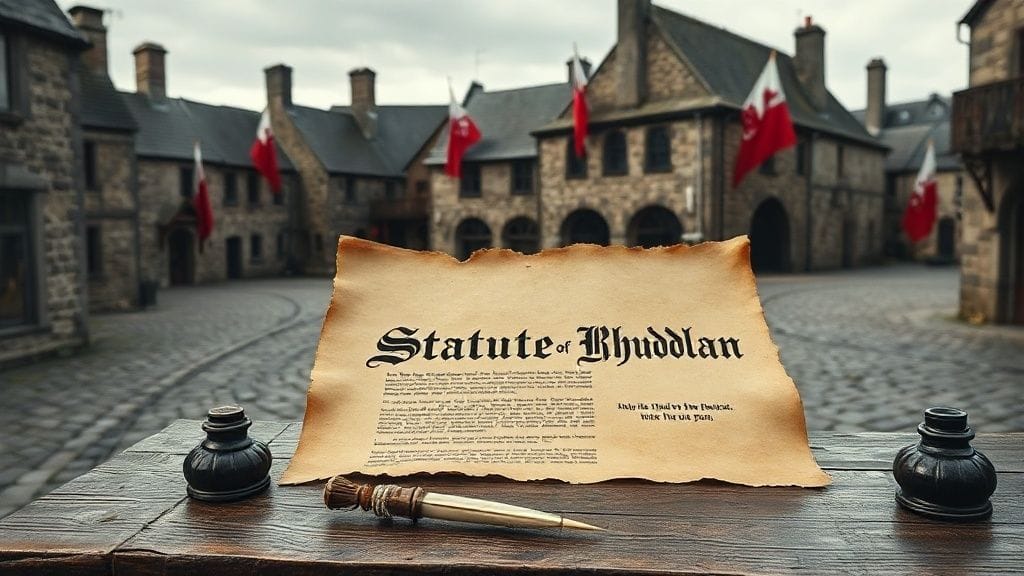
It was a cold, gray morning in the castle town of Rhuddlan, perched on the northern coast of Wales. The wind swept over the rugged Welsh hills as courtiers and barons from both English and Welsh lands gathered under the looming towers. This was not a day of celebration but of transformation — a moment when the fate of an entire nation hung in the balance. On March 3, 1284, King Edward I of England cast a long shadow over Wales by enacting the Statute of Rhuddlan, a legal declaration that would mark the formal integration of Wales into the English crown’s domain.
As parchment was inscribed and proclamations made, the echoes of Welsh resistance faded into an uneasy silence. The Statute promised to bring law, order, and English justice to the turbulent lands — but at what cost to the ancient identity and sovereignty of the Welsh people? This was no mere legal edict; it was the codification of subjugation, a script for a new political reality.
2. Wales Before the Statute: A Land Divided and Defiant
Before delving into the statute itself, one must understand Wales’ fractured mosaic of principalities, mountain clans, and fiercely autonomous lords. For centuries, Wales existed as a patchwork of kingdoms—Powys, Gwynedd, Deheubarth, and others—each governed by its own customs and laws, particularly the native Welsh laws codified in the Laws of Hywel Dda.
Despite its rugged terrain and a proud, warlike population, Wales was no stranger to English incursions. Repeated invasions and shifting alliances dotted the medieval period, yet the Welsh held firm to their autonomy. The principality of Gwynedd, under Llywelyn ap Gruffudd, the “Last Prince of Wales,” had managed to consolidate power unprecedentedly by the mid-13th century. Yet royal ambitions across the border viewed this resurgence as a threat — a defiant Welsh heartbeat resisting English dominion.
3. Edward I: The Conqueror King’s Vision and Ambitions
Edward I, a monarch of iron will and strategic acumen, was no stranger to the art of conquest. His eyes fixed resolutely on Wales not only as territory to be subdued but as a jewel integral to his vision of a unified British kingdom. He understood that military victory alone was insufficient to cement control; the wielding of law and administration was equally essential.
His campaign in the 1270s and 1280s was methodical and ruthless. Castles rose like grotesque sentinels in the Welsh landscape—Caernarfon, Conwy, Harlech—architectural symbols of English authority designed to intimidate as well as defend. Edward’s vision extended beyond mere military occupation: he sought legal and political integration, binding Wales permanently to the Crown’s orbit.
4. The Long Shadow of Brutality: The Aftermath of the Welsh Wars
The decade preceding the Statute saw brutal suppression of Welsh resistance. The wars were bloody and merciless, with scorched earth tactics employed by English forces devastating rural communities. Llywelyn ap Gruffudd himself met a violent end in 1282, his death a decisive blow to Welsh hopes of independence.
Yet, the cost was high for all involved. Villages were destroyed, nobles dispossessed, and the social fabric torn. Survivors faced a stark reality: the old order was crumbling. The Statute of Rhuddlan did not emerge out of peace but was forged in the crucible of conflict and conquest. It was the legal embodiment of subjugation, a tool to enforce a new order.
5. Why Rhuddlan? The Strategic Choice for Integration
Rhuddlan was not an accidental site for this historic announcement. The castle, perched on the banks of the Clwyd estuary, was a symbol of Edward’s reign in North Wales. Constructed as a bastion of English power, it was accessible yet intimidating, a site where attention could be focused.
Moreover, Rhuddlan represented a gateway — controlling access to the northern territories and acting as an administrative center. By choosing it, Edward underscored his grip on the region. The place itself became an instrument of governance and a stage where history turned decisively in favor of English supremacy.
6. The Statute’s Foundations: Legal Frameworks and Administrative Overhaul
The Statute of Rhuddlan went beyond symbolic gestures; it established a comprehensive framework aimed at restructuring Welsh governance in the English model. It installed English common law in criminal matters while allowing the continuance of Welsh law in civil cases such as land inheritance—an uneasy compromise reflecting Edward’s pragmatic approach.
The Statute created new administrative units — counties similar to those in England, governed by sheriffs appointed by the crown. A system of English courts was introduced, alongside the establishment of the Exchequer in Wales to manage royal revenues. This was not simply annexation but a redefinition of order and justice, forcibly imposed upon a proud people.
7. Incorporating Wales: The Marcher Lords and English Law
One of the Statute’s most complex facets was the ambiguous status it granted to the Marcher Lords, the aristocrats who governed border territories with considerable autonomy. While Edward’s law sought to impose a unified system, the Marcher Lords retained special privileges, governing their lands almost as petty kings.
This arrangement revealed the challenges of controlling Wales: the need for strong, loyal intermediaries to enforce English rule while managing the inherent resistance of the Welsh populace. The coexistence of English law in royal counties and the semi-independent Marcher territories created tensions and contradictions that endured for centuries.
8. The Creation of the Counties: Redrawing the Map of Wales
Under the Statute, Wales was divided into four new counties — Anglesey, Merioneth, Caernarfon, and Flint — administratively linked to England. This division struck at the heart of traditional Welsh loyalties and identities, erasing previous principalities and lordships from formal recognition.
These counties mirrored English governance structures with sheriffs, coroners, and juries, effectively “Anglicizing” the territory. Roads, markets, and legal institutions followed. But this redrawing was more than geography: it was a psychological re-mapping, an attempt to break the Welsh spirit by imposing foreign boundaries.
9. Language, Law, and Legacy: The Impact on Welsh Society
A particularly poignant aspect of the Statute was its impact on the Welsh language and culture. While Welsh remained the language of everyday life, English became the language of law, governance, and officialdom. The law courts required English, and Welsh elites found themselves marginalized politically.
This linguistic imposition foreshadowed centuries of cultural suppression and renaissance. The Statute was not simply a political conquest; it set the stage for subtle forms of cultural colonization. The resonance of this clash between language and power would echo through Welsh history.
10. The Statute’s Immediate Reactions: Resistance, Adaptation, or Resignation
The Welsh response to the Statute was varied and complex. Some nobles accepted English rule, hoping to retain lands and status. Others quietly resisted, maintaining Welsh customs and defying new laws where possible. Discontent simmered beneath the surface, occasionally flaring into open rebellion, as with the uprising led by Madog ap Llywelyn in 1294.
For the everyday Welsh peasant, the statute brought confusion and hardship, as old rights were curtailed and new taxes imposed. Yet life, as always, found ways to persist. Adaptation became a survival strategy even amid dispossession and legal transformation.
11. Castles, Courts, and Councils: Manifestations of English Rule
Edward’s castles in Wales stood as physical and symbolic manifestations of conquest. Beyond military fortifications, these stone giants functioned as administrative hubs, housing courts and councils that enforced the Statute’s mandates.
The judicial system took root in these halls, and sheriffs wielded authority with increasing confidence. These institutions became instruments of a nascent colonial governance, ensuring that law and order translated the king’s will into reality.
12. The Statute’s Role in the Evolution of British Identity
While the immediate effect was the subjugation of Wales, the Statute of Rhuddlan played a pivotal role in the broader construction of what would become the United Kingdom. It marked one of the earliest attempts at political and legal integration of distinct peoples under a single crown.
This process was messy, painful, and fraught with resistance, but it laid groundwork for future union efforts. The concepts of sovereignty, identity, and governance were being renegotiated in ways that would shape British—and Welsh—histories for centuries.
13. Economic Shifts: From Feudal Holdings to Crown Revenues
The Statute fostered changes not only in governance but also in the Welsh economy. Royal officials began to collect rents, taxes, and duties directly, redirecting wealth from local lords to the Crown. Markets were regulated, trade routes secured, and resource management centralized.
However, this shift disrupted traditional economic patterns and sometimes impoverished local communities. The Crown’s encroachment on Welsh lands altered landownership dynamics and introduced a more bureaucratic, monetized system.
14. Cultural Consequences: Welsh Identity Under Siege
Though politically integrated, Welsh culture remained vibrant, even in defiance. The Statute's imposition stirred a cultural resistance that would become a defining thread of Welsh history. Oral traditions, bardic poetry, and local customs sustained a sense of identity under pressure.
This era marked the beginning of a tension between assimilation and preservation, a dialectic that shaped Welsh nationalism in later centuries. The Statute's cultural consequences extended far beyond immediate politics.
15. The Statute in the Eyes of Chroniclers and Poets
Contemporary chroniclers recorded the Statute with mixed tones. English clerks praised it as the triumph of order over chaos, a king’s justice restored to a lawless land. Welsh poets, in the meantime, lamented the loss of sovereignty and mourned the fading of an era.
Poetic laments invoked the death of Llywelyn as a symbol of the nation’s fall, while historical accounts framed the Statute as a turning point—sometimes necessary, sometimes tragic. These texts provide invaluable windows into the emotional and intellectual landscape surrounding the Statute.
16. Long-term Political Ramifications: The Seeds of Future Conflicts
The Statute did not end Welsh resistance. Rather, it planted seeds for future rebellion and shaped the political contours of the realm. Periodic revolts tested English authority, and the uneasy relationship between the Marcher Lords, Welsh gentry, and the Crown persisted well into the late Middle Ages.
Ultimately, the Statute established a pattern of governance that, while effective in consolidating England’s hold, never fully extinguished Welsh aspirations for self-rule. The tensions forged on that day in Rhuddlan echoed down the centuries.
17. Echoes Through Time: The Statute’s Place in Modern Welsh History
Today, the Statute of Rhuddlan is recognized as a moment that irrevocably changed Wales. For some, it symbolizes conquest and loss; for others, foundation and integration. It is studied as a legal landmark and as a reminder of the complexities of nationhood.
Modern Welsh identity negotiates its relationship to this history — honoring heritage while acknowledging the profound ruptures introduced by the Statute. Commemorations and scholarship continue to explore its facets with nuance and care.
18. Reflections on Colonialism and Governance in Medieval Britain
Viewed through a contemporary lens, the Statute of Rhuddlan provides an early example of colonial governance strategies: military conquest followed by administrative absorption and cultural imposition. It illustrates the dynamics of power, resistance, and adaptation that characterize colonization processes.
Understanding this helps frame medieval British history as part of broader, global patterns of empire-building — complete with ethical questions that still resonate.
19. The Statute Compared: Other Medieval Acts of Integration
The Statute of Rhuddlan was not unique in its approach. Similar efforts to integrate rival territories through legal and administrative reforms occurred in Scotland, Ireland, and continental Europe. Yet its scale and combination of law, language, and territorial restructuring make it a distinctive case.
Comparative study reveals common patterns of conquest and control, but also highlights Wales’ particular experience of cultural resilience.
20. The Modern Memory: Commemoration and Controversy
The Statute remains a subject of debate. Some historians and cultural commentators see it principally as a harsh imposition; others suggest it brought essential order and integration. Public memory oscillates between interpretations of victimhood and pragmatic acceptance.
Monuments, plaques, and educational programs reflect this ambivalence, ensuring that the memory of Rhuddlan remains charged with meaning.
Conclusion: Wales Transformed – Legacy of the Statute of Rhuddlan
The Statute of Rhuddlan was more than a mere legal document; it was a decisive moment when the tides of power swept irrevocably into Welsh lands and altered their destiny. Edward I’s statute formalized conquest and inaugurated a system of governance that redrew boundaries—not only territorial but cultural and political.
Yet amidst the imposition, the Welsh spirit endured. Language, tradition, and identity did not vanish; they adapted, resisted, and persevered. The Statute’s legacy is one of transformation and tension: a story of empire and survival, domination and defiance.
As we look back to that cold March day in 1284, we see not just the end of an independent Wales but the birth of a complex and evolving Wales within the ever-shifting mosaic of British history. The echoes of Rhuddlan remain alive in modern struggles for identity, autonomy, and justice—a testament to the enduring voice of a proud nation that history could not silence.
FAQs
Q1: What was the Statute of Rhuddlan and why was it important?
A1: The Statute of Rhuddlan was a legal decree issued by Edward I on March 3, 1284, that formalized the annexation of Wales into the kingdom of England. It established English law and administrative systems in Wales, integrating it politically while preserving some Welsh legal traditions. It was vital as it laid the foundation for centuries of English rule over Wales.
Q2: Who was Edward I and what role did he play in Welsh history?
A2: Edward I, often called the “Hammer of the Scots,” was the English king who conquered Wales through military campaigns culminating in the death of Llywelyn ap Gruffudd. He enacted the Statute of Rhuddlan to consolidate his control over Wales, marking a turning point in Welsh history.
Q3: How did the Statute affect Welsh laws and customs?
A3: The Statute imposed English criminal law upon Wales but allowed Welsh laws to persist in civil matters such as land inheritance. This created a hybrid legal system but ultimately marginalized native customs in favor of English governance.
Q4: What was the reaction of the Welsh people to the Statute?
A4: Reactions varied; some Welsh nobles adapted to maintain their status, others resisted either passively or through rebellion, such as the uprising led by Madog ap Llywelyn in 1294. The common people experienced disruption and hardship, with many losing traditional rights and lands.
Q5: What role did the Marcher Lords play after the Statute?
A5: Marcher Lords governed border territories with significant autonomy, often acting as intermediaries between the Crown and the Welsh. While the Statute sought centralization, these lords retained privileges and power, contributing to political complexity in the region.
Q6: How did the Statute of Rhuddlan influence future British political structures?
A6: The Statute was an early example of legal and administrative integration of a previously independent territory into a larger kingdom, setting precedents for later political unifications within Britain, including the eventual formation of the United Kingdom.
Q7: Is the Statute of Rhuddlan remembered positively or negatively today?
A7: Memory is mixed. Many view it as an instrument of conquest and cultural suppression, while others acknowledge it as part of Wales’ historical journey. It remains a subject of scholarly debate and public reflection in Wales.
Q8: Where can I learn more about the Statute of Rhuddlan?
A8: A good starting point is the Statute of Rhuddlan Wikipedia page, which offers detailed historical information and resources for further reading.

