Table of Contents
- The Dawn of an Era: Moldavia on the Brink
- Stephen the Great: Rise of a Reluctant Prince
- Political Fragmentation in Eastern Europe: Threats and Alliances
- The Ottoman Shadow Looms Large
- Preparing for War: Moldavian Society Mobilizes
- The Battle of Vaslui (1475): A Thunderous Victory
- Aftermath of Vaslui: Triumph and Challenge
- The Siege of Neamț Fortress: The Ottoman Onslaught
- The Campaign of 1476: Stephen’s Defiant Return
- The Counteroffensive: Pushing Back the Ottomans
- The Role of Suceava: Strategic Heart of Moldavian Resistance
- Alliance Building: Poland, Hungary, and the Moldavian Cause
- Life in Wartime: Civilians Caught Between Empires
- Stephen’s Use of Guerrilla Tactics and Terrain Knowledge
- The Religious Dimension: Faith as a Shield and Sword
- Economic Strain and Revolutionary Resilience
- Legacy of the Campaigns: Moldavia's Sustained Autonomy
- Stephen the Great’s Image in History and Folklore
- The Long Shadow: Regional Power Balance in the Late 15th Century
- Conclusion: The Human Spirit and Sovereignty
- FAQs about Stephen the Great’s Campaigns and Moldavian History
- External Resources
- Internal Link
The Dawn of an Era: Moldavia on the Brink
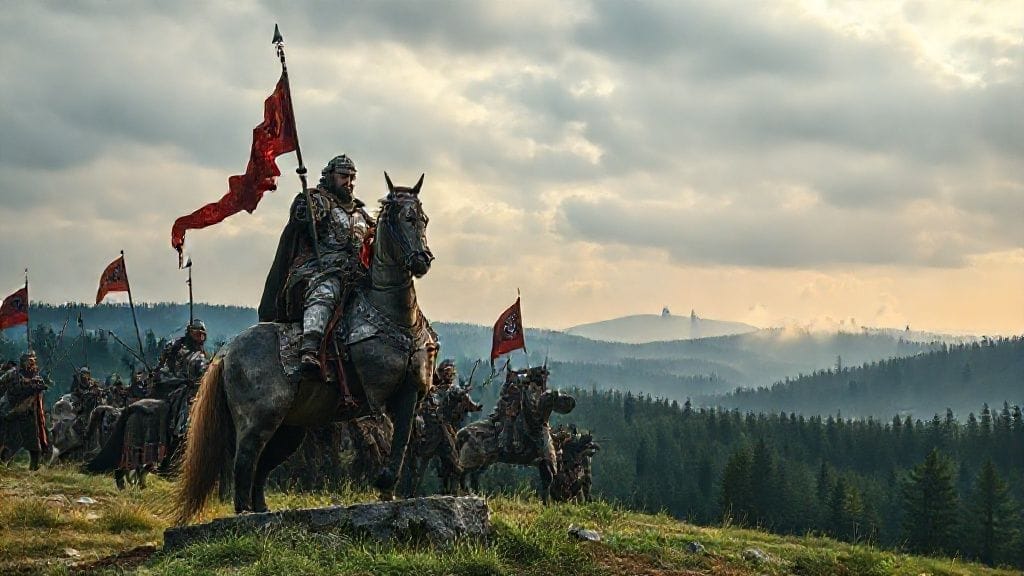
The cold mist swept over the jagged peaks and rolling hills of Moldavia as dawn broke on a spring morning of 1475. The air was thick with the scent of damp earth and smoke from hurriedly built fires. Along the river valleys, the heavy footsteps of Moldavian warriors echoed as they marshaled their forces, their hearts pounding against the rising tension. In the distance, the Ottoman host advanced like an ominous shadow, hungry for conquest. This was more than a battle for land; it was a desperate fight for autonomy—freedom against the encroaching hammer of empire.
Stephen the Great, the Prince of Moldavia, stood before his troops at the pinnacle of his courage and leadership. His steely eyes surveyed the faces of nobles, peasants, and seasoned soldiers alike, each ready to defend their homeland with unwavering resolve. The events that would unfold in these years—marked by sieges, diplomacy, and bloodshed—would not only decide the fate of Moldavia but carve the name of Stephen into the annals of history as a titan of resistance.
Stephen the Great: Rise of a Reluctant Prince
Born in 1433 into the House of Mușat, Stephen faced a realm fraught with political instability and constant external threats. Initially a figure shadowed by stronger neighbors—Hungary to the west, the Polish-Lithuanian Commonwealth to the north, and the ever-expanding Ottoman Empire to the south—Stephen’s ascension to the throne in 1457 was no mere formality. He was sworn into a crucible, a principality caught in the crosshairs of imperial ambitions.
His early years on the throne were characterized by shrewd maneuvers to consolidate power internally. Yet, the true test lay beyond Moldavia’s borders as the Ottomans advanced into the Balkans and Danube regions. The threat was existential; Moldavia was a small kingdom, yearning for survival amid giants. Stephen quickly realized that a passive stance would mean erasure— Moldavia had to define its own destiny.
Political Fragmentation in Eastern Europe: Threats and Alliances
The geopolitical landscape of 15th-century Eastern Europe was a complex mosaic of competing claims and fragile alliances. The Kingdom of Hungary was distracted by internal disputes and external crusades, while Poland wove a cautious policy of balancing influence between Christian powers and the Muslim Ottoman Empire.
Moldavia’s position was precarious. Situated between these powers, it had to navigate a diplomatic labyrinth as much as a battlefield. Stephen acutely understood that forging alliances was as vital as strengthening his military. Yet, the stakes were high—alliances were fickle and could offer little protection from the crescent’s advance.
The Ottoman Shadow Looms Large
By the 1470s, the Ottoman Empire under Mehmed II was a ravenous force of expansion. Mehmed "the Conqueror" had already humbled Constantinople in 1453; his ambition for further northern ventures was clear. Moldavia’s strategic position controlled vital trade routes and served as a buffer between the empire and Eastern Europe.
The Ottomans sought to bring Moldavia under suzerainty, demanding tribute and submission. Stephen rejected these demands, aware that any capitulation would result in eroded sovereignty and cultural assimilation.
Preparing for War: Moldavian Society Mobilizes
War was more than the clash of armies—it was the mobilization of an entire society. Stephen’s success was due in part to his ability to rally the Moldavian people across social strata. The nobility, vested with land and power, supplied cavalry—Moldavia’s renowned mounted troops—while peasants took up arms to defend their homes.
Strategic fortresses such as Suceava and Neamț were reinforced, and supply lines managed with military precision. The prince's leadership extended beyond the battlefield; it infused a unifying spirit among a populace weary from decades of conflict.
The Battle of Vaslui (1475): A Thunderous Victory
On January 10, 1475, near the village of Vaslui, southwest of Iași, Stephen the Great faced the mighty Ottoman army led by Hadım Suleiman Pasha, purportedly numbering over 100,000 men. Against overwhelming odds, Stephen deployed ingenious tactics that exploited the region’s rugged terrain and bitter winter conditions.
Employing ambush strategies and guerrilla warfare, Moldavian forces annihilated the Ottoman columns in a decisive victory celebrated as one of medieval Europe’s greatest military feats. Contemporary historians such as Paolo Giovio lauded it as "an unparalleled rout." His chronicler, Macarie, immortalized Stephen’s words following the battle: “God is with the righteous.”
Aftermath of Vaslui: Triumph and Challenge
The victory at Vaslui was euphoric but fleeting. While the Ottomans suffered a severe blow, the empire’s vast reserves meant retaliation was inevitable. Furthermore, the logistical toll on Moldavia’s already strained resources was considerable.
Mehmed II swiftly organized a new offensive in 1476, intent on crushing Stephen and making an example of Moldavia. The win at Vaslui had demonstrated the prince’s tactical genius but had also unleashed a storm.
The Siege of Neamț Fortress: The Ottoman Onslaught
The fortress of Neamț, perched on a hilltop overlooking the Moldova River, was a linchpin of Stephen’s defensive strategy. As Ottoman forces advanced in the spring of 1476, this stronghold became the epicenter of resistance.
Despite repeated assaults and harsh conditions, the Moldavian defenders repelled the siege through resilience and innovative fortifications. The fortress stood as both a tactical and symbolic bastion of Moldavian determination.
The Campaign of 1476: Stephen’s Defiant Return
In the summer of 1476, Stephen, after regrouping and securing alliances, launched a daring counteroffensive. The prince struck at Ottoman supply lines and leveraged hit-and-run tactics to offset his numerical inferiority.
His most famous triumph during this campaign came at the Battle of Valea Albă (Războieni), where despite a tactical defeat, Stephen’s forces delayed the Ottoman advance enough to prevent full conquest.
The Counteroffensive: Pushing Back the Ottomans
Buoyed by the resilience of his troops and the loyalty of his subjects, Stephen pursued a war of attrition against the Ottoman invaders. Over the next decade, military campaigns ebbed and flowed, with tactical retreats balanced by strategic victories.
The use of mountain ambushes, scorched earth policies, and the utilization of Moldavia’s dense forests frustrated Ottoman attempts to establish dominance. This sustained resistance preserved Moldavian autonomy far beyond what many contemporaries deemed plausible.
The Role of Suceava: Strategic Heart of Moldavian Resistance
Suceava, the capital of Moldavia, was not just a seat of government but the nerve center of military planning. Its formidable walls and position on important trade routes rendered it vital for supply and communication.
Stephen invested heavily in fortifying Suceava, transforming it into a fortress-city that withstood multiple sieges and served as a rallying point for Moldavian forces. The city’s resilience inspired the people and was a beacon of hope in bleak times.
Alliance Building: Poland, Hungary, and the Moldavian Cause
Recognizing the overwhelming power of the Ottoman Empire, Stephen sought to weave a patchwork of alliances with neighboring Christian powers. Both Poland and Hungary, wary of Ottoman expansion, provided varying levels of support.
While these alliances were hampered by competing interests and occasional betrayals, they granted Moldavia crucial military aid and political leverage. The diplomacy surrounding these partnerships was as complex as the battles fought on Moldavian soil.
Life in Wartime: Civilians Caught Between Empires
The relentless campaigns took a heavy toll on Moldavia’s civilian population. Villages were razed, crops destroyed, and famine a constant threat. Yet, the spirit of the people endured; monasteries became sanctuaries and centers of cultural preservation.
Stories from this period reflect profound human suffering but also resilience. Elderly women knitting by hearths, farmers hiding their grain from pillagers, and children growing up amidst banners and battle cries compose the unseen fabric of the era.
Stephen’s Use of Guerrilla Tactics and Terrain Knowledge
Stephen’s mastery of Moldavia’s rugged and forested landscape was a cornerstone of his military strategy. Traditional open-field battles favored the large Ottoman cavalry; Stephen, however, favored ambushes, hit-and-run raids, and night attacks.
Historians note his campaigns as early illustrations of asymmetric warfare, presaging tactics used in later centuries by smaller forces defending against empires. His soldiers knew every river bend and forest path, turning geography into an impregnable ally.
The Religious Dimension: Faith as a Shield and Sword
Orthodox Christianity was both a unifying force and a source of resistance. Stephen was a devout ruler who saw his campaign as a defense of Christendom against Muslim expansion. Monasteries dotted the countryside, becoming symbols of identity and sanctuaries for troops.
The prince founded many religious institutions during and after these tumultuous years, intertwining faith with national identity. This spiritual underpinning infused soldiers with moral courage and helped mold a lasting cultural legacy.
Economic Strain and Revolutionary Resilience
War drains a nation’s resources, and Moldavia was no exception. Tribute payments, disrupted trade, and continuous military expenditure pushed the principality to its limits.
Yet, Stephen’s reforms in taxation and land management helped stabilize the economy. The mobilization of local craftsmen and farmers for war efforts demonstrated an economic adaptation that fueled prolonged resistance.
Legacy of the Campaigns: Moldavia's Sustained Autonomy
Thanks to Stephen the Great’s relentless campaigns in the 1470s and 1480s, Moldavia retained its de facto independence at a time of imperial sweepstakes.
This autonomy allowed the preservation of its unique language, culture, and political structures. While tributary relationships with the Ottomans persisted, Moldavia avoided the fate of total conquest and assimilation that befell many neighbors.
Stephen the Great’s Image in History and Folklore
Stephen’s legacy transcended his death in 1504. His reputation as a national hero grew, immortalized in folklore, religious iconography, and epic poetry.
He became the archetype of the just warrior-prince—wise, pious, and courageous. His image has inspired Romanian identity and resistance narratives up to the modern era, symbolizing a time when the human spirit shaped history.
The Long Shadow: Regional Power Balance in the Late 15th Century
The protracted campaigns of Moldavia forced regional powers to reckon with the limits of Ottoman expansion and the tenacity of small principalities.
While the Ottomans consolidated the Balkans, Stephen’s defiant Moldavia became a symbol that empires could be checked. This had ripple effects in the diplomacy and warfare of Eastern Europe for decades.
Conclusion: The Human Spirit and Sovereignty
In a world ruled by empires and shifting alliances, the Moldavian campaigns under Stephen the Great stand as a testament to resilience, leadership, and the quest for sovereignty. They remind us that history isn’t merely the story of kings and armies but the pulse of countless human lives entwined in struggle and hope.
Stephen’s campaigns were not just about territory or power—they were about identity, faith, and the assertion of a people’s will to endure. His story sings through centuries, a powerful narrative that even the mightiest empire could not silence.
FAQs about Stephen the Great’s Campaigns and Moldavian History
Q1: What triggered Stephen the Great’s campaigns against the Ottoman Empire?
A1: The Ottoman Empire’s demands for tribute and suzerainty, along with their military incursions into Moldavian territory, forced Stephen to take up arms to preserve Moldavia’s autonomy.
Q2: How significant was the Battle of Vaslui in 1475?
A2: The Battle of Vaslui was one of the most decisive victories against the Ottomans during the medieval period, bolstering Stephen’s reputation and preserving Moldavian independence for several more decades.
Q3: What strategies did Stephen use to counter the larger Ottoman forces?
A3: Stephen employed guerrilla tactics, exploitation of terrain, ambushes, scorched earth policies, and strategic fortress defenses to neutralize the Ottoman numerical superiority.
Q4: How did Moldavia manage alliances during these campaigns?
A4: Stephen cultivated alliances with neighboring powers such as Poland and Hungary, though these were often unstable and limited. These alliances provided some military and diplomatic support.
Q5: What role did religion play in Stephen’s campaigns?
A5: Orthodox Christianity was a rallying banner, providing spiritual motivation and justification for resistance against Muslim Ottoman expansion, deeply influencing cultural and political unity.
Q6: How did these campaigns impact the civilian population?
A6: The civilian populace endured hardships including displacement, famine, and destruction of property, yet their resilience contributed critically to the sustained defense of Moldavia.
Q7: What was the significance of fortresses like Suceava and Neamț?
A7: These fortresses were critical defensive hubs, allowing Moldavia to resist Ottoman sieges and serve as centers for military operations and refuge.
Q8: What is Stephen the Great’s legacy today?
A8: Stephen remains a national hero in Romania and Moldova, symbolizing resistance, leadership, and the defense of cultural identity against overwhelming odds.

