Table of Contents
- The Dawn of a New Nation: Sudan’s Independence Day, January 1, 1956
- Threads of History: Sudan under Anglo-Egyptian Rule
- The Rise of Nationalist Movements: Voices for Freedom and Unity
- Political Awakening: The Role of Parties and Leaders in the 1940s and 1950s
- The Winds of Change: External Influences and Cold War Dynamics
- The Road to Self-Governance: Negotiations and Promises
- Khartoum on the Edge: Preparing for the Moment of Liberation
- Midnight in the Capital: The Official Proclamation of Independence
- Faces of Freedom: The Leaders Who Made Independence Possible
- A Nation Divided: The Fragile Unity of North and South Sudan
- Hope and Challenges: Initial Responses and National Sentiment
- Economic Foundations: From Colonial Structures to National Aspirations
- Cultural Renaissance: Identity, Language, and National Symbols
- Internal Struggles: Ethnic and Regional Tensions Begin to Surface
- Sudan on the Global Stage: Early Diplomacy and International Recognition
- The Legacy of Anglo-Egyptian Condominium: Political and Social Impacts
- From Liberation to Turmoil: The Seeds of Future Conflicts
- Sudan’s Independence in African Decolonization Context
- Remembering January 1: Commemorations Then and Now
- Lessons from 1956: How Sudan’s Birth Shaped Its Destiny
On the dawn of January 1, 1956, the city of Khartoum seemed almost to hold its breath. The very air shimmered with anticipation, a rare stillness in a region often swayed by the turbulent currents of empire and local upheaval. At the stroke of midnight, Sudan—vast and ancient, cradled between the Blue and White Nile—stepped into the light as a sovereign nation. Flags waved, voices rose in jubilation, and streets flooded with people who dared to believe in a future shaped by their own hands. But beneath the euphoric celebrations lurked unanswered questions, deep-rooted divisions, and the heavy shadows of colonial legacies.
Sudan’s independence was not just a date on the calendar—it was the climax of decades of struggle, negotiation, and identity forging. It was the moment when a land often fragmented by geography, ethnicity, and history declared a united dream for self-determination. This chapter in world history is a testament to the resilience of a people and a sobering reminder of the complexities that youth in nationhood often face.
Threads of History: Sudan under Anglo-Egyptian Rule
To understand Sudan’s birth as an independent state, one must journey back to the late 19th century, when Sudan entered the grip of the Anglo-Egyptian Condominium. In 1899, the United Kingdom and Egypt formally agreed to administer Sudan jointly, a strange partnership designed more to assert British imperial interests than to serve Sudanese aspirations.
For decades, Sudan existed under a dual system of governance, with British officers wielding real power behind the facade of Egyptian authority. This peculiar arrangement fostered a paternalistic administration, focused on resource extraction and strategic control of the Nile. Infrastructure was built, yes—railways, telegraphs, administrative centers—but local voices were marginalized. Economic policies favored foreign interests and northern elites, often deepening regional disparities.
Central to the condominium’s legacy was the suppression of political expression. Sudanese nationalism was a carefully contained ember, stifled under strict regulations and surveillance. Yet, the very contradictions of colonial governance—their overreach, cultural alienation, economic imbalance—were fomenting the ground for resistance and aspiration.
The Rise of Nationalist Movements: Voices for Freedom and Unity
By the 1930s and 1940s, Sudanese intellectuals, students, merchants, and religious leaders increasingly craved autonomy. Inspired by broader anti-colonial struggles across Africa and Asia, Sudanese activism burgeoned. Newspapers championed the cause, clubs and associations served as incubators for political thought, and leaders began to envision a Sudan that stood independently, proud and self-determined.
Among the most influential organizations was the Graduates’ General Congress, formed in 1938, which united educated Sudanese around common goals—constitutional reforms, national unity, and eventual independence. At its heart was the belief that Sudan, with its mosaic of peoples including Arabs and Africans, deserved to chart its own destiny beyond imperial dictates.
This period saw an efflorescence of discourse over Sudan’s identity and future. Would it remain tied to Egypt, become truly independent, or align differently? Debates ensued within parties, religious groups, and even families, reflecting the complex fabric of Sudanese society.
Political Awakening: The Role of Parties and Leaders in the 1940s and 1950s
In the wake of World War II, political organization in Sudan accelerated. The establishment of political parties gave form and structure to nationalist aspirations. The National Unionist Party (NUP) advocated for unity with Egypt, reflecting historical ties and Islamic cultural affinities, while the Umma Party articulated vision for full Sudanese independence.
The dynamic between these parties illustrated Sudan’s internal divisions but also its vibrant political culture. Leaders like Ismail al-Azhari, who became the first Prime Minister upon independence, emerged as figures of hope and complexity. They navigated not only colonial pressures but also the delicate balancing act among Sudan’s diverse populations.
Throughout negotiations and political manoeuvres, the question of the southern provinces—mainly inhabited by non-Arab, non-Muslim groups—loomed ominously. Often marginalized in colonial policy, their aspirations and fears were largely ignored in early nationalist discourses, planting seeds of discord to come.
The Winds of Change: External Influences and Cold War Dynamics
Sudan’s route to independence unfolded in the broader context of postwar decolonization and the emerging Cold War. Western powers, distracted and stretched thin after WWII, were gradually ceding control of their colonial possessions, either reluctantly or strategically.
At the same time, Egypt’s own nationalist government, led by Gamal Abdel Nasser after 1952, influenced Sudan’s politics profoundly. Egypt sought to keep Sudan within its sphere, wary of British intentions and eager to consolidate Arab nationalism.
International bodies like the United Nations observed Sudan’s transition with cautious optimism, offering diplomatic channels and frameworks for peaceful handovers. Despite the geopolitical chess game, Sudanese leaders retained agency, skillfully maneuvering between British and Egyptian influences to assert Sudanese sovereignty.
The Road to Self-Governance: Negotiations and Promises
Negotiations toward independence were both complex and delicate. The British increasingly viewed Sudan’s political maturation as inevitable and sought to ensure stability in the handover process.
By 1953, legislative elections allowed Sudanese politicians to take greater control, and a transitional government prepared the administrative and legal frameworks for full independence. Constitutional drafts were written, debates raged, and compromises struck.
Yet, beneath the surface, tensions simmered. The southern regions remained underdeveloped and underrepresented, and questions about the nature of the Sudanese state—unitary or federal—were unresolved. Still, on January 1, 1956, an agreement was reached: Sudan would be independent, free from colonial ties.
Khartoum on the Edge: Preparing for the Moment of Liberation
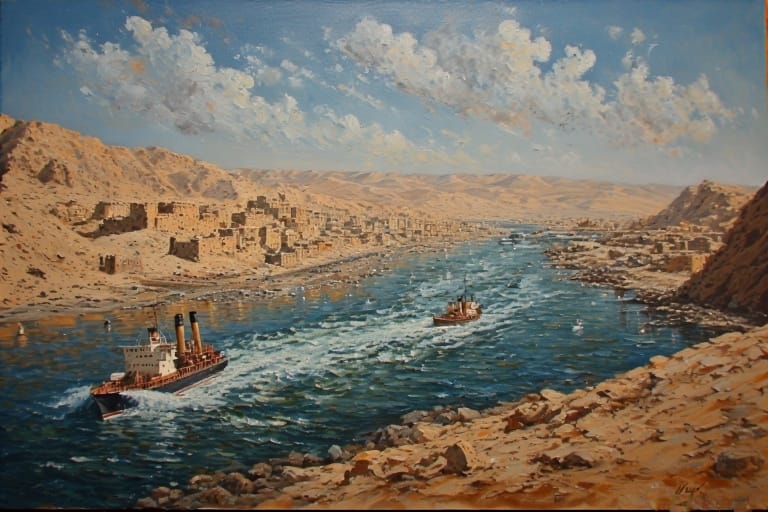
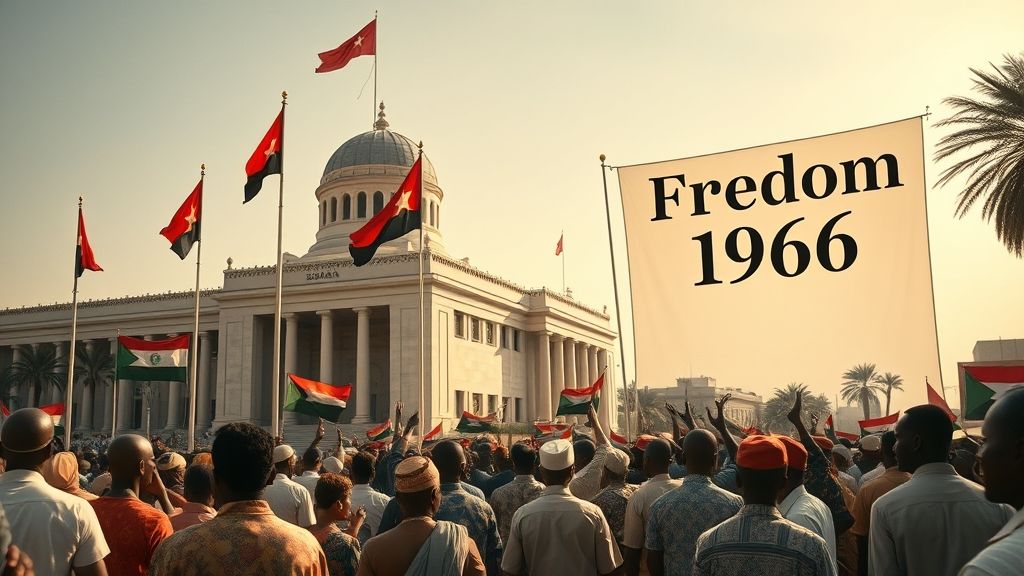
In the days leading to independence, Khartoum transformed into a city of hope and feverish activity. Streets were festooned with flags and banners; the Nile’s waters reflected celebrations lighting the night.
Public speeches, military parades, and religious ceremonies were organized to mark the birth of a sovereign state. The atmosphere was electric, mingling triumph and uncertainty. Local businesses closed their doors, families gathered, and communities awaited the moment when Sudan would cast off its colonial chains.
Journalists and diplomats from across the globe converged, recognizing the significance of Sudan’s emergence as the largest country in Africa by land area. Yet, for most Sudanese, the day was deeply personal—a long-awaited validation of years of sacrifice and struggle.
Midnight in the Capital: The Official Proclamation of Independence
When the clock struck midnight on New Year’s Day, a profound silence enveloped Khartoum, quickly replaced by an outburst of cheers. Politicians and citizens alike embraced, tears mingling with laughter. The Union Jack was lowered, and Sudan’s new flag—green, yellow, and blue symbolizing land, wealth, and Nile waters—rose proudly.
Ismail al-Azhari stepped forward to read the declaration: “Sudan is sovereign and free… no longer a territory ruled by foreign powers.” The words echoed through the halls and hearts of a people who had imagined this moment for decades.
Yet the euphoria was tempered by an acute awareness of the immense responsibilities ahead. Governing a diverse and vast land was no small feat, and many wondered if unity could be maintained.
Faces of Freedom: The Leaders Who Made Independence Possible
Sudan’s independence was the fruit of numerous visions and sacrifices. Ismail al-Azhari, often called the ‘Father of Sudanese Independence,’ was a charismatic and pragmatic leader who balanced competing interests with finesse.
Other figures, such as Abdullah Khalil and Muhammad Ahmed Mahjub, shaped policy and guidance behind the scenes. Religious leaders, tribal chiefs, and grassroots activists also contributed—though often anonymously—to the tapestry of liberation.
These individuals embodied Sudan’s hopes as well as its internal contradictions, forever etched into the national memory.
A Nation Divided: The Fragile Unity of North and South Sudan
Despite the joyous proclamation, Sudan’s internal divisions remained a persistent reality. The North, predominantly Arab and Muslim, largely controlled political and economic life, while the South—composed of myriad African ethnic groups practicing Christianity and indigenous beliefs—felt excluded.
The colonial powers had governed Southern Sudan separately, fostering different administrative systems and cultural outlooks. At independence, the lack of political integration became a fault line, eventually erupting into prolonged civil conflicts.
This fragile unity was an early sign that the dream of an indivisible Sudan was fraught with challenges.
Hope and Challenges: Initial Responses and National Sentiment
Public reaction to independence was overwhelmingly positive among northern Sudanese, who celebrated the victory over imperial domination. Schools, civil servants, and soldiers all embraced new roles under national authority.
However, the South’s response was more mixed, marked by suspicion and resistance to northern-dominated governance. Rural populations, distant from Khartoum’s streets, often remained disconnected from the political process.
Economic hardships and administrative inexperience quickly emerged as obstacles. Despite these hurdles, the euphoria of independence inspired rebuilding efforts and nationalistic pride.
Economic Foundations: From Colonial Structures to National Aspirations
Sudan inherited an economy designed to serve foreign interests: agriculture focused on cotton exports, a small industrial base, and transport infrastructure concentrated around colonial centers.
Post-independence governments sought to diversify and develop the economy, but faced limited resources, bureaucratic challenges, and regional imbalances.
Infrastructure projects, educational reforms, and attempts to industrialize marked early years, though success was uneven. The dependency on Nile waters for farming underscored economic vulnerability.
Cultural Renaissance: Identity, Language, and National Symbols
Liberation fueled a cultural awakening. Arabic language and Islamic traditions gained prominence, intertwined with the formation of national symbols that sought to unify.
Yet Sudan’s multicultural reality complicated any singular identity. Literature, music, and oral traditions blossomed, reflecting both pride and the tensions beneath.
Schools and the media promulgated nationalism while sometimes marginalizing minority groups—a tension intrinsic to young nationhood.
Internal Struggles: Ethnic and Regional Tensions Begin to Surface
As years passed, the fault lines within Sudan widened. The South’s grievances over political exclusion and cultural suppression fueled discontent.
The military, increasingly politicized, began to play a role in national affairs, leading to coups and instability in the following decade.
Ethnic rivalries and economic disparities compounded problems, making Sudan’s sovereignty a living struggle rather than a concluded victory.
Sudan on the Global Stage: Early Diplomacy and International Recognition
Sudan’s independence was internationally recognized swiftly. The United Nations admitted Sudan as a member state in November 1956, solidifying its status on the world stage.
Sudan sought diplomatic ties with African, Arab, and Western nations, balancing its non-aligned stance amid Cold War rivalries.
The nation became a symbol of African emancipation, inspiring others while navigating the complexities of global politics.
The Legacy of Anglo-Egyptian Condominium: Political and Social Impacts
The condominium left a mixed heritage. While infrastructure and education systems bore its imprint, so did political centralization and social stratification.
Colonial policies entrenched divisions, sidelining large segments of the population and complicating post-independence governance.
Understanding this legacy is crucial to grasping Sudan’s subsequent political upheavals and social challenges.
From Liberation to Turmoil: The Seeds of Future Conflicts
Sudan’s early independence was not an endpoint but a beginning fraught with trials. Political infighting, military coups, civil war in the South (1955–1972), and later conflicts were rooted, in part, in how the independence process and colonial history shaped governance.
Nonetheless, the spirit of 1956 remains a beacon, a reminder of what Sudanese unity looks like in its most hopeful form.
Sudan’s Independence in African Decolonization Context
Sudan’s birth was part of a larger wave sweeping Africa and Asia. Its experience mirrored that of other newly independent states juggling diverse populations, colonial legacies, and Cold War pressures.
Yet, Sudan’s sheer size, diversity, and geopolitical location made its journey unique and prescient in the study of decolonization.
Remembering January 1: Commemorations Then and Now
Each year, Sudan marks Independence Day with parades, speeches, and public festivities. Yet, the day also invites reflection on unfinished business—reconciliation, development, and national unity.
Memory of 1956 is both celebratory and contemplative, a national anchor amid change.
Lessons from 1956: How Sudan’s Birth Shaped Its Destiny
Sudan’s independence teaches that freedom is both triumph and trial. The delicate fabric of unity needs constant care, inclusivity, and vision.
The histories and hopes woven into January 1, 1956, remind us that the birth of a nation is the beginning of an ongoing story—one Sudan continues to write.
Conclusion
Sudan’s independence, declared in the hushed streets of Khartoum on a cold January night in 1956, was a monumental moment suffused with hope, courage, and the promise of self-rule. It was the culmination of long struggles against foreign domination, the rallying cry of diverse peoples yearning for recognition and agency. Yet, it also laid bare the immense challenges of nation-building in a land as vast and complex as Sudan.
This chapter of history is more than a date or event—it is an emotional tapestry of dreams and contradictions. Sudan’s emergence onto the world stage was both a celebration and a warning: independence would not erase divisions or guarantee peace without sustained effort, dialogue, and inclusiveness. The story of Sudan reminds us that freedom is never simply granted; it is won, guarded, and renewed with each generation.
As Sudan continues to grapple with its identity and future, the memory of that midnight hour in Khartoum compels admiration for the past and hope for the future — a testament to humanity’s unyielding desire for dignity and self-determination.
FAQs
1. Why did Sudan gain independence in 1956?
Sudan’s independence resulted from the gradual collapse of colonial rule, rising nationalist movements, geopolitical changes post-WWII, and negotiated agreements between Sudanese leaders, Britain, and Egypt after decades under Anglo-Egyptian Condominium.
2. Who were the key figures in Sudan’s independence?
Ismail al-Azhari is considered the foremost leader. Other important figures included Abdullah Khalil and Muhammad Ahmed Mahjub, as well as the broader political parties like the National Unionist Party and the Umma Party.
3. What role did Britain and Egypt play in Sudan’s independence?
Britain and Egypt jointly administered Sudan but had different agendas. British policy shifted towards decolonization, while Egypt aimed to keep Sudan linked to its Arab identity. Both negotiated Sudan’s eventual independence.
4. How did independence affect the relationship between northern and southern Sudan?
Independence intensified existing divisions. The South feared domination by northern elites, leading to political exclusion and eventual conflicts, setting the stage for prolonged civil wars.
5. What were the major challenges Sudan faced immediately after independence?
Sudan grappled with political instability, economic dependency on colonial structures, ethnic and regional tensions, administrative inexperience, and reconciling diverse cultural identities.
6. How is January 1, 1956, remembered in Sudan today?
It is a national holiday marked by celebrations and reflection on the country’s journey. The day serves both as a celebration of sovereignty and a moment to consider ongoing challenges of unity and development.
7. How did Sudan’s independence fit into the broader African decolonization movement?
Sudan’s independence was one of the earlier African countries to gain freedom in the wave of decolonization that swept the continent in the 1950s and 1960s. It reflected common struggles of post-colonial identity and governance.
8. What is the legacy of the Anglo-Egyptian Condominium?
The condominium left a legacy of centralized governance, social stratification, and regional disparities, which complicated Sudan’s nation-building efforts and contributed to future conflicts.