Table of Contents
- The Dawn of a Violent Encounter: The Battle at the River Órbigo, 456
- The Suebi Kingdom in Decline: A Fragmented Bastion in Hispania
- The Visigoths’ Rise: From Foederati to Hispania’s Dominant Power
- Political Intrigue and Power Struggles in Fifth Century Iberia
- The River Órbigo: Geography and Strategic Importance
- The Heralds of Conflict: Prelude to Battle
- The Armies Assemble: Warriors, Leaders, and Loyalties
- Clash of Titans: The Battle Unfolds on the Riverbanks
- Tactics and Warfare: Visigothic Military Mastery versus Suebi Desperation
- The Turning Point: How the Visigoths Secured Victory
- Casualties and Captives: The Human Cost of the Battle
- Aftermath in Astorga: The Fall of a Suebi Stronghold
- The Suebi Kingdom’s Fragmentation and Flight
- Visigothic Consolidation of Power in Northwestern Hispania
- The Broader Context: Rome’s Waning Influence and Barbarian Kingdoms
- Cultural and Societal Transformations Following the Battle
- Legacy of the Battle at the River Órbigo in Iberian History
- Echoes in Later Chronicles and Medieval Memory
- The Battle’s Place in the Narrative of Visigothic Expansion
- Conclusion: The End of an Era and the Dawn of the Visigothic Hispania
- FAQs: Clarifying the Battle, Its Actors, and Its Impact
- External Resource
- Internal Link
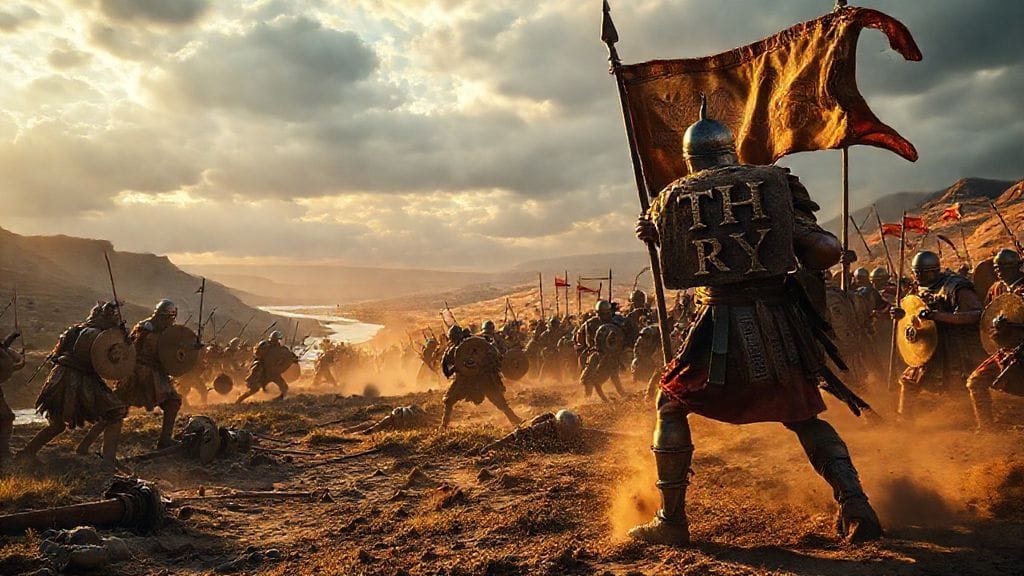
The late summer of 456 AD on the rolling plains near the River Órbigo was charged with tension. Dark clouds gathered ominously over the waters as two ancient peoples—Suebi and Visigoths—faced each other in one of the decisive confrontations in the struggle for control over Hispania. The air resonated not with the songs of birds, but with the low murmur of warriors, the clank of armor, and the silent dread of men poised on the brink of annihilation.
For decades, the Suebi had carved a kingdom out of the decaying Roman province, establishing a stronghold centered around the town of Astorga, a jewel set amid the rugged landscapes of northwestern Hispania. But their strength had begun to wane under relentless pressure from the ascendant Visigoths, themselves former Roman foederati turned conquerors and rulers. The two powers, born out of Rome’s collapse, were now locked in a desperate competition for survival and supremacy.
The battle near the Órbigo would mark not just a military engagement but a turning point in the history of the Iberian Peninsula. What happened on those riverbanks would shape the fate of kingdoms, redraw borders, and echo through centuries as the Visigothic shadow deepened over Hispania.
The Suebi Kingdom in Decline: A Fragmented Bastion in Hispania
The Suebi, who had crossed the Rhine with other barbarian tribes during the turbulent years of late antiquity, had settled in Gallaecia, today's Galicia and northern Portugal, establishing what some historians consider the first medieval kingdom on the Iberian Peninsula. Their rule, however, had always been fragile and fragmented, lacking the centralized strength enjoyed by neighboring powers.
By mid-fifth century, internal divisions and external pressures eroded their borders. The Suebi kings grappled with succession disputes and local chieftains’ ambitions, which weakened the unity necessary to resist the aggressive advances of the Visigoths. Economic strains, caused in part by the decimation of Roman infrastructure and trade routes, further undermined their capacity to field and maintain effective armies.
Astorga, once a Roman administrative center, had become a Suebi capital—its walls took on the grave burden of defense, watching nervously as Visigothic forces moved ever closer. The scene was set for a clash whose implications stretched beyond mere territorial control.
The Visigoths’ Rise: From Foederati to Hispania’s Dominant Power
Meanwhile, the Visigoths, led by their ambitious king Theodoric II, were consolidating power with remarkable energy and political acumen. Initially federated allies of Rome, they transitioned from mercenaries and protectors into sovereign rulers with imperial aspirations.
Their victory over the Romans and other barbarian tribes had paved the way for their movement into Hispania, a region ripe for conquest but fractured by competing claims. The Visigoths brought to the Iberian heartland not just military might, but a coherent administrative system inspired partly by Roman law and governance, blending it with their own customs.
Their campaign against the Suebi was as much ideological as it was territorial—a battle for legitimacy and the right to rule Hispania. The Visigoths sought not just a switch in dominance but the creation of a stable, lasting kingdom. The ensuing conflict by the River Órbigo was their crucible.
Political Intrigue and Power Struggles in Fifth Century Iberia
The political landscape of fifth-century Iberia was a patchwork of alliances, betrayals, and shifting loyalties. The Roman authority had all but vanished, leaving a vacuum filled with a mixture of barbarian kingdoms, Roman heirs, and local potentates.
In this unstable environment, the Suebi, Visigoths, Vandals, and others jockeyed for position. Within the Suebi, King Rechiar had been assassinated decades earlier, leaving a legacy of discord. His successors lived under constant threat, not only from outside aggressors but from internal rebellion.
The Visigoths, by contrast, rallied around the figure of Theodoric II, whose military campaigns extended their reach, including incursions into regions dominated by other tribes. The contest over Astorga and the Órbigo region was the culmination of years of mounting tension.
The River Órbigo: Geography and Strategic Importance
The River Órbigo winds through the crushed earth of the Castilian-Leonese Plateau, near the ancient settlement of Astorga. Its waters and marshy banks created natural barriers and difficult terrain for maneuvering large armies.
Control of the river crossings was vital for the movement of troops and supplies. The area functioned as a gateway from the northwestern corner of the peninsula to the central plateaus and beyond. For the Suebi, holding this line meant preserving their independence; for the Visigoths, crossing it was essential to penetrate further into Iberia.
The late summer weather exacerbated the difficulties, with swollen waters threatening to impede troops and horses alike. Nature itself seemed an adversary to those who dared fight here.
The Heralds of Conflict: Prelude to Battle
In the months preceding the confrontation, scouts from both sides reported sightings of enemy movements—small raiding parties, intercepted messengers, and the ominous clearing of fields around Astorga for mustering troops.
Suebi warlords held tense councils, attempting to forge a united front amidst growing doubts and frictions. The Visigoths, confident in their superior numbers and discipline, pressed the attack, sending envoys with ultimatums that were ignored or scorned.
As the armies amassed on opposite sides of the Órbigo, the atmosphere was thick with the smell of sweat, iron, and war. Campfires flickered in the dusk, the clinking of weapons echoed through the silent woods, and warriors whispered prayers to gods both Christian and pagan.
The Armies Assemble: Warriors, Leaders, and Loyalties
The Suebi force, though brave and battle-hardened, was numerically inferior and suffering from a lack of centralized command. Their warriors came from mixed tribal bands, bound more by regional loyalty than by the vision of a unified kingdom.
Their commander, whose name has been lost or distorted by history, was faced with an unenviable task: holding ground against a determined and better-equipped foe.
On the Visigothic side, Theodoric II’s lieutenants marshaled elite cavalry units, infantry armed with the classic spatha swords, and archers trained in the long-range skirmishing tactics reminiscent of their Gothic forebears. Discipline, experience in Roman-style formations, and a sense of purpose infused their ranks with confidence.
Clash of Titans: The Battle Unfolds on the Riverbanks
The encounter began at dawn, with the mist lifting over the river to reveal two armies poised for combat. Initial skirmishes broke out as scouting parties disputed control of the river crossing, leading to a crescendo of violence.
The Suebi, fighting defensively, tried to exploit the terrain—using the forested banks and marshes to hinder Visigothic cavalry charges. Meanwhile, the Visigoths leveraged their superior coordination, focusing on breaking through the center of the Suebi lines.
Hours passed in brutal exchanges—arrows darkened the sky, swords bit into shields, and the ground churned beneath clashing feet and hooves.
Tactics and Warfare: Visigothic Military Mastery versus Suebi Desperation
Visigothic commanders employed a combination of feigned retreats and enveloping maneuvers to disorganize the Suebi ranks. The use of heavy cavalry, a novelty compared to the Suebi’s mainly infantry force, gave them a crucial advantage.
The Suebi struggled to maintain cohesion, their lines faltering under pressure. Desperation seeped into their fighting—not the valor of honorable warriors, but the panic of those facing annihilation.
On the riverbank, muddy and treacherous, some Suebi soldiers were swept away by the floods or found themselves trapped in pockets of encirclement.
The Turning Point: How the Visigoths Secured Victory
The tide turned when Theodoric II personally led a decisive charge into the Suebi command center, shattering their remaining resistance and prompting a general rout.
Captured banners and prisoners symbolized the collapse of Suebi morale. Theodoric’s orders to restrain from wholesale slaughter indicated an intention to absorb and integrate, not simply annihilate.
By midday, the battlefield was in Visigothic hands. The Suebi, shattered and fleeing, retreated westward toward their last bastions.
Casualties and Captives: The Human Cost of the Battle
Though exact numbers remain lost to history, chroniclers describe heavy losses on the Suebi side—scores of warriors killed, drowned, or captured.
Visigoth casualties, while significant, were comparatively lighter, testament to their superior tactics and exploitation of terrain.
Civilian populations in and around Astorga suffered collateral damage—homes burned, farmland trampled, and communities displaced. The battle marked not only a military defeat but a social upheaval.
Aftermath in Astorga: The Fall of a Suebi Stronghold
With the Visigoths pressing their advantage, Astorga fell into chaos. The Suebi rulers fled or were captured, and local nobility shifted allegiance under pressure or desire for survival.
Visigothic forces installed garrisons and began the process of reasserting control over the region’s administrative structures. The battle’s result effectively ended Suebi autonomy in this key area, signalling a decisive shift in power.
The Suebi Kingdom’s Fragmentation and Flight
The defeat accelerated the disintegration of Suebi power. Some leaders and their followers retreated into more remote areas, where they maintained a fragile independence for years, while others integrated into the expanding Visigothic polity.
The Suebi, once a vibrant kingdom with Roman and barbarian elements fused, faded into the historical background, their identity absorbed and transformed.
Visigothic Consolidation of Power in Northwestern Hispania
For the Visigoths, the victory was a stepping stone to greater dominion. The conquest of Suebi lands facilitated the expansion into Galicia and further strengthened control over northern Hispania.
Visigothic governance mixed Roman administrative legacy with Gothic military aristocracy, setting foundations that would endure until the Muslim invasions centuries later.
The Broader Context: Rome’s Waning Influence and Barbarian Kingdoms
This battle was one among many clashes marking the twilight of Roman influence in the West. As the Roman Empire crumbled under internal decay and external pressure, barbarian kingdoms like the Visigoths and Suebi filled the void.
The transition was complex—neither wholesale destruction nor simple conquest, but a fusion of cultures, laws, and traditions that paved the way to medieval Europe.
Cultural and Societal Transformations Following the Battle
After the battle and subsequent Visigothic control, Hispania saw increased Catholicization efforts, legal reforms, and the fusion of Roman and Gothic cultures.
Suebi traditions persisted in folklore and local customs, but the dominant narrative shifted to one centered on Visigothic identity and law, influencing language, art, and social organization.
Legacy of the Battle at the River Órbigo in Iberian History
While often overshadowed by later events, the Battle at the Órbigo remains emblematic of the dynamic power struggles that shaped early medieval Iberia.
It stressed the importance of military prowess, political acumen, and adaptability in turbulent times, and served as a precursor to the eventual Visigothic Kingdom of Toledo.
Echoes in Later Chronicles and Medieval Memory
Medieval chroniclers, such as Isidore of Seville, referenced the decline of the Suebi with a tone of inevitability mingled with sorrow; their writings preserve fragments of the battle’s impression on collective memory.
The event entered legend, symbolizing the passing of an era and the rise of a new order.
The Battle’s Place in the Narrative of Visigothic Expansion
This confrontation fits into a larger narrative of Visigothic ascendancy—transforming from tribal warriors to kings of a kingdom whose influence extended beyond military conquest to law, religion, and culture.
The battle stands as a testament to the Visigoths’ capacity to absorb and dominate their rivals while laying the groundwork for medieval Iberian unity.
Conclusion: The End of an Era and the Dawn of the Visigothic Hispania
The Battle at the River Órbigo in 456 AD was far more than a bloody struggle over a river crossing—it was the fatal blow to a once proud kingdom and the herald of Visigothic dominance in Hispania.
As dawn broke over the bloodied earth, a new chapter in Iberian history was inscribed—one marked by transformation, resilience, and the relentless reshaping of political landscapes.
The rivers flowed on, indifferent to human ambition, but the legacy of the clash remains etched in the stones of Astorga and in the annals of history. Through the echoes of war cries and the silent witness of the Órbigo’s waters, the story of two peoples entwined in fate continues to inspire reflection on power, identity, and the inexorable march of time.
FAQs
1. Why were the Suebi and Visigoths fighting in Hispania in 456 AD?
The conflict arose from competing territorial ambitions following the collapse of Roman authority. The Suebi sought to maintain their kingdom in northwestern Hispania, while the Visigoths aimed to expand their control and consolidate power in the peninsula.
2. Who was leading the Visigoths during the battle at the River Órbigo?
The Visigothic forces were led by King Theodoric II, an able military strategist focused on expanding his kingdom’s reach.
3. What geographical advantages did the River Órbigo provide?
The river offered a natural defensive line, difficult terrain for attacking forces, and was strategically vital as a gateway toward internal regions of Hispania, making its control critical in the conflict.
4. What were the main reasons for the Suebi defeat?
Inferior numbers, lack of centralized command, less effective military tactics, and the Visigoths' use of heavy cavalry and coordinated maneuvers contributed decisively to their defeat.
5. How did the battle affect the Suebi Kingdom?
The battle marked the collapse of Suebi power in the region, leading to fragmentation, loss of territory, and eventual absorption into the Visigothic kingdom.
6. What was the broader significance of this battle for Hispania’s history?
It signaled a major shift toward Visigothic dominance, setting the stage for the formation of the Visigothic Kingdom that would govern much of Iberia until the Muslim invasion.
7. Are there any surviving contemporary accounts of the battle?
Direct contemporary sources are scarce; much of what is known comes from later chroniclers like Isidore of Seville and archaeological inference.
8. How is the battle remembered today?
It remains a symbol of early medieval upheaval in Iberia, studied for its military, political, and cultural implications in the transition from Roman antiquity to medieval kingdoms.

