Table of Contents
- The Autumn of an Empire: Suleiman’s Final Campaign
- Suleiman the Magnificent: Architect of an Era
- The Ottoman-Hungarian Struggle: A Century of Conflict
- The Siege of Szigetvár: Prelude to Destiny
- The Gathering Storm: Ottoman Forces Assemble
- The Defenders of Szigetvár: Courage Against the Odds
- September 6, 1566: The Last Day of the Sultan
- Suleiman’s Death: Shrouded in Secrecy and Legend
- The Siege’s Decisive Battle: Tactical Genius Amidst Chaos
- The Aftermath at Szigetvár: Victory and Mourning
- The Empire’s Reaction: Shock and Succession
- The Legacy of Suleiman’s Death on Ottoman Politics
- The Impact on European Balance of Power
- The Memory of Szigetvár in Ottoman and Hungarian Narratives
- Suleiman the Magnificent: Between Myth and History
- Reflections on Mortality, Power, and Empire
- Conclusion: End of an Epoch, Dawn of a New Era
- FAQs: Suleiman’s Final Campaign, Legacy, and Historical Significance
- External Resource
- Internal Link
1. The Autumn of an Empire: Suleiman’s Final Campaign
The late summer of 1566 bore the weight of colossal ambitions and fragile mortality. Over the plains and fortresses of Hungary, the air thickened with the sounds of war—the thunder of cannons, the clamor of soldiers, and the resolute cries of men who knew that history watched closely. Suleiman the Magnificent, sultan of the Ottoman Empire, now in the twilight of his life, led his final military campaign. His intent was monumental: to seize control over Szigetvár, a fortress standing as a stalwart symbol of resistance on the empire’s western frontier. Yet fate, whimsical and inexorable, would not grant Suleiman the glorious triumph he desired. Instead, on September 6, 1566, within the besieging Ottoman camp by Szigetvár, an empire’s heartbeat faltered. The death of Suleiman the Magnificent was to resonate far beyond the fortress walls, shaking the foundations of empire and Europe alike.
2. Suleiman the Magnificent: Architect of an Era
Suleiman I, known as “the Magnificent” in the West and “the Lawgiver” (Kanuni) in his own realm, was no ordinary ruler. Born in 1494, his reign of 46 years (1520–1566) transformed the Ottoman Empire into a superpower bridging three continents. Under his command, imperial domains stretched from the gates of Vienna to the tip of the Red Sea, from the sands of Egypt to the heart of Hungary. Suleiman was a warrior-poet, legislator, and patron of arts—his legacy enmeshed deep in the cultural and military fabric of the 16th century. Yet as he grew older, his imperium faced stiffening resistance. The Habsburgs, Safavids, and local Hungarian forces challenged Ottoman supremacy, testing the limits of Suleiman’s enduring might.
3. The Ottoman-Hungarian Struggle: A Century of Conflict
Hungary held a unique place in Ottoman ambitions. Following the Battle of Mohács (1526), where the young Suleiman had crushed the Hungarian king Louis II, the region became a fulcrum of intense struggle. Divided between pro-Habsburg forces in the north and Ottoman-backed rulers in the south-central regions, Hungary was a battleground where East clashed with West. Fortresses like Szigetvár were linchpins in controlling the region, serving as gateways either to further Ottoman expansion into Central Europe or as bulwarks for Christian powers resisting Islamization and Ottoman domination.
4. The Siege of Szigetvár: Prelude to Destiny
In 1566, now elderly but unbowed, Suleiman set out to capture Szigetvár, a strategically vital fortress governed by Hungarian count Miklós Zrínyi. For months, tensions simmered and the armies clashed. The fortress, perched on rocky hills and surrounded by marshes, was almost impregnable despite being heavily outnumbered. The stakes were nothing less than the control of this contested frontier. The siege’s opening days saw artillery thunder and skirmishes that foreshadowed the brutal contest ahead.
5. The Gathering Storm: Ottoman Forces Assemble
Suleiman’s forces were vast—news reports estimate upwards of 100,000 men including elite janissaries, cavalry, and artillery units. Commanders included venerable figures like Sokollu Mehmed Pasha and Lala Mustafa Pasha, experienced leaders who had navigated previous campaigns through Hungary and the Balkans. The depiction of the Ottoman army at Szigetvár is almost cinematic: vast encampments sprawling across the countryside, black tents dotted among river banks, soldiers and camels milling amid the dusty fog of war.
Yet even for an empire accustomed to conquest, the siege at Szigetvár posed unusual challenges. The defenders were resolute. The marshy terrain minimized the effectiveness of cavalry charges, and the narrow approaches subjected besiegers to fierce defensive fire.
6. The Defenders of Szigetvár: Courage Against the Odds
Count Miklós Zrínyi, the castle’s Croatian-Hungarian commander, knew he faced overwhelming odds. His garrison numbered only about 2,500 men. Yet Zrínyi was a skilled soldier and inspired leader, committed to defending Christian Europe’s frontier against further Ottoman incursion. His resolve turned the fortress into a thorn in Sultan Suleiman’s side.
Zrínyi’s men withstood grueling bombardments and numerous sorties, refusing to yield for weeks. The defenders’ diaries and letters reveal a grim determination, tempered by frequent contemplation of mortality. One reflection from a soldier’s memoirs captures the mood well: “Each stone we defend is a testament to our souls, even if we fall, our stand will echo beyond these walls.”
7. September 6, 1566: The Last Day of the Sultan
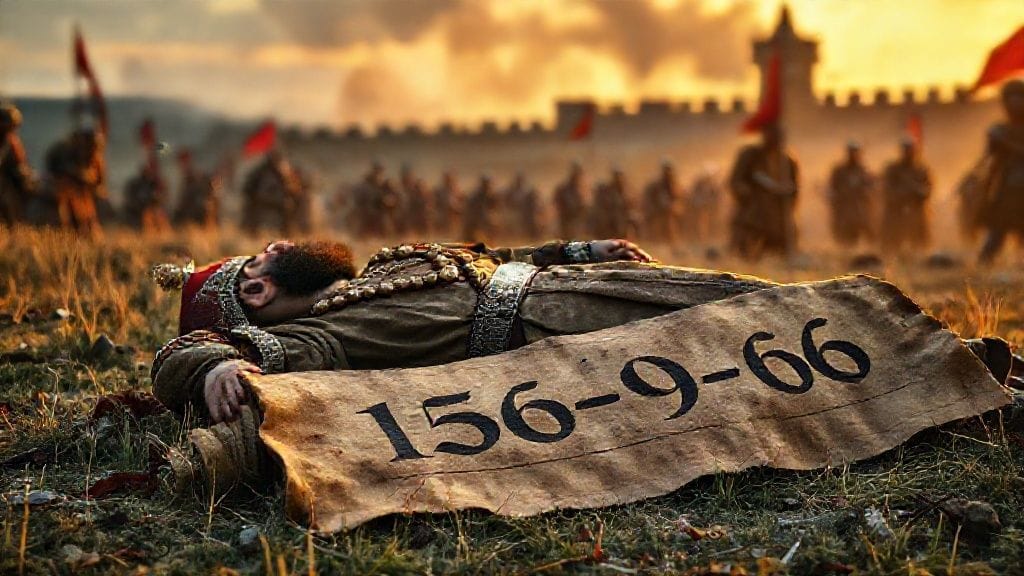
It was on the cusp of this epic siege that Suleiman’s life faded. On that early morning of September 6, amidst the deafening barrage and the cries of battle, the Sultan died quietly in his tent. Contrary to the dramatic images one might imagine—a battlefield death amidst charging soldiers—his passing was subdued, a stark moment veiled in secrecy.
Ottoman chroniclers noted that Suleiman, exhausted by years of rule and the campaign’s hardship, suffered a sudden illness—likely a stroke or heart attack. His personal attendants quickly concealed the death from the troops and command staff, fearing that news could shatter morale and invite chaos in the ranks.
Nevertheless, Suleiman’s demise changed the course of the siege and the empire’s immediate future.
8. Suleiman’s Death: Shrouded in Secrecy and Legend
The handling of Suleiman’s death is itself a tale of political intrigue. His grand vizier, Sokollu Mehmed Pasha, took swift control, ordering that the news be kept secret until the siege concluded. Rumors swirled, and various accounts later offered contradictory versions, some suggesting conspiracy, others heroic stoicism.
The Sultan’s body was embalmed and preserved in a tent, reportedly with great care, awaiting a discrete burial. Such circumspection reflected Ottoman concerns over leadership stability—Suleiman’s son, Selim II, was the designated heir, but internal court factions could have exploited any moment of vulnerability.
9. The Siege’s Decisive Battle: Tactical Genius Amidst Chaos
With Suleiman gone, the Ottoman commanders faced both logistical and morale challenges. Yet they pressed on toward victory. The siege culminated in a ferocious assault on the fortress. Despite the overwhelming numbers, the defenders’ resilience forced the attackers into brutal hand-to-hand combat.
Zrínyi himself died during a final desperate sortie, reportedly blowing up the fortress magazine rather than surrender. The battle was a Pyrrhic victory for the Ottomans—Szigetvár fell, but at extraordinary human cost. Estimates suggest that thousands of soldiers on both sides were killed, including many elite janissaries.
10. The Aftermath at Szigetvár: Victory and Mourning
Though the fortress was taken, the conquest was bittersweet. Ottoman forces mourned their beloved sultan, whose death cast a shadow over the triumph. The army paused, reflecting on the price of victory.
For the empire, it was a moment of transition—one where dreams of further European expansion collided with the realities of mounting resistance and administrative challenges.
11. The Empire’s Reaction: Shock and Succession
News of Suleiman's death was carefully communicated to Istanbul. The transition to Selim II's rule was relatively smooth, though the young sultan lacked his father’s military vigor and visionary leadership.
Within the imperial court, Suleiman was remembered with reverence and sorrow. Poets composed elegies; mosques held prayers for the “Great Sultan.” Yet the empire faced a slowly changing dynamic—one that saw the beginning of a gradual shift away from the relentless expansionism of Suleiman’s era.
12. The Legacy of Suleiman’s Death on Ottoman Politics
Suleiman’s death marked more than the fall of an individual—it signaled a turning point. Under Selim II and later successors, the Ottoman Empire subtly recalibrated its priorities. Internal factionalism grew; corruption seeped into bureaucracy; military innovation slowed.
Many historians argue that 1566 was the cusp of the empire’s gradual stagnation—a process stretching over decades. Thus, Suleiman’s demise was both an end of an age and the prologue to new challenges.
13. The Impact on European Balance of Power
The death of Suleiman resonated deeply in Europe. His campaigns had defined much of mid-16th century geopolitics. With his passing, European powers—Habsburg Austria, the Polish-Lithuanian Commonwealth, and the nascent Holy Roman Empire—recalibrated their strategy vis-à-vis the Ottoman threat.
Szigetvár, with its heroic defense, became legendary in Christian Europe; it offered hope that the Ottoman advance could be checked. The battle and the Sultan’s death are often seen as the start of the empire’s "western limit."
14. The Memory of Szigetvár in Ottoman and Hungarian Narratives
In Hungary, Szigetvár became a symbol of national heroism. Miklós Zrínyi’s defense is immortalized in poetry, ballads, and art, embodying sacrifice and resilience. For Hungarians, the fortress represented one of the few bright beacons resisting a powerful invader.
Conversely, Ottoman memory venerates Suleiman the Magnificent as the sublime sovereign who reached the zenith of imperial glory. His death at Szigetvár is mourned as a tragic yet dignified close to a life that forged an empire.
15. Suleiman the Magnificent: Between Myth and History
The Sultan’s persona has often oscillated between mythic grandeur and human vulnerability. Tales describe him as a just lawmaker, a passionate poet, and an invincible commander. But his final moments remind us that even those who seem larger than life meet fate as mortals.
Historians continue to debate details of his death and the exact nature of his final campaign, but the narrative remains potent—a blend of legend and documented fact that enriches the tapestry of early modern history.
16. Reflections on Mortality, Power, and Empire
Suleiman's death highlights universal themes: the fragility of power, the inevitability of mortality, and the ephemeral nature of empires. It invites reflection on the limits of human ambition amid the tides of history.
For an empire that had conquered so much, the passing of its greatest sultan at the edge of his dreams is a sobering reminder of history’s capriciousness.
17. Conclusion: End of an Epoch, Dawn of a New Era
September 6, 1566, marks an epochal moment where the grand narrative of Suleiman the Magnificent’s reign finds its solemn close. His death near Szigetvár, amid the echoes of war and the dust of cannon fire, encapsulates the dramatic interplay of glory and grief, conquest and loss.
While the fortress eventually fell and the Ottoman Empire pressed on, the memory of Suleiman’s final campaign lingers as a human story of an aging emperor whose empire’s heartbeat almost faltered on the distant fields of Hungary—yet whose legacy endures in the very foundations of history.
Conclusion
The tale of Suleiman the Magnificent’s death near Szigetvár is not just a chronicle of mortality but an intimate glimpse into the twilight of a colossal empire. As cannons roared and warriors clashed, a great life quietly slipped away, changing forever the course of Ottoman and European history. This event teaches us about courage under pressure, the complexities of leadership, and the enduring human spirit confronting its limits. Suleiman’s passing was a pivotal breath in the long story of empire—both an ending and a beginning, whispered through the ages beneath the banners of empire and revolution.
FAQs
Q1: What caused Suleiman the Magnificent’s death?
A1: Historical accounts suggest that Suleiman died of natural causes—most likely a stroke or heart attack—during the siege of Szigetvár. Fatigue from his long reign and the rigors of campaigning in harsh conditions contributed to his sudden demise.
Q2: Why was Suleiman’s death kept secret during the siege?
A2: Ottoman commanders feared that revealing the Sultan’s death too early would demoralize the troops and potentially cause chaos in the ranks. Therefore, his passing was concealed until the fortress was captured.
Q3: Who succeeded Suleiman the Magnificent?
A3: Suleiman was succeeded by his son, Selim II, who inherited an empire at its zenith but lacked his father’s military and political vigor, marking a gradual shift in Ottoman imperial policy.
Q4: What was the significance of the Siege of Szigetvár?
A4: The siege was pivotal because it marked a determined stand by European forces against Ottoman expansion. Though the fortress fell, the costly victory slowed Ottoman advances and boosted European morale.
Q5: How is Suleiman remembered in Turkish and Hungarian history?
A5: In Turkish history, Suleiman is revered as the greatest Ottoman sultan, a lawgiver and conqueror. In Hungary, Szigetvár symbolizes heroic resistance, immortalized by the valor of Count Miklós Zrínyi.
Q6: Did Suleiman’s death impact the Ottoman Empire immediately?
A6: Yes. Although the empire remained vast, Suleiman’s death ushered in a period of political uncertainty and gradual decline, as successors struggled to maintain his legacy.
Q7: What role did Miklós Zrínyi play in the siege?
A7: Zrínyi was the fortress commander and hero of Szigetvár. Despite overwhelming odds, he led a determined defense and died heroically in battle, embodying the spirit of resistance.
Q8: How did the death of Suleiman influence European politics?
A8: Suleiman’s death encouraged European powers, who saw an opportunity to curb Ottoman influence. It altered diplomatic and military strategies across the continent for decades.