Table of Contents
- Introduction
- Early Life in Trabzon
- Education and Character
- Accession to the Throne
- Expanding the Empire
- The Battle of Mohács and Hungary
- The Siege of Vienna
- Naval Dominance and the Mediterranean
- Internal Reforms and the Kanun
- Patron of the Arts and Architecture
- Suleiman and Hürrem Sultan
- The Death of Mustafa
- Suleiman’s Final Campaign
- His Legacy Today
- External Resource
- Internal Link
1. Introduction
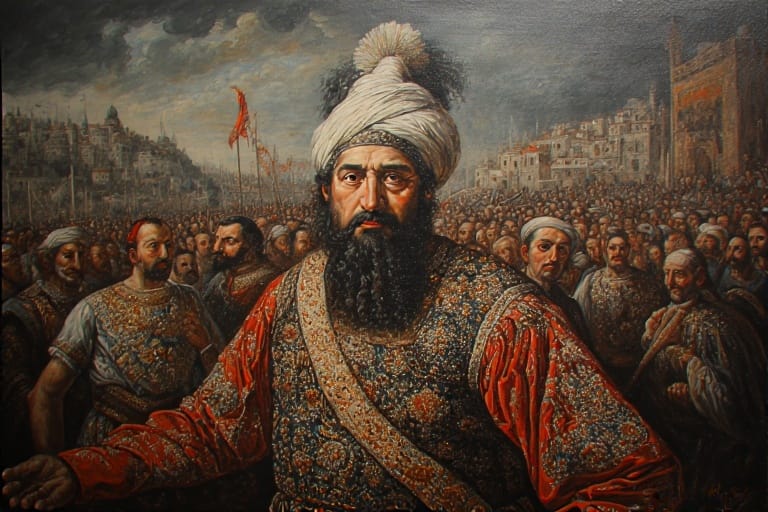
In the pantheon of Islamic and world rulers, few names shine as brightly as Suleiman the Magnificent. Reigning from 1520 to 1566, he presided over the Ottoman Empire at its geographical, cultural, and political peak. Known both in the East as “Kanuni” (the Lawgiver) and in the West as “the Magnificent,” Suleiman was more than a military commander—he was a reformer, a patron of the arts, and a strategist who understood the importance of legacy.
2. Early Life in Trabzon
Suleiman was born on November 6, 1494, in Trabzon, a coastal city on the Black Sea. He was the only son of Şehzade Selim (later Selim I, known as Selim the Grim) and Hafsa Sultan, a woman of possibly Crimean or Circassian origin. His early years in Trabzon exposed him to the diverse cultural and religious tapestry of the empire’s frontier.
Even as a child, Suleiman displayed keen intelligence and a fascination with governance and military matters.
3. Education and Character
Suleiman was sent to the imperial palace school in Constantinople (Istanbul), where he received a classical Islamic education: theology, literature, mathematics, military strategy, and languages, including Persian and Arabic.
He was known for his serious demeanor, love for poetry, and strong sense of justice. These traits would come to define his later rule.
4. Accession to the Throne
When his father Selim I died in 1520, Suleiman ascended the throne without opposition. The Ottoman Empire was already a powerful entity, stretching from Algeria to the borders of Persia. Yet Suleiman saw room for growth, not just territorial but cultural and administrative.
He was 26 years old, and his reign would last 46 years, the longest of any Ottoman sultan.
5. Expanding the Empire
Suleiman quickly moved to expand the empire’s borders. His early campaigns targeted Europe:
- 1521: He captured Belgrade, a vital fortress on the Danube.
- 1522: He took Rhodes from the Knights Hospitaller after a long siege.
- 1526: He achieved a stunning victory at the Battle of Mohács, decimating Hungarian forces and killing King Louis II.
This victory opened the door to Central Europe and sent shockwaves through the continent.
6. The Battle of Mohács and Hungary
The Battle of Mohács is often cited as one of the most decisive victories in Ottoman history. Suleiman’s forces annihilated the Hungarian army in under two hours, leading to Ottoman control of most of Hungary for over a century.
It demonstrated the military sophistication of the Ottomans: coordinated cavalry, Janissaries with muskets, and strategic use of terrain.
7. The Siege of Vienna
In 1529, Suleiman attempted to capture Vienna, capital of the Habsburg Empire. Though the siege failed, it marked the high tide of Ottoman expansion into Europe. A second siege in 1532 was also inconclusive.
Still, these campaigns ensured that the Ottomans remained a perpetual threat to European powers and a central player in continental politics.
8. Naval Dominance and the Mediterranean
Suleiman extended Ottoman influence into the Mediterranean Sea, Red Sea, and Persian Gulf. Under the command of Barbarossa Hayreddin Pasha, the Ottoman navy defeated Spain, Venice, and Genoa.
The Battle of Preveza (1538) gave the Ottomans dominance in the eastern Mediterranean for decades. Suleiman also fortified Aden, Yemen, and secured routes to Mecca and the Indian Ocean.
9. Internal Reforms and the Kanun
One of Suleiman’s most enduring legacies is his legal reform. While the empire already had Sharia law, Suleiman issued secular laws (known as Kanuns) to cover areas not addressed by religious law: taxation, criminal justice, property rights.
He standardized laws across provinces, reined in corruption, and ensured legal protection for subjects, regardless of religion. Hence his Eastern title, “Kanuni Sultan Suleiman.”
10. Patron of the Arts and Architecture
Suleiman’s reign was also the golden age of Ottoman culture. He sponsored poets, scholars, and artists. He was himself a poet, writing under the pen name Muhibbi.
He commissioned the architect Mimar Sinan, who designed over 300 structures, including the Süleymaniye Mosque, one of Istanbul’s most iconic landmarks.
Ottoman tilework, calligraphy, manuscript illumination, and ceramics reached new heights under Suleiman.
11. Suleiman and Hürrem Sultan
Suleiman’s personal life also broke conventions. He married his concubine, Roxelana, later known as Hürrem Sultan, a Christian slave of Ukrainian origin. She became an influential political advisor, a unique position for a woman in the Ottoman court.
Their relationship was deeply affectionate, evidenced by letters and poetry. Hürrem’s rise marked the beginning of the Sultanate of Women, an era when imperial consorts and mothers gained considerable influence.
12. The Death of Mustafa
A tragic chapter of Suleiman’s life involved the execution of his son Mustafa, a popular and capable prince. Suleiman, allegedly convinced by Hürrem and Grand Vizier Rüstem Pasha that Mustafa was plotting against him, ordered his death in 1553.
This decision would haunt him and create dynastic instability that lingered long after his death.
13. Suleiman’s Final Campaign
Even in his old age, Suleiman continued to lead military campaigns. In 1566, during the siege of Szigetvár in Hungary, he died of natural causes in his tent. His death was kept secret until the victory was secured.
He was buried in Istanbul, next to the Süleymaniye Mosque. His heart and organs, however, were buried near the battlefield—a custom for warriors who died far from home.
14. His Legacy Today
Suleiman’s reign represents the zenith of Ottoman power. He expanded the empire, streamlined governance, encouraged religious diversity, and fostered a cultural renaissance. His rule is still studied by historians, military strategists, and political thinkers.
In modern Turkey, he is revered as a wise and powerful leader. Globally, his legacy is complex but monumental.
15. External Resource
 Wikipedia – Suleiman the Magnificent