Table of Contents
- A River Kingdom Awakens: Setting the Stage for Wu
- From Merchant’s Son to Warlord’s Heir: The Early Life of Sun Quan
- The Shadow of a Fallen Han: A Fractured Realm in Turmoil
- Brothers in Arms: Sun Ce’s Conquests and Sun Quan’s Unexpected Inheritance
- Learning to Rule a Shattered Southland
- Of Rivals and Regents: Wei, Shu, and the Struggle for Legitimacy
- Red Cliffs and Rising Ambitions
- From King to Would-Be Emperor: Titles, Diplomacy, and Dangerous Balances
- The Road to 229: Calculations Behind the Imperial Diadem
- The Coronation on the Southern River: Sun Quan Emperor of Wu
- Building an Imperial Court: Rituals, Laws, and the Shape of Wu
- City of Copper and Silk: Life in Jianye under the New Emperor
- War, Diplomacy, and the Three Thrones of China
- Within the Palace Walls: Family, Succession, and Tragedy
- Merchants, Mariners, and Marshes: The Society of the River Kingdom
- The Long Sunset of an Aging Ruler
- Legacy on the Waterways: Memory of the Emperor of Wu
- Echoes in Story and Screen: Sun Quan in Culture and Romance
- Conclusion
- FAQs
- External Resource
- Internal Link
Article Summary: Along the lower reaches of the Yangtze River, amid marshes, rice paddies, and bustling ports, a new dynasty emerged when Sun Quan declared himself emperor of Wu in the year 229. This article traces how a cautious young heir, initially overshadowed by his charismatic brother, transformed into Sun Quan emperor of Wu, a ruler able to defy northern hegemony and carve out a lasting kingdom. We journey from the fall of the Han to the formation of the Three Kingdoms, exploring the political gambits, bloody battles, and quiet reforms that allowed Wu to survive between two powerful rivals. Through vivid narratives of the Battle of Red Cliffs, palace intrigues, and river-borne commerce, we witness how Sun Quan’s decision to claim the imperial title reshaped the balance of power. The article also uncovers the lives of ordinary people—sailors, farmers, and merchants—whose fates were bound to this new regime on the water. In examining both the human drama and the institutional changes, it reveals why the proclamation of Sun Quan emperor of Wu was more than a personal triumph; it was a statement that the Chinese world itself had changed. Finally, we consider how later historians and storytellers remembered him, and how the legacy of Wu’s brief but brilliant dynasty still glimmers in China’s cultural memory. By the end, the rise of Sun Quan emperor of Wu stands not only as a milestone of the Three Kingdoms era but as a lens on power, legitimacy, and survival in an age of fragmentation.
A River Kingdom Awakens: Setting the Stage for Wu
The story of Sun Quan’s imperial coronation begins not with a crown but with water. In the early third century, the land we now call China was no single country. It was a mosaic of fortresses and river ports scattered along the twisting spine of the Yangtze. The south, which would become the Kingdom of Wu, was a realm of dense forests, steaming summers, and winding waterways that both connected and isolated communities. Barges heavy with grain and copper slipped past reed-choked banks where fishermen mended their nets. In the distance, the haze of wood smoke and temple incense rose above growing settlements like Jianye, the city that would someday serve as imperial capital.
In this humid landscape, power did not ride on horseback alone; it sailed. Whoever mastered the river could move armies quickly, feed them reliably, and tax every sack of rice and every bolt of silk. That is what made the south so coveted and yet so difficult to control. Northern dynasties had long viewed the lower Yangtze as a frontier—wealthy, yes, but distant, difficult, and suspiciously different in its customs. Local gentry families, minor warlords, and bandit leaders rose and fell, often professing loyalty to the nominal Han court while ruling, in reality, as near-independent lords.
By 229, when Sun Quan emperor of Wu finally proclaimed himself sovereign of a fully independent empire, this river country had already endured decades of war and upheaval. But this was only the beginning of our tale. To understand why a man from a family of frontier officers dared to challenge the very idea of a single, unified Chinese empire, one must step back into the twilight of the Han and follow the path that led from provincial skirmishes to imperial coronation.
At the heart of this story stands Sun Quan himself: a ruler remembered less for dazzling charisma than for his ability to endure, adapt, and seize the moment when rivals overreached. Unlike the fiery generals who died in their thirties or the brilliant strategists consumed by plots, he would reign across decades. His rise from teenage heir to sun quan emperor of wu illustrates how patience, geography, and careful alliances could be as decisive as any single great battle. Yet behind the celebrations of his coronation lay a question that haunted his own age and those that followed: in a world where three men called themselves emperor, who truly owned the legacy of China?
From Merchant’s Son to Warlord’s Heir: The Early Life of Sun Quan
Sun Quan was born in 182, as the Eastern Han dynasty staggered under corruption and rebellion. His father, Sun Jian, was not a great aristocrat but a seasoned fighter from the lower Yangtze region, sometimes described in later chronicles as a tiger among men. Sun Jian’s reputation grew when he suppressed pirates and rebels along the rivers and coasts, his campaigns earning him posts and titles from a nervous central government desperate for capable commanders. Wealth followed: war spoils, land grants, and the gratitude of local elites who saw in him a shield against chaos.
The boy grew up in the shifting world of military garrisons and river towns, watching his father depart on campaigns that would bring glory but also risk. While the adult Sun Jian clashed with rival warlords such as Dong Zhuo in the north, young Sun Quan remained largely in the south, exposed to both the humble realities of border life and the ambitions of a family on the rise. His mother, Lady Wu, provided the backbone of domestic stability, ensuring her children were educated and well connected, mindful that in an age of war, birth alone was never enough.
Contemporaries later said that Sun Quan had purple-tinged hair and striking, almost feline eyes, details that may have been embroidered by storytellers but hint at how later generations wanted to remember him: unusual, marked out by fate. More important than appearance, however, were his habits. Where his elder brother Sun Ce was renowned for boldness and reckless courage, Sun Quan was quieter, watchful, sometimes even hesitant. To many, he seemed the less likely candidate for greatness.
The death of Sun Jian in 191 on campaign changed everything. Sun Ce—brilliant, dashing, and hungry for power—took up their father’s mantle, gathering followers and carving out territory along the Yangtze. Sun Quan, nearly ten years younger, watched as his brother became a regional strongman. For the moment, his role was secondary: learn, observe, and survive. Yet this apprenticeship among camps and councils gave him a political education no classroom could provide. He saw how alliances were made and broken, how gifts of silk and gold moved hearts as effectively as soldiers, and how a charismatic leader could hold together wildly different men through sheer force of personality.
These early years did not yet suggest the future sun quan emperor of wu, but they planted in him a deep understanding of the south’s landscape and people. He learned the rhythms of the river trade, the concerns of local gentry worried about taxes and security, and the rugged independence of commanders who had little patience for distant emperors in Luoyang or Chang’an. That mix of experiences—military, economic, and social—would later allow him to bind Wu together not just as a warlord’s territory, but as a functioning state.
The Shadow of a Fallen Han: A Fractured Realm in Turmoil
While Sun Quan was maturing in the humid air of the south, the Han dynasty was dying by inches. The Yellow Turban Rebellion of 184 had ripped open old wounds: tax burdens, natural disasters, and a sense that the emperor had lost the Mandate of Heaven. Even though the rebellion was eventually crushed, the cost was catastrophic. Military governors, originally empowered to deal with the crisis, began to think of their provinces as personal fiefdoms. Eunuchs and court factions in the capital struggled for control, their intrigues increasingly detached from the realities of a crumbling countryside.
By the end of the second century, the fiction of a unified empire persisted, but real power lay scattered among warlords. Cao Cao in the north, Liu Biao in the central plains, Liu Zhang in the west, and countless smaller figures each claimed, at least in public, to serve the Han emperor. In practice, they minted their own coins, levied their own taxes, and waged their own wars. The imperial household became a prize to be seized, not a moral authority to be obeyed.
It’s astonishing, isn’t it? A dynasty that had governed for four centuries, whose bureaucracy and culture had shaped the very idea of “China,” now survived mainly as a symbol to be manipulated. But this was only the beginning of the chaos. Floods, locust plagues, and banditry multiplied. Refugees poured from burned-out villages into walled cities, hoping for protection. A whole generation grew up with the sight of conscription officers in the streets and the sound of distant drums marking yet another army on the march.
In this fractured world, the south offered both danger and opportunity. Its distance from the capital meant that Han authority was relatively weak; its awkward terrain made large-scale invasions risky. Yet the wealth of rice, timber, and trade meant that whoever controlled the region could support significant armies. A visionary leader with river fleets and local allies could dream of more than just survival—he could imagine ruling a realm that rivaled whatever power dominated the north.
This was the broader canvas on which the future sun quan emperor of wu would paint his ambitions. The fall of Han was not a single event but a slow collapse, and men like Sun Quan had to decide whether they would merely endure the wreckage or claim a piece of the shattered imperial legacy for themselves.
Brothers in Arms: Sun Ce’s Conquests and Sun Quan’s Unexpected Inheritance
The next chapter of Wu’s story belongs to Sun Ce, the elder brother whose exploits would set the stage for Sun Quan’s future. In the late 190s, as northern warlords clashed, Sun Ce looked east and south. With a combination of inherited troops, personal charisma, and alliances with local magnates, he launched campaigns to conquer the lower Yangtze region. His rise was meteoric. City after city fell, often more from persuasion than outright assault, as he dangled positions, titles, and security before exhausted local elites.
Sun Ce’s energy was legendary. He fought at the front, laughed at danger, and rewarded his followers with liberality. Tales later circulated—half history, half folklore—of his reckless hunts and his willingness to duel enemies personally. Under his leadership, the Sun family’s domain grew rapidly, stretching from modern Jiangsu down toward Zhejiang. He made Jianye into his base, laying the foundations of the city that would later become Sun Quan’s capital.
Within this whirlwind, young Sun Quan held junior posts, governing small commanderies, plugging gaps, and learning how to command men. He saw firsthand that conquest alone was not enough. New territories had to be pacified, tax systems reestablished, and resentful gentry reassured. Sun Ce was the sword; Sun Quan increasingly became the hand that steadied it.
Then, in 200, catastrophe struck. Sun Ce was assassinated, apparently by followers of a defeated rival. The daring general who had seemed invincible died in his late twenties, leaving behind an unfinished conquest and an heir not yet twenty. On his deathbed, according to later accounts preserved in the Records of the Three Kingdoms (Sanguozhi), Sun Ce entrusted Sun Quan to loyal advisors, urging them to support his younger brother as they had supported him.
The transition might easily have failed. Many of Sun Ce’s officers were rough veterans, loyal to the man more than the family name. Some could have carved out their own fiefdoms or defected to other powers. Sun Quan, with his quieter temperament, did not naturally command the same fierce loyalty. But he had two advantages: a core of senior advisors dedicated to the Sun clan’s survival, and a keen sense of his own limitations.
In these crucial months, he listened. He allowed capable men such as Zhang Zhao and Zhou Yu to guide strategy, showing a restraint unusual in a young warlord. In doing so, he performed his first great act of rulership: he preserved the realm he inherited. The man who would one day be hailed as sun quan emperor of wu began not by expanding recklessly, but by holding firm in a moment of crisis.
Learning to Rule a Shattered Southland
Sun Quan’s early reign over the south was an exercise in survival and consolidation. Unlike some rivals, he did not possess immediate claims to noble lineage nor overwhelming numbers. What he did have was a defensible territory, a growing navy, and a population eager for some semblance of stability. He understood that if he tried to imitate the swashbuckling style of Sun Ce, he might squander all three.
Consequently, he embraced a more deliberative style of leadership. He convened councils of advisors and allowed debate, sometimes sitting in silence as his ministers clashed over policy. Zhang Zhao, stern and conservative, often urged caution and the preservation of Confucian norms. Zhou Yu, refined yet audacious, argued for bolder military moves. Sun Quan alternated between them, sometimes leaning on one, sometimes the other, trying to balance risk and security.
Under his guidance, the administration of Jiangdong—“East of the River”—began to take on the shape of a proto-state. Tax registers were reconstructed, granaries repaired, and conscription organized more systematically. The Sun regime, still professing nominal loyalty to the Han court, nonetheless behaved increasingly like an independent government. Local elites were drawn in with official posts; some were married into the Sun family’s extensive network, binding personal loyalty to political allegiance.
Sun Quan also encouraged the development of naval power. The waterways of the lower Yangtze and its tributaries became his lifelines. Skilled shipwrights were employed to build war junks and transport vessels; harbors were fortified; sailors trained in coordinated maneuvers. The rivers that had long isolated communities from each other were slowly turned into arteries of a budding state.
During these years, battles were still frequent—border skirmishes, suppression of rebels, clashes with neighboring warlords—but for Sun Quan, governance itself became a kind of warfare. Winning the hearts of farmers, merchants, and gentry was as important as defeating enemy generals. The future sun quan emperor of wu was, in a very real sense, already practicing imperial rule long before he claimed the imperial title.
Yet external threats loomed large. In the north, Cao Cao was building a formidable military machine, while in the southwest, figures associated with the Liu royal clan were beginning to rise. The question was no longer whether the Han would fall, but who would inherit its shattered domains.
Of Rivals and Regents: Wei, Shu, and the Struggle for Legitimacy
Three names would ultimately dominate the era: Cao Cao, Liu Bei, and Sun Quan. Only two of them would ever formally take the title of emperor in their own lifetimes, but all three contended for something more abstract and elusive—legitimacy. Who acted in the true spirit of Han? Who protected the people? Who, in the moral language of the time, possessed the Mandate of Heaven?
Cao Cao, the most feared of Sun Quan’s rivals, commanded the wealth of the north China plain. He held the emperor of Han in his capital of Xu (and later Ye), effectively reducing the imperial court to a ceremonial hostage. With vast recruitment efforts, agricultural reforms, and a strong cavalry, Cao Cao forged a war machine that dwarfed most others. His claims were pragmatic: he was the protector of the Han, the man who restored order. Yet everyone knew that his power rested on steel more than ceremony.
Liu Bei, by contrast, cultivated the image of a wandering, benevolent lord with an impeccable genealogy—a distant member of the Han imperial clan itself. For years he wandered from patron to patron, losing battles as often as he won them, but accumulating a legend: the righteous man in an age of villains. His eventual alliance with the strategist Zhuge Liang would propel him to seize the west and found what became the state of Shu-Han.
Sun Quan, wedged between these two, lacked the obvious northern strength of Cao Cao and the sacral lineage of Liu Bei. But he had two key assets: secure geography and time. By consolidating the south first and avoiding rash challenges to either rival, he could let them exhaust each other. The notion of sun quan emperor of wu was, for the moment, less important than that of Sun Quan the survivor, the stable anchor in a storm.
Still, questions of legitimacy mattered. Sun Quan continued, for years, to acknowledge the Han emperor nominally, accepting titles granted through the northern court and performing rituals in line with precedent. Such gestures cost little but bought time and a veneer of orthodoxy. They also allowed him to style himself as a regional king or duke operating within the old order, rather than as a rebel usurper—at least until circumstances forced a bolder step.
Red Cliffs and Rising Ambitions
If there was a single turning point that made the later coronation of Sun Quan possible, it was the Battle of Red Cliffs, fought around the winter of 208–209. Cao Cao, flushed with victory over northern rivals and advancing southward, intended to crush both Sun Quan in the east and Liu Bei in the west with a single, overwhelming campaign. He boasted of bringing hundreds of thousands of troops; the exact numbers are debated by modern historians, but his force was undeniably immense.
Sun Quan’s court divided. Some advisors, fearing Cao Cao’s power, urged surrender in exchange for security and recognition. Zhang Zhao’s warnings, recorded in later chronicles, stressed the danger of resisting a man who now held the emperor and much of the north. Others, notably Zhou Yu and Lu Su, argued that submission would mean the end of the Sun family’s autonomy and eventually their lives.
It was a moment of profound anxiety for Sun Quan. According to one famous account, he retreated with a sword, pacing beneath a tree and carving at its bark as he brooded. The decision he made would shape the destiny of the south: he chose resistance. He agreed to form an alliance with Liu Bei, combining Wu’s naval strengths with Liu’s desperate determination.
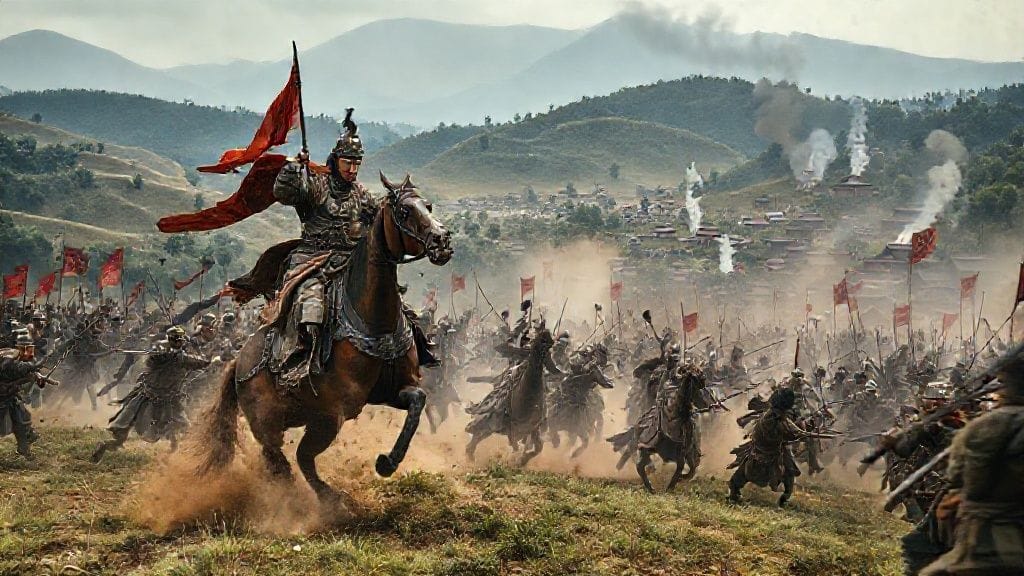
The ensuing battle on the Yangtze near Chibi—Red Cliffs—has been retold in chronicles, poetry, and modern cinema. Wu’s lighter, more maneuverable ships and its commanders’ familiarity with river conditions allowed them to counter Cao Cao’s largely land-based forces, many of whom suffered from seasickness and disease. A daring fire attack, orchestrated by Wu’s commanders, turned Cao Cao’s line of warships into a floating inferno. The northern army retreated in chaos, harried by disease, weather, and local resistance.
In the quiet after the battle, as riverside villagers picked through wreckage, the political meaning of Red Cliffs began to emerge. Cao Cao had been checked. The south, under Sun Quan, had proven that it could not be easily absorbed. As one later historian would note, Red Cliffs “divided the realm into three,” setting the pattern that would define the age (a judgment echoed in modern scholarship by Rafe de Crespigny, who highlights Red Cliffs as the decisive fracture).
For Sun Quan, victory brought more than security. It brought confidence. The idea that he might one day stand as sun quan emperor of wu, not merely a regional lord, started to seem less like hubris and more like a plausible destiny. Yet he knew better than to rush. First, he needed to strengthen his realm and navigate the shifting web of alliances that Red Cliffs had set in motion.
From King to Would-Be Emperor: Titles, Diplomacy, and Dangerous Balances
In the years that followed Red Cliffs, Sun Quan walked a tightrope between ambition and prudence. He expanded his territories, sometimes in cooperation with Liu Bei, sometimes at his expense. One of the sharpest points of contention was Jing Province, a strategic corridor along the Yangtze whose fertile lands and key river crossings both men coveted. Temporary arrangements gave parts of it to Liu Bei, but mistrust simmered beneath the surface.
Diplomatically, Sun Quan maneuvered between nominal submission and practical independence. For a period, he accepted titles from Cao Cao’s regime, which would later be formally known as the state of Wei. These titles—such as “King of Wu”—granted through a Han emperor controlled by Cao Cao, gave his rule a legal gloss without requiring true subordination. To many observers, it looked like cynical double-dealing; to Sun Quan, it was strategy. He could use the north’s recognition to strengthen his legitimacy at home, even as he prepared for a future in which no northern authority would dictate his status.
Meanwhile, Liu Bei, after consolidating control of the southwest, proclaimed himself emperor of “Han” in 221, claiming to continue the fallen dynasty’s moral line. This was a bold move, a direct challenge to Wei’s dominance and a statement that the Mandate had moved west. For Sun Quan, the proclamation was both provocative and instructive. If Liu Bei could assume the imperial title based on lineage and perceived righteousness, why should the lord of the prosperous south be forever content with the title of king?
Yet Sun Quan held back. He understood that timing was everything. Declaring himself emperor too soon might isolate Wu diplomatically and unite others against him. Instead, he gradually altered internal court rituals, experimented with new forms of address, and strengthened the bureaucratic apparatus that would be needed to sustain an imperial household.
In this liminal period, the phrase sun quan emperor of wu remained an aspiration, whispered perhaps by flattering courtiers or bold strategists but not yet inscribed on official seals. The south was still, in name, a kingdom. But its ruler was thinking in dynastic terms, weighing how and when to transform a regional regime into a declared empire.
The Road to 229: Calculations Behind the Imperial Diadem
By the 220s, the political landscape had shifted again. Cao Cao died in 220, and his son Cao Pi formally ended the Han dynasty by forcing the last Han emperor to abdicate. In its place, Cao Pi proclaimed the state of Wei, with himself as emperor. This act, shocking yet unsurprising, forced every other major warlord to reconsider their position. The fiction that they were still generals or kings serving Han could no longer be maintained.
Liu Bei responded by declaring himself emperor of Shu-Han in 221, arguing that he alone represented the true continuation of Han legitimacy. The realm was now openly multipolar: multiple men wore imperial crowns, each claiming that Heaven favored them. In such a world, remaining merely a king increasingly looked like accepting second-tier status.
Sun Quan initially adopted a hybrid stance. In 222, after a breakdown in relations with Shu-Han and the seizure of Jing Province, he leaned toward accommodation with Wei, receiving titles from Cao Pi. For a time, he was officially a vassal-king under the Wei emperor, though in practice his regime remained autonomous. Some of his followers disliked this posture; others saw it as buying time.
Over the remainder of the decade, Wu strengthened internally. Sun Quan’s administration expanded agricultural colonies, improved river defenses, and cultivated trade along both inland waterways and coastal routes. The population, though still scarred by past wars, began to experience a measure of stability. A generation was coming of age that knew Sun Quan as their primary sovereign, not the distant ghosts of Han emperors.
By 229, the moment was ripe. Wei’s grip over the empire was not absolute; Shu-Han still defied it in the west, and Wu’s own defenses remained robust. Within Sun Quan’s court, voices in favor of a full imperial title grew louder. Advisors argued that continuing to acknowledge Wei’s superiority undermined morale and prestige. If Shu-Han could claim imperial status with a smaller population and more precarious geography, surely the rich, populous lands of Jiangdong deserved the same.
There were risks, of course. Declaring himself emperor would formalize the division of the realm, making reconciliation or unification under a single dynasty far more difficult. It might also provoke harsher campaigns from Wei. But Sun Quan, after decades of cautious maneuvering, judged that Wu had matured into an entity that could not be dismissed. The time of provisional titles was over. The figure who had so long balanced humility and ambition was ready to be known openly as sun quan emperor of wu.
The Coronation on the Southern River: Sun Quan Emperor of Wu
The year 229 became a watershed for the south. Reports from that time, later preserved by historians such as Chen Shou, describe a series of elaborate ceremonies held near Jianye to mark Sun Quan’s assumption of the imperial title. The exact details may have blurred over the centuries, but the core image remains powerful: a ruler of the riverlands, surrounded by banners and bronze, declaring that the Kingdom of Wu was, in fact, an empire.
Dawn on the chosen day likely broke humid and mist-laden, the river shrouded in low fog. In the capital, officials donned ceremonial robes, their colors and patterns carefully specified according to new court regulations modeled, in part, on the old Han but modified to assert Wu’s distinct identity. Drums thundered across the water, summoning dignitaries and officers to the palace precincts. Commoners gathered at a distance, watching the movement of processions and listening for the clang of ritual bells.
Within the palace, Sun Quan himself would have undergone purification rites—bathing, fasting, and abstaining from certain foods and pleasures—to signal spiritual readiness. Then, flanked by high ministers, he emerged to perform sacrifices to Heaven and Earth, invoking the cosmic order that, in traditional Chinese thought, granted legitimacy to emperors. Behind the carefully choreographed gestures lay a simple but radical message: Heaven now smiled on Wu, not just Wei or Shu-Han.
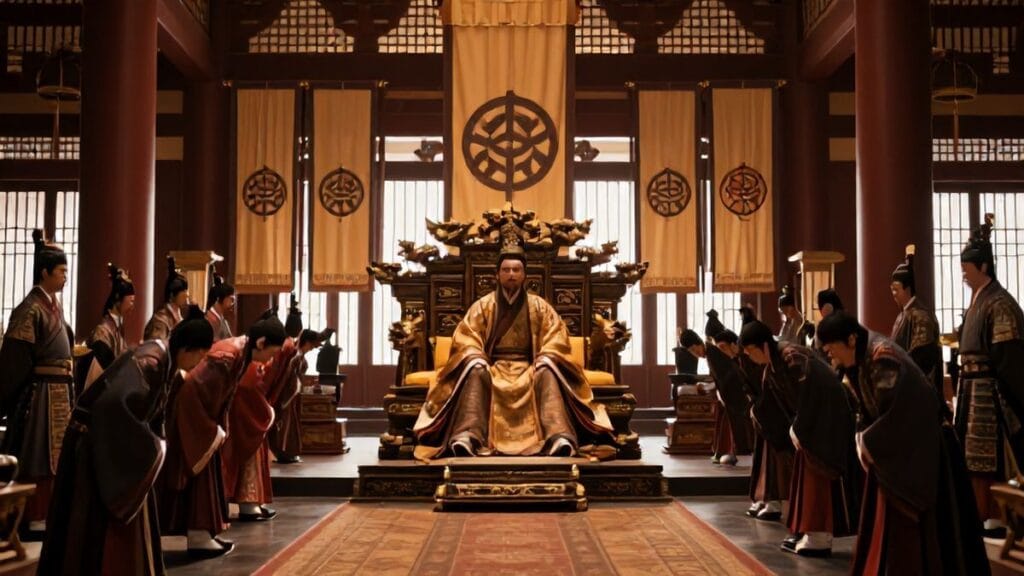
Proclamations were read aloud, declaring the founding of a new imperial era. The name “Wu” was elevated from a regional designation to the label of a dynasty. Seals were recarved; edicts would henceforth bear the signature of an emperor, not a king. Courtiers knelt and cried out their formal acclamations, pledging loyalty to sun quan emperor of wu, the newly anointed Son of Heaven of the southeast.
Yet behind the celebrations, anxieties lingered. Everyone knew that beyond the marshes and hills, two other men claimed the same celestial favor. The coronation did not end the wars; it crystallized them. It legitimized not just Sun Quan’s rule in the eyes of his followers, but also the idea that the empire could be divided, at least for a time, into three competing thrones.
For ordinary people in Jianye, the day may have meant an extra ration of grain, a ceremonial cup of wine, or the spectacle of distant fireworks and lanterns reflected on the river. For the political class, it marked a profound shift. From this moment, Wu’s officials no longer answered, even nominally, to any northern authority. Their careers, honors, and hopes were tied to a dynasty rooted in the south—an unprecedented inversion of centuries of northern dominance.
Building an Imperial Court: Rituals, Laws, and the Shape of Wu
Proclaiming an empire was one thing; running it was another. After 229, Sun Quan and his ministers set about reshaping the Wu government from a warlord’s headquarters into a fully articulated imperial court. Institutions that had functioned informally or under the guise of Han-era titles were formalized, expanded, and given new hierarchies.
The imperial secretariat, responsible for drafting and managing edicts, grew in importance. A chancery oversaw the appointment and evaluation of officials across the realm. Legal codes, some inherited from Han practice and others newly drafted, were compiled and circulated to local administrations. The aim was to standardize governance, reducing the arbitrary power of local strongmen and creating a system in which appeals could flow back to Jianye.
Ritual specialists played a surprisingly central role. They advised on the correct performance of sacrifices, the alignment of palaces according to geomantic principles, and the selection of auspicious dates for major decisions. Their work might seem esoteric, but in an age when political legitimacy was closely tied to cosmic harmony, these details mattered. Every correctly performed ceremony reinforced the message that sun quan emperor of wu was not a mere usurper but a ruler in tune with Heaven’s will.
Sun Quan also patronized scholars and literati, inviting them to court and commissioning histories and commentaries. By doing so, he sought not only their intellectual labor but their prestige. For an emperor from a comparatively modest background, the endorsement—or at least service—of learned men helped bridge the gap between martial origins and refined rulership. The court of Wu, though smaller than that of Wei, became a center of culture in its own right, producing poetry, essays, and administrative treatises.
Law enforcement and taxation under Wu reflected both pragmatism and ambition. Land surveys sought to ensure accurate assessment of grain dues, while state-sponsored agricultural colonies in frontier regions helped feed the army and integrate unsettled lands. Discipline in the military was tightened, with harsh punishments for desertion and mutiny, but also rewards for valor. The empire’s survival depended on a delicate balance: firm enough control to maintain order, yet flexible enough to accommodate the diversity of local conditions along the Yangtze and beyond.
City of Copper and Silk: Life in Jianye under the New Emperor
While imperial edicts reshaped institutions, life in Jianye, the capital, unfolded in rhythms that mixed the ancient with the newly imperial. Situated along a bend of the Yangtze, the city bustled with traffic. War junks with high sterns and armed decks lay moored alongside cargo barges bearing rice, salt, and ceramics. Foreign merchants—some from other parts of China, others perhaps from as far as the Korean peninsula or Southeast Asia—wandered its markets, bringing strange goods and stranger tales.
In the narrow streets of artisan quarters, the clang of metalworkers echoed from dawn until dusk. Copper and iron were hammered into weapons, tools, and fittings for ships. Silk workshops spun thread into fine garments, some destined for the imperial household, others for wealthy merchants and officials. Markets smelled of fish, spices, and fermenting wine. Street performers recited ballads of recent battles, turning the exploits of Sun Quan and his generals into entertainment and informal propaganda.
For many residents, the proclamation of sun quan emperor of wu was less about ideology and more about practical outcomes. Were taxes lower or higher? Were bandits kept at bay? Could they trade without arbitrary levies at each checkpoint? Under Wu’s rule, some found modest improvement: more regular taxation, a clearer chain of authority, and, after years of turmoil, a sense that the government might endure long enough to invest in.
Still, hardships remained. Periodic military campaigns disrupted trade; conscription pulled young men from fields and workshops. Floods along the river could wipe out entire harvests, and the state’s capacity to respond was limited. In such times, imperial titles offered little comfort. Yet the relative stability of Jianye compared with war-torn northern cities made it a magnet for migrants. Families who had fled battles around the central plains resettled in the south, bringing new skills, dialects, and customs, enriching Wu’s cultural tapestry.
Beneath the formal order of palaces and offices, informal networks thrived. Tavern owners cultivated cronies among minor officials; smugglers learned which harbor masters could be bribed to look the other way. Buddhist and Daoist monks, though not yet as institutionally prominent as they would become centuries later, offered rituals and advice, blending local cults with wider religious movements. The capital of Wu was not just an administrative center—it was a living organism, adapting constantly to the pressures and possibilities of an embattled age.
War, Diplomacy, and the Three Thrones of China
Sun Quan’s declaration as emperor did not end his dealings with Wei and Shu-Han; it reframed them. Now, each letter exchanged between courts, each envoy received, occurred between self-proclaimed equals—all of them, in theory, Sons of Heaven. The language of correspondence shifted from one of vertical hierarchy to one of uneasy parity, though Wei, with its greater territory, never fully accepted the others as equals.
Militarily, Wu adopted a posture of defensive offense. Its strategic priority was to hold the Yangtze line against northern incursions while probing for opportunities along the fringes. Naval raids struck at Wei’s riverine outposts; fortified cities guarded key crossings. Wu’s commanders knew that a full-scale land invasion northward would overextend their resources, so they sought instead to bleed and deter the enemy, turning the rivers into moats.
Relations with Shu-Han oscillated between alliance and hostility. After the disputes over Jing Province and the death of Liu Bei in a failed campaign against Wu, the two states slowly edged back toward cooperation, recognizing that their true existential threat lay in Wei’s dominance. Joint operations and coordinated defenses became possible, if never entirely free from suspicion. Zhuge Liang’s northern campaigns indirectly benefited Wu by pressuring Wei from another direction.
Diplomatic exchanges often belied the harsh realities on the ground. Envoys arrived bearing gifts—fine cloth, rare animals, delicate works of art—while behind them, border skirmishes continued. Each emperor framed his cause in moral language: Wei as the bringer of order, Shu-Han as the heir of Han, Wu as the protector of the southern people. In this battle of narratives, chroniclers played a crucial role, and the legacy of sun quan emperor of wu would later depend heavily on which texts survived and who copied them.
Occasionally, opportunities for expansion presented themselves. Wu pushed into what is now parts of Vietnam, establishing a measure of control over northern coastal regions and seeking maritime routes that might bypass northern dominance. These ventures showed that Wu’s gaze extended beyond the immediate theater of the Three Kingdoms, toward a larger world linked by sea and river. The empire of the south was, in its own way, already experimenting with a more oceanic vision of Chinese power.
Within the Palace Walls: Family, Succession, and Tragedy
Publicly, Sun Quan appeared as a composed, capable emperor. Privately, the pressures of age, family rivalry, and succession tore at the fabric of his household. Like many rulers of long reigns, he faced the question no one could permanently evade: who should follow him?
Sun Quan had several sons, and for many years his designated heir was Sun Deng, a prince praised for his virtue and learning. Courtiers placed their hopes in him, seeing in the prince a chance for a smooth transition that would secure Wu’s future. But fate intervened. Sun Deng died young, leaving a vacuum that revived old tensions. Other sons, notably Sun He and Sun Ba, became pawns and players in factional struggles.
As these rivalries intensified, the aging emperor found it increasingly difficult to maintain balance. He was torn between affection, political calculation, and the manipulations of courtiers who saw in each prince a path to power. Accusations flew; advisors were exiled or executed; trust frayed. In a tragic pattern familiar from other courts across history, the family that had united to build an empire now threatened to fracture it from within.
The emotional toll on Sun Quan is hard to measure, but hints emerge from the harsh edicts and sudden reversals of his later years. The man who once patiently listened to diverse counsel grew more suspicious and abrupt. The coronation of sun quan emperor of wu had once symbolized a confident future; now, as his health declined, that future seemed more fragile, imperiled by the very heirs meant to secure it.
Eventually, he designated Sun Liang, a younger son, as heir, but the choice satisfied few. Powerful regents would dominate the boy’s early reign after Sun Quan’s death, and the seeds of factionalism sown in the later years of the founder’s life would bear bitter fruit. Within the palace walls, beneath paintings of imperial dragons and banners proclaiming Wu’s glory, the dynasty’s foundations were quietly cracking.
Merchants, Mariners, and Marshes: The Society of the River Kingdom
Beyond the court and capital, the Kingdom of Wu was a mosaic of communities woven together by water and trade. In the river ports, merchants functioned as the empire’s nervous system. They moved goods, information, and, at times, rumors more quickly than any official courier. Grain from inland farms, salt from coastal works, iron tools, lacquerware, and woven mats all changed hands in riverside markets under Wu’s banners.
Mariners formed a distinct social group, half respected, half suspect. They were indispensable in war and commerce, but their mobility and knowledge of hidden inlets made them hard to control. Some served proudly in Wu’s navy; others struggled on the margins, eking out a living by smuggling or opportunistic piracy. The state alternated between repression and co-optation, punishing those who disrupted trade while seeking to employ those whose skills could strengthen imperial fleets.
In the rice paddies stretching away from the main river channels, peasants labored to feed both themselves and the armies that guarded them. State granaries bought or requisitioned grain at varying prices, depending on local conditions and the honesty of officials. Periodic relief efforts during famine or flood helped maintain a sense of imperial responsibility, but abuses were frequent. For many farmers, the proclamation of sun quan emperor of wu was distant news, filtered through the proclamations read in local yamen offices and the occasional spectacle of troops marching through.
Local culture in Wu’s territories blended older southern traditions with imported Han norms. Lineage temples stood near shrines to river spirits; festivals mixed Confucian rites with more exuberant, regionally distinct celebrations. Storytellers in village squares might recount not only the great battles of the age but also tales of ghosts in the marshes or dragons in the deep currents. Over time, Wu’s people came to see themselves as part of a distinctive southern world—still Chinese, but marked by climate, cuisine, and custom.
Women’s lives, too, reflected this diversity. In elite families, women could wield considerable influence within households, managing estates and sometimes shaping marriages that had political stakes. In poorer communities, women worked in fields, markets, and workshops, their labor essential yet rarely recorded. Occasionally, a woman’s name surfaces in the chronicles—a mother whose advice tempered a general’s anger, a widow who defended her village—but most remain anonymous, their stories carried only in the oral traditions that later historians never heard.
The Long Sunset of an Aging Ruler
As the 240s approached, Sun Quan was no longer the vigorous commander who had outlasted rivals and dared to claim the imperial title. He was an old man, bearing the scars of decades of war and rule. His hair, once described as dark with purplish hints in romanticized accounts, had turned white; his steps slowed; his health faltered. Yet he clung to power, watching as entire generations of subordinates and enemies passed away.
During these later years, Wu’s external position remained relatively stable. Wei and Shu-Han continued their struggles, with occasional clashes along Wu’s borders but no decisive invasions. Internally, however, stresses multiplied. Succession disputes, as noted earlier, eroded unity. Some of Sun Quan’s most capable early ministers had died or been sidelined, replaced by men whose loyalties were more personal and less principled.
The emperor’s decisions grew more erratic. At times he displayed flashes of his former prudence; at others, he lashed out against perceived threats, executing or exiling officials whose only crime may have been honesty. The weight of years sat heavy on his shoulders. He had outlived Cao Cao and Liu Bei, as well as many of their heirs, but longevity did not automatically translate into lasting institutional strength.
Still, there were moments of tenderness and reflection. One can imagine Sun Quan, seated in a palace overlooking the Yangtze at dusk, watching the play of light on the water and hearing distant oars creak. The river, which had been backdrop and lifeline to his entire career, flowed on indifferent to human titles. Whatever happened to his dynasty, the boats would keep moving, the merchants haggling, the fishermen casting their nets, the rains swelling and receding.
In 252, after a reign that had seen him evolve from regional warlord to sun quan emperor of wu and then to a frail patriarch wrestling with the consequences of his own choices, Sun Quan died. His passing marked the end of an era, not because war stopped—far from it—but because the founding generation of the Three Kingdoms had finally faded. Into the space they left stepped new rulers, less tested, inheriting systems they did not build.
Legacy on the Waterways: Memory of the Emperor of Wu
What remained of Sun Quan after his death? In material terms, his empire lingered for another three decades, ruled by successors who struggled to match his skill. Wu would eventually fall in 280 to the Jin dynasty, which reunified China after nearly a century of fragmentation. The banners bearing the emblem of Wu were lowered; its last emperor was taken north as a captive. Officially, the line of sun quan emperor of wu ended in defeat.
But legacy is not measured only in dynastic survival. By successfully founding and sustaining a southern empire for more than half a century, Sun Quan and his regime helped consolidate the economic and cultural development of the lower Yangtze region. The south, once a somewhat peripheral frontier, now stood firmly within the core of Chinese civilization. Later dynasties would rely heavily on its resources and population, and cities like Jianye (renamed and rebuilt over time) would remain central to imperial politics.
Historians have debated Sun Quan’s place among the great rulers of his age. Some, especially those writing under dynasties that favored northern regimes, tended to downplay his achievements, portraying him as cautious to a fault, overly reliant on advisors, and ultimately responsible for leaving a fractured succession. Others, including some modern scholars, have emphasized his pragmatism, his ability to adapt to rapidly changing circumstances, and his refusal to be dragged into unwinnable offensives.
His reputation among the people of the south seems to have been more affectionate. Local gazetteers and later folklore often remember him as a protector of Jiangdong, a ruler who understood the value of ships and rice fields, who did not strip the land bare for vainglorious northern campaigns. In this sense, sun quan emperor of wu can be seen as a pioneer of a distinctively southern model of power: maritime, commercial, and resilient.
Moreover, the very existence of Wu as one of the Three Kingdoms shaped Chinese historical consciousness. The tripartite division became a template for thinking about balance and rivalry, with each state embodying certain perceived virtues or flaws. In that triad, Wu often represented resourcefulness, naval strength, and the tenacity of the periphery against the center. Even in defeat, Sun Quan’s empire left an imprint on the mental map of China.
Echoes in Story and Screen: Sun Quan in Culture and Romance
Centuries after the last Wu banner fell, the story of the Three Kingdoms lived on in ballads, operas, and eventually in one of the most influential novels in East Asian literature: Romance of the Three Kingdoms, traditionally attributed to Luo Guanzhong. Writing in the 14th century, the author wove history and legend into a sprawling narrative that elevated figures like Zhuge Liang, Guan Yu, and Cao Cao into near-mythical archetypes. Sun Quan appears, too, though often in the shadow of more flamboyant characters.
In the novel, Sun Quan is portrayed as intelligent but somewhat pliable, swayed by advisors like Zhou Yu and Lu Su. His role in great events, such as the Battle of Red Cliffs, is acknowledged but sometimes understated compared with the dramatic flair granted to others. This literary choice has colored public perceptions: many readers remember him as a shrewd but secondary figure, a foil to the moral radiance of Liu Bei or the demonic brilliance of Cao Cao.
Modern scholarship, drawing on earlier histories like the Sanguozhi and commentaries by later historians such as Pei Songzhi, offers a more balanced view. It emphasizes Sun Quan’s agency, his long-term strategic decisions, and the institutional work that underpinned Wu’s endurance (as discussed, for instance, in the work of modern historian Yoshikawa Kojiro). Still, fiction often leaves a deeper emotional imprint than archival analysis, and so the literary Sun Quan coexists with the historical one in the popular imagination.
In recent decades, film, television dramas, and video games have breathed new life into his story. Productions like the Red Cliff films visually dramatize the world in which sun quan emperor of wu lived, even if they take artistic liberties. Video games in the “Three Kingdoms” genre allow players to command Wu’s fleets, to ally or clash with Shu and Wei, to rewrite battles whose outcomes seemed fixed in the chronicles. Each retelling adds another layer of interpretation, keeping alive the question of who Sun Quan was and what his rule meant.
Across these cultural forms, one theme recurs: the south as a place of possibility, where a man not born to imperial purple could, through tenacity, cunning, and a deep understanding of his environment, ascend to the dragon throne. The echo of that ascent continues to ripple like waves along the Yangtze, long after the physical traces of his palaces have faded.
Conclusion
The declaration of Sun Quan as emperor of Wu in 229 was not an isolated act of arrogance; it was the culmination of decades of struggle, calculation, and adaptation in a world where an ancient order had crumbled. From his early years as a younger son overshadowed by Sun Ce, through the crucible of Red Cliffs, to his cautious maneuvering between Wei and Shu-Han, Sun Quan crafted a space for the south that neither northern armies nor rival claimants could easily erase. His coronation gave formal shape to a reality already in being: Wu was a functioning state, with its own institutions, culture, and vision of authority.
In tracing this story, we have seen how geography—the winding Yangtze, the marshes and coasts—shaped politics as much as any single general or minister. We have glimpsed the lives of commoners and elites, the tensions within a palace and the cramped decks of warships, the interplay of ritual and realpolitik. The figure of sun quan emperor of wu emerges not as a flawless hero but as a deeply human ruler, capable of prudence and misjudgment, compassion and severity, foresight and blindness.
His empire did not last; few do. Yet its legacy endures in the development of southern China, in the narratives that continue to enthrall readers and viewers, and in the historical lesson that power can emerge from unexpected quarters when old centers collapse. The Three Kingdoms period remains one of the most studied and storied eras in Chinese history precisely because it forces us to grapple with fragmentation, competing legitimacies, and the ambiguous nature of “rightness” in politics.
Standing on a modern riverside, watching container ships glide where Sun Quan’s war junks once sailed, it is easy to forget how fragile his world was. But beneath the hum of engines and the glow of city lights, the river is still there, bearing silent witness. On its waters, long ago, a merchant’s son became an emperor, and the Kingdom of Wu took its place in the long, unfinished story of China.
FAQs
- Who was Sun Quan?
Sun Quan was a warlord and statesman who rose to power in the lower Yangtze region during the late Eastern Han dynasty. He inherited his position from his brother Sun Ce and, through careful governance and military success, eventually declared himself emperor of the Kingdom of Wu in 229, becoming one of the three major rulers of the Three Kingdoms period. - Why did Sun Quan declare himself emperor of Wu?
Sun Quan declared himself emperor to formalize Wu’s de facto independence and to place himself on equal footing with the rulers of Wei and Shu-Han, who had already assumed imperial titles. By 229, Han rule had ended, and multiple claimants vied for legitimacy; Sun Quan’s coronation asserted that the prosperous south was not merely a vassal state but an autonomous empire with its own Mandate of Heaven. - How did the geography of the south influence Wu’s development?
The riverine and coastal geography of the south, centered on the Yangtze, favored naval power, trade, and localized authority. Sun Quan and his predecessors capitalized on this by building strong fleets, fortifying river cities, and fostering commerce. The difficult terrain made large-scale invasions from the north risky, allowing Wu to survive despite being smaller than Wei. - What was the significance of the Battle of Red Cliffs for Wu?
The Battle of Red Cliffs (c. 208–209) was crucial because it halted Cao Cao’s attempt to conquer the south and unify China under his control. Wu’s alliance with Liu Bei and its mastery of river warfare turned the tide, preserving Sun Quan’s regime and effectively dividing the realm into three major powers. Without this victory, there likely would have been no independent Kingdom of Wu and no later coronation of Sun Quan as emperor. - How long did the Kingdom of Wu last after Sun Quan’s death?
Sun Quan died in 252, and the Kingdom of Wu survived for roughly another 28 years. Internal struggles, weak successors, and the growing strength of the Jin dynasty (which replaced Wei) ultimately led to Wu’s conquest in 280. Despite its fall, Wu’s nearly half-century of imperial existence under Sun Quan and his heirs left a lasting impact on southern China. - How is Sun Quan portrayed in historical sources versus popular culture?
Historical sources like the Records of the Three Kingdoms depict Sun Quan as prudent, adaptable, and politically astute, though not without flaws in his later years. Popular culture, especially the novel Romance of the Three Kingdoms and modern films, often presents him as a secondary figure overshadowed by more flamboyant characters. Recent scholarship tends to restore his importance, emphasizing his role in building a durable southern state.
External Resource
Internal Link
Other Resources
- Encyclopaedia Britannica – general search for the exact subject
- Google Scholar – academic search for the exact subject
- Internet Archive – digital library search for the exact subject