Table of Contents
- Dawn over the Alps: The Myth and Reality of Early Swiss Unity
- The Geopolitical Landscape of the Late 13th Century Europe
- The Cantons Before Confederation: Uri, Schwyz, and Unterwalden
- The Threat of Habsburg Expansion: Seeds of Resistance
- The Federal Charter of 1291: A Pact Forged in Mountain Shadows
- Rütli Meadow: The Symbolic Heart of Swiss Confederation
- The Role of Local Leaders and Community Voices in the Charter
- From Pact to Power: Early Consolidation and Military Alliances
- The Battle of Morgarten (1315): The Confederation's First Test of Strength
- The Evolution from Local Pact to Regional Confederacy
- Diplomatic Maneuvering: Relations with the Habsburgs and Neighboring Powers
- The Role of Mythmaking in Cementing Swiss Identity
- Expansion Beyond the Original Three Cantons: Growth of the Confederacy
- The Political Structure Emerging from the Charter
- Economic Consequences: Trade, Autonomy, and Alpine Resources
- Cultural Resonance: How the Charter Shaped Swiss Values
- The Federal Charter in Later Swiss Legal and Political Thought
- Historiographical Debates: Fact, Fiction, and National Myth
- The Charter’s Influence on Modern Federalism
- Contemporary Commemoration and Symbolic Power
- Conclusion: Legacy of the Swiss Federal Charter
- FAQs About the Swiss Confederation’s Birth
- External Resource
- Internal Link
Dawn over the Alps: The Myth and Reality of Early Swiss Unity
It was a brisk morning in the late summer of 1291, when beneath the looming peaks of the Central Swiss Alps, three communities huddled in unwavering resolve. The mist rolled down the valleys of Uri, Schwyz, and Unterwalden, concealing more than just the rugged landscape—it veiled a pact that would seed the roots of an enduring confederation. Around flickering campfires and over the hushed clatter of wooden chalices, the inhabitants of these alpine enclaves crafted a vow of mutual defense and support. It was a moment that history would turn into legend, a spark igniting the dawn of the Swiss Confederation.
Yet the reality was layered with complexities—these were not simply independent warriors united in brotherhood but pragmatic communities wrestling with external threats and internal survival. The Federal Charter of 1291, preserved in the shadows of narrow passes and alpine meadows, challenged both mighty empires and the passage of time, establishing principles of autonomy and collective security that reverberate to this day.
To understand this historic turning point in the high mountains, we must first immerse ourselves in the geopolitical, social, and ideological undercurrents that shaped this fragile alliance.
The Geopolitical Landscape of the Late 13th Century Europe
The late thirteenth century was a turbulent era across Europe, dominated by clashing monarchies, emerging city-states, and sprawling empires. The Holy Roman Empire, under the jagged rule of King Rudolf I of Habsburg, was a patchwork of semi-autonomous regions, ecclesiastical dominions, and fiercely independent communities. Power was fluid, alliances fragile, and the specter of conquest ever-present.
Meanwhile, the alpine valleys, seemingly isolated by sheer rock faces and dense forests, had strategic importance far beyond their size. Control over mountain passes meant control over trade routes—arteries carrying goods, troops, and ideas from Italy to Northern Europe. The three cantons of Uri, Schwyz, and Unterwalden occupied such gateways, their fate inextricable from the ambitions of the Habsburgs, who sought to consolidate their dominion in the region.
But these mountain communities, though modest in population and wealth, carried a fierce sense of independence forged by their environment. The mountain life necessitated cooperation and resilience, factors that would prove crucial in resisting imperial encroachments.
The Cantons Before Confederation: Uri, Schwyz, and Unterwalden
Long before the formal charter, Uri, Schwyz, and Unterwalden thrived as rural communities bonded by kinship, shared customs, and mountain laws codified in local traditions. Their economies were grounded in agriculture, pastoralism, and limited trade. The life cycle revolved around the seasons: harsh winters made solidarity vital, while summers meant hard toil and community festivals.
Uri, guarding the passes over the Gotthard, was a keeper of vital mountain roads, shaping its identity as a guardian of transit routes. Schwyz, in the rugged heartland, balanced agriculture with early manufacturing skills, while Unterwalden, split between two valleys, reflected a shared tradition tempered by topographical separation.
Social life centered on village assemblies and councils of elders. While their political systems were simple and rooted in local democracy, a growing threat to their liberties loomed—one that demanded unprecedented cooperation.
The Threat of Habsburg Expansion: Seeds of Resistance
The ambitions of the Habsburg dynasty cast a long shadow over the Alpine valleys. Having secured the imperial throne for Rudolf I in 1273, the Habsburgs began to extend their influence in Swabia and over the Swiss plateau. Their strategy was blunt but effective: buy lands, wield feudal privileges, and enforce allegiance.
For the mountain communities, this expansion threatened their cherished autonomy. The imposition of Habsburg-appointed bailiffs, taxes, and legal interference created friction that escalated into outright hostility. The local populations faced the prospect of losing centuries-old freedoms and submitting to a distant, powerful overlord.
Scholars debate whether the Pact of 1291 was a direct reaction to a specific Habsburg edict or a broader movement to safeguard tradition. Some chroniclers from the era depict a palpable fear of subjugation; others show a pragmatic alliance to pool resources and bolster mutual defense, an example of "bottom-up" political innovation in medieval Europe.
The Federal Charter of 1291: A Pact Forged in Mountain Shadows
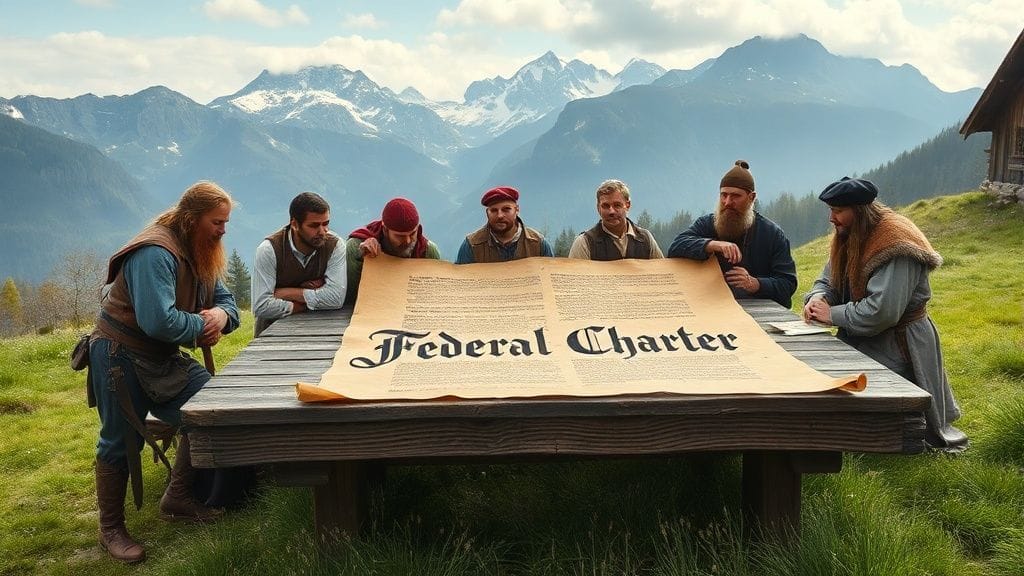
The essence of the Federal Charter lies in its anonymous nature and stark brevity—a document neither grandiose nor verbose. Drafted ostensibly at Rütli Meadow near Lake Lucerne, the Charter binds Uri, Schwyz, and Unterwalden “in faithful alliance to assist each other against all violence and injustice.”
Though the original text survives only in later copies, historians unanimously recognize it as a foundational treaty, capturing a revolutionary idea: local communities claiming collective sovereignty while agreeing to defend their liberties through mutual aid.
What makes this Federal Charter truly remarkable is its emphasis on the rule of law and communal responsibility, well before such ideas crystallized elsewhere in Europe. It codified an unwritten social contract, foretelling later notions of federalism and decentralized governance.
Yet it was no mere symbolic gesture. It was a strategic calculation, a deliberate line drawn against external overlords, inviting both solidarity and defiance.
Rütli Meadow: The Symbolic Heart of Swiss Confederation
Rütli Meadow, a small plateau overlooking Lake Lucerne, pulsates in Swiss memory like a mythical hearth where the Confederation was born. It is said that representatives from Uri, Schwyz, and Unterwalden met here in secrecy, swearing oaths that echoed through the valleys.
Even if the precise historicity of this meeting is debated, the meadow has become an epicenter of Swiss identity. Annual commemorations celebrate the Rütli Oath as a cornerstone of liberty and unity, giving tangible form to abstract ideals.
The natural amphitheater of the Alps, with its jagged silhouettes and piercing cold, lent the gathering an almost sacred aura—a reminder that the land itself was intertwined with the people's destiny.
The Role of Local Leaders and Community Voices in the Charter
Far from merely a treaty amongst nobles, the Federal Charter encapsulated the voices of local leaders—village notables, militia captains, and assemblies who represented the will of mountain folk.
Figures such as Werner Stauffacher of Schwyz, Walter Fürst of Uri, and Arnold von Melchtal of Unterwalden emerge in later Swiss legend as champions of liberty. Their roles were not just martial but deeply political, uniting disparate communities with shared interests in self-governance.
Moreover, the Charter reflects the communal nature of the Alpine societies, where decision-making involved extended participation, consensus, and appeals to justice grounded in local customs.
From Pact to Power: Early Consolidation and Military Alliances
The immediate aftermath of the Confederation was not serene. The alliance’s resolve was soon tested by aggressive moves from the Habsburgs, who viewed the pact as rebellion.
Yet, Uri, Schwyz, and Unterwalden sustained their unity and refined their military cooperation. Their militia, skilled in mountain warfare and guerrilla tactics, used the rugged terrain to their advantage. The Confederation thus evolved from a defensive pact to a proactive political entity.
This early military alliance laid the groundwork for later successes and cemented trust amongst the cantons. It demonstrated how cooperation could convert vulnerability into strategic advantage.
The Battle of Morgarten (1315): The Confederation's First Test of Strength
If the 1291 Charter was a quiet declaration of unity, the Battle of Morgarten in 1315 was its thunderous proclamation. Habsburg forces sought to crush the rebellious cantons once and for all.
On a fog-drenched November day, Austrian knights found themselves ambushed in the treacherous terrain near Lake Ägeri. The Swiss militia, outnumbered but intimate with the land’s unforgiving contours, overwhelmed the invaders with surprising ferocity.
The victory at Morgarten was more than a military triumph—it was a vindication of the Confederation’s purpose and a turning point in European medieval warfare. It shattered myths about feudal invincibility and enshrined the mountain union as a force to be reckoned with.
The Evolution from Local Pact to Regional Confederacy
Following Morgarten, the alliance expanded beyond the original triad. Neighboring regions, inspired by the success and pragmatic benefits of union, sought entry into the ever-coalescing Swiss Confederacy.
By the early 14th century, the principles enshrined in the Federal Charter guided legal frameworks, military obligations, and diplomatic engagements for a growing collection of cantons.
The Confederation skillfully balanced local autonomy with collective responsibility, a model that beguiled political theorists centuries later.
Diplomatic Maneuvering: Relations with the Habsburgs and Neighboring Powers
The Confederation’s survival hinged not only on military resilience but on adept diplomacy. The Swiss cantons negotiated cautiously with the Habsburgs, balancing defiance with moments of truce.
Likewise, relations with the Holy Roman Empire fluctuated between subordination and autonomy, reflecting shifting power dynamics.
The cantons also engaged with neighboring city-states and ecclesiastical principalities, weaving a complex web of alliances and rivalries that influenced Central European politics.
The Role of Mythmaking in Cementing Swiss Identity
Behind the political and military history lies an undercurrent of mythmaking that shaped Swiss national consciousness. Tales of the Rütli Oath, emblematic heroes, and mountain valor were embellished over centuries—sometimes blurring fact and fiction.
This evolving narrative strengthened communal identity during times of threat, providing a shared memory that transcended local rivalries.
Historians today weigh these myths critically but acknowledge their power in shaping a cohesive Swiss spirit rooted in liberty, perseverance, and unity.
Expansion Beyond the Original Three Cantons: Growth of the Confederacy
The gradual inclusion of Zürich, Lucerne, Zug, Glarus, and others broadened the Confederacy into a political mosaic of diverse traditions and economies.
Each new member enriched the alliance while requiring delicate compromises, further refining federal structures.
This growth underscored the fluid yet resilient nature of the Swiss political experiment, embracing diversity under a shared commitment to mutual defense and self-rule.
The Political Structure Emerging from the Charter
From a simple defensive league, the Confederacy evolved complex institutions: joint councils, rotating leadership, and mechanisms for dispute resolution.
Despite the absence of a centralized monarchy, these political structures fostered stability and cooperation across cantonal boundaries.
The Charter’s ethos of communal consent and legal equality resonated throughout this system, anticipating federalist ideas that would reemerge in modern political thought.
Economic Consequences: Trade, Autonomy, and Alpine Resources
The Swiss Confederation’s formation had immediate economic ripple effects. Control over mountain passes enabled cantons to regulate trade routes, levy tolls, and secure vital revenues.
Autonomy ensured that local economies could adapt without external interference, promoting agrarian resilience and artisanal crafts.
Moreover, the union provided security that encouraged merchants and travelers, further boosting the alpine economy and enabling the Confederation to gain influence beyond its territorial borders.
Cultural Resonance: How the Charter Shaped Swiss Values
The Federal Charter did more than formalize alliance; it embedded values of solidarity, liberty, and local governance deeply into Swiss culture.
The enduring emphasis on self-determination, consensus, and egalitarianism echoes today in Switzerland's political and social fabric.
Cultural festivals, folk literature, and public education often hark back to the Charter as emblematic of Swiss uniqueness—a fusion of mountain spirit and democratic ideals.
The Federal Charter in Later Swiss Legal and Political Thought
Throughout Swiss history, the Charter of 1291 has been invoked in constitutional debates and nationalist movements.
By the 19th century, it became a foundational myth in the construction of the modern Swiss federal state.
Legal scholars examined its clauses as precursors to modern constitutionalism, establishing Switzerland as a pioneer of balanced federal governance.
Historiographical Debates: Fact, Fiction, and National Myth
The Charter’s origins invite continued scholarly inquiry and debate. Questions about the document's authenticity, the historicity of the Rütli meeting, and political motivations remain topics of vibrant discussion.
Historians sift through archival materials, contemporary chronicles, and oral traditions to disentangle myth from reality—an endeavor that enriches our understanding of medieval political culture.
These debates embody the dynamic tension between history and memory in forging national identity.
The Charter’s Influence on Modern Federalism
The Swiss model influenced political thinkers from the Enlightenment to the modern era, showcasing how decentralized governance could sustain unity amid diversity.
The Charter’s principles inspired various experiments in federalism worldwide, from the United States to Canada, highlighting its significance beyond Alpine borders.
Switzerland’s ongoing political stability and direct democracy owe much to the enduring legacy initiated by the 1291 pact.
Contemporary Commemoration and Symbolic Power
Today, the Federal Charter is celebrated annually in Swiss national holidays, educational curricula, and public monuments.
Rütli Meadow remains a pilgrimage site, symbolizing Swiss courage and commitment to freedom.
The Charter continues to serve as a living symbol, connecting past struggles with present aspirations for democracy and multicultural harmony.
Conclusion: Legacy of the Swiss Federal Charter
The Federal Charter of 1291 transcends its modest parchment origins to embody an inspiring human story of courage, cooperation, and resilience. Born out of necessity in the shadowed valleys of the Alps, it forged a path to political innovation—one that challenged imperial dominance through unity and collective will.
The journey from wary cantons to a thriving Confederation reflects an unyielding desire for self-determination, grounded in a profound sense of community shaped by nature’s harshness and human spirit’s fortitude.
Today, as the Alpine breezes carry whispers of that ancient pledge, the Swiss Federal Charter reminds us that liberty, when nurtured by solidarity, can endure across the centuries.
FAQs About the Swiss Confederation’s Birth
Q1: What motivated the mountain communities to form the Federal Charter in 1291?
A1: Fear of Habsburg domination and desire to protect traditional rights and autonomy motivated Uri, Schwyz, and Unterwalden to form a defensive alliance codified in the Federal Charter.
Q2: Was the Federal Charter a legally binding document?
A2: While brief and somewhat symbolic, the Charter was a binding pact of mutual defense, respected by the cantons and later recognized as foundational for the confederation’s political order.
Q3: Who were the key figures behind the Charter?
A3: Legendary figures such as Werner Stauffacher, Walter Fürst, and Arnold von Melchtal are traditionally credited with leading the alliance, although the Charter likely reflected broader communal consensus.
Q4: How did the Battle of Morgarten in 1315 relate to the Federal Charter?
A4: The battle was a direct military test of the Confederation’s unity, where the allied cantons defeated the Habsburg knights, validating the Charter’s promise of mutual defense.
Q5: How did the Confederation expand after the original three cantons?
A5: Inspired by the Charter’s success, neighboring regions joined the alliance, gradually expanding political and military cooperation into a broader confederacy.
Q6: What role does myth play in the memory of the Swiss Confederation’s founding?
A6: Myths like the Rütli Oath help unify national identity, though historians distinguish legend from factual history when analyzing the Confederation’s origins.
Q7: Why is the Charter of 1291 important for modern federalism?
A7: It represents an early example of decentralized governance through voluntary association, influencing later ideas about federal political systems worldwide.
Q8: How is the founding of the Swiss Confederation commemorated today?
A8: Switzerland celebrates August 1st as its national day, honors the Rütli Meadow, and incorporates the Charter’s story into education and cultural life.

