Table of Contents
- The Gathering Storm: A Europe on the Brink in 794
- Setting the Stage: The Political and Religious Landscape of Early Medieval Francia
- Charlemagne’s Ambitions and the Unification of Christendom
- What is Adoptionism? The Controversial Christological Doctrine
- The Spread of Adoptionism: From Spain to the Frankish Court
- The Papacy’s Response: Tensions Between Rome and the Frankish Kingdom
- Convening at Frankfurt: The Politics Behind the Synod
- The Opening Day: Atmosphere and Key Figures in Attendance
- Doctrinal Debates: Rejecting Adoptionism in Forceful Terms
- The Iconoclastic Question: Addressing the Use and Veneration of Images
- The Synod’s Decisions: A Blueprint for Orthodoxy and Art in Christian Europe
- Personalities in Play: Theodulf of Orléans, Paulinus of Aquileia, and Alcuin of York
- The Aftermath: Immediate Reactions Within Francia and Beyond
- The Papal Response and the Ostrogothic Intrigues Post-Frankfurt
- Longer-Term Consequences: The Cementing of Carolingian Religious Authority
- The Synod of Frankfurt and the Carolingian Renaissance
- Adoptionism’s Decline and the Triumph of Nicene Christology
- Icon Policy’s Impact on Medieval Art and Worship Practices
- Legacy in Church Councils and Medieval Theology
- Reflections on Faith, Power, and Identity in Early Medieval Europe
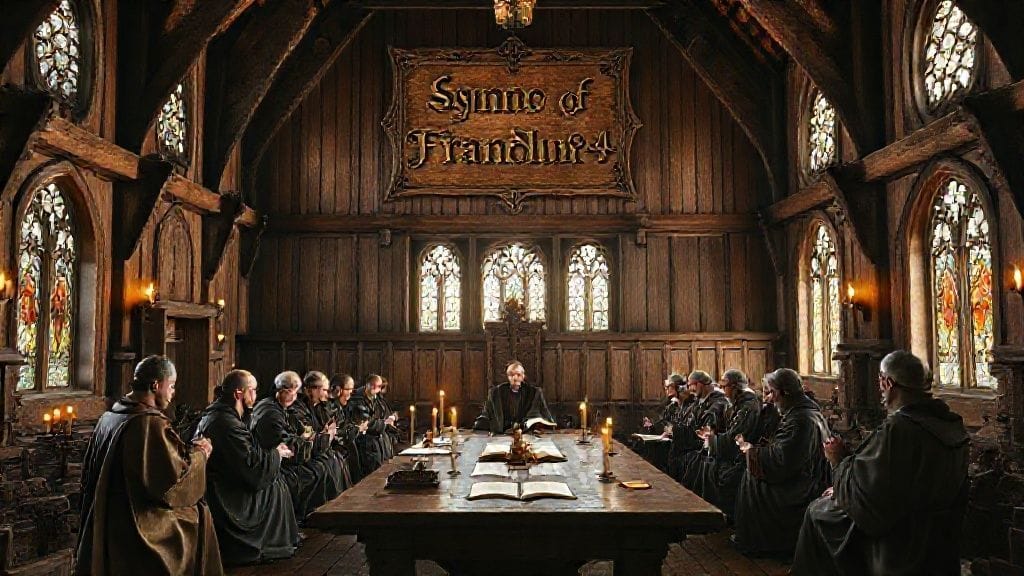
The air was thick with anticipation in the city of Frankfurt in the chilling spring of 794. Bound by faith and politics, nobles, bishops, abbots, and clerics crossed their lands converging on the imperial throne. The greatest Christian ruler of the age, Charlemagne, reigned supreme, and beneath his watchful eye, a council was about to forge decisions that would imprint themselves indelibly on the fabric of European Christendom.
The Gathering Storm: A Europe on the Brink in 794
It was an era shaped by uncertainty and ambition. The Carolingian Empire lay across vast swaths of Western Europe, yet its religious unity was threatened by a theological controversy that had simmered dangerously close: Adoptionism. This Christological doctrine, claiming that Christ was adopted as God’s Son rather than eternally begotten, was viewed by many as heretical, yet it had gained traction in far-flung corners of the Christian world, notably within the Iberian Peninsula.
Charlemagne, on his mission to consolidate both the empire and the faith, decided to confront this challenge head-on. But the synod would not only address doctrine; it would also engage a subtle and equally contentious debate on icon policy, which had simmered since the waves of Byzantine iconoclasm disrupted Christian practice centuries prior.
Setting the Stage: The Political and Religious Landscape of Early Medieval Francia
Early medieval Francia was a tapestry of newly forged political unity and fragile ecclesiastical allegiances. Charlemagne, crowned King of the Franks and Lombards, sought to revive the Roman imperial tradition under Christian auspices, positioning himself as the supreme defender of orthodoxy. His realm was a mosaic of Germanic traditions, Latin culture, and Christian doctrine, and he relied heavily on an educated clerical elite—like Alcuin of York—to cultivate intellectual and spiritual cohesion.
However, the empire’s strength faced tests not only from external enemies such as the Saxons and Avars but also from internal religious disputes that threatened to fracture the unity essential to Charlemagne’s vision. The subtle, yet subversive idea of Adoptionism, centered on Christ’s nature, was one such fissure.
Charlemagne’s Ambitions and the Unification of Christendom
Charlemagne’s reign was marked by grand visions of Christian unity, uniting his multi-ethnic subjects under one faith, law, and ruler. His coronation in 800 AD as Emperor of the Romans symbolized his desire to resurrect the glory of late antiquity, but the theological uniformity of his realm remained fragile.
The prevention of heresies was a mission both religious and political: heresy threatened to undermine the divine legitimacy his reign claimed. Adoptionism, with its bold assertions, demanded a thorough and public refutation. For Charlemagne, controlling the theological narrative was a means of consolidating imperial authority and control over the Church.
What is Adoptionism? The Controversial Christological Doctrine
Adoptionism was no mere abstract theological speculation. Emerging notably in the Christian communities of early medieval Spain, particularly among the Mozarabs, Adoptionism suggested that Jesus was not the eternal Son of God but was adopted into divine sonship at his baptism or resurrection. To orthodox thinkers steeped in Nicene Creed dogma, this offensively undermined the divinity of Christ.
Its proponents argued for a nuanced understanding of Jesus’ dual nature but, in doing so, challenged centuries of established doctrine. The notion was scandalous in asserting a rupture in the co-eternal relationship within the Trinity.
The Spread of Adoptionism: From Spain to the Frankish Court
Adoptionism had found fertile ground in the Christian kingdoms of northern Spain—most notably among Bishops Elipandus of Toledo and Felix of Urgell. Their teachings filtered into Francia through various clerical and scholarly contacts, becoming a source of concern for Rome and the Carolingian court.
Theological letters and embassies circulating around the time had brought the issue to Charlemagne’s personal attention. Recognizing that silence risked the spread of what he regarded as heresy, the emperor initiated a synod to address the matter decisively.
The Papacy’s Response: Tensions Between Rome and the Frankish Kingdom
The relationship between the Frankish kingdom and Rome was complex, underscored by mutual dependencies and subtle rivalries. Pope Adrian I, seated in Rome, had long relied on Charlemagne as protector, but the theological waters stirred by Adoptionism and the icon question agitated old wounds.
Rome’s suspicions of Frankish involvement in doctrinal policing outside papal jurisdiction threatened to complicate the situation. The synod in Frankfurt would become not just a theological tribunal but a delicate diplomatic maneuver, seeking alignment but also asserting Carolingian leadership in religious matters.
Convening at Frankfurt: The Politics Behind the Synod
The Synod of Frankfurt was no accidental gathering. It was meticulously planned, convened under imperial auspices with a clear agenda: to reject Adoptionism unequivocally and to regulate the use and veneration of religious images, a matter still stirred by memories of Byzantine iconoclasm.
Frankfurt was a symbolic imperial seat, accessible for the many bishops and abbots summoned from across the realm. The synod represented Charlemagne’s assertion that Francia would take the mantle of orthodoxy from a politically and religiously weakened East.
The Opening Day: Atmosphere and Key Figures in Attendance
As ecclesiastical dignitaries assembled, there was a palpable mix of solemnity and purpose. Among the prominent figures were Alcuin of York, the emperor’s chief theological advisor, known for his scholarship and diplomatic tact; Theodulf of Orléans, a persuasive orator and bishop; and Paulinus of Aquileia, an influential advocate for orthodox Christology.
The atmosphere was electric—a collision of diverse theological traditions, political ambitions, and pressures from Rome and Constantinople alike.
Doctrinal Debates: Rejecting Adoptionism in Forceful Terms
The debates were intense, meticulous, and at times contentious. Proponents of Nicene orthodoxy outlined the dangers inherent in Adoptionism, highlighting scriptural and patristic testimonies. The council condemned Adoptionism outright, branding it heretical and dangerous to the unity of the Church.
The synod’s canons explicitly reaffirmed the doctrines of the eternal divinity of Christ, as articulated by the Council of Nicaea and subsequent orthodox councils. The decisiveness of the condemnation was designed to leave no room for ambiguity.
The Iconoclastic Question: Addressing the Use and Veneration of Images
Simultaneously, the Synod addressed the contentious issue of icons, a discourse shaped by the devastating iconoclast controversies of Byzantium. Whereas Byzantium had seen waves of imperial policy discouraging images, the Frankish Church sought a middle ground.
The Synod of Frankfurt decreed the veneration of images as a legitimate form of Christian devotion but rejected any practices that could be construed as idolatrous. The decrees balanced theological caution with pastoral necessity, promoting sacred art as an aid to worship and instruction rather than mere decoration.
The Synod’s Decisions: A Blueprint for Orthodoxy and Art in Christian Europe
The council’s conclusions were monumental: Adoptionism was condemned, Nicene orthodoxy reaffirmed, and a cautious but clear icon policy established. These decisions not only shaped Frankish religious practice but radiated outward, influencing wider European Christendom.
They constituted a blueprint for religious and cultural policy, uniting doctrine and devotional practice under Carolingian auspices, setting a precedent for future synods.
Personalities in Play: Theodulf of Orléans, Paulinus of Aquileia, and Alcuin of York
Behind the council’s formal acts stood compelling personalities whose life stories add a human dimension to this theological drama. Alcuin, an Anglo-Saxon monk and scholar, was instrumental in advising Charlemagne and navigating the theological intricacies of the day. Theodulf, a Visigothic descent and poet bishop, eloquently contributed to both the rejection of Adoptionism and shaping liturgical norms. Paulinus, with Italian and Balkan roots, bridged West and East Christian traditions.
Their interplay of intellect, diplomacy, and faith shaped the tenor and outcomes of the Synod.
The Aftermath: Immediate Reactions Within Francia and Beyond
The Synod of Frankfurt sent shockwaves across Christendom. Adoptionist leaders were discredited and marginalized, though some small pockets of resistance lingered. The emperor consolidated his religious authority, and clergy across his realm communicated the synod’s decisions widely.
Rome cautiously welcomed the decisions despite prior tensions, while the Byzantine East remained ambivalent, facing its own iconoclastic turbulence.
The Papal Response and the Ostrogothic Intrigues Post-Frankfurt
Pope Adrian I issued subsequent endorsements of the Synod’s doctrinal positions, though lingering doubts about Carolingian claims to ecclesiastical primacy persisted. Meanwhile, the Ostrogothic territories and other Iberian Christian kingdoms, influenced by the synod’s decisions, moved towards orthodoxy, tempering Adoptionist influence.
These developments hinted at the gradual consolidation of Western Christendom under Frankish aegis.
Longer-Term Consequences: The Cementing of Carolingian Religious Authority
The Synod of Frankfurt marked a watershed moment in the Carolingian era. By addressing heresy and religious expression simultaneously, it laid foundations for the Carolingian Renaissance—a cultural revival emphasizing learning, art, and doctrine.
Charlemagne’s empire emerged as a spiritual as well as political beacon, steering Western Christendom’s evolution for centuries.
The Synod of Frankfurt and the Carolingian Renaissance
The intellectual vigor fueling the synod echoed widely. The increased patronage of monastic scriptoria, artistic commissions, and theological scholarship underscored a new epoch of Christian cultural flowering. The synod’s decisions on icon veneration underpinned a revival of religious art that transformed Christian liturgical spaces.
This period, often remembered as the Carolingian Renaissance, had deep roots in these foundational council decisions.
Adoptionism’s Decline and the Triumph of Nicene Christology
The decisive rejection of Adoptionism at Frankfurt contributed directly to its decline as a serious theological contender. Nicene Christology, emphasizing the consubstantial relationship of Christ with the Father, emerged more firmly entrenched.
The synod reaffirmed doctrinal clarity essential to medieval Christian unity and shaped the parameters of orthodoxy that would endure across Western Europe.
Icon Policy’s Impact on Medieval Art and Worship Practices
By affirming a nuanced stance on images, the synod encouraged an explosion of sacred art forms, avoiding Byzantine extremism on either iconoclasm or idolatry. This policy influenced the decoration of churches, the production of devotional objects, and the use of imagery as a didactic tool.
This balance became a hallmark of Western medieval spirituality.
Legacy in Church Councils and Medieval Theology
The Synod of Frankfurt’s acts resonated through subsequent church councils, informing debates on Christology and religious art. Its fusion of imperial authority and ecclesiastical discipline presaged the medieval relationship between Church and State.
The synod remains a touchstone for understanding the evolving medieval synthesis of faith and power.
Reflections on Faith, Power, and Identity in Early Medieval Europe
The Synod of Frankfurt symbolizes more than just a doctrinal victory; it reveals the entwining of religion with politics, identity, and artistic expression. Its decisions crystallized a vision of Christianity intimately tied to imperial power, intellectual revival, and cultural renewal.
Charlemagne’s synod was not just about heresy; it was a defining moment in the shaping of European civilization.
Conclusion
The Synod of Frankfurt in 794 stands as a monumental episode where faith met imperial ambition under the gaze of history. It was a decisive repudiation of theological error, a nuanced articulation of sacred art’s role, and a pivotal moment in the Carolingian quest to shape a unified Christendom. This gathering of minds and powers was more than a council: it was a crucible where the identity of medieval Europe was forged.
Through its condemnations and decrees, the Synod crafted a legacy that echoed through centuries, embedding itself into the very soul of Western Christianity. Beyond dogma, it reminds us that the struggle for truth, unity, and expression in faith is intertwined with humanity’s political and cultural journeys—a lesson as relevant today as it was in the great halls of Frankfurt over twelve centuries ago.
FAQs
Q1: What exactly was Adoptionism, and why was it considered heretical?
Adoptionism claimed that Jesus Christ was not the eternal Son of God but was adopted as God’s son at his baptism or resurrection. This contradicted the Nicene Creed, which affirmed Christ’s eternal divinity and consubstantiality with the Father, making Adoptionism a heresy undermining Christian doctrine on the nature of Christ.
Q2: Why did Charlemagne take such a strong interest in condemning Adoptionism?
Charlemagne aimed to unify his empire not only politically but also religiously. Containing and suppressing heresies like Adoptionism was essential to maintaining doctrinal unity and consolidating his authority as a divinely ordained ruler.
Q3: What was the significance of the Synod’s rulings on religious images?
The Synod struck a balance by endorsing the veneration of images as important to Christian worship while rejecting idolatry. This approach influenced the flourishing of religious art in Western Europe, setting it apart from the iconoclastic controversies that troubled the Byzantine East.
Q4: How did the Papacy react to the Synod of Frankfurt’s decisions?
Pope Adrian I cautiously approved the Synod’s condemnation of Adoptionism, though tensions remained over the Carolingian assertion of religious authority. Over time, Rome aligned more closely with the Frankish theological stance as Charlemagne’s power grew.
Q5: Who were the main theological figures involved, and what roles did they play?
Alcuin of York was Charlemagne’s chief advisor, influencing the doctrinal positions. Theodulf of Orléans and Paulinus of Aquileia contributed as leading bishops defending orthodoxy and shaping liturgical policies.
Q6: What impact did the Synod of Frankfurt have on European Christianity long-term?
The Synod entrenched Nicene orthodoxy, weakened Adoptionist influence, and established a framework for the medieval Church’s relationship with images and imperial authority. It helped set the stage for the Carolingian Renaissance and medieval Christendom’s cultural identity.
Q7: Did the Synod have any effect on relations between the Western and Eastern Churches?
While the Synod aligned Western Europe firmly against Adoptionism and set icon veneration policies, the Byzantine Empire was still grappling with its iconoclastic disputes. Thus, the Synod highlighted theological and cultural divergences that would gradually widen the East-West divide.
Q8: How is the Synod of Frankfurt remembered today?
Though often overshadowed by larger councils, the Synod of Frankfurt is recognized by historians as a critical moment of theological clarification and cultural policy, illuminating the dynamics of faith, power, and art in early medieval Europe.

