Table of Contents
- A Gathering in a Time of Ruin: Setting the Stage at Hohenaltheim
- East Francia in Turmoil: Kings, Dukes, and a Fractured Realm
- The Road to the Synod of Hohenaltheim: Intrigue, Violence, and Hope
- Hohenaltheim: A Village Made Historic by a Single Autumn
- Men of the Cloth and Men of the Sword: The Participants Assemble
- Opening the Synod: Rituals, Prayers, and Unspoken Fears
- Rebellion on Trial: Bishops, Dukes, and the Question of Loyalty
- The Shadow of Otto and Henry: Family Rivalries and Royal Authority
- Law, Canon, and Conscience: The Decrees of Hohenaltheim
- Church and Crown Entwined: Sacral Kingship in Practice
- From Parchment to Battlefield: Immediate Consequences of the Synod
- Echoes Across the Realm: How Ordinary People Felt the Decisions
- From Hohenaltheim to the Ottonians: Laying the Groundwork for a New Empire
- Memory, Chronicle, and Silence: How Historians Found Hohenaltheim Again
- Hohenaltheim in the Long Arc of Church–State Relations
- A Day in the Synod Hall: A Reconstructed Scene
- Lessons from 916: Power, Responsibility, and the Fragility of Order
- Conclusion
- FAQs
- External Resource
- Internal Link
Article Summary: In the autumn of 916, in the small East Frankish village of Hohenaltheim, bishops, abbots, and nobles gathered for what would become one of the most consequential yet often overlooked assemblies of the early Middle Ages: the synod of hohenaltheim. Convened under the fragile authority of King Conrad I, this church council sought to restore order in a realm ravaged by internal rebellion and external threats. The article follows the synod’s tense proceedings, where questions of loyalty, royal legitimacy, and the moral foundations of power were debated beneath the vaulted timbers of a rural church. We explore how the synod of hohenaltheim tried to fuse sacred judgment with political necessity, condemning rebellious dukes and reaffirming a sacral vision of kingship. At the same time, we trace the human side of the event—fearful clerics, ambitious nobles, and communities caught between warring elites. The narrative shows how the synod’s decrees, though written in ink on fragile parchment, would echo into the age of the Ottonian emperors and help shape medieval church–state relations. By weaving chronicles, later scholarship, and reconstructed scenes, the article brings to life a moment when a kingdom on the brink turned to its bishops for salvation. In doing so, it argues that the synod of hohenaltheim was more than a footnote: it was an attempt to reimagine power in a time of collapse.
A Gathering in a Time of Ruin: Setting the Stage at Hohenaltheim
The year was 916, and East Francia felt older than its age. Only a few generations earlier, Charlemagne’s empire had stretched from the Pyrenees to the Elbe, an astonishing expanse that chroniclers praised as a new Rome. Now, in the early tenth century, that empire was a memory—cracked into shards, passed among rival kings, devoured by warlords, and gnawed at the edges by Magyar raiders. The synod of hohenaltheim emerged in this age of fragmentation, a desperate attempt not simply to hold a council but to hold a kingdom together.
When people today imagine medieval councils, they often picture vast city cathedrals—crowded naves, colored glass, and the murmuring of Latin words. Hohenaltheim was nothing like that. It was a modest place in Swabia, a village in East Francia that had never imagined it would host kings and bishops. Yet in the autumn of that year, riders arrived from every direction, leading sweating horses, their cloaks stiff with road dust. They brought news, accusations, and, above all, anxieties. These men understood that their world was unstable, perhaps even collapsing, and that decisions made in this little village could either shore up the order of things or hasten the chaos.
The synod of hohenaltheim was as much a political emergency meeting as it was a spiritual assembly. It gathered under the name of God but under the shadow of dukes who defied their king and regions that slipped from royal control. In the brittle Latin of the surviving acts, one can still glimpse the strain, the sense of crisis: bishops discussing rebellion, bloodshed, and the duties of a Christian ruler. When we read those parchments today, they seem quiet, almost serene—the words neatly lined across a calm page. Yet behind those lines lay a drama of power, fear, and faith that deserves to be retold.
This article steps back into that drama, peeling away centuries of forgetfulness to place us among the men who came to Hohenaltheim. We will meet the embattled King Conrad I, the dukes who challenged him, the bishops who claimed the right to judge them, and the ordinary people whose lives were shaped by decisions they would never hear explained. Through narrative and analysis, we follow the paths that led to this synod, the debates that filled its days, and the consequences that rippled outward—from small village to great empire, from 916 to the later crowns of the Ottonian and Salian rulers. It all begins with a realm in disarray.
East Francia in Turmoil: Kings, Dukes, and a Fractured Realm
To understand why the synod of hohenaltheim mattered, one must first feel the tension in East Francia at the beginning of the tenth century. After the division of Charlemagne’s empire, the eastern portion—East Francia—roughly corresponded to what would later become the German kingdom. It was vast, diverse, and difficult to govern. Its king, Conrad I of the Conradine family, had been elected in 911 after the extinction of the East Frankish branch of the Carolingians. That very fact—that he was chosen, not descended directly from Charlemagne—was both his strength and his curse.
Conrad I ruled not from a position of unquestioned sacral dynastic authority, but from the fragile base of consensus. Powerful regional dukes in Bavaria, Saxony, Franconia, and Swabia had their own interests, their own armies, and their own visions of what “the realm” meant. In the pages of the chronicler Widukind of Corvey and in the Annals of Fulda, we glimpse a kingdom where royal commands could be ignored, and where dukes were nearly little kings in their own right. Conrad needed allies. He also needed the church.
The East Frankish church, for all its internal rivalries, held immense moral capital. Bishops oversaw not only souls but lands, courts, and revenues. Abbeys dotted the landscape like fortified islands of literacy and learning. A royal decree might travel from city to city by the hand of a bishop. In return, kings granted immunities and lands, making bishops into their vassals, yet also—paradoxically—into potential critics. The bishop’s crozier and the duke’s sword were different symbols of power, but both could cut.
By 916, Conrad’s reign was already scarred by conflicts with these very dukes. The most dangerous of them was Arnulf of Bavaria, a prince with deep regional support and ambitions that pushed against royal authority. In Saxony, the formidable Liudolfing family, ancestors of the later Ottonian emperors, watched Conrad with suspicion. Among such figures, loyalty was a calculation, not a given. The king’s authority had to be justified not only in political but in spiritual terms. That is precisely where a gathering like the synod of hohenaltheim entered the story: it promised to clothe political necessity in the garments of canon law and divine judgment.
East Francia was also under siege from without. The Magyar horsemen, whose raids had already devastated much of central Europe, tested the defenses of the eastern borderlands. Villages burned, churches were looted, and peasants fled to forests or hilltop refuges. The realm needed a strong center capable of raising coordinated defenses. But how could a king command when his great lords treated him as a rival rather than a leader? This was not a theoretical problem to be solved in a monastery school; it was a matter of life and death. The synod, therefore, was not just about doctrine; it was about survival.
The Road to the Synod of Hohenaltheim: Intrigue, Violence, and Hope
The path toward the synod of hohenaltheim was marked by betrayals and uneasy truces. Conrad I had attempted, with varying success, to forge alliances by granting favors, confirming titles, and occasionally confronting his opponents in arms. Some conflicts ended in negotiated settlements; others in bloodshed. Meanwhile, bishops watched warily. They needed the king’s support to protect their lands from rapacious neighbors, but they also depended on the goodwill of local dukes. To take sides was always to risk losing on both fronts.
What tipped the scales toward convening a synod? The precise trigger is debated by modern historians, who sift obsessively through sparse mentions in charters and chronicles. Yet a broad outline is clear: Conrad and a core of loyal bishops recognized that the realm’s political crisis had become a moral crisis. Great men were breaking their oaths, waging private wars, and undermining the peace that Christian rulers were thought to uphold. The king could not simply punish them by force; his military resources were limited. So he turned to the one weapon that could strike deeper than a sword: ecclesiastical condemnation.
The decision to call a synod in Hohenaltheim was pragmatic. Swabia, where the village lay, was a contested but central region, and the location was likely chosen because it was reachable for a critical mass of bishops and royal supporters, yet not firmly in the camp of any single over-mighty duke. The very anonymity of Hohenaltheim worked in its favor. It was an ordinary place summoned to serve an extraordinary purpose.
Bishops and abbots were summoned in the king’s name, bearing letters sealed with wax that bore Conrad’s authority. Some came willingly; others may have arrived with reluctance, calculating how their presence might affect relations with local dukes. They traveled with retinues—priests, scribes, and servants—and with minds full of rumors. Who would be accused? Would the synod confront Arnulf of Bavaria directly? Would the Saxons stand with or against the king? Above all, could any council, however solemn, pull the realm back from the brink?
And yet, there was hope. In the early medieval imagination, a synod was not just another meeting. It was a space where the Holy Spirit might speak through assembled bishops, a place where old injustices could be righted and a fractured community made whole. Some clerics who rode toward Hohenaltheim must have clung to this ideal, even as they understood the brutal politics underpinning it. The tension between those two realities—spiritual hope and political calculation—would define everything that followed.
Hohenaltheim: A Village Made Historic by a Single Autumn
Hohenaltheim, before 916, was a dot on the map, if it appeared on maps at all. It lay among fields and low hills, not far from trade routes but far from the great royal centers. Like countless other villages in East Francia, it lived by the rhythms of agriculture and the church calendar: sowing and harvest, Lent and Easter, baptism and burial. The largest building was likely the church itself—simple, perhaps stone, perhaps partly timber, with a small apse and a wooden roof framed like an upturned ship.
For the villagers, the arrival of the synod must have been astonishing. Imagine the dust clouds of approaching companies, the clatter of hooves on hardened ground, the flash of metal harness, and the sight of strange banners flickering in the light. Local peasants, bound to their lords yet curious nonetheless, would have peered from doorways or from the edges of fields as processions of clerics tramped past in long robes, their fingers ink-stained from a lifetime of writing prayers and charters.
The church and surrounding buildings had to be adapted quickly. Space was needed not only for sessions of the synod but also for lodging participants, storing records, and holding private consultations. Tents and temporary shelters may have sprouted around the village, while nearby houses were commandeered to host prominent guests. The local priest suddenly found himself at the center of the realm’s attention, his modest parish transformed into the stage for a royal–ecclesiastical drama.
It is astonishing, isn’t it, how such quiet places can become, in a heartbeat of history, the focus of an entire kingdom? Modern archaeologists can only guess at the physical traces left by the synod of hohenaltheim, if any survive at all: a disturbed layer of soil here, an atypical find of imported pottery there. The records that anchor our knowledge are not buried in the ground but preserved in archives—parchments copied and recopied across centuries. Yet the choice of Hohenaltheim speaks volumes. In a world where great cities were rare and often vulnerable, power could be exercised anywhere a king and a college of bishops chose to sit in judgment.
When the last bishop departed and the royal banners vanished down the road, Hohenaltheim would go back to its old life. But it would never be entirely the same again. For a few weeks, the village had served as a hinge on which East Francia’s history turned. The memory may have filtered into local legend, perhaps told in whispers long after the Latin words of the synod’s acts had faded from everyday awareness.
Men of the Cloth and Men of the Sword: The Participants Assemble
The synod of hohenaltheim brought together an elite but diverse cast of characters. At its core were the bishops—men who had risen through cathedral chapters, monastic schools, or the favor of kings and nobles. Each bishop was a composite of roles: shepherd of souls, landholder, judge, royal advisor. Their names echo faintly across the centuries: bishops of Regensburg, Augsburg, Constance, and other sees, each carrying the weight of his diocese’s needs and loyalties.
Alongside them came abbots, representatives of monasteries whose lands and immunities depended heavily on royal protection. Some abbots were spiritual reformers, concerned with discipline and prayer; others were keen administrators, more at home in the negotiation of charters than in the cloister. A few might have been both, shifting seamlessly between the altar and the council chamber.
Though the synod was ecclesiastical in nature, lay magnates hovered constantly at its edges. Certain nobles, loyal to Conrad, were likely present in or near Hohenaltheim, lobbying bishops, offering private counsel, and ensuring that the king’s interests were not forgotten. Others, particularly those targeted by the synod’s accusations, were conspicuously absent, either by choice or by royal design. Their absence itself spoke volumes: it signified both defiance and vulnerability. To be condemned in absentia was perilous, yet to attend and submit might mean political humiliation.
And then there was the king. Conrad I did not preside in the manner of a modern parliamentarian, yet his presence—direct or indirect—shaped everything. Some accounts suggest he remained nearby rather than in the council chamber itself, allowing the church to appear as the primary judge while still guiding outcomes. This arrangement suited both sides. Bishops could claim moral autonomy, while Conrad could present the synod’s decisions as independent, even divinely sanctioned, ratifications of his political needs.
Among the participants were also the quiet figures who rarely receive mention: the clerks who sharpened quills, prepared ink, and drafted resolutions; the interpreters who bridged dialects and legal traditions; and the servants who ensured that food and lodging were available in sufficient quantity. Without them, the lofty debates of bishops and kings would have ground to a halt. History rarely records their names, but their fingerprints are there—in the steady script of the surviving acts, in the logistics that made the synod possible, and in the lived memory that carried its story forward.
Opening the Synod: Rituals, Prayers, and Unspoken Fears
The synod began, as such assemblies always did, with liturgy. Before any accusations could be voiced, before any decree was drafted, the participants gathered in the church to hear Mass. Latin chants rose toward the wooden rafters: the Kyrie eleison, the solemn readings from Scripture, the murmured prayers for guidance. The bishops processed in order of rank, their vestments catching what light filtered through small windows, their croziers tapping rhythmically against the floor.
To modern eyes, these rituals might appear as formalities, but for those present they were far more. They were reminders that what was about to occur was not merely a political negotiation; it was framed as a spiritual discernment. The synod of hohenaltheim claimed to act “in the name of God,” and the liturgy gave that claim visible form. Priests invoked the Holy Spirit, asking for wisdom and justice. Psalm verses about kingship, obedience, and divine law would have resonated with special force.
Yet behind the pious words, unspoken fears circled like birds above a battlefield. Bishops worried about being drawn too deeply into royal quarrels. What if Conrad’s rivals triumphed in the future? Would today’s defenders of royal authority become tomorrow’s traitors? Conversely, to refuse the king’s call might invite immediate reprisals: confiscation of lands, royal disfavour, or the placing of dioceses under pressure from hostile dukes.
The opening sessions were likely consumed with procedural questions—confirmation of the synod’s legitimacy, verification of who had the right to vote, and the presentation of the royal summons or capitulary that defined the synod’s purpose. Witnesses might have been called to testify about recent acts of rebellion or lawlessness. Messengers would have presented written complaints, some perhaps dictated by Conrad’s own advisors. Clerks, their hands tired but steady, recorded the main points. Still, beneath the structure and the ceremony, everyone knew where this was heading: toward judgment.
In that tense atmosphere, each phrase assumed heightened importance. To call a noble’s behavior “rebellious” rather than “misguided” was to place him in a certain legal and moral category. To invoke earlier councils, such as those from the Carolingian age, was to wrap current decisions in the authority of tradition. So, from the very first day, participants were not only acting; they were interpreting their actions in ways that would matter in the years to come.
Rebellion on Trial: Bishops, Dukes, and the Question of Loyalty
The heart of the synod of hohenaltheim lay in its confrontation with rebellion. The exact wording of the accusations has reached us in a distilled form through synodal decrees and later narratives, but the basic picture is clear: certain great lords, above all Duke Arnulf of Bavaria and his allies, were charged with breaking their oaths to the king, seizing royal property, and undermining the peace of the realm.
Imagine a bishop rising to speak, his voice echoing in the packed church. Before him lay documents attesting to Arnulf’s refusal to recognize Conrad’s authority, his failure to attend the royal court, his alliances with other discontented nobles. The bishop’s task was delicate: he had to depict these acts as not only politically dangerous but morally and spiritually wrong. Rebellion was framed as a sin, a violation not only of the king’s rights but of an order established by God.
Some participants may have recalled the words of earlier Carolingian capitularies, which stressed the sacred nature of oaths to one’s rightful lord. In quoting such texts—one can imagine a cleric unrolling a parchment and reading aloud—they anchored their judgments in precedent. A later chronicler, like the author of the Annals of Fulda, would portray such assemblies as guardians of legitimate order. The message was stark: to oppose the king, once duly chosen and anointed, was to oppose the peace of Christendom itself.
But the accused dukes were not simple villains. Arnulf of Bavaria, for example, commanded genuine support among his people. He had defended Bavaria against external threats and acted as a strong regional leader. His defiance of Conrad could be interpreted not purely as ambition but as resistance to perceived royal overreach or incompetence. This complexity hung unspoken in the room. Those judging him knew that their words did not erase his popularity.
Despite these ambiguities, the synod’s momentum moved toward condemnation. Absent nobles could not easily defend themselves, and the assembled bishops—encouraged by Conrad’s allies—emphasized the dangers of tolerating such insubordination. Formal sentences were pronounced: rebels were denounced, their actions declared unlawful and sinful, and, in some cases, their supporters threatened with ecclesiastical sanctions. Through these judgments, the synod of hohenaltheim tried to draw a line in the sand: between acceptable negotiation and intolerable rebellion, between disagreement and treason.
Yet this was only the beginning. Condemning rebellion was one thing; preventing it from recurring was another. For that, the synod had to articulate a positive vision of what loyalty and rulership meant in a Christian kingdom.
The Shadow of Otto and Henry: Family Rivalries and Royal Authority
While the synod of hohenaltheim addressed immediate conflicts, it also unfolded in the long shadow of dynastic rivalry. Conrad I was a Conradine, not a Carolingian. His claim to the throne rested on election by leading nobles and bishops, not on direct descent from Charlemagne. That made his position both flexible and precarious. It opened the door to the idea that kingship could be transferred to the “most suitable” candidate, yet it also raised the question: who decides what suitability means?
In the north, the Liudolfing family—especially Henry of Saxony, later known as Henry the Fowler—watched developments closely. Though not the immediate focus of the synod’s condemnations, Henry had already had clashes with Conrad. Their relationship was a mixture of armed conflict and negotiated peace. The bishops at Hohenaltheim could not ignore the possibility that today’s ally might be tomorrow’s king—or tomorrow’s rebel.
This dynastic uncertainty lent an air of almost prophetic weight to the synod’s deliberations. When bishops articulated principles about obedience to a rightful king, they were not speaking into a vacuum. Their words would later be read and interpreted in the context of Henry’s eventual accession and the rise of his son Otto I, who would be crowned emperor in 962. As historian Gerd Althoff has argued in another context, early medieval politics was saturated with symbolic acts, oaths, and rituals that carried long-term interpretive power. Councils like Hohenaltheim were part of that symbolic landscape.
If Conrad hoped the synod would solidify his personal rule, its lasting legacy was more subtle. By condemning certain forms of rebellion and endorsing a sacral vision of kingship, the synod helped construct what later rulers, including Henry and Otto, could claim as the “proper” model of royal authority. It is one of history’s ironies that a king who struggled to maintain control contributed, through such assemblies, to the ideological foundations of a stronger monarchy that his own dynasty would not live to enjoy.
At the same time, family rivalries among the higher nobility shaped how different participants heard the synod’s words. Some saw in its decrees a shield against unruly neighbors; others feared a blueprint for future kings to crush regional autonomy. These conflicting expectations were not resolved in 916. They would continue to haunt the politics of East Francia for decades.
Law, Canon, and Conscience: The Decrees of Hohenaltheim
When we speak of the synod of hohenaltheim today, we do so largely through its surviving acts—those terse, legalistic statements that crystallized days of discussion into a series of canons and decrees. These documents, written in the tight Latin of ecclesiastical law, may initially appear dry. Yet they contain the distilled essence of the synod’s vision for the kingdom.
Among the central themes was the condemnation of disloyalty to the king. Canon after canon insisted that those who took up arms against their lord, seized royal property, or refused to attend the royal court were acting contrary to both secular and divine law. Bishops threatened such rebels with excommunication, the church’s most severe sanction short of damnation itself. To be excommunicated was not simply to lose access to the sacraments; it was to be cast symbolically out of the Christian community, with profound social and psychological consequences.
The synod also reaffirmed the inviolability of church property and the special protection owed to ecclesiastical institutions. In a time when dukes and lesser lords frequently encroached upon church lands, such statements were both principled and self-interested. By linking respect for church property to loyalty to the king, the bishops at Hohenaltheim argued that the defense of ecclesiastical rights and the defense of royal authority were two sides of the same coin.
Another cluster of decrees addressed clerical discipline and moral behavior more broadly—matters such as simony, sexual conduct, and the performance of liturgical duties. These canons served to remind participants that the crisis of the realm was not only external but internal. A negligent or corrupt clergy could not credibly call lay magnates to account. Thus, the synod implicitly recognized that kings and bishops were bound in a reciprocal moral relationship: the king must rule justly, and the clergy must live in such a way that their judgments would carry spiritual weight.
What makes the decrees of the synod of hohenaltheim especially significant is their blend of scriptural and legal reasoning. Passages from the Bible—especially those concerning obedience to authorities and the divinely ordained nature of political order—were interwoven with references to earlier councils and to royal capitularies from the Carolingian age. The result was a layered argument that situated contemporary decisions within a larger Christian and imperial tradition. Future chroniclers, like those who later wrote the “Saxon Chronicles,” would look back on such texts as evidence of a continuous line of thought linking Charlemagne’s world to the Ottonian and beyond.
Church and Crown Entwined: Sacral Kingship in Practice
Behind the legal language of the synod’s decrees lay a potent idea: sacral kingship. In the early medieval imagination, a king was not merely the most powerful warrior or the richest landowner; he was God’s chosen protector of the Christian people. Anointed with holy oil at his coronation, he bore a quasi-priestly status, standing between the earthly and the divine. Yet his authority needed constant reinforcement through rituals, symbols, and, crucially, the endorsement of the church.
The synod of hohenaltheim offered precisely such reinforcement. By gathering bishops under the royal summons and by having them issue decrees in support of Conrad’s authority, the council enacted a visible partnership between throne and altar. When bishops condemned rebels, they were not only defending the king; they were also confirming that kingship itself was a sacred institution. The message was simple yet powerful: to obey the king was, within proper bounds, to obey God’s order.
This did not mean that the church acted as a mere tool of royal policy. Bishops preserved, at least in theory, the right to rebuke kings who failed in their Christian duties. The partnership was always tense, always subject to renegotiation. Still, moments like Hohenaltheim tilted the balance toward cooperation rather than confrontation. For Conrad, whose dynastic claim was less established than that of the Carolingians, such sacral support was invaluable.
In practice, sacral kingship looked like this: bishops preaching in their dioceses about the duties of subjects to their ruler; liturgical prayers naming the king and asking God to grant him wisdom; oaths sworn on relics and altars to uphold royal peace. The synod’s decrees gave these practices renewed urgency. They implied that a realm wracked by rebellion and invasion was not merely politically unstable but spiritually disordered. Only a king recognized and supported by the church could hope to restore that balance.
Later generations, especially under Otto I and his successors, would refine and dramatize this idea even further. Royal processions, imperial coronations, and dramatic public penances would all stage the intricate dance of power between emperor and bishops. But the DNA of that relationship—its assumptions, its language, its rituals—can already be traced in assemblies like the synod of hohenaltheim.
From Parchment to Battlefield: Immediate Consequences of the Synod
Did the synod of hohenaltheim change the world overnight? Of course not. No parchment, however solemnly written, can instantly transform the complex realities of power and allegiance. Yet the synod’s decisions set in motion a series of consequences that unfolded in the months and years that followed.
For rebels like Arnulf of Bavaria, condemnation at Hohenaltheim increased the stakes of resistance. They were no longer merely in conflict with the king; they now stood, at least on paper, outside the moral order endorsed by the church. This did not automatically strip them of followers—local loyalties and military strength still mattered immensely—but it complicated the calculations of potential allies. To side with Arnulf was to risk not only royal wrath but ecclesiastical disfavor, including the possibility of excommunication.
Conrad, armed with the synod’s support, attempted to reassert control over resistant regions. Some lords may have chosen accommodation, negotiating renewed submission in exchange for concessions. Others held out, leading to renewed skirmishes and sieges. The chronicle tradition hints at a kingdom still aflame with intermittent conflict, despite the best efforts of councils and royal decrees. Yet the synod had added a new layer: conflicts were now explicitly framed in terms of fidelity and infidelity, orthodoxy and rebellion, not just brute force.
The king’s personal fortunes, however, did not improve dramatically. Conrad’s reign remained troubled, and his health eventually failed. On his deathbed, he is said to have recommended that the nobles choose Henry of Saxony as his successor—a remarkable gesture that acknowledged the limits of his family’s power. In that act, the storylines of the Conradines and the Liudolfings intersected decisively.
Still, even as dynasties rose and fell, the memory of the synod of hohenaltheim persisted in legal and ecclesiastical circles. Its canons were copied, referenced, and occasionally invoked in later disputes. The precise political circumstances faded, but the model it offered—of a kingdom confronting rebellion through a fusion of law, morality, and ecclesiastical authority—remained influential.
Echoes Across the Realm: How Ordinary People Felt the Decisions
Councils and synods often appear in our sources as affairs of kings and bishops alone, but their reverberations spread far beyond royal courts and cathedral chapters. The synod of hohenaltheim was no exception. Its decisions, carried outward on parchment and in the sermons of bishops, eventually brushed the lives of peasants, townsfolk, monks, and nuns across East Francia.
Consider a village in Bavaria or Saxony. News of the synod did not arrive as a neat list of Latin canons. Instead, it filtered in through local priests, traveling merchants, and rumors from returning soldiers. A parish priest might announce, during Sunday Mass, that certain great lords were now excommunicated or under threat of ecclesiastical censure. He might preach about the duty of Christians to support the peace of the realm and to remain loyal to their divinely appointed king.
For ordinary people, this message intersected with daily concerns in visceral ways. If the synod’s condemnation weakened a local duke, his ability to protect the region from raiders—or to maintain order among lesser nobles—might diminish. Alternatively, if the synod strengthened the king’s hand, royal officials might gain greater freedom to collect taxes or demand military service. In either case, the abstract principles discussed at Hohenaltheim translated into very concrete questions: Who would defend our fields? Who had the right to demand our labor? Whose banner should we follow when the marshals called?
Monasteries and churches, too, felt the impact. The synod’s reaffirmation of ecclesiastical property rights gave abbots and bishops more confidence to resist encroachments. A local lord attempting to seize church lands could now be reminded, sternly, that his actions were not only unjust but ran counter to a synod supported by the king himself. Such arguments did not always prevent violence, but they provided a moral and legal framework for resistance.
We rarely hear the voices of ordinary men and women reacting directly to events like the synod of hohenaltheim. Their thoughts were seldom written down. Yet in the rhythms of village life, in the adjustments of local power, and in the anxieties about war, famine, and salvation, the council’s decisions became part of the invisible architecture shaping their world.
From Hohenaltheim to the Ottonians: Laying the Groundwork for a New Empire
In hindsight, the synod of hohenaltheim looks like a bridge between two eras. On one side stood the fading world of Carolingian unity and Conradine fragility; on the other, the emerging order of the Ottonian empire. When Henry I took the East Frankish throne after Conrad’s death, and when his son Otto I later transformed that kingdom into a revived empire, they inherited not only lands and titles but also a political theology.
That theology, in part, was articulated and rehearsed at Hohenaltheim. The idea that kingship was sacred, that rebellion was a sin as well as a crime, and that the church had a duty to support legitimate royal authority found fuller expression under the Ottonians. Otto I, in particular, cultivated close relations with bishops, appointing loyal men to key sees and using ecclesiastical structures as pillars of imperial governance. Historians have famously described this as a “Reichskirche” system, in which the imperial church formed an integral arm of state power.
While it would be misleading to claim a direct line of causality from one synod in 916 to the coronation of Otto as emperor in 962, the continuities are striking. Decrees like those of the synod of hohenaltheim furnished precedents that Ottonian rulers and clerics could cite when confronting later rebellions and disputes. In effect, the council helped to normalize the idea that major political crises should be addressed through ecclesiastical assemblies, where law, theology, and royal interests could converge.
Moreover, the very memory of a king convening a broad synod to deal with insubordinate dukes may have influenced how Henry and Otto thought about their own options in times of conflict. They, too, faced powerful regional lords and needed to balance force with moral suasion. In 10th-century politics, victory on the battlefield was rarely enough. A ruler also needed to win the narrative—to have chroniclers and bishops tell the story in ways that framed him as defender of order and justice.
In that sense, Hohenaltheim was part of the slow, uneven construction of what we might call “medieval statecraft.” It demonstrated how a king could marshal ecclesiastical authority to buttress fragile political control. Its legacy lived not only in laws and chronicles but in the mental world of rulers and churchmen who, decades later, would face crises of their own and remember—or be reminded—how their predecessors had responded.
Memory, Chronicle, and Silence: How Historians Found Hohenaltheim Again
One of the striking things about the synod of hohenaltheim is how easily it might have vanished from view. Compared with great battles or spectacular coronations, a church council in a small village does not naturally lend itself to legendary status. Yet modern historians have rediscovered its importance by patiently assembling clues from scattered sources.
Medieval chroniclers mentioned the synod only briefly, often in passing, as part of broader narratives about Conrad’s troubled reign. The acts of the council themselves survived in a limited number of manuscript copies, preserved in ecclesiastical archives more by routine than by any special sense of their long-term significance. For centuries, they lay largely unnoticed, overshadowed by more dramatic episodes of medieval history.
It was only with the rise of critical historical scholarship in the 19th and 20th centuries—exemplified by projects like the Monumenta Germaniae Historica—that the synod of hohenaltheim began to receive serious attention. Scholars compared different manuscript copies, reconstructed the political context, and debated the exact implications of the canons. Some emphasized the synod’s role in Conrad’s conflict with the dukes; others saw it as a landmark in the evolving relationship between kingship and ecclesiastical authority.
Even today, there is no complete consensus. Some historians argue that the synod’s practical impact was limited, pointing to Conrad’s continuing difficulties and the eventual rise of Henry I. Others stress its symbolic and ideological weight, suggesting that Hohenaltheim’s real legacy lies in its articulation of principles rather than in any immediate political triumph. Both perspectives have merit. History, after all, is not a contest between events but a tapestry woven from actions, ideas, and memories.
The synod also raises a methodological question: how do we write the history of an event that survives largely in legal formulae and terse narrative mentions? To bring Hohenaltheim to life, historians must read between the lines, reconstructing motives and emotions from what is not said as much as from what is. As one modern scholar has put it in another context, early medieval sources are “scripted performances,” designed to project particular images of power and piety. The task is to understand both the performance and the reality it sought to shape.
In doing so, we are reminded of the fragility of historical memory. That we can speak at all of the synod of hohenaltheim is due to the survival of a handful of manuscripts and the labor of generations of archivists and editors. Countless other councils and decisions, perhaps no less important to those who lived through them, have slipped into silence. Hohenaltheim stands for them as well, a rare visible peak in an otherwise submerged landscape.
Hohenaltheim in the Long Arc of Church–State Relations
Looking across the centuries, the synod of hohenaltheim appears as an early milestone in a vast and complicated story: the relationship between church and state in medieval Europe. Later epochs would witness more famous clashes and concordats—the Investiture Controversy of the 11th and 12th centuries, the struggles between emperors and popes, the assertion of papal supremacy in documents like Unam Sanctam. Against such giants, Hohenaltheim may seem small. Yet its core questions foreshadowed those later conflicts.
At Hohenaltheim, bishops asserted their right and duty to judge the moral legitimacy of political actions. They claimed the authority to condemn rebellion, to protect church property, and to articulate norms of Christian rulership. At the same time, they allied themselves closely with a particular king’s cause. This dual role—as guardians of moral order and as partners of secular rulers—would remain a defining tension of medieval church history.
From one angle, the synod strengthened royal power by providing spiritual legitimacy for Conrad’s struggle against recalcitrant dukes. From another, it strengthened the church by affirming its role as arbiter of justice and loyalty. In this mutual reinforcement lay the seeds of both cooperation and future conflict. Later kings would attempt to control episcopal appointments, treating bishops almost as royal officials. Later popes and reformers would push back, insisting on the independence of ecclesiastical authority. The dance between integration and separation, between partnership and rivalry, had already begun in 916.
Modern readers, accustomed to thinking in terms of “separation of church and state,” may find this entanglement puzzling. But for the participants at Hohenaltheim, there was no clear boundary between religious and political life. The health of the kingdom was a spiritual matter; the enforcement of canon law had political implications. To separate the two would have seemed both impossible and undesirable.
That is why the synod of hohenaltheim remains instructive today. It shows us a world in which power was justified not only by military strength or legal precedent, but by appeals to divine order, scriptural interpretation, and ecclesiastical consensus. In that world, a council in a small village could weigh as heavily on the scales of history as a battle, because it helped define what victory and justice were supposed to mean.
A Day in the Synod Hall: A Reconstructed Scene
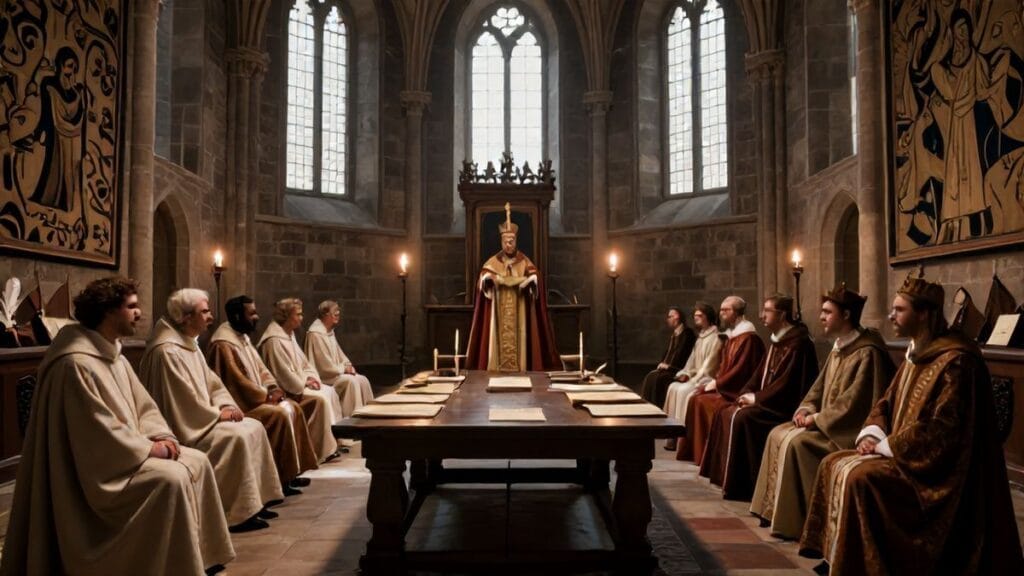
To grasp the lived reality of the synod of hohenaltheim, imagine entering the church on a pivotal day of its proceedings. The morning light filters through small, unglazed windows, drawing pale rectangles on the packed earth and wooden planks of the floor. The air smells of wax, incense, and damp woolen cloaks. At the front, near the altar, rows of benches have been arranged for the bishops. Behind them, lesser clerics stand or sit on stools, clutching tablets or scraps of parchment for notes.
The room murmurs with low conversation in Latin and in various Germanic dialects. A clerk near the altar revises the draft of a canon, his lips silently forming each word as he writes. A bishop from a distant diocese leans over to another, asking in a hushed voice whether the latest accusations against Arnulf are accurate or exaggerated. Outside, through a slightly open door, one can hear the neighing of horses and the shouted commands of grooms.
A bell rings, and the hall gradually quiets. A presiding bishop—perhaps the metropolitan of a leading see—rises and intones a brief prayer. He then announces the subject of the session: the formal condemnation of certain rebels and the affirmation of the king’s rights. A messenger, dusty from travel, steps forward to present a letter from Conrad. It is opened and read aloud, its Latin phrases thick with deference to God and the church, yet firm in their description of the offenses committed.
As the reading ends, a debate begins. Some bishops speak quickly, eager to support the king and end what they see as a grave scandal. Others are more cautious, asking whether all legal procedures have been followed, whether the accused have been given sufficient opportunity to respond. A particularly bold cleric reminds the assembly that a king, too, must fulfill his Christian obligations—protecting the weak, ruling justly, and listening to wise counsel. The atmosphere tightens. Everyone is aware that the line between loyal admonition and subtle criticism is thin.
After hours of discussion, a consensus emerges. A clerk is instructed to draft a canon declaring that those who knowingly and persistently oppose the king’s legitimate authority act against divine order and shall be subject to ecclesiastical censure. The wording is debated down to individual verbs and adjectives, for each term carries legal implications. Finally, a text is agreed upon. The bishops rise, one by one, to voice their assent. Some do so with conviction; others with resignation. But publicly, at least, the synod speaks with one voice.
By evening, the hall empties. Participants spill out into the cool air, stretching their limbs and rubbing their eyes. Conversations continue in smaller groups over meals of bread, cheese, and watered wine. Some men feel relief, believing that they have taken a decisive step toward restoring order. Others feel unease, wondering how the condemned dukes will respond, and whether today’s decisions will lead to further bloodshed. A few scribes remain by candlelight, copying the day’s decrees into a fair hand for preservation. They cannot know that a thousand years later, historians will pore over those same lines, trying to reconstruct the very scene that is now quietly dissolving into the night.
Lessons from 916: Power, Responsibility, and the Fragility of Order
What, then, does the synod of hohenaltheim teach us? Beyond its immediate historical context, the council offers a window into enduring questions about power, responsibility, and the fragile nature of political order. In 916, East Francia teetered between disintegration and consolidation. Kingship itself seemed contested, not as an institution but as a lived reality. The synod was one attempt among many to steady the realm, to assert that there were rules—even for the powerful.
One lesson lies in the council’s insistence that authority must be anchored in something more than force. Conrad I lacked the unchallengeable lineage of a Carolingian and the overwhelming military superiority of a conqueror. To govern, he needed a story—a narrative that framed his rule as legitimate and necessary. Hohenaltheim helped provide that story. It declared that the king was not just a political actor but the linchpin of a divinely ordained order, and that those who undermined him risked both temporal and spiritual ruin.
Another lesson concerns the role of institutions in times of crisis. The synod brought together a network of bishops and abbots, whose shared identity as churchmen allowed them to transcend, at least briefly, the narrower loyalties of region and clan. They could act as mediators, judges, and legislators, drawing on traditions older than any single dynasty. Yet their very participation in royal politics exposed them to accusations of partisanship. This tension between institutional integrity and political entanglement remains familiar in many contexts today.
The synod of hohenaltheim also reminds us how contingent history is. Had Conrad been stronger, perhaps he would not have felt compelled to seek such robust ecclesiastical backing. Had the rebels been weaker, they might have submitted without provoking a council of condemnation. Had the acts of the synod not survived in manuscript copies, we might never have known the event took place at all. The path from 916 to the later medieval world was not predetermined; it was shaped by choices, accidents, and the fragile survival of records.
Finally, there is a more personal lesson. Behind the abstract terms—king, duke, bishop—stood individuals grappling with fear, hope, ambition, and conscience. Some sincerely believed they were defending the common good. Others prioritized family honor or territorial advantage. Many were torn between conflicting obligations. Their world was harsher than ours in many ways, yet their dilemmas were recognizable: How do you balance loyalty with justice? When do you resist a ruler, and when do you submit for the sake of peace? The synod did not answer these questions once and for all. It simply offered one historically specific attempt to wrestle with them, an attempt that still invites reflection today.
Conclusion
The synod of hohenaltheim, held in a modest village in East Francia in 916, was a small event by the standards of world history, yet it stands at a crossroads of medieval Europe’s political and spiritual development. Convened amid the turmoil of Conrad I’s reign, it sought to do something audacious: to bind together fractured loyalties with the cords of law, theology, and ecclesiastical consensus. In condemning rebellious dukes and proclaiming a sacral vision of kingship, the assembled bishops did more than support a struggling monarch; they helped define what legitimate power should look like in a Christian kingdom.
We have followed the council from its roots in East Frankish turmoil, through its tense proceedings in the church at Hohenaltheim, to its reverberations in the rise of the Ottonian empire and the long saga of church–state relations. Along the way, we have glimpsed not only grand political strategies but also the lived experiences of villagers, clerks, and lesser nobles whose fates were tied, often invisibly, to decisions made in that synodal hall. The surviving acts of the synod, fragile and few, have been expanded by modern scholarship into a fuller portrait of an age struggling to reconcile faith and force, conscience and command.
In the end, Hohenaltheim did not save Conrad’s dynasty. His reign remained embattled, and his chosen successors came from another family line. Yet the ideas and patterns rehearsed there—about obedience, rebellion, and the mutual obligations of king and church—outlived the immediate crisis. They informed how later rulers and bishops thought about their roles, how chroniclers narrated conflicts, and how communities interpreted the demands of authority.
To study the synod of hohenaltheim is therefore to encounter a world both distant and familiar. Distant, in its reliance on oaths sworn on relics, on councils convened in village churches, on the intertwining of altar and throne. Familiar, in its anxieties about disorder, its debates over legitimacy, and its efforts to ground political power in something more enduring than fear. For a brief moment in 916, all these threads converged in Hohenaltheim, leaving behind a story that, once recovered, offers enduring insights into the nature of power and the human longing for just rule.
FAQs
- What was the Synod of Hohenaltheim?
The Synod of Hohenaltheim was an ecclesiastical council held in 916 in the village of Hohenaltheim in East Francia. Convened under King Conrad I, it gathered bishops and abbots to address rebellion among powerful dukes, reaffirm royal authority, and issue canons on loyalty, church property, and clerical discipline. - Why was the synod of Hohenaltheim convened?
It was convened because King Conrad I faced serious resistance from regional dukes, especially Arnulf of Bavaria. Lacking overwhelming military strength, Conrad turned to the church to condemn rebellion as both a political crime and a spiritual offense, hoping that ecclesiastical backing would bolster his precarious rule. - Who participated in the synod?
The synod was attended primarily by East Frankish bishops and abbots from major dioceses and monasteries, along with clerical staff and royal envoys. While some lay nobles were probably present nearby, the formal deliberations were ecclesiastical in character, even though they dealt with profoundly political issues. - What were the main decisions made at Hohenaltheim?
The synod condemned rebellious nobles who defied the king, threatened them and their supporters with ecclesiastical penalties such as excommunication, reaffirmed the protection of church property, and issued canons on clerical conduct. Together, these decisions articulated a vision of sacral kingship and linked loyalty to the king with obedience to divine order. - How did the synod affect King Conrad I’s reign?
The synod strengthened Conrad’s moral and legal position by providing church-backed justification for his struggle against disloyal dukes. However, it did not fully resolve his political problems, and his reign remained troubled. In the long term, its ideological legacy proved more important than its immediate impact on his fortunes. - What is the significance of the synod of Hohenaltheim for later medieval history?
The synod helped crystallize ideas about the sacred nature of kingship, the sinful character of rebellion, and the church’s role in judging political conflicts. These concepts influenced later rulers, especially the Ottonian kings and emperors, and contributed to the evolving pattern of cooperation and tension between church and crown throughout the Middle Ages. - How do historians know about the synod?
Historians rely on the surviving acts of the synod, preserved in a small number of medieval manuscripts, and on brief references in contemporary chronicles such as the Annals of Fulda. Modern critical editions and studies, including those published in the Monumenta Germaniae Historica series, have reconstructed its context and importance.
External Resource
Internal Link
Other Resources
- Encyclopaedia Britannica – general search for the exact subject
- Google Scholar – academic search for the exact subject
- Internet Archive – digital library search for the exact subject

