Table of Contents
- The Gathering Storm: The Setting of 12th Century Soissons
- Pierre Abelard: The Man at the Heart of Controversy
- Philosophy Meets Faith: Abelard’s Radical Theology
- The Road to Soissons: Prelude to a Doctrinal Showdown
- The Synod of Soissons: A Dramatic Conclave of Power and Belief
- Condemnation and Consequences: Abelard’s Theological Trial
- The Church’s Authority Underlined: Institutional Control and Orthodoxy
- Abelard’s Intellectual Legacy Amidst Reproach
- The Ripple Effect: Impact on Scholasticism and Theology
- The Intersection of Power: State and Church Dynamics in 12th Century France
- Personal Tragedy and Public Drama: Abelard’s Human Story
- The Aftermath: Abelard, Heloise, and Historical Memory
- Socio-Political Echoes: The Synod’s Resonance Beyond Religion
- Revisiting Soissons: Modern Perspectives on the 1121 Synod
- The Enduring Question: Faith, Reason, and Authority Through the Ages
The Gathering Storm: The Setting of 12th Century Soissons
The air hung heavy over the ancient city of Soissons in the early summer of 1121. Narrow cobbled streets bustled with merchants, clerics, and nobles converging under the shadow of soaring Gothic cathedrals and modest timber-framed homes. This was a place deeply steeped in tradition—the cradle of Carolingian kings, the battleground of faith and power, and now, the improbable stage for a theological reckoning that would echo far beyond the stone walls of its cathedrals.
As bishops, abbots, and royal envoys assembled, the atmosphere brimmed with more than just routine ecclesiastical deliberations. Minds clashed, voices rose, and the future of Christian doctrine teetered on a precarious fulcrum. This was the Synod of Soissons, convened not merely to debate ideas but to draw firm lines around acceptable belief—a process that would forever mark the intellectual journey of Pierre Abelard and the Church that sought to control him.
Pierre Abelard: The Man at the Heart of Controversy
In the midst of this ecclesiastical gathering was Pierre Abelard, a figure both revered and reviled. His life alone reads like a medieval epic: from humble beginnings in Brittany to becoming one of Europe’s most celebrated philosophers and teachers. Abelard’s struggle was not just with ideas but with power—challenging the accepted truths of Church doctrine while navigating the treacherous waters of political intrigue.
Known for his sharp intellect and bold questioning, Abelard was a man whose very presence in Soissons carried weight. Defiant yet earnest, he embodied the tension between reason and faith, innovation and orthodoxy. His ideas did not emerge in a vacuum—they were the product of a fertile yet volatile intellectual climate that questioned, sought, and often feared the uncharted territories of thought.
Philosophy Meets Faith: Abelard’s Radical Theology
Abelard’s theological treatises delved into the heart of Christian beliefs with analytical rigor. Employing dialectic methods, he disassembled traditional understandings and reassembled concepts to reconcile apparent contradictions — from the nature of the Trinity to the mysteries of atonement. His work “Theologia Summi Boni” (Theology of the Highest Good) exemplified this approach, provoking admiration and unease.
His insistence on reason as a tool of faith was daring. Where many saw dogma as unquestionable, Abelard saw a landscape to explore intellectually. Yet this same penchant for controversy sealed his fate: his doctrinal positions were deemed dangerously unorthodox by many bishops entrenched in defensive traditionalism.
The Road to Soissons: Prelude to a Doctrinal Showdown
The years leading to the Synod were marked by mounting tensions. Abelard’s students and writings spread his ideas across the universities of France, reaching ears both curious and suspicious. Church authorities—keen to maintain doctrinal uniformity—began to view him as a threat.
Personal rivalries intersected with theological disputes, notably with Bernard of Clairvaux, a powerful abbot whose influence in the Church was formidable. Bernard’s disdain for Abelard’s intellectual approach contributed to mounting pressures, painting Abelard as a danger to spiritual order.
The Synod of Soissons: A Dramatic Conclave of Power and Belief
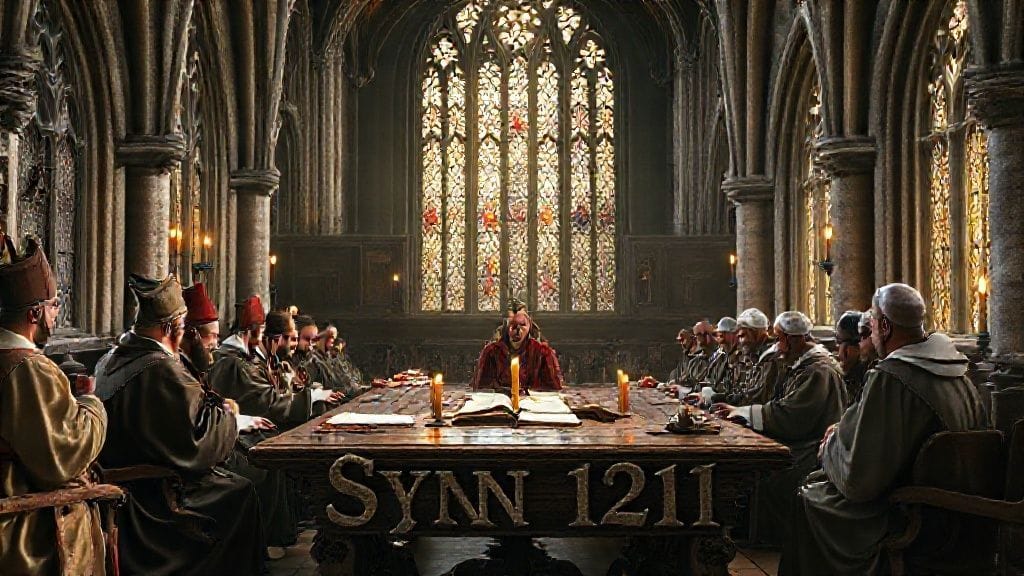
When the Synod convened in Soissons in 1121, the purpose was clear: to confront Abelard and decide the orthodoxy of his teachings. The assembly of clerics was not merely an academic panel—it was a force wielding the authority of the institutional Church. Abelard’s presence at the council was both a summons and a symbol of the broader struggle between innovation and control.
Witnesses recall the charged atmosphere—rows of bishops adorned in rich vestments, the murmur of prayers and whispered counsel, faces stern with resolve. The debate unfolded with intensity, Abelard defending his arguments with his characteristic eloquence and logic, yet inevitably meeting accusations of heresy and deviation from accepted doctrine.
Condemnation and Consequences: Abelard’s Theological Trial
The verdict was swift and unambiguous: Abelard’s works were condemned, his ideas anathematized. This official denunciation did not merely affect his writings but marked a public censure of his entire intellectual project. The weight of ecclesiastical power pressed heavily, signaling that deviation from orthodoxy carried severe penalties.
For Abelard, this synodal condemnation meant exile from certain teaching privileges, disruption of his career, and the harsh personal toll of being branded a heretic. Yet it also paradoxically cemented his position in intellectual history, as the conflict spotlighted the dynamic tensions between theology, philosophy, and church authority.
The Church’s Authority Underlined: Institutional Control and Orthodoxy
The Synod served as a stark statement about the Church’s role as arbiter of truth. In an era when faith shaped the very fabric of society, controlling doctrine was synonymous with preserving social order. The condemnation of Abelard reinforced this primacy, sending a clear message that intellectual freedom had boundaries—boundaries fiercely guarded by ecclesiastical hierarchy.
It was also a vivid illustration of how theology was inseparable from power. The bishops of Soissons were not merely discussing abstract ideas—they were defending the Church’s political and spiritual authority in a Europe still coalescing from the fragmentation of feudalism.
Abelard’s Intellectual Legacy Amidst Reproach
Despite his condemnation, Abelard’s ideas did not vanish. Far from it: they permeated medieval intellectual life and set the stage for scholasticism’s flowering. His method of questioning and critical analysis influenced later thinkers like Thomas Aquinas, who sought a synthesis of faith and reason.
Abelard became a martyr of reason to some, a cautionary tale to others. His legacy in logic, ethics, and theology opened new pathways for medieval and modern philosophy, marking a turning point in the Western intellectual tradition.
The Ripple Effect: Impact on Scholasticism and Theology
The Synod’s dramatic narrative embodies the tension underlying scholasticism’s rise—a movement characterized by rigorous dialectic inquiry yet framed by orthodox constraints. Abelard’s trials foreshadowed the enduring struggle between dogma and inquiry that would animate debate through centuries.
The intellectual ferment sparked by his condemnation encouraged a more defined, systematic theology later embodied by the great universities. This synthesis would propel the Church’s intellectual authority while allowing incremental exploration of reason alongside faith.
The Intersection of Power: State and Church Dynamics in 12th Century France
The Synod epitomized the intricate dance between secular and ecclesiastical power. Soissons, situated strategically within the Capetian kingdom, was a city where royal authority and Church influence overlapped and competed.
By supporting the condemnation, the Church signaled to the monarchy and broader society its intent to be not only a spiritual authority but a decisive political actor. Such moments reinforced the symbiotic yet tension-laden relationship between Church and crown, framing administration and governance for generations.
Personal Tragedy and Public Drama: Abelard’s Human Story
Behind theological arguments was a man beset by personal trials—his infamous romance with Héloïse, a young scholar, and their subsequent tragedies colored his reputation and soul. The events at Soissons were not merely intellectual but deeply human: a story of ambition, love, defiance, and suffering.
Abelard’s condemnation was a public pulverization of a brilliant mind and a sensitive heart. His experiences reflect the fraught nature of medieval scholarly life, where ideas could uplift but also destroy.
The Aftermath: Abelard, Heloise, and Historical Memory
Following the Synod, Abelard retreated from public controversy but his dynamism persisted through his letters and monastic writings. The poignant correspondence with Héloïse immortalized their story, blending passion with philosophical reflection.
For centuries, their narrative shaped both scholarly and popular imagination, casting Abelard as a figure who dared to challenge authority and pay a heavy price—a timeless emblem of the tortured genius.
Socio-Political Echoes: The Synod’s Resonance Beyond Religion
The condemnation reverberated beyond ecclesiastical halls. It influenced social norms, intellectual freedom, and governance. Townsfolk, nobles, and clerics alike grappled with questions of authority and innovation, shaping cultural dialogues around obedience and dissent.
This event offers a window into medieval society’s struggle with change, where disruptions in belief could ripple through every aspect of life, from educational institutions to royal courts.
Revisiting Soissons: Modern Perspectives on the 1121 Synod
Today, historians approach the Synod with a nuanced lens: not merely as a tale of suppression but as a complex interaction of personalities, power, and ideas. Abelard’s condemnation is seen as both a setback and a catalyst—a pivotal moment in the evolution of Western thought.
Archaeologists, theologians, and philosophers continue to study Soissons, seeking to understand how this medieval episode shaped trajectories of faith, reason, and governance that resonate even in contemporary debates.
The Enduring Question: Faith, Reason, and Authority Through the Ages
The Synod of Soissons invites reflection on perennial human concerns. How does society balance spiritual conviction and intellectual freedom? What limits, if any, should institutions place on inquiry? Abelard’s ordeal reminds us that these questions are not new—they are woven into the fabric of history and remain deeply relevant.
His story challenges us to consider the cost and value of critical thought, the fragility of genius confronted by dogma, and the ongoing dialogue between tradition and innovation.
Conclusion
The Synod of Soissons in 1121 stands as a crucible of medieval spirituality, intellect, and power. It was an event where the aspirations of a singular mind collided with the imperatives of institutional orthodoxy—a moment suffused with passion, fear, and determination. Abelard’s condemnation reveals not only the Church’s desire to define truth but also the inherent tensions within the human pursuit of knowledge.
Beyond the theological verdict lies a timeless narrative of courage and tragedy, of the quest for understanding in a world reluctant to change. It reminds us that the dialogue between faith and reason is never settled, but an ongoing, often painful journey. The echoes of Soissons ripple still, inviting each generation to grapple anew with the boundaries of belief and the reach of human thought.
FAQs
Q1: What were the main theological ideas of Pierre Abelard that led to his condemnation at Soissons?
Abelard challenged prevailing dogmas by employing dialectical reasoning to explore Christian mysteries, including the nature of God, the Trinity, and atonement. He emphasized reason alongside faith, questioning literal interpretations, which unsettled orthodox authorities who saw his approach as undermining Church doctrine.
Q2: How did the Synod of Soissons reflect the relationship between Church and State in 12th century France?
The Synod signified the Church’s assertion of doctrinal authority not just in spiritual matters but also in political influence. By condemning Abelard, the Church reinforced its role as a gatekeeper of ideas in a society where religious and royal powers were intertwined and mutually reinforcing.
Q3: What personal consequences did Abelard face after the Synod?
Abelard was publicly censured, faced restrictions on his teaching, and endured exile from some ecclesiastical circles. Beyond professional repercussions, the condemnation deepened his personal tragedies, including tensions in his relationship with Héloïse, ultimately influencing his retreat into monastic life.
Q4: In what ways did Abelard’s trial influence the development of scholasticism?
Though condemned, Abelard’s insistence on reason and dialectic shaped scholastic methods that fused theology with philosophy—an intellectual tradition carried forward by later thinkers such as Thomas Aquinas, who sought harmony between faith and reason.
Q5: Why was Bernard of Clairvaux opposed to Abelard, and what role did he play in the Synod?
Bernard, a leading Church figure, viewed Abelard’s rational approach as heretical and a threat to spiritual purity. His vocal opposition and influence contributed to the mounting pressures that culminated in Abelard’s condemnation, embodying the broader ideological conflict between mystical faith and scholastic inquiry.
Q6: How is the Synod of Soissons remembered in modern historical discourse?
It is seen as a pivotal event that encapsulates medieval tensions between innovation and authority. Modern scholars regard it as both a suppression of intellectual freedom and a catalyst for theological and philosophical development, serving as a case study of faith’s complex relationship with reason.
Q7: What role did Abelard’s personal life, particularly his relationship with Héloïse, play in his legacy?
The passionate and tragic romance between Abelard and Héloïse humanized the philosopher, illustrating the interplay between personal experience and public controversy. Their correspondence offers rich insight into the emotional and intellectual life behind his ecclesiastical struggles.
Q8: Did the condemnation at Soissons end Abelard’s influence on theology and philosophy?
Far from ending it, the condemnation paradoxically amplified Abelard’s influence. His methodologies and ideas continued to circulate, inspire, and challenge thinkers, ensuring a lasting impact on medieval and modern intellectual traditions.