Table of Contents
- The Awakening of Tavurvur: Rabaul on the Brink
- East New Britain: A Land of Volcanoes and History
- Geological Context: The Ring of Fire’s Fierce Child
- The Calm Before the Storm: Rabaul in Normalcy
- Precursors and Early Signs: Nature’s Ominous Warnings
- September 19, 1994: The Day Tavurvur Roared to Life
- The Eruption Unfolds: Ash Clouds, Pyroclastic Flows, and Panic
- Evacuation Chaos and Human Resilience
- The Impact on Rabaul’s Population and Infrastructure
- Scientific Response: Monitoring the Volcano’s Fury
- The Aftermath: Environmental and Economic Consequences
- Living with Lava: How Rabaul Transformed Post-Eruption
- Cultural Narratives and Oral Histories of Tavurvur
- Lessons in Disaster Preparedness and Response
- Global Attention on Tavurvur: Media and Geologists Unite
- Tavurvur’s Legacy in Volcanology
- Rebuilding and Renaming: Rabaul’s New Chapter
- The Psychological Toll on Survivors and Community Healing
- Comparing Tavurvur: Lessons from Other Volcanic Eruptions
- Conclusion: Nature’s Power and Humanity’s Endurance
- FAQs: Answering the Burning Questions About Tavurvur
- External Resource
- Internal Link
The Awakening of Tavurvur: Rabaul on the Brink
On a seemingly ordinary morning in September 1994, the people of Rabaul, a quiet town cradled in the lush landscapes of East New Britain, Papua New Guinea, noticed a menacing plume rising in the distance. Tavurvur, a stratovolcano long silent but restless, was awakening with a fury that would soon uproot lives and remake the land. The ground trembled beneath the feet of the inhabitants; thick clouds of ash began to blot out the sky as molten rivers carved paths through the old streets. It was not just an eruption; it was a violent rending of the earth itself, an elemental act that demanded mankind’s attention.
East New Britain: A Land of Volcanoes and History
The island of New Britain, part of the Bismarck Archipelago, is a place of contrasts—tropical beauty shadowed by the omnipresence of volcanic threats. Native villages, colonial history, and wartime stories weave together with the raw force of geological activity. Tavurvur, one of two volcanoes looming over Rabaul, had been quiescent for decades, its last significant eruption recorded in 1937. The region’s deep-rooted volcanic activity shaped the culture and the fears of local communities.
Geological Context: The Ring of Fire’s Fierce Child
Tavurvur sits on a caldera complex formed by massive eruptions in the past, its very existence a testament to the dynamic forces driving the Pacific “Ring of Fire.” Situated on the subduction zone where the Pacific Plate dives beneath the Indo-Australian Plate, Tavurvur’s eruptions have historically been explosive and devastating. The volcano’s magma is rich in silica, leading to highly viscous lava and violent expulsions—phenomena well-recognized by volcanologists but ever astonishing when witnessed firsthand.
The Calm Before the Storm: Rabaul in Normalcy
Before the eruption, Rabaul was a bustling, yet peaceful town of approximately 17,000 people. Its harbor was a center of commerce, fishing, and culture. The town bore the scars of World War II but had thrived steadily in the decades after. For locals, the dormant volcano was both a sentinel and a threat—respected but often forgotten amid daily life. Markets bustled, children played near the shoreline, and fishermen prepared their boats for the day. Yet beneath this placidity, subtle tremors whispered an impending upheaval.
Precursors and Early Signs: Nature’s Ominous Warnings
By early September 1994, volcanic tremors had increased in frequency. Seismometers installed by the Rabaul Volcano Observatory picked up long-period earthquakes and harmonic tremors—signs of magma movement beneath the surface. Local residents reported faint sulfur smells and faint rumblings, but without clear explosive activity, many felt the threat remained distant. Still, scientists urged caution. This was a classical build-up: pressure was mounting underground, and magma was forcing its way upward, fracturing rocks and heating pockets of gas.
September 19, 1994: The Day Tavurvur Roared to Life
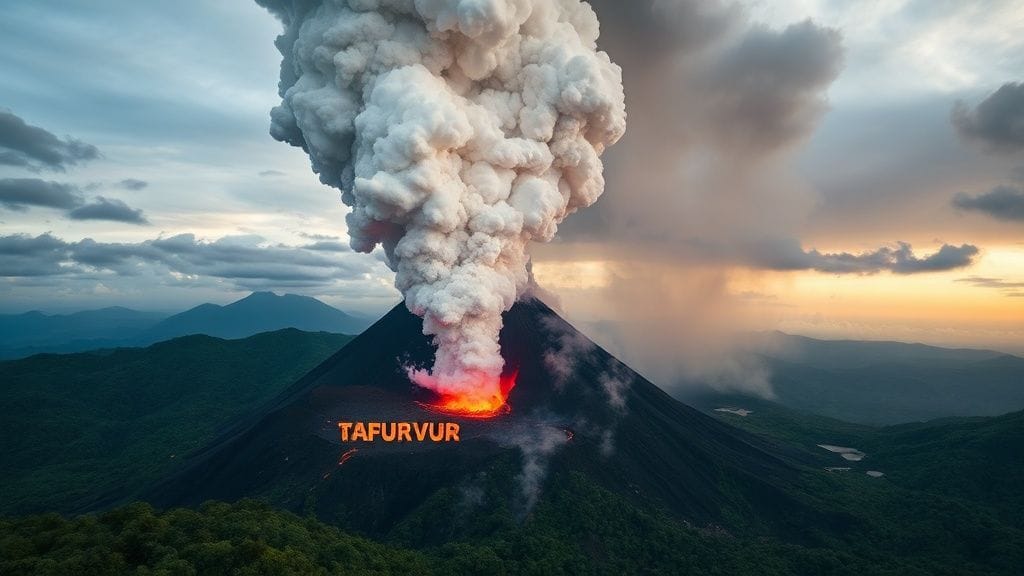
At dawn, Tavurvur’s fury broke loose. A towering column of ash and gas surged thousands of meters into the sky, darkening the sun and casting eerie shadows across Rabaul. Explosions ripped through the caldera; pyroclastic flows—fast-moving currents of hot gas and volcanic material—descended the slopes like fiery avalanches. The air filled with choking ash, and the ground shook violently. For residents, the eruption was surreal and terrifying—homes crumbled without warning, visibility vanished, and the constant menace of lava flows threatened all in their path.
The Eruption Unfolds: Ash Clouds, Pyroclastic Flows, and Panic
The eruption intensified throughout the day, with multiple explosive pulses. Ashfall settled thick as snow, burying crops, vehicles, and buildings alike. The vent produced incandescent bombs and toxic gases, making close proximity impossible. The roar of angry earth and sky overwhelmed all senses, forcing people to flee with whatever they could carry. Panic mingled with determination; community members rallied to warn neighbors and organize evacuations despite the chaos.
Evacuation Chaos and Human Resilience
Evacuating tens of thousands from Rabaul was no easy feat. Roads became clogged with vehicles, and communication lines struggled under strain. The Papua New Guinea government, aided by international agencies, coordinated airlifts and bus convoys to safer regions inland. Families faced impossible decisions: stay and risk death or abandon homes and belongings. Amid fear, stories emerged of heroism—neighbors sheltering the vulnerable, volunteers distributing food, and even animals fleeing instinctively. A tense hope infused the evacuation.
The Impact on Rabaul’s Population and Infrastructure
By the end of September, the Rabaul of old lay buried beneath meters of volcanic ash. Approximately 10,000 people were displaced, many losing everything. Buildings collapsed, harbors filled with debris, and farmland was rendered unusable. The local economy stalled as ports closed and transportation halted. Yet remarkably, direct casualties were limited, thanks in part to timely warnings and community efforts. This was a testament to human resilience amid disaster, even as grief and loss weighed heavily.
Scientific Response: Monitoring the Volcano’s Fury
Volcanologists from PNG and global institutions intensified monitoring efforts during and after the eruption. Satellite imagery revealed ash cloud movements, while ground instruments tracked deformation and seismicity. The Rabaul Volcano Observatory’s work underlined the importance of continuous vigilance. Lessons learned from Tavurvur influenced volcanic hazard management, highlighting the critical role of early detection and public education. The eruption became a case study in balancing scientific observation with urgent humanitarian action.
The Aftermath: Environmental and Economic Consequences
The environmental toll was severe—forests were scorched, rivers clogged with volcanic sediments, and marine life near the coast suffered from ash runoff. The region’s biodiversity faced disruption, though over time some ecosystems adapted to the altered landscape. Economically, East New Britain endured years of hardship. Fishing collapsed, tourism evaporated, and reconstruction costs soared. Yet these challenges fueled innovation and collaboration among government entities, NGOs, and the local populace working toward recovery.
Living with Lava: How Rabaul Transformed Post-Eruption
Rabaul was eventually abandoned as the primary urban center; a new town, Kokopo, some 20 kilometers away, was developed as the administrative and economic hub. This marked an unprecedented relocation, reflecting a pragmatic acceptance of nature’s power. Tavurvur remained an active threat, monitored closely, but the community adapted to a new normal—living with the volcano’s shadow rather than defying it. Streets, homes, and schools gradually dotted the rebuilt landscape, weaving past trauma into modern resilience.
Cultural Narratives and Oral Histories of Tavurvur
For the local Tolai people and other communities of East New Britain, Tavurvur is not merely a geological feature but a living entity embedded in spiritual and cultural realms. Oral histories recount ancestral knowledge about eruptions, survival rites, and respect for the land. Following the 1994 eruption, storytellers and elders preserved memory through song, dance, and ritual, framing the disaster as both tragedy and renewal. These narratives offer profound insights into human-environment relationships that official reports can overlook.
Lessons in Disaster Preparedness and Response
The Tavurvur eruption underscored the imperative for robust volcanic hazard strategies. It exposed gaps in infrastructure, preparedness, and public awareness but also demonstrated the life-saving power of coordinated efforts. Post-eruption, Papua New Guinea enhanced its monitoring networks, emergency planning, and education campaigns. Regional cooperation grew stronger, with neighboring island nations sharing expertise. Tavurvur’s story became a global cautionary tale and a beacon for improving resilience in volcanic zones worldwide.
Global Attention on Tavurvur: Media and Geologists Unite
International media coverage brought Tavurvur’s eruption to a global audience, generating empathy and scientific intrigue. Documentaries, photographs, and eyewitness accounts circulated widely, stimulating funding and research collaborations. Geologists flocked to East New Britain to study the volcano’s dynamics, and the event enriched knowledge about caldera eruptions and ash plume behavior. Tavurvur’s reputation as one of the world’s most accessible and observable active volcanoes was cemented, making it a key focus for ongoing research.
Tavurvur’s Legacy in Volcanology
Scientifically, Tavurvur’s 1994 eruption contributed valuable data on eruptive mechanisms, gas emissions, and community impacts. It helped refine predictive models and informed global volcanic hazard reduction policies, such as those promoted by the United Nations Office for Disaster Risk Reduction. Researchers continue to observe Tavurvur, employing new technologies like drones and real-time monitoring to deepen understanding. The volcano stands as a natural laboratory—both a challenge and an opportunity for science and humanity.
Rebuilding and Renaming: Rabaul’s New Chapter
The physical and symbolic shift from Rabaul to Kokopo represents profound change. Reconstruction woven with respect to the volcano’s legacy moved beyond mere practicality—it was about forging identity amid loss. New infrastructure incorporated volcanic hazard considerations, blending traditional architecture with modern engineering. Schools taught the story of Tavurvur alongside literacy and math, embedding disaster awareness into education. Over time, Kokopo flourished, attracting residents and businesses, while Rabaul’s caldera transformed into a solemn reminder.
The Psychological Toll on Survivors and Community Healing
Beyond bricks and ash, the eruption’s trauma lingered in hearts and minds. Survivors wrestled with grief, displacement, and uncertainty. Mental health support was limited initially, but over time community programs and counseling emerged. Rituals of healing and remembrance offered comfort, and collective memory became a source of strength. The eruption left scars that shaped generational perspectives on nature, risk, and hope, forging a community that knows both vulnerability and resilience intimately.
Comparing Tavurvur: Lessons from Other Volcanic Eruptions
When placed alongside catastrophic eruptions like Mount St. Helens (1980) or Pinatubo (1991), Tavurvur’s event exemplifies unique and shared challenges. Each eruption underscores the balance between preparedness and unpredictability. Yet Tavurvur’s relatively low death toll, given the scale, highlights how local knowledge, scientific monitoring, and rapid evacuation can mitigate disaster. The comparative lens enriches disaster science and public policy, encouraging vigilance in volcanic hotspots globally.
Conclusion: Nature’s Power and Humanity’s Endurance
Tavurvur’s 1994 eruption is a testament to the profound force of our planet’s internal heat—unforgiving, swift, yet also a catalyst for transformation. For Rabaul and East New Britain, the eruption was a rupture but also a rebirth. It tested human spirit and ingenuity in the face of elemental fury. As the ash settled and the skies cleared, communities rebuilt with a deeper awareness of the precariousness of life on a living earth. Tavurvur continues to watch over the land, a reminder that humanity must constantly listen, respect, and adapt.
FAQs
1. What caused the 1994 Tavurvur eruption?
The eruption resulted from the movement of magma beneath the volcano, driven by tectonic activity along the Pacific and Indo-Australian plates. Pressure built over years, culminating in an explosive release on September 19, 1994.
2. How many people were affected by the eruption?
Approximately 17,000 people lived in Rabaul at the time, with about 10,000 displaced. Thanks to timely evacuation, casualties were relatively low, though property damage was extensive.
3. What kinds of volcanic hazards were posed by Tavurvur?
The eruption produced ashfall, pyroclastic flows, lava bombs, toxic gases, and ground shaking, all of which endangered life and infrastructure.
4. How did the government and community respond?
Evacuations were swiftly organized, supported by scientific monitoring and international aid. Community solidarity played a critical role in minimizing casualties.
5. What is the significance of Tavurvur in volcanology?
Tavurvur is a prime site for studying explosive caldera eruptions; data from 1994 enhanced understanding of eruption forecasting and hazard mitigation.
6. How has Rabaul changed since the eruption?
The town was largely abandoned; a new administrative center, Kokopo, was developed inland. Rabaul remains a hazardous but culturally important site.
7. What lessons can other volcanic regions learn from Tavurvur?
Early warning systems, community engagement, and disaster preparedness are key to reducing volcanic risk, as exemplified by Tavurvur’s relatively low casualty rate.
8. How is the Tavurvur eruption remembered culturally?
Local oral histories, rituals, and art preserve the event’s memory, highlighting the intertwining of nature, culture, and resilience in East New Britain.

