Table of Contents
- The Dawn of a New Era: March 10, 1876, Boston
- Alexander Graham Bell: The Man Behind the Vision
- Early Telecommunications: The Limitations of the Telegraph
- The Birth of the Telephone: From Idea to Prototype
- A Historic Day in Boston: The First Telephone Call
- The Famous Words: “Mr. Watson, Come Here…”
- Technical Challenges and Breakthroughs
- The Race Against Time: Bell and Edison
- Public Skepticism and Early Criticism
- Telephone Patents and Legal Battles
- The Telephone’s Early Expansion in America
- Social Transformations Sparked by the Telephone
- Economic Impacts: Changing Business and Communications
- From Boston to the World: Global Spread of the Telephone
- The Legacy of March 10, 1876: How That Call Changed Everything
- Reflections on Innovation and Human Connection
- The Telephone in Cultural Memory
- Modern Technology’s Roots in Bell’s First Call
- Conclusion: The Human Voice Across Time
- FAQs about the First Telephone Call
- External Resource
- Internal Link
On a crisp morning in Boston, March 10, 1876, the world shifted on its axis—not with a grand parade or a blast of cannon fire—but through an unprecedented flicker in the ether, a whispered ripple of human voice traveling over wires for the very first time. The air buzzed with a strange excitement. Somewhere in a lab, a man spoke into a strange instrument, and on the other end, a companion heard those words come alive—not written, not tapped, but spoken and received in real-time. It was the world’s first telephone call: a fragile, tentative human breakthrough that would irrevocably entwine humanity’s voices across space.
This moment, both intimate and epochal, was the fruit of genius, perseverance, and a deep yearning to collapse distances—not just physical, but human. It was the beginning of a profound transformation in how people connected, communicated, and ultimately understood one another.
1. The Dawn of a New Era: March 10, 1876, Boston
The morning sun glinted through the laboratory windows of Boston, casting sharp light on cluttered workbenches, tangled wires, and curious apparatuses that looked part science fiction, part alchemy. In this unassuming workshop, Alexander Graham Bell was about to shatter the world’s auditory silence between two points.
At 10:35 a.m., Bell uttered those first revolutionary words through an instrument: “Mr. Watson, come here—I want to see you.” On the other side, Thomas A. Watson responded to the call, hearing clearly the physical presence of sound over a wire. For the first time, the human voice was transported electrically and audibly—an act that until then had only existed in dreams and sketches.
It was an utterly human moment that also marked the advent of a technological revolution. The invisible threads that connected people would soon traverse cities, countries, continents, and oceans, reshaping the very fabric of society.
2. Alexander Graham Bell: The Man Behind the Vision
Alexander Graham Bell was more than a scientist; he was a passionate educator and inventor, deeply influenced by his family’s work with speech and hearing. His father had developed a visible speech system to aid the deaf, and Bell himself worked tirelessly with deaf students, nurturing a lifelong commitment to communication.
A Scottish emigrant to Canada and later the United States, Bell’s obsession was the transmission of sound—human voice and speech—across distance. He was a man of contradictions: a rigorous experimentalist combined with a poetic longing to unite voices and hearts separated by space.
His laboratory was a place of chaos and order, where he juggled various projects, from flight to optical telecommunications. But the telephone became his obsession—the dream that, if realized, would seal his place in history.
3. Early Telecommunications: The Limitations of the Telegraph
Before the telephone, the telegraph was king. Invented by Samuel Morse and others in the 1830s and 1840s, the telegraph revolutionized communication by transmitting coded sequences of dots and dashes over wires. It was the 19th century’s equivalent of lightning—speedy compared to horse or ship.
But the telegraph had limits. Only those trained in Morse code could understand its messages; it was cumbersome, impersonal, and binary. There was no nuance in emotion, no warmth in the mechanical tapping. People longed for something more natural, an electrical instrument that could carry the fluidity of human speech.
Into this void stepped Bell, determined not just to send signals but to recreate the living voice across the wires.
4. The Birth of the Telephone: From Idea to Prototype
Bell’s work was grounded in the study of acoustics and electrical circuits, yet his inspiration was also philosophical—how to convert sound waves into electrical signals and back again.
By late 1874, Bell and his assistant, Thomas Watson, were experimenting with liquid transmitters—a crude but effective method of converting mechanical vibrations into electrical impulses. This was revolutionary in itself, but the challenge was devising a system sensitive enough and clear enough to carry voice.
After months of trial and error, their breakthrough came in early 1876. Using a vibrating diaphragm connected to an electromagnet, Bell was able to transmit the vibrations of his voice along wires amplified by an electrical current. But an idea only becomes reality when it gains coherence; the first intelligible words uttered over the line were the baptism of that dream.
5. A Historic Day in Boston: The First Telephone Call
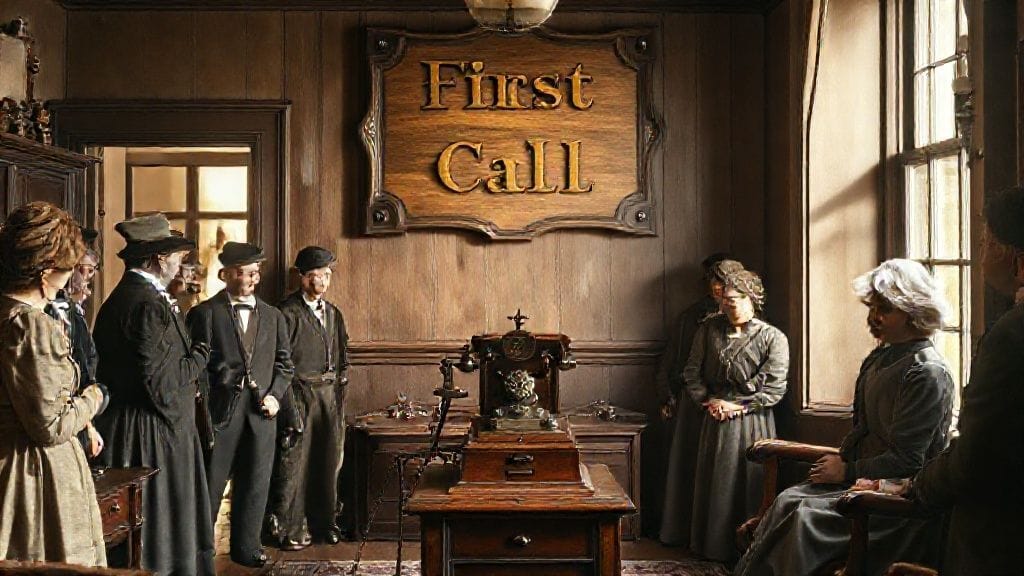
March 10, 1876, remains etched in history: a day when invention crossed the threshold into everyday life. Bell spoke into the transmitter suspended from the ceiling of his workshop. “Mr. Watson, come here—I want to see you.”
Watson, working in another room, hurried to Bell’s side, astonished that he heard, not a click or a buzz, but words, alive and human.
Bell’s diary entry from that day, filled with awe and hope, conveys the human drama behind the science:
“I feel sure that I am the first inventor to speak to a man through an electric wire.”
This simple message marked an incredible breakthrough—proof that the human voice no longer belonged to space or distance.
6. The Famous Words: “Mr. Watson, Come Here…”
The line uttered by Bell is one of history’s most iconic phrases, ringing through time with the excitement of discovery and possibility. These words were not rehearsed; they were spontaneous, capturing the raw essence of human connection.
Watson’s response and the ability to hear spoken language instantaneously was a miracle to onlookers. It was the first time that the intangible—the tone, inflection, emotion—was preserved and transmitted electrically.
Culturally, these words have come to symbolize the birth of an entire communication era. They echo today as reminders of the ingenuity and spirit of human innovation.
7. Technical Challenges and Breakthroughs
Behind the romantic narrative, the telephone’s invention was riddled with technical obstacles. Early transmitters struggled with clarity and range; electrical interference was a persistent enemy, and the fragile components were often temperamental.
Bell and Watson had to invent new materials, refine diaphragms, experiment with magnets, and address power source limitations. The path from the initial prototype to a commercial, reliable instrument took years of perseverance.
They also had to innovate network technologies, such as switching systems and wire infrastructure, which would later become essential for scaling telephone service.
8. The Race Against Time: Bell and Edison
Bell was not alone in imagining the transmission of voice; Thomas Edison and Elisha Gray were also hot on the trail. Edison’s work on improving transmitters and Gray’s telephone designs set off a fierce race for intellectual and commercial dominance.
These rivalries spurred rapid developments but also led to protracted patent disputes. The battle for the telephone’s patent—won famously by Bell—would shape the industry’s future.
This contest was a testament to the period’s thirst for progress and the complex intersection of invention and entrepreneurship.
9. Public Skepticism and Early Criticism
Despite its wonder, the telephone initially faced skepticism. Many doubted it was practical or necessary; some called it a gadget for the wealthy or a mere curiosity.
Newspapers and public figures expressed doubts: How useful could a device be that required wires and receivers? How would it be better than the telegraph? These critiques underscore the difficulties that all radical innovations face: acceptance beyond the laboratory.
Yet the device’s proponents continued to demonstrate its potential, gradually winning over governments, businesses, and the public.
10. Telephone Patents and Legal Battles
Bell’s 1876 patent was a legal and commercial milestone, but it was fiercely contested. Competitors sought to undermine his claims, leading to decades of litigation.
The importance of the patent system was underscored, highlighting how invention was intertwined with law and capital. Bell Telephone Company’s eventual dominance rested upon these legal victories.
These struggles are reminders that progress is rarely smooth but often fought on courts as much as in laboratories.
11. The Telephone’s Early Expansion in America
Following the historic call, telephone lines quickly spread through Boston, then New England, and beyond. Entrepreneurs and Bell’s company wired homes, businesses, and public institutions, creating a network never before imagined.
Telephone exchanges began to appear, enabling multiple connections and expanding accessibility. By the 1880s, thousands of telephones were in use, transforming American social and economic life.
The infrastructure development was rapid, and its impact profound.
12. Social Transformations Sparked by the Telephone
The telephone redefined social interactions. Families could hear voices instantly; businesses reached clients without delay; and even emergencies gained new immediacy.
Yet it also raised concerns about privacy, social etiquette, and the blurring of public and private boundaries. The new technology forced society to rethink communication norms.
Moreover, the telephone helped flatten distances, making urban-rural divides a bit smaller and enabling migrations and connections.
13. Economic Impacts: Changing Business and Communications
For businesses, the telephone was revolutionary. Transactions sped up, decision-making was instantaneous, and new commercial models emerged.
From stock exchanges to small shops, the telephone became a tool for efficiency, expanding markets and enabling coordination at a scale unthinkable before.
This was not just a convenience but an engine of economic transformation.
14. From Boston to the World: Global Spread of the Telephone
News of Bell’s invention spread quickly abroad. Within years, European countries, Canada, and others adopted and adapted telephone technology.
It became a global network, binding continents and cultures more tightly. Transatlantic cables and international telephony would follow, transforming diplomacy, commerce, and culture.
The first Boston call was the seed of a worldwide web of voices that now encircles the globe.
15. The Legacy of March 10, 1876: How That Call Changed Everything
The first telephone call was not only a technological triumph but a cultural watershed. It marked the beginning of real-time voice communication and paved the way for today’s digital and mobile ecosystems.
From Bell’s modest laboratory to the smartphones in millions of hands today, that early moment is a testament to human ingenuity and the timeless desire to reach out and be heard.
16. Reflections on Innovation and Human Connection
Behind every invention lies a story of human hope, frustration, failure, and triumph. The telephone was no exception. Bell’s vision was not just wires and magnets but the human voice—a bridge between souls.
This innovation reminds us that technology, at its best, serves to connect, to understand, and to bring closer what is far.
17. The Telephone in Cultural Memory
The phrase “Mr. Watson, come here—I want to see you” has entered cultural lore, symbolizing the moment when speech could cross wires and distance became less daunting.
It is celebrated in films, literature, museums, and public imagination as a spark of modernity, encapsulating the excitement of discovery and the dawn of a connected world.
18. Modern Technology’s Roots in Bell’s First Call
Today’s internet, mobile phones, and voice-over-IP technologies can trace their lineage to that first electric whisper from Bell to Watson.
Understanding that lineage offers perspective on how innovation builds layer upon layer, each breakthrough standing on the shoulders of previous giants.
19. Conclusion: The Human Voice Across Time
March 10, 1876, was more than a technical milestone; it was a human epiphany. From that first first call—yes, telephone first call—a new era of closeness was inaugurated.
Voices that once traveled only by foot, horse, or ship now surged through copper wires, shrinking the world. This was the birth of an era where conversation no longer required proximity, but only intention.
It is incredible, isn’t it? That across 150 years, the essence remains the same: a yearning to be heard, to connect, to belong.
Conclusion
The story of the first telephone call in Boston on March 10, 1876 is a monumental chapter in humanity’s history—a moment when sound transcended space and transformed society. Alexander Graham Bell’s vision crystalized the intangible desires of communication into a tangible, working reality, opening a door to a future where voices would travel unseen but deeply felt.
This event did not simply create a device; it forged a new way of being human, redefining relationships, economies, and the very notion of community. It is a story of persistence against skepticism, of science entwined with passion, and of the timeless human need to reach out across the void.
From that lab in Boston to the smartphones of today, the legacy of the telephone first call pulses through every conversation, reminding us that inventions start small, but their echo can resonate through centuries.
FAQs about the First Telephone Call
Q1: Why is March 10, 1876, significant in the history of communication?
It marks the day Alexander Graham Bell made the first successful telephone call in Boston, where he spoke to his assistant Thomas Watson over a wire, inaugurating voice communication by electricity.
Q2: Who was Alexander Graham Bell?
Bell was a Scottish-born inventor and educator, deeply involved in speech and hearing sciences, who invented the first practical telephone.
Q3: What were the main technical challenges in inventing the telephone?
Challenges included converting sound waves into electrical signals accurately, amplifying these signals, and ensuring clarity over distance, requiring numerous experiments with diaphragms, magnets, and circuits.
Q4: How did society initially react to the telephone invention?
Many were skeptical, doubting its practicality or usefulness; some dismissed it as a novelty or a luxury for the rich, but gradual demonstrations revealed its transformative potential.
Q5: What was the impact of the first telephone call on business and everyday life?
It revolutionized communication efficiency, enabling instant voice exchanges that transformed commercial operations, emergency responses, social interactions, and more.
Q6: Were there any competing inventors working on similar technology?
Yes, inventors like Thomas Edison and Elisha Gray worked on similar devices, leading to patent disputes and a race for commercial control of the telephone.
Q7: How did the telephone spread beyond Boston and America?
Thanks to rapid adoption, entrepreneurial expansion, and international interest, telephone networks emerged worldwide, connecting continents and changing global communication.
Q8: What is the cultural significance of the phrase “Mr. Watson, come here—I want to see you”?
It symbolizes the birth of voice communication and human connection through technology; it is a historic utterance representing innovation and human ingenuity.