Table of Contents
- The Dawn of a New Vision: London, January 26, 1926
- Setting the Stage: The World Before Television
- John Logie Baird: The Man Behind the Images
- The Science of Seeing: How Early Television Worked
- The Historic Night: A Demonstration Unlike Any Other
- The Audience Behind the Glass: Witnesses and Reactions
- From Nipkow Discs to Moving Pictures: The Technology Unfolds
- Challenges in a Black-and-White World: Technical Hurdles and Skepticism
- The Ripple Effect: Immediate Impact on Science and Society
- The Role of the BBC and British Technological Ambition
- Transmissions Beyond London: Early Broadcasts and Experiments
- The Road to Commercial Television: Dreams and Delays
- Television’s Place in the Roaring Twenties: Culture and Expectations
- The Interplay of Radio and Television: Allies or Rivals?
- Legacy of the 1926 Demonstration: A Catalyst for the Future
- The Human Element: Baird’s Persistence Against Doubt
- Global Reverberations: How Other Nations Reacted
- From Novelty to Necessity: Television’s Transformation Over Time
- Societal Changes Prompted by Visual Broadcasting
- Reflection in the Lens: How the First Demonstration Shaped Modern Media
- Conclusion: The Birth of a Medium and Its Enduring Vision
- FAQs: Unraveling the Beginnings of Television
- External Resource: Wikipedia Link
- Internal Link: Visit History Sphere
When the gas lamps of London flickered into evening glow on January 26, 1926, a small room in a humble building pulsed with an energy that extended far beyond its walls. The air was thick with anticipation — a heady mix of curiosity, skepticism, and hope. On this chilly winter night, the very fabric of communication was poised to change forever.
In that dimly lit setting, a grainy, flickering image danced across a small screen — the first true demonstration of television. It was shadowy, fragmented, almost ghostly, but undeniably alive. This was not merely a technological feat; it was a leap of faith into the future, a first glimpse of the unseen, a medium that would soon knit together the world in ways never imagined.
The Dawn of a New Vision: London, January 26, 1926
London wasn’t just the epicenter of the British Empire; it was also the crossroads of innovation and aspiration during the roaring twenties. Amidst post-war recovery and a burst of cultural life, a quiet revolution was about to be unveiled. The date—January 26, 1926—marks the moment when John Logie Baird presented the world’s first successful demonstration of television, at a small room in Frith Street, Soho.
The significance? An image broadcast in real time over wires, experienced by an audience of scientists, journalists, and skeptics. “Ladies and gentlemen,” Baird had said moments before, “I am about to show you the pictures of the future.”
But this future was born not merely from ambition, but from years of scientific toil, failure, and unyielding belief.
Setting the Stage: The World Before Television
Before the flicker of Baird’s apparatus, the world’s information flowed primarily through print and radio. Newspapers spread news, stories, and images that had to be interpreted by the mind; radio waves carried voices and music but left all images to the imagination.
Visual communication was confined largely to photography, cinema, and still images—static, silent, and limited by geography. The technological desire to send moving images had simmered since the late 19th century but remained out of reach.
The industrial powers, including Britain, Germany, and the United States, were hotbeds of experimentation. The race was on—not just to invent the technology, but to invent how the world would see itself.
John Logie Baird: The Man Behind the Images
Born in Helensburgh, Scotland, in 1888, John Logie Baird was a self-taught engineer, tinkerer, and visionary. Without a formal university degree, his background was a testament to curiosity and stubborn determination.
Baird’s fascination with electrical engineering and telecommunication burst forth after World War I, as he experimented in a small shed with rudimentary components. His idea was radical: what if images could be broken into tiny parts, transmitted electrically, and reassembled in real time at the receiving end?
His work was thorny, fraught with skepticism and financial struggle. Many contemporaries derided television as impossible, a folly of the imagination. Yet, Baird pressed on, protected by a blend of scientific rigor and a showman’s flair.
The Science of Seeing: How Early Television Worked
What Baird demonstrated was a mechanical system employing what is now known as the Nipkow disc—a spinning disc with neon-sized holes arranged in a spiral, scanning an image line by line.
This disc, combined with a selenium photoelectric cell, converted light from an object into electrical signals. On the receiving end, a similar disc reconstructed the image by shining a light that varied with the received electrical current.
The screen was small, about 3 inches in size, and images were extremely low resolution—around 30 lines. But this was the critical breakthrough: live moving images could be transmitted to a distant receiver.
The Historic Night: A Demonstration Unlike Any Other
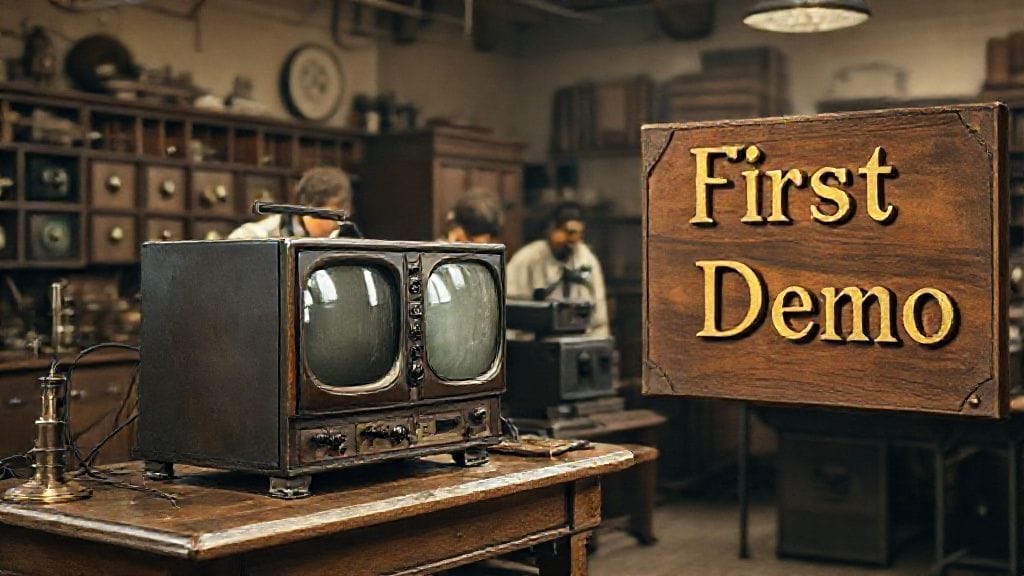
On that January evening, the atmosphere in Baird’s cramped laboratory was electric. A small group of witnesses huddled close, balancing wonder and disbelief as the machine was activated.
Suddenly, a blurry image appeared—a ventriloquist’s dummy named “Stooky Bill” blinked on the screen. The image was far from clear; the outline flickered, and features were indistinct.
Yet, as one journalist later recalled, “For the first time, we saw a shadow of life transmitted through wires. It was as though electricity had the power to conjure visages from nowhere.”
Baird then transmitted moving images of a human face—a breakthrough that proved the system's viability beyond mere novelty.
The Audience Behind the Glass: Witnesses and Reactions
Among the fifteen or so witnesses, a selection of scientists, journalists, and enthusiastic supporters met a technological marvel.
The British Broadcasting Company (later Corporation)—embryonic at that time—saw the immense potential, as did public figures like Lord Thomson of Cardross. Yet many in the scientific community remained cautious. Technical limitations, such as low resolution and small screen size, raised doubts about commercial feasibility.
Nonetheless, newspapers reported the demonstration as “visionary” and “startling,” planting the seeds for public imagination worldwide.
From Nipkow Discs to Moving Pictures: The Technology Unfolds
The 1926 demonstration was not a sudden spark but the climax of decades of incremental progress. The Nipkow disc, invented in 1884 by Paul Nipkow, was an essential precursor, providing a mechanical method of scanning images.
Baird’s genius lay in combining this with electrical transmission and photoelectric technology to create a working prototype. While contemporaries like Charles Francis Jenkins in the U.S. pursued similar experiments, Baird’s combination set him apart.
This hybrid mechanical-electrical television was imperfect but functional, capable of transmitting crudely realistic moving images.
Challenges in a Black-and-White World: Technical Hurdles and Skepticism
The very charm of Baird’s invention—its mobility, mechanical simplicity—was also its limitation. Images were monochrome, pixelated by today’s standards, and transmitted at extremely low frame rates, causing flicker.
Early radio waves were limited, and coaxial cables necessary for clearer transmission were expensive and impractical.
Many critics dismissed television as an engineer’s toy, impractical for mass adoption. Skeptics predicted that radio and cinema would dominate entertainment and information.
Yet, Baird’s persistence meant these challenges were just obstacles to be surmounted.
The Ripple Effect: Immediate Impact on Science and Society
Although the demonstration was a controlled event, its implications rippled quickly across technological and cultural landscapes.
In laboratories across the world, inventors accelerated their own experiments. Investors, while cautious, started to envision a future where homes would glow with moving images.
The British government kept a watchful eye. In an era of empire and global influence, mastering such technology was a strategic priority.
For the public, the very notion of “seeing at a distance” began to infuse popular imagination with dreams of new kinds of connection—beyond telegrams and wireless voices.
The Role of the BBC and British Technological Ambition
The BBC, founded in 1922, was then an organization committed to pioneering broadcast technology. After Baird’s demonstration, it engaged in experimental broadcasts, testing transmission methods between London and parts of England.
Britain’s official support positioned the country at the forefront of early television development. The blend of government backing and private enterprise forged a path to eventual public broadcast.
Yet the journey would be slow—years of experimentation and refinement lay ahead before television could become a household medium.
Transmissions Beyond London: Early Broadcasts and Experiments
Following the 1926 demonstration, Baird progressed to transatlantic experiments and moving image transmissions over radio waves.
By 1928, Baird’s system transmitted images to both London and Glasgow, expanding the spatial reach of television. These broadcasts were primitive, sometimes blurred, but undeniably real.
This period saw a quiet revolution, laying groundwork for the 1930s public transmissions and the birth of TV programming.
The Road to Commercial Television: Dreams and Delays
Despite technical achievements, widespread adoption would take years. The Great Depression, World War II, and technical challenges imposed delays.
It wasn’t until 1936 that the BBC began regular public television broadcasts. By then, electronic television—using cathode ray tubes—was becoming dominant, overtaking mechanical systems.
Yet, the 1926 demonstration remained the spark that ignited the journey toward the glowing screens that would soon flood living rooms.
Television’s Place in the Roaring Twenties: Culture and Expectations
The 1920s was a decade of cultural dynamism. Jazz, cinema, and new media reshaped society. The visual age beckoned with promises of glamour and immediacy.
Television, though nascent, captivated imaginations. People imagined artists performing live in their own homes, news unfolding as it happened, and a world more connected than ever.
Baird’s success fed into the era’s optimism about science and technology leveling social divisions and expanding horizons.
The Interplay of Radio and Television: Allies or Rivals?
Radio was the reigning monarch of home entertainment and information in 1926.
Television was initially feared as a rival, but also quickly recognized as a complementary medium.
Radio broadcasters began exploring the visual dimension, while television pioneers counted on established radio networks for infrastructure.
This interplay shaped the culture and pace of broadcast technology throughout the 20th century.
Legacy of the 1926 Demonstration: A Catalyst for the Future
Baird’s January 1926 demonstration was much more than a simple demonstration; it was a rhetorical statement to science and society.
“The pictures of the future,” as Baird proclaimed, were now a reality.
Though his mechanical system would soon be eclipsed by new technologies, his handiwork was the foundation of television itself.
The moment was a hallmark of innovation, demonstrating how technology can reshape human perception and communication.
The Human Element: Baird’s Persistence Against Doubt
Behind the machines was a man—a tenacious engineer who faced mockery, financial woes, and repeated failure.
Baird’s words, “I have lived to see the impossible made possible,” echoed the spirit of countless pioneers.
His story is a testament to the resilience of human ingenuity and belief amid uncertainty.
Global Reverberations: How Other Nations Reacted
The shockwaves of the demonstration reached beyond Britain.
In the United States, inventors redoubled efforts; in Germany, industrial firms began research; in the Soviet Union, television’s propaganda potential was explored.
The 1926 event is often regarded as the symbolic birth of a global broadcasting revolution.
From Novelty to Necessity: Television’s Transformation Over Time
What began as a grainy image of a dummy’s face soon evolved into a medium that shapes politics, culture, and society.
By mid-century, television was a daily companion, a stage for democratic discourse, and a mirror reflecting societal change.
The January 1926 demonstration, though primitive, was the genesis of this profound transformation.
Societal Changes Prompted by Visual Broadcasting
Television altered how people consumed information, understood events, and pictured the world.
It eroded distances, made leaders visible, and forged a shared cultural experience.
In many ways, the world we live in today—where screens influence politics, social behavior, and identity—owes its earliest roots to that chilly London evening.
Reflection in the Lens: How the First Demonstration Shaped Modern Media
Today’s televisions—flat, colorful, ultra-high-definition—are distant cousins to Baird’s flickering images.
Yet every pixel and broadcast owes a debt to that pioneering moment.
More than technology, the demonstration heralded the concept of instantaneous global visual communication, a principle that underpins the internet era as well.
Conclusion
January 26, 1926, was more than just a date; it was a beacon lighting the path forward. John Logie Baird’s television first demonstration in London was a triumph of imagination, science, and sheer human will.
From a fragile, spinning disc rose a new form of storytelling—one that would change how we connect, learn, dream, and see each other.
It reminds us that history’s turning points often come wrapped in flickering shadows, waiting for visionaries to bring them into the light.
FAQs
Q1: Why is the January 26, 1926 event considered the first television demonstration?
Because it was the first time a moving, live, human image was transmitted and visually received by an audience using an electronic-mechanical system successfully—a true milestone in television history.
Q2: Who was John Logie Baird and why is he important?
Baird was a Scottish inventor who combined the Nipkow disc with electronics to demonstrate moving images on a screen, pioneering the practical transmission of television.
Q3: How did early television technology work in 1926?
Mechanical scanning of images using rotating discs coupled with photoelectric cells converted images into electrical signals, then reconstructed images on the receiver’s side with synchronized discs.
Q4: What were the main challenges faced during the early development of television?
Low resolution, poor image quality, limited range of transmission, high costs, skepticism, and competition from radio and cinema technologies.
Q5: How did the 1926 demonstration influence future broadcasting?
It inspired further research worldwide, attracted government and commercial interest, and initiated the slow process toward public television broadcasts.
Q6: Why did it take so long for television to become mainstream after 1926?
Due to technological limitations, economic issues like the Great Depression and World War II, and the need for more advanced electronic systems.
Q7: How did television change society in the long term?
By transforming information dissemination, culture, politics, and social interaction, creating a shared visual experience on a global scale.
Q8: Are there any surviving recordings or images from the 1926 demonstration?
No direct recordings survive due to the technological limitations, but photographs and written reports document the event.