Table of Contents
- The Twilight of a King: The Death of Theoderic the Great
- Ravenna in the Early 6th Century: A City at the Crossroads
- Theoderic’s Reign: Building an Ostrogothic Renaissance
- From Warrior to Statesman: The Political and Cultural Synthesis
- The Day of Reckoning: August 30, 526, Ravenna’s Silent Morning
- The Final Illness: The King’s Decline and the Court’s Uncertainty
- The Last Rites: Rituals, Religion, and the Passing of a Monarch
- The Burial in Ravenna: A Monument to Ostrogothic Majesty
- Theoderic’s Legacy: Architect of Unity or Relic of a Bygone Era?
- Ravenna after Theoderic: From Gothic Capital to Byzantine Prize
- The Fragility of Power: Succession and the Gothic Kingdom’s Demise
- Memory in Stone: Theoderic’s Mausoleum and Its Symbolism
- Political Reverberations: Italy and the Mediterranean after 526
- Cultural Echoes: Art, Law, and Architecture under Theoderic
- Theoderic in Historical Perspective: Hero, Tyrant, or Enigma?
- Modern Reflections: Theoderic’s Place in Italy’s National Identity
- Conclusion: The End of an Era and the Dawn of Transformation
- FAQs: Exploring Theoderic’s Death and Its Aftermath
- External Resource
- Internal Link
The Twilight of a King: The Death of Theoderic the Great
On a late summer’s day, August 30, 526, the city of Ravenna stood hushed beneath a heavy sky. It was not the usual hum of a thriving capital pulsating with imperial ambition but a solemn stillness—seemingly the city itself was holding its breath. Theoderic the Great, the formidable Ostrogothic king revered as architect of a fragile peace in Italy, had taken his last breath. The ruler who had carved a kingdom from the ruins of the Western Roman Empire, whose reign was a compelling blend of diplomacy, military might, and cultural patronage, slipped away quietly into history. Yet, this moment was not just an end but a hinge upon which the fate of Italy—and indeed the Mediterranean—would turn.
As the news spread, shock rippled across Ravenna’s marble palaces, mosaic-lit basilicas, and bustling marketplaces. For decades, Theoderic’s presence had been a constant, a symbol of order amid chaos, of a Gothic identity intertwined inseparably with Roman legacy. Now, uncertainty loomed. Who would succeed the king who ruled with both an iron fist and a philosopher’s mind? And what fate awaited the kingdom he had fought so tirelessly to build?
Ravenna in the Early 6th Century: A City at the Crossroads
To understand the weight of Theoderic’s passing, one must first step into Ravenna itself during this pivotal epoch. The city was far more than a provincial seat; it was the contested jewel of the Italian Peninsula, shaped by centuries of imperial ambition. Once the heart of the late Roman Empire’s administration in the West, Ravenna had evolved into an eclectic center where Gothic warriors rubbed shoulders with Roman senators, Eastern Christians debated theology, and artisans crafted the basilicas that would endure for millennia.
By 526, Ravenna was a city of grandeur and fragility. Its walls held memories of Julius Caesar, Emperor Honorius, and now Theoderic. Strategically perched on the Adriatic coast, it bore the marks of Gothic conquest but was still imbued with Roman law and culture. The city’s mosaics whispered tales of Christian devotion mingled with pagan legacies, reflecting the delicate cultural fusion that characterized Theoderic’s reign: a synthesis of barbarian and Roman worlds that few rulers had managed to achieve.
Theoderic’s Reign: Building an Ostrogothic Renaissance
To recount Theoderic’s death without appreciating his life is to miss the full human drama. Born around 454, Theoderic rose from Gothic prince and hostage in Constantinople to the architect of an Ostrogothic kingdom that sought harmony rather than war. His vision was neither mere conquest nor chaos but a renewal—a rebirth of Italy under Gothic rule but with Roman institutions restored and respected.
His reign spanning over three decades was marked by ambitious public works, legal reform, and the delicate management of a diverse population. He rebuilt aqueducts, commissioned churches, and promulgated laws aimed at coexistence between Romans and Goths. His court in Ravenna became a beacon of learning and diplomacy, its shining example across a fractured Europe.
From Warrior to Statesman: The Political and Cultural Synthesis
Theoderic was a paradox: a warrior king who preferred the arts to endless battle, a barbarian who could quote Latin poets and respected Roman traditions. His diplomacy extended beyond Italy—he forged alliances with the Franks, the Visigoths, and even maintained tentative peaceful relations with the Eastern Roman Emperor Justinian.
This synthesis was fragile, delicately balanced between competing religious factions, ethnic groups, and shifting power dynamics. Yet it endured, a testament to Theoderic’s skill and daring. His court’s patronage of architecture, art, and jurisprudence elevated Ravenna to a level of splendor not seen since the glory days of Rome itself.
The Day of Reckoning: August 30, 526, Ravenna’s Silent Morning
The day of Theoderic’s death unfolded with a haunting serenity. The king, reportedly suffering from a debilitating illness—possibly gout or diabetes—had withdrawn from public life, his once-commanding presence diminished. Those closest to him spoke of his contemplative silence, a sovereign aware that the hour of departure was near.
As dawn broke over Ravenna’s lagoon, the corridors of the palace grew quiet. Court officials, nobles, and clergy gathered for the final rites, often in hushed tones or prayerful reverence. Theodoric’s death, while perhaps expected, shattered the composure of those who counted on his steady hand to maintain order.
The Final Illness: The King’s Decline and the Court’s Uncertainty
Reports from chroniclers hint at a lengthy deterioration. Theoderic’s body weakened, his formidable will challenged by the frailty of sickness. His illness was metaphorical as well as physical—a kingdom held together by his authority alone, now vulnerable in the absence of its anchor.
The court was tense. Factions maneuvered quietly for power. The king’s heirs, particularly his daughter Amalasuintha, faced an uncertain future. The question was no longer just about preserving a kingdom, but about how to adapt to an inevitable transformation. Behind closed doors, advisors whispered fears of imperial retribution from Constantinople and the growing ambitions of neighboring peoples.
The Last Rites: Rituals, Religion, and the Passing of a Monarch
Theoderic’s death was not just a political event; it was a ritual passage marked by rites reflecting the complex religious interplay of the time. Ostrogoths were Arians, a branch of Christianity distinct and often at odds with the Catholic majority of Italy. Yet Theoderic’s reign had been tolerant if not conciliatory.
His funeral rites echoed both Gothic customs and Christian symbolism—a testament to his endeavours to unify the spiritual fabric of his realm. Monks, bishops, and Gothic nobles attended a ceremony that wove ancestral traditions and the emergent Christian faith, symbolizing the kingdom’s layered identity.
The Burial in Ravenna: A Monument to Ostrogothic Majesty
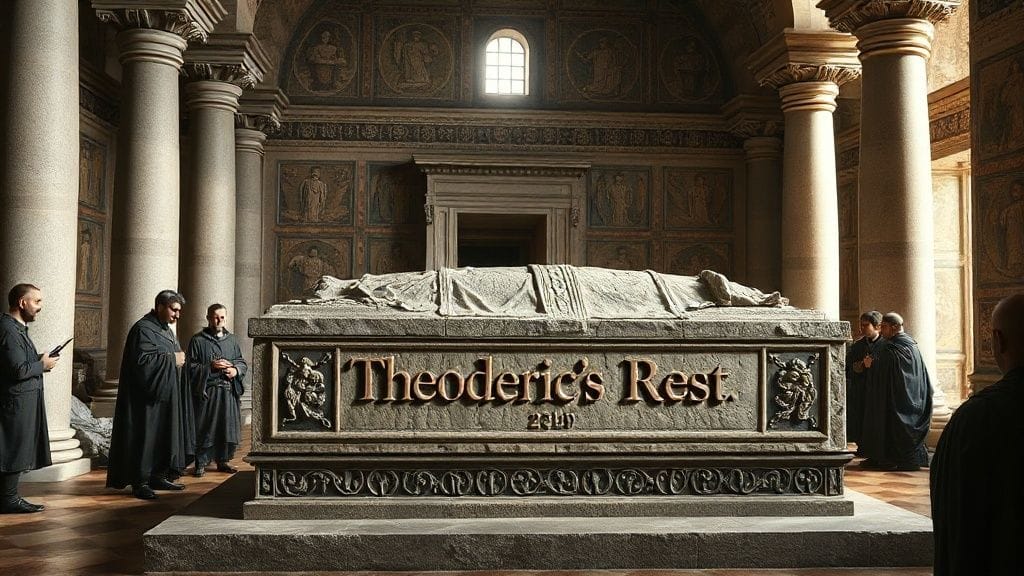
Following his death, Theoderic was interred in what would become one of the most striking monuments of early medieval Europe: the Mausoleum of Theoderic. Situated near Ravenna, this tomb is an architectural marvel, built from a single massive stone and adorned with intricate symbolism that spoke of power, eternity, and divine favor.
The mausoleum stands today as a silent testament to Theoderic’s vision—a fusion of Gothic strength and Roman artistry. Its preservation through centuries of change underscores the enduring impact of the king’s legacy and Ravenna’s historical significance.
Theoderic’s Legacy: Architect of Unity or Relic of a Bygone Era?
When we contemplate Theoderic’s death, the question arises: what legacy did he leave behind? Was he a unifier who bridged the divide between Roman civilization and barbarian kingdoms, or was he a defiant relic clutching to fading power?
History suggests a nuanced answer. His reign brought relative peace and cultural flourishing in a turbulent time. Yet his death marked the beginning of decline. The fragile Ostrogothic kingdom could not survive long without its master’s forceful guidance, and Roman-Byzantine ambitions soon seized Italy once again.
Ravenna after Theoderic: From Gothic Capital to Byzantine Prize
The years following Theoderic’s death were tumultuous. Ravenna, once the gleaming capital of an Ostrogothic renaissance, became a prize coveted by the Eastern Roman Empire. The Gothic War (535–554), initiated by Justinian, uprooted the fragile order Theoderic had imposed, reshaping Italy’s political landscape.
Ravenna’s shifting fortunes mirror broader Mediterranean transformations—from barbarian kingdoms to Byzantine reconquest—highlighting how Theoderic’s interlude was both remarkable and transient.
The Fragility of Power: Succession and the Gothic Kingdom’s Demise
Theoderic’s successors struggled to maintain cohesion. His grandson Athalaric, and later daughter Amalasuintha acting as regent, faced internal dissension and external threats. The unity forged by Theoderic’s personality and power was never institutionalized deeply enough to endure.
The court intrigues and factionalism that followed his death exposed the kingdom’s fragility. It was a cautionary tale of how personal rule, no matter how brilliant, can fail without strong structural foundations.
Memory in Stone: Theoderic’s Mausoleum and Its Symbolism
The mausoleum stands not merely as a tomb but as a message etched in stone. Its design blends Roman architectural elements with Gothic style, symbolizing Theoderic’s identity and political philosophy.
The massive monolithic roof, colossal in scale, conveyed durability and strength. The burial site became a pilgrimage of sorts—a reminder of a ruler who dreamed of unity beyond ethnicity, culture, and faith.
Political Reverberations: Italy and the Mediterranean after 526
Theoderic’s death accelerated seismic shifts. Italy became a battlefield among empires and tribes, from Ostrogoths to Byzantines, Lombards, and Franks. Theoderic’s political equilibrium gave way to centuries of conflict and realignment.
The Mediterranean itself was reshaped, as the Eastern Roman Empire under Justinian sought to restore its fading dominion, setting the stage for medieval Europe’s political boundaries.
Cultural Echoes: Art, Law, and Architecture under Theoderic
Despite political upheavals, Theoderic’s reign left a profound cultural impact. Law codes blending Roman and Gothic traditions influenced subsequent jurisprudence. Artistic achievements—particularly Ravenna’s mosaics—remain among the period’s greatest cultural treasures, revealing an epoch where barbarian and classical worlds intertwined.
His patronage allowed for a unique hybrid culture that bridged the ancient and the medieval, influencing generations of artists, scholars, and rulers.
Theoderic in Historical Perspective: Hero, Tyrant, or Enigma?
Historians have long debated Theoderic’s character. Procopius paints a darker portrait—accusing him of tyranny—whereas Cassiodorus and others emphasize his wisdom and justice. This duality makes Theoderic both a hero of synthesis and a figure of intrigue.
Was he a visionary king, a brutal conqueror, or a complex man caught between worlds? The answer likely lies in the tension between these truths.
Modern Reflections: Theoderic’s Place in Italy’s National Identity
In modern Italy, Theoderic occupies a curious niche—not quite Roman, not fully barbarian—a symbol of Italy’s deep historical layering. Theoderic’s story invites reflection on identity, unity, and the meaning of power across cultural frontiers.
Ravenna’s preservation of his monuments nurtures a collective memory that transcends eras, reminding us of the fragile bridges history builds between peoples.
Conclusion: The End of an Era and the Dawn of Transformation
The death of Theoderic the Great on August 30, 526 was more than the passing of a king; it was the close of a chapter in European history. His life and reign represented a fleeting moment of concord and cultural richness amid the fractured post-Roman world.
Yet, as his body rested beneath Ravenna’s skies, the kingdom he forged teetered on the edge of dissolution. The future belonged to change—wars, invasions, and transformations that would remake Italy and the continent itself.
In remembering Theoderic, we glimpse the complexity of power, the resilience of culture, and the profound human dramas nestled within the folds of history—a legacy that is as inspiring as it is cautionary.
FAQs
Q1: Who was Theoderic the Great, and why is his death significant?
Theoderic was the king of the Ostrogoths and ruler of Italy from 493 to 526. His death marked the end of a relatively stable Gothic kingdom that bridged Roman traditions with Gothic rule, and it precipitated political turmoil in Italy.
Q2: What caused Theoderic’s death?
Historical sources suggest Theoderic suffered a prolonged illness, possibly gout or diabetes. His physical decline was accompanied by political instability at his court.
Q3: Where was Theoderic buried?
He was buried in the famous Mausoleum of Theoderic in Ravenna, an architectural monument combining Gothic and Roman styles.
Q4: How did Theoderic’s death affect the Ostrogothic kingdom?
It led to instability and internal conflicts that weakened the kingdom, opening the door for Byzantine reconquest under Justinian.
Q5: What was Ravenna’s role during Theoderic’s reign?
Ravenna was the capital of his kingdom, a vibrant city symbolizing the fusion of Roman and Gothic culture.
Q6: How is Theoderic remembered in modern history?
He is viewed as a complex figure: a skilled statesman and warrior who achieved cultural synthesis but whose death exposed the vulnerabilities of his kingdom.
Q7: What cultural legacies did Theoderic leave behind?
He patronized the arts, architecture, and legal reform, leaving a rich hybrid cultural footprint exemplified by Ravenna’s mosaics and his mausoleum.
Q8: Did Theoderic’s religious beliefs influence his rule?
Yes, as an Arian Christian amidst a predominantly Catholic population, he pursued a policy of religious tolerance to maintain peace.