Table of Contents
- From Imperial Sunlight to Gathering Shadows: The Empire on the Eve of 391
- Theodosius the Emperor and the Cross: A Ruler Shaped by Faith and War
- An Aging Pantheon: Paganism’s Place in the Fourth-Century Roman World
- The Long March toward Intolerance: Laws before 391
- Year of the Turning Tide: Theodosius I’s Edicts against Paganism in 391
- Idols in Chains: Temples, Altars, and the Physical Destruction of the Old Gods
- The Altar of Victory Falls: Elites Caught between Tradition and the New Faith
- Alexandria in Flames: Serapeum, Riots, and the Theater of Holy Zeal
- Voices of Loss and Defiance: Pagan Intellectuals and the Last Defenders of the Gods
- Law, Fear, and Everyday Life: How Ordinary People Lived the Edicts
- Bishops, Monks, and Magistrates: Who Enforced the War on Pagan Rites?
- Between Text and Reality: Were the Edicts a Total Religious Revolution?
- An Empire Reimagined: Political and Social Consequences of Religious Uniformity
- Memory Wars: How Christians and Pagans Remembered Theodosius
- Long Echoes of 391: From Late Antiquity to the Idea of Christendom
- Conclusion
- FAQs
- External Resource
- Internal Link
Article Summary: In 391, a series of decisive laws, known collectively as theodosius i edicts against paganism, marked a turning point in the religious history of the Roman Empire. This article follows the empire from its twilight of many gods to the harsh midday glare of an officially Christian state, tracing how legislation reached into temples, homes, and hearts. It explores the emperor’s biography, the fragile state of paganism, and the slow tightening of legal controls that culminated in the ban on sacrifices and public cults. Through vivid scenes in Rome and Alexandria, we witness the drama of falling statues, shuttered shrines, and the brave or desperate voices that tried to resist. Political interests, episcopal ambition, and popular fervor intertwine, revealing that theodosius i edicts against paganism were as much about power as about piety. The narrative also considers how far these laws were truly enforced, questioning whether they instantly remade religious life or only started a longer process of transformation. Finally, it follows the echoes of 391 through medieval Christendom and modern debates about tolerance, showing how theodosius i edicts against paganism became a symbol, both praised and condemned, of the first Christian empire.
From Imperial Sunlight to Gathering Shadows: The Empire on the Eve of 391
In the last decade of the fourth century, the Roman Empire still stretched from the sun-scorched deserts of Egypt to the damp frontiers along the Rhine and Danube. Marble forums glittered in the light, and processions still wound through cities built under Augustus and Hadrian. Senators in purple-striped tunics discussed tax reforms beneath painted ceilings, while merchants bargained over spices and silks arriving from as far as India and China. On the surface, it was the same empire that had ruled the Mediterranean for centuries.
Yet beneath that bright façade, the world of the Roman gods was dimming. In some cities, smoke from sacrifices still curled up into the morning air; in others, the altars were already cold, grass reclaiming the stones where once bulls had bled for Jupiter and Artemis. Old men remembered the great games and processions of their youth; their grandchildren, baptized in church fonts, knew the psalms better than the hymns to Apollo. Between the columns of the Forum and the arches of distant provincial towns, tensions crept quietly into daily life.
At the heart of this transformation stood a man from Hispania, elevated to imperial purple in a moment of crisis: Theodosius. His rise coincided with a new and uncompromising Christian confidence. By the 380s, Christianity was no longer a persecuted sect hiding in catacombs. It was the religion claimed, guarded, and wielded by emperors. A generation earlier, Constantine had favored Christian bishops and endowed churches. Now, under Theodosius, a different question was being asked: not whether Christian worship should be tolerated, but whether pagan worship should be permitted to survive at all.
In law books copied in neat script by imperial scribes, a series of brief Latin sentences began to accumulate—a prohibition here, a penalty there. At first glance, they seemed technical, even dull. But their implications were immense. By 391, these clauses would crystallize into theodosius i edicts against paganism, laws that would declare the traditional rites of Rome illicit, even criminal. To contemporaries on all sides of the religious divide, it felt like watching the sun slip behind a mountain, the landscape still half-lit but already changing shape.
This was not simply a matter of theology. The edicts struck at the social fabric that had bound cities and provinces together for centuries. What did it mean to be a citizen of the Roman world if the festivals that had once defined communal life were labeled superstitions or crimes? Could an empire, long accustomed to including many gods and many peoples, survive the attempt to unify belief under a single, exclusive faith? The stage was set for a collision of traditions, ideologies, and human fears that would make the year 391 one of the most fateful in Roman—and indeed in European—history.
Theodosius the Emperor and the Cross: A Ruler Shaped by Faith and War
Theodosius did not begin his life as the hammer of the old gods. Born around 347 in Hispania, he grew up on the western fringes of the empire, the son of a respected general, Theodosius the Elder. His childhood was shadowed by the clash of legions and the murmur of Latin prayers. By the time he reached adulthood, the empire had been Christian for more than a generation, at least in theory. Yet the Christianity of his youth was still jostling among rival bishops, creeds, and local traditions.
He first made his name on the battlefields of Britain and along the Danube. Barbarian incursions, frontier collapses, and the disintegration of central authority followed the catastrophic defeat of Emperor Valens at Adrianople in 378. It was in this moment of panic that Theodosius was summoned east and elevated as co-emperor by Gratian. The empire, teetering between recovery and ruin, handed him a desperate mandate: restore order, restore unity, and hold the frontiers.
This experience colored everything that followed. Theodosius understood power in military terms: discipline, unity, and clear chains of command. He carried this outlook into religious policy. To a soldier steeped in the ethos of loyalty and obedience, the cacophony of conflicting Christian theologies and the lingering presence of pagan cults might appear not as charming diversity, but as dangerous fractures in the body politic.
The emperor’s personal faith was shaped as much by politics as by piety. In 380, together with Gratian and Valentinian II, he issued the edict known as Cunctos populos, declaring Nicene Christianity—the belief in the consubstantial Trinity articulated at the Council of Nicaea—as the only legitimate form of Christian doctrine in the empire. This move placed him firmly on the side of bishops such as Ambrose of Milan, who envisioned a tightly defined orthodoxy under imperial protection. It was a sharp signal: the emperor would no longer stand above theological quarrels as a neutral arbiter; he would choose a side.
Yet even then, Theodosius was not openly at war with paganism. Pagans still held high office. The senate in Rome was still largely attached to the old rites. But his conception of imperial unity could not forever coexist with a religious landscape that included multiple gods and multiple claims to transcendence. For Theodosius, Christianity was not simply a personal creed; it was the ideological glue that could keep the battered empire together. His later decisions would flow from that conviction, with a severity that astonished even some Christians of his age.
Like many emperors, he saw omens in military fortunes. Victories against Gothic and other barbarian groups were read as divine favor; setbacks were interpreted as chastisements from the Christian God. When he marched under the sign of the cross and returned alive from brutal campaigns, it seemed to confirm a narrative: that the empire’s fate was now inextricably tied to one God, one faith, one church. In that story, pagan sacrifices were not quaint survivals; they were provocations, invitations for divine wrath, remnants of a past that threatened the future he hoped to secure.
An Aging Pantheon: Paganism’s Place in the Fourth-Century Roman World
To imagine the world Theodosius inherited, one must picture an empire filled with overlapping religious landscapes. Temples to Jupiter and Juno still towered over urban skylines, their columns fluted and majestic. Shrines to local deities dotted countryside roads: springs dedicated to nymphs, groves sacred to obscure gods of place, household altars smoky with modest offerings of wine and incense. Mystery cults of Isis, Mithras, and Cybele thrived in ports and garrison towns, promising salvation and esoteric knowledge to those initiated into their rites.
Yet this sprawling religious ecosystem was not as robust as its stones suggested. For more than a century, traditional Roman polytheism had been under pressure. Philosophical elites were increasingly drawn to Neoplatonism, a system of thought that could reinterpret the many gods as emanations of a single, transcendent principle. Such thinkers, like the famed Iamblichus or later Proclus, did not abandon the gods, but they understood them in abstract, metaphysical terms. Rituals persisted, but their meanings shifted, becoming more symbolic, more esoteric, less obviously tied to the rough-and-tumble of civic life.
Christianity, meanwhile, was spreading not only among the poor and marginalized, but also among the urban middle classes and sections of the aristocracy. In some cities, a Christian basilica stood within sight of the old temples, its interior humming with psalms while the priests of the older cults struggled to attract donors. In rural areas, paganism remained stronger, woven into the agricultural calendar, the cycle of sowing and harvest, the fear of droughts and plagues. This rural persistence would later give rise to the stereotype—never entirely fair—that “paganus,” a villager, was synonymous with “pagan.”
Under emperors like Constantius II and later Valentinian I, pagan rites had already been nudged to the edges of public life. Imperial funds for temple maintenance were cut or redirected. Harsh laws were occasionally passed against sacrifices, only to be only partially enforced or quietly ignored. Pagan senators in Rome, many of them fabulously wealthy, did what Roman elites had always done: they adapted, maneuvered, and tried to protect their interests. Some sponsored both temples and churches, hedging their bets in an uncertain spiritual marketplace.
Still, the old religious system carried immense emotional weight. Public sacrifices were intertwined with civic identity. Victory processions, dedication ceremonies, and many elements of judicial and military rituals were bound up with the invocation of the gods. To forbid sacrifices was not simply to suppress a set of theological beliefs; it was to unpick the threads of a culture’s daily life. People married, buried their dead, and marked the passage of time within this sacred framework. That is why the shock of theodosius i edicts against paganism would reverberate so profoundly: they would strike at the habits by which Romans understood themselves as Romans.
For pagans, the empire’s increasing Christianization was a source of bewilderment, anger, or desperate rationalization. Some, like the senator Symmachus, argued that multiple cults had always coexisted in Rome, and that this plurality was precisely the secret of Rome’s greatness. Others took refuge in philosophy, persuading themselves that the Christian God was merely another name for the highest principle, and that the rites of the old gods could be harmonized with this reality. But as the fourth century wore on, such strategies became harder to sustain. The empire’s rulers were no longer impartial guardians of all cults. They were Christian emperors, and that fact would increasingly shape the fate of every altar and every statue in their dominions.
The Long March toward Intolerance: Laws before 391
By the time the year 391 dawned, the legal groundwork for theodosius i edicts against paganism had already been laid. The story of 391 is not one of a sudden storm, but of a sky that had been darkening for decades. Earlier emperors—some fervently Christian, others more pragmatic—had experimented with restrictive measures against traditional cults. Each law was a push, sometimes subtle, sometimes brutal, in one direction: away from the gods of ancestral custom and toward the exclusive claims of the Christian deity.
Constantine, the first Christian emperor, had not outlawed pagan worship. He continued to use pagan imagery, to consult oracles on occasion, and to tolerate sacrifices performed by others, even when he did not personally participate. But he shifted patronage decisively toward the church, showering bishops with gifts, granting them tax exemptions, and allowing them jurisdiction over some legal disputes. The scales of imperial favor were tilted, and although sacrifices were not yet criminalized, they no longer enjoyed the unchallenged support of the state.
Under Constantius II, in the mid-fourth century, explicit bans on sacrifices appeared. Laws issued in the 350s condemned sacrifices as impious and treasonous, especially when performed for divinatory purposes, such as trying to discover the future of emperors. Yet these measures were unevenly enforced, often limited to political contexts. Divination that could be interpreted as plotting against the emperor attracted severe punishment; more ordinary rituals might still be overlooked. Imperial bureaucracy, vast and often sluggish, struggled to fully translate edicts into everyday realities.
Julian, known as “the Apostate,” briefly reversed this current in the early 360s, restoring many pagan cults and attempting to rebuild a philosophically sophisticated form of polytheism. But his reign was short, and his death in Persia in 363 allowed his Christian successors to frame his experiment as a failed, almost blasphemous detour. Thereafter, paganism increasingly appeared in Christian narratives as a decaying, doomed system.
Valentinian I and Valens, ruling in the 360s and early 370s, adopted a more cautious approach. They did not support paganism actively, but they refrained from an all-out crusade against it. Their reigns show an empire where Christians and pagans still shared public space, where the old rituals survived but no longer basked in the full radiance of imperial favor. It was in this context that the young Theodosius learned statecraft: a world where traditional cults still existed, but their future was precarious, their legal status ambiguous.
By the time Theodosius became emperor in the East in 379, the accumulation of laws against certain sacrificial and divinatory practices created a clear trajectory. He did not invent the idea of legislating religious practice; he inherited it. The question was not whether emperors could regulate worship, but how far they would go. In 380 and 381, Theodosius concentrated mainly on defining Christian orthodoxy, banning Arian and other heretical interpretations of the faith. Yet these same habits of control—the issuing of edicts, the deployment of state power in religious disputes—would soon be turned with growing force against those who still served the traditional gods.
Year of the Turning Tide: Theodosius I’s Edicts against Paganism in 391
Against this long backdrop, 391 stands out like a thunderclap. In that year, Theodosius issued a set of laws that, taken together, would be remembered as theodosius i edicts against paganism. Preserved in the Codex Theodosianus, a compilation of imperial legislation assembled in the fifth century, these texts are terse, almost cold, in their legal Latin. But the world they sought to reorder was warm, noisy, and deeply human.
In February 391, from the imperial court, Theodosius decreed that no one, under any circumstance, was to perform sacrifices, visit temples for worship, or practice any form of public pagan cult. The text stripped away previous ambiguities. No more could an official claim that he tolerated sacrifices out of respect for local traditions; no more could a city quietly continue festivals under the polite fiction that they were “mere customs.” The law forbade the burning of incense before statues, the adornment of household shrines with garlands, and the offering of libations—even within private homes—when these acts were understood as religious worship.
Another law, directed specifically at the prefects and governors, ordered that temples be closed. Their doors, which had once opened to the smell of sacrificial smoke and the murmur of supplicants, were to be sealed shut. The edicts did not, in most cases, mandate outright demolition; the empire was too full of temples to raze them all without provoking logistical chaos and resistance. Instead, the strategy was to suffocate the cults: ban their public rites, cut off the legal and social oxygen that kept them alive.
Punishments were severe. Those who violated the edicts risked confiscation of property, heavy fines, and even death in extreme cases, especially if they were seen as leading or organizing prohibited rites. Officials who failed to enforce the laws could themselves be punished. The emperor’s words reached out along the arteries of imperial administration into city councils, garrisons, and village assemblies. How far this hand actually extended is another question, but the intention is unmistakable: to sever the bonds between Roman identity and the ancient cults of the gods.
To Christians, especially committed bishops and ascetic monks, this seemed a moment of vindication. For generations they had preached against “idols,” denouncing the sacrifices as demonic. Now the emperor himself appeared to agree. Theodoret of Cyrrhus, writing in the fifth century, would later celebrate Theodosius as a champion who “abolished the madness of paganism” and “purified the earth of sacrificial smoke.” To such writers, theodosius i edicts against paganism were milestones in the long war between the true God and the false gods.
For pagans, the same laws were experienced as a kind of state-sponsored amnesia, a command to forget their own past. Imagine a priest of Jupiter, aging but dignified, now told that the rites he had performed all his life were illegal. Imagine a family who had always marked weddings by offering incense at a local shrine, waking to find that this simple, tender act might bring ruin upon them. In legal terms, the edicts were short; in human terms, they were enormous.
The impulse behind them was not solely religious. By 391, Theodosius had been hardened by civil war, particularly his conflict with the usurper Magnus Maximus in the West. After defeating Maximus in 388, he had consolidated his authority, but the memory of usurpation lingered. Unified Christian orthodoxy, backed by decisive legislative gestures, offered a powerful tool of control. The same laws that criminalized pagan rites also signaled loyalty: to disobey them was not only to challenge the church, but to defy the emperor. Political stability and religious uniformity were, in Theodosius’s eyes, parts of the same project.
Idols in Chains: Temples, Altars, and the Physical Destruction of the Old Gods
Law alone cannot tear down a temple, but it can unleash those who are willing to do the work. Once theodosius i edicts against paganism condemned sacrifices and ritual visits to temples, the buildings themselves became contested spaces. Were they to stand as silent monuments, stripped of cult, or to be transformed and destroyed, their stones repurposed in service of the Christian God?
Across the empire, the answer varied. In many cities, temples were hastily locked, their doors barred by nervous officials fearful of being accused of leniency. Statues of gods were left in the dark, their painted eyes staring into silence. In other places, especially where Christian bishops wielded strong influence, zeal went further. There are accounts of statues toppled, altars smashed, and temple precincts invaded by chanting monks carrying crosses and relics.
Some temples were converted into churches. The architectural logic was often irresistible: a spacious, central building in a prime location could easily be adapted for Christian worship. Marble altars dedicated to Jupiter or Venus were stripped of their inscriptions, perhaps rotated or re-cut, and reinstalled as Christian altars. Friezes depicting mythological scenes were plastered over or reinterpreted allegorically—Hercules’s labors becoming, in a sympathetic Christian’s eye, a symbol of spiritual struggle, even if no official theology sanctioned such readings.
Other temples suffered cruder fates. Stones were carted away for new civic buildings or fortifications. In North Africa and the Near East, where earthquakes and climate wore heavily on structures, abandoned sanctuaries quickly decayed into picturesque ruins. Children played among the fallen columns, scarcely aware that these stones had once framed the most sacred spaces of their grandparents’ world.
The violence was not always initiated from above. In some regions, militant monks and lay Christians took the edicts as a license to act. They marched into rural shrines, overturned sacrificial tables, and smashed idols with an almost ecstatic fervor. Bishops sometimes tried to restrain this energy, fearing that uncontrolled mobs might stir up civil unrest or provoke reprisals against Christian minorities. At other times, they quietly encouraged it, treating the demolition of temples as a spectacle of piety. The physical landscape of the empire became a canvas on which the new faith wrote its triumph, often literally inscribing crosses over erased dedications to the old gods.
Yet the picture is not simply one of one-sided destruction. In some cities, local elites negotiated compromises, preserving aesthetically valuable temples as public monuments or museums of sorts, empty of rituals but rich in art. Pagan artisans continued to carve classical motifs, now reinterpreted as decorative rather than sacred. The stones survived, but their meanings were displaced. In this sense, theodosius i edicts against paganism did not only destroy; they also initiated a long, complex process of cultural recycling in which the material heritage of paganism was appropriated into a new Christian story.
The Altar of Victory Falls: Elites Caught between Tradition and the New Faith
Long before 391, one particular object had come to symbolize the struggle between old and new: the Altar of Victory in the Roman Senate. Set up under Augustus, this altar, crowned by a winged statue of Victory, had witnessed centuries of debates, oaths, and legislative rituals. Senators would sprinkle grains of incense upon it before taking their seats, acknowledging the goddess who had blessed Rome’s conquests.
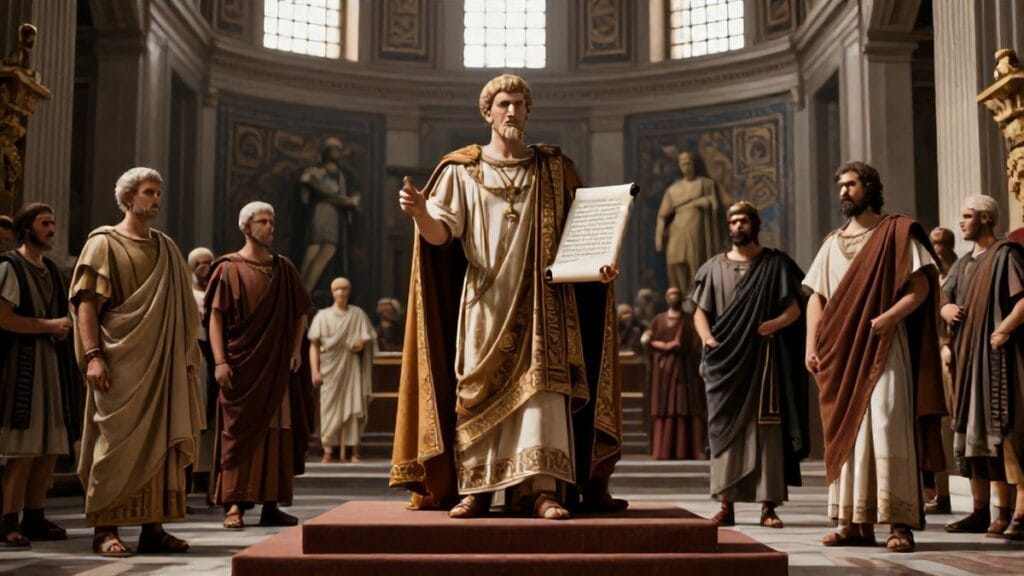
In the 380s, the fate of this altar became a litmus test for imperial policy. The Christian emperor Gratian ordered it removed from the Senate house, provoking a storm of protest from pagan senators led by Quintus Aurelius Symmachus. Symmachus composed an eloquent petition, pleading for the restoration of the altar. “We ask for peace for the gods of our fathers,” he argued, insisting that Rome’s greatness had been built under the gaze of these deities and that to abandon them was to sever the empire from its own history. His argument was one of continuity and pluralism: let many cults flourish, and the empire will be strong.
Ambrose of Milan, the formidable Christian bishop who wielded enormous influence over Theodosius, wrote a counter-petition. To restore the altar, he insisted, would be to betray Christ and to encourage idolatry. Ambrose’s tone was uncompromising. He went so far as to suggest that the emperor’s salvation depended on refusing the senators’ request. Between Symmachus’s dignified defense of tradition and Ambrose’s severe theology, Theodosius made his choice: the altar would not return.
This episode, occurring slightly before the full force of theodosius i edicts against paganism, reveals the new balance of power. The pagan aristocracy, still wealthy, educated, and proud, discovered that their arguments about custom and heritage carried less weight than the moral authority claimed by bishops. While the Altar of Victory controversy did not itself outlaw pagan rites, it sent a clear message: the old symbols of Roman state religion were no longer welcome at the heart of government.
For pagan senators, the loss of the altar was both a spiritual and a personal humiliation. Their public identity was deeply tied to the rituals of the Senate, to the idea that Rome’s destiny was guided by the old gods. Now, to enter the Senate house was to step into a space redefined by Christian norms. Some adapted, converting to Christianity publicly while privately harboring nostalgia or even clandestine devotion to the gods. Others clung stubbornly to the old ways, at least in their villas and country estates, knowing that the world they loved was slipping away.
The Altar of Victory became a memory, a contested symbol cited in later centuries as a moment when paganism made its last, eloquent stand in the corridors of power and was gently but firmly pushed aside. When theodosius i edicts against paganism arrived, many of these same elites would feel that history was repeating itself, but now on a grander, more unforgiving scale.
Alexandria in Flames: Serapeum, Riots, and the Theater of Holy Zeal
If Rome’s Senate house was the stage for a symbolic defeat of paganism, Alexandria offered a far more violent theater. The cosmopolitan Egyptian city, with its hall-of-fame roll call of philosophers, scientists, and scholars, was also home to the Serapeum, a grand temple complex dedicated to Serapis. This hybrid deity, blending elements of Greek and Egyptian religion, had long been a focus of devotion and civic pride. The Serapeum loomed over the city, a sacred and intellectual landmark.
Tensions in Alexandria had been simmering for years. Christians, Jews, and pagans jostled for influence, and civic disputes often flared into street fights. In 391, shortly after the promulgation of theodosius i edicts against paganism, a violent confrontation erupted. According to accounts like those of the church historian Socrates Scholasticus, some pagans, enraged by Christian attacks on their shrines and images, barricaded themselves inside the Serapeum. They took hostages, some of whom they are said to have forced to participate in pagan rites.
The situation escalated quickly. The imperial prefect, faced with this standoff, feared that a brutal assault on the temple might plunge the city into chaos. Theodosius was consulted. The answer that came back from the emperor aligned with his broader policy: those who had committed acts of violence could receive clemency if they surrendered, but the temple itself was to be destroyed. The Serapeum, once one of the wonders of the Mediterranean world, was doomed.
Christian sources describe the demolition with something like awe. Cross-bearing crowds surged into the temple precincts, toppling the massive statue of Serapis. Some accounts, almost theatrical in their details, describe how the statue’s head shattered, releasing a swarm of rats—interpreted as a sign of the god’s impotence and corruption. Floors were ripped up, altars smashed, and the sacred spaces defiled. The temple was systematically stripped and then, in part, leveled. A church would later rise over its ruins.
For Christians, the fall of the Serapeum was proof that the gods were nothing, that the cross had triumphed not only in councils and courtrooms but in the very stones of the city. For pagans, it was utterly traumatic. One can imagine elderly priests watching from a distance as the rituals they had guarded for decades were annihilated in a few days of rage and jubilation. The destruction was not only religious; it was cultural, extinguishing a center of learning and symbol of Alexandrian identity.
The Serapeum’s fate shows how theodosius i edicts against paganism interacted with local tensions. Laws were one thing; their application on the ground another. In Alexandria, existing rivalries and animosities magnified the impact of imperial decrees. Zealots took the edicts as authorization. Officials, seeking to maintain favor with the emperor and the powerful bishop Theophilus, leaned into the new policies. The result was an event that burned itself into memory—a conflagration of stone and faith that later writers would both celebrate and mourn.
Voices of Loss and Defiance: Pagan Intellectuals and the Last Defenders of the Gods
Not all resistance to theodosius i edicts against paganism took the form of barricades and riots. Some of the sharpest and most poignant responses came from pagan intellectuals, men and women steeped in classical learning who wielded pen and voice rather than sword or torch. They found themselves stranded between admiration for the empire that had nourished their culture and grief at the religious transformation it was undergoing.
One of the most famous among them was the orator Libanius of Antioch. A friend of the late emperor Julian and an admirer of the classical tradition, Libanius watched with increasing horror as temples were closed and monks rampaged through rural sanctuaries. In his oration “Pro templis” (“In Defense of the Temples”), delivered around 386 but still intensely relevant after 391, Libanius condemned the destruction of temples, arguing that they were beloved not only by pagans but by many ordinary citizens, regardless of belief. He portrayed temple-razing monks as bandits in religious garb, disturbers of civic peace.
Libanius’s plea was subtle. He did not openly defy the emperor or deny the power of the Christian God. Instead, he argued from the perspective of public order and cultural heritage. Temples, he said, were part of the cities themselves, “the ornaments of the world.” To tear them down was to impoverish the empire both aesthetically and spiritually. His oration reveals a world where some educated pagans still hoped that an appeal to Roman ideals of moderation and pluralism might slow the tide of change. But the law was moving in the opposite direction.
In Rome, Symmachus picked up a similar tune, insisting that there was wisdom in the traditions of the ancestors. “We gaze upon the same stars, the sky is common to us all,” he wrote, suggesting a shared natural religion that Christians and pagans might both acknowledge. His words, preserved later by Christian authors like Ambrose who quoted them in order to refute them, have the tone of a dignified but increasingly desperate defense. He sensed that he was arguing not just for an altar, but for an entire way of understanding the sacred woven into the state.
Other figures, less famous but no less passionate, turned inward, cultivating philosophical schools that tried to keep the old gods alive in the realm of metaphysics and myth. Neoplatonist centers in Athens and elsewhere continued to teach about the gods as manifestations of divine intelligences, even as their public cults were suppressed. Hypatia of Alexandria, a later figure but shaped by this same milieu, would inherit this intellectual paganism: more a religion of books and reason than of blood and smoke, and all the more vulnerable for its distance from popular practice.
These voices did not stop the laws. Theodosius did not rescind the edicts. But the writings of Libanius, Symmachus, and others ensure that the story of 391 is not told only from the perspective of triumphant Christianity. Through their words, we glimpse the sorrow and indignation of those who felt their world being dismantled piece by piece. “It is not only the statues that you break,” one can almost hear them say, “but the memories and hopes of generations.”
Law, Fear, and Everyday Life: How Ordinary People Lived the Edicts
Laws often seem grand and abstract in the pages of legal codes, but their true meaning emerges in kitchens, marketplaces, and quiet corners of private homes. How did theodosius i edicts against paganism reshape ordinary lives? The answer is complex, varying by region, class, and personal conviction, but certain patterns emerge from the scattered evidence of letters, sermons, and later histories.
In major cities where bishops wielded influence and Christian populations were large, the edicts likely had the most immediate effect. Temple festivals that had once punctuated the year were canceled or dramatically reduced. Processions honoring local deities no longer paraded through the streets with music and garlands. Artisans who had made a living crafting religious images or supplying sacrificial animals saw their market dwindle. A butcher who once derived much of his income from temple offerings might have to find new customers or shift to supplying Christian households and charitable institutions.
In some families, the edicts caused generational rifts. Younger members, already Christianized, might welcome the suppression of “superstition,” while elders mourned the rituals that had given shape to their lives. Imagine a grandmother who had always lit a small lamp before a household statue of the Lares, the spirits of the ancestors, now warned that such acts could be seen as illegal worship. Perhaps she continued to slip a pinch of incense onto the coals at dawn, doing so in secret rather than with the open pride of earlier years. Fear crept into acts that had once been simply expressions of affection toward the divine.
In rural areas, the story was different. There, imperial decrees filtered slowly through layers of administration. Local landowners, some still pagan, might choose to ignore or minimize the new laws, especially if no zealous bishop or official was pressing for enforcement. Rural festivals, harvest rituals, and old superstitions likely persisted behind a façade of Christian conformity. People might baptize their children in village churches and still whisper protective charms to their old gods at night. The boundary between “pagan” and “Christian” practice was not always clear, and the edicts, for all their severity, could not instantly redraw these lines in every hamlet.
Fear of denunciation, however, was real. Some Christians, eager to prove their zeal, reported neighbors or local officials suspected of covert pagan practices. Preachers thundered from pulpits against syncretism, warning that God’s wrath would fall on communities that tolerated idols in their midst. Pagans learned to speak cautiously, to cloak their loyalties. In the marketplace, jokes about the gods might fall silent as a stranger approached. The social trust that once allowed open religious banter was eroded.
Not everyone experienced the edicts as tragic. For many Christians, especially those who had grown up facing mockery or marginalization from pagan majorities, 391 felt like a long-awaited vindication. Now, when they processed through the streets on saints’ days, there were no longer rival processions to the temples. The sounds of hymns, not flutes and drums for Dionysus or Cybele, dominated the soundscape. A new calendar, structured around Christian feasts, began to replace the old system of civic festivals. In the lived experience of time itself, the empire was being remade.
Bishops, Monks, and Magistrates: Who Enforced the War on Pagan Rites?
An edict, however severe, remains ink on parchment unless someone enforces it. In the case of theodosius i edicts against paganism, the actors on the stage included not only imperial officials, but also bishops and monks who saw themselves as guardians of Christian purity. Their relationships were complicated—sometimes cooperative, sometimes tense—but together they shaped how the laws played out across the empire.
Provincial governors and city magistrates were the formal executors of imperial will. They received the laws, posted them publicly, and were expected to investigate violations. Yet many of these officials were themselves products of a world in which paganism had long been respectable. Some were still quietly attached to the old rites; others were lukewarm Christians or simply indifferent to religious matters. For such men, enforcing anti-pagan measures could be a distasteful duty, one they might perform minimally or delay in the hope that imperial attention would move elsewhere.
Bishops, by contrast, often approached the edicts with fervor. Men like Ambrose of Milan, Theophilus of Alexandria, and others in major sees understood that the laws offered them unprecedented leverage. They could petition governors to act against specific temples or festivals, citing imperial edicts as justification. When governors hesitated, bishops sometimes threatened to complain directly to the emperor, leveraging their spiritual authority and their ability to mobilize popular opinion. The boundary between ecclesiastical and civil power blurred.
Monks were the shock troops of this new religious order. From deserts of Egypt to the mountains of Syria, ascetic communities had long cultivated a counter-cultural identity, rejecting the comforts and compromises of urban Christian life. To many monks, pagan statues and shrines were not just wrong; they were demonic. When news of theodosius i edicts against paganism reached them, some interpreted the laws as an invitation, even a command, to wage physical war on the material symbols of paganism. Armed with sticks, stones, and iron bars, gangs of monks descended on rural sanctuaries, sometimes supported, sometimes merely tolerated by local bishops and officials.
This informal enforcement could alarm more cautious authorities. Rampaging monks could spark riots, damage property indiscriminately, and provoke counter-violence from pagans not yet reconciled to their loss of status. There are hints in some sources that certain governors tried to restrain such zeal, arguing that order, not chaos, was the emperor’s true desire. But the line between legitimate enforcement and enthusiastic excess was not clearly drawn, and in the heat of religious passion, that ambiguity often worked to the detriment of pagan sites and communities.
At the imperial court itself, advisers and bishops contributed to shaping Theodosius’s stance. Ambrose famously confronted the emperor after the massacre of Thessalonica in 390, insisting on penance before reconciliation. This episode has often been read as a moment when episcopal moral authority triumphed over imperial might. Whether or not the reality was so simple, it is clear that Theodosius listened to bishops, internalizing an understanding of his role as a Christian ruler charged with guarding not only the empire’s borders but also its doctrinal purity. The edicts thus emerge from a web of influences in which religious leaders and imperial magistrates were locked together in a project of transformation that neither could have fully controlled alone.
Between Text and Reality: Were the Edicts a Total Religious Revolution?
From a distance, and especially through the triumphalist lens of later Christian writers, theodosius i edicts against paganism can appear as a clean break: one year there were sacrifices, the next there were none. But history is rarely so straightforward. When we look more closely, through fragmentary local evidence and the hints preserved in later chroniclers, we see a more uneven, ambiguous picture—a mosaic of enforcement and evasion, of outward conformity and inner resistance.
In some regions, notably parts of the East with strong episcopal structures and large Christian populations, the edicts likely caused drastic changes. Public sacrifices ceased visibly. Temples were closed or repurposed. Civic rituals were rapidly Christianized or abandoned. The social prestige of pagan priests declined sharply. For those living in such areas, the laws may well have felt like an almost overnight revolution.
Elsewhere, the impact was slower. Archaeological evidence in some rural areas shows pagan dedications and altars being used well into the fifth century, suggesting that local cults persisted under the radar of official scrutiny. The empire’s vast geography, its patchwork of languages and cultures, made it difficult for even the most determined emperor to enforce absolute uniformity. Local magistrates might quietly ignore certain practices as long as they remained discreet and did not challenge Christian dominance in public space.
There is also the problem of sources. Much of what we know about this period comes from Christian writers, for whom the narrative of a decisive triumph over paganism held theological and rhetorical power. They had every incentive to present the edicts as more universally effective than they may actually have been. For them, ambiguity was inconvenient; clarity served the story of God’s victory. Pagan voices are rarer and often preserved only in snippets, quoted by their opponents or filtered through later Christian copyists.
Some modern historians argue that Theodosius’s laws were as much performative as practical—grand declarations meant to signal imperial piety and define norms rather than to erase pagan practice completely overnight. Legislation could set the direction of change, but the actual erosion of paganism would take decades, even centuries, shaped by local conversions, demographic shifts, and cultural blending. In this reading, 391 marks less the end of paganism than the point at which the state formally ceased to protect it.
Yet even if the reality on the ground was messy, the psychological and symbolic weight of the laws was immense. To declare a religion illegal is to alter its status in the collective imagination. Even if some continued to practice in secret, they did so under the cloud of potential punishment, stigma, and shame. Children grew up knowing that the gods of their grandparents were not simply different but forbidden, cast as enemies of God and empire alike. Over time, this redefinition of what was respectable, safe, and honorable in religious life would do its work, eroding the social base of the old cults even where the last sacrifices still smoldered in hidden places.
An Empire Reimagined: Political and Social Consequences of Religious Uniformity
Theodosius i edicts against paganism were not merely acts of religious policy; they were tools for reimagining the Roman Empire itself. By targeting the ancient cults that had once underpinned imperial ideology, these laws forced a profound transformation in how subjects related to their ruler, their communities, and their own past.
Politically, the edicts signaled that loyalty to the emperor was now entangled with loyalty to a particular religion. To be Roman and to be Christian were increasingly presented as overlapping identities. This shift did not instantly erase ethnic, regional, or linguistic differences, but it did provide a new overarching framework. Emperors would henceforth be judged not only by their military victories and administrative skills, but also by their orthodoxy and zeal in defending the church. Heresy, schism, and lingering paganism became not only theological problems but political threats.
This fusion of empire and church had tangible effects on governance. Bishops gained new authority, sitting alongside magistrates in councils, influencing imperial appointments, and sometimes even adjudicating civil disputes. Their sees became power centers, distributing charity, mediating conflicts, and speaking for their congregations. While the alliance between bishops and emperors was never without tension, it created a durable structure that would outlast the western empire itself: a Christian hierarchy integrated into the machinery of rule.
Socially, the edicts accelerated stratification between Christians and non-Christians. Pagans gradually found themselves excluded from certain offices or pressured—by law or by social norms—to accept baptism as the price of advancement. In some cities, conversion became as much a career move as a spiritual journey. Families balanced their convictions with their ambitions, weighing the cost of clinging to old gods against the lure of prestige in a Christianizing court.
At the same time, the suppression of pagan institutions affected networks of patronage that had long tied communities together. Temples had been centers of economic as well as spiritual life, employing workers, commissioning art, and redistributing resources. Their decline shifted economic flows toward churches and Christian charities. The poor, who might once have sought food or relief during pagan festivals, now turned increasingly toward bishops and monastic institutions, binding them emotionally and materially to the new religious order.
Culturally, the edicts contributed to a selective remembering and forgetting. Some aspects of the classical heritage—philosophy, rhetoric, certain literary works—were preserved and christianized. Virgil, for example, would be read as a kind of pagan prophet, foreshadowing Christian truths. Other elements, particularly the ritual and mythological content of paganism, were marginalized or demonized. Statues of gods became “demons” in Christian stories; the myths were recast as lurid tales of moral depravity. The empire did not stop looking back to its past, but it learned to view that past through new lenses, filtering it to fit a Christian narrative of providence.
Memory Wars: How Christians and Pagans Remembered Theodosius
After Theodosius’s death in 395, his body lay in state, surrounded by the symbols of imperial power he had wielded so decisively. His successors gratefully inherited a framework of law and ideology that treated Christianity as the soul of the empire. But his memory was not uncontested. How he was remembered depended on who was telling the story, and for what purpose.
Christian authors, especially those writing ecclesiastical histories, portrayed Theodosius as a model Christian emperor. Sozomen and Theodoret highlighted his piety, his support of orthodoxy, and his role in crushing both heretics and pagans. Theodoret, for example, wrote that Theodosius “extinguished the impiety of many gods, and made all men worship one God.” In such narratives, theodosius i edicts against paganism were strokes of righteous courage, comparable to the deeds of biblical kings who tore down idolatrous shrines in ancient Israel.
Bishops like Ambrose, in their letters and sermons, held up Theodosius’s submission to ecclesiastical discipline as proof that emperors should bow to the church in matters of faith. The story of Thessalonica—where Theodosius’s soldiers massacred civilians after a riot, and where Ambrose allegedly barred the emperor from communion until he repented—became a moral legend. Whether every detail is historically exact or not, the tale serves to cast Theodosius as both powerful and penitent, a monarch who ultimately recognized the higher authority of Christian ethics.
Pagan memory, by contrast, was bittersweet. Some pagan elites, having converted or at least outwardly conformed, learned to speak of Theodosius in cautious terms, praising his efforts to maintain order while privately mourning the laws that had shattered their old religious landscape. In the more defiant corners of pagan philosophy, Theodosius could be seen as a destroyer, a man who had allowed mobs to tear down the serene images of the gods and had thrust the empire into a narrow-minded zeal. Yet these critiques were rarely written openly; doing so would have been dangerous. Silence, evasion, and coded allusions were safer strategies.
In later centuries, as the Western Roman Empire fell and the Eastern (Byzantine) Empire evolved into a more explicitly Christian polity, Theodosius’s image hardened into that of a saintly lawgiver, the one who had driven the final nail into the coffin of paganism. Medieval chroniclers, looking back through the mists of time, often smoothed out the ambiguities, presenting 391 as the clear end of the old era. The messiness of gradual change, the persistence of local cults, and the human costs of coercion faded from view.
Modern historians have re-opened the case, examining legal texts, archaeological remains, and literary sources to redraw a more nuanced portrait. Some see Theodosius as a sincere believer whose efforts to align law with his faith inadvertently empowered extremists and provoked unnecessary suffering. Others emphasize his role as a pragmatic ruler who used religious policy to consolidate power, arguing that piety and politics were inseparable in his mind. Either way, his legacy remains controversial—a man remembered simultaneously as a defender of truth and as an architect of intolerance.
Long Echoes of 391: From Late Antiquity to the Idea of Christendom
Theodosius I could not have foreseen how far the ripples of his decisions would travel. Yet the framework he helped establish—an officially Christian empire that marginalized and criminalized rival cults—would echo throughout European and Mediterranean history. Theodosius i edicts against paganism set precedents that later rulers, bishops, and reformers would invoke, adapt, or resist.
In the fifth and sixth centuries, as Germanic kingdoms arose on former Roman soil, many adopted Christianity as a marker of legitimacy and civilization. The idea that a kingdom should have a single official faith, with alternative practices suppressed or tightly controlled, drew in part on the late Roman experience. Councils of bishops, legal codes, and royal decrees all show the stamp of an assumption that Theodosius had helped to normalize: that true religion and rightful government walk hand in hand.
In the Byzantine Empire, this pattern continued even more directly. Emperors convened church councils, legislated doctrine, and sometimes persecuted heresies with vigor. Paganism, once the dominant spiritual force of the Mediterranean, lingered mainly as a memory or as isolated superstition. Meanwhile, attitudes forged in the battles of the fourth century—particularly the habit of thinking in stark terms of “orthodoxy versus error”—shaped Christian responses not only to pagans but also to Jews, Samaritans, heretical Christians, and eventually Muslims. Intolerance, though it took different forms in different eras, found nourishment in the soil prepared by earlier state-church alliances.
Even the idea of “Christendom”—an interconnected realm of Christian polities in medieval Europe—owes something to the Theodosian settlement. When medieval popes and kings imagined themselves as heirs of the Christian Roman emperors, they drew on legal texts and historical memories that celebrated rulers like Theodosius as exemplars. The notion that the suppression of pagan practices was not merely permissible but praiseworthy became part of the ideological toolkit of missionary campaigns, crusades, and internal religious reforms.
Yet the legacy of 391 is not only one of repression. It also forced Christianity to grapple with power. Early Christians, persecuted minorities for centuries, had cherished certain words of Jesus about loving enemies and turning the other cheek. Once they held the levers of the state, they had to decide whether those ideals applied to policies toward religious others. The uneasy answers they found—alternating between mercy and coercion—have haunted Christian thought ever since. Theodosius’s age confronted questions that later theologians and reformers would revisit with urgency: Can a faith that preaches love truly be served by legal force? Is unity of belief worth the suffering of dissenters?
In modern times, as ideas of religious freedom and pluralism have gained ground, 391 often appears in histories as a cautionary tale. Some see in theodosius i edicts against paganism the origins of a long tradition of religious persecution in Europe, a moment when the door to legally enforced conformity swung open and remained so for centuries. Others argue that the context—a fragile empire, deep theological conflicts, and a world still steeped in sacrificial cults—makes simple moral judgments difficult. Yet regardless of interpretation, the year 391 remains a reference point in debates about the uses and abuses of religious power.
Conclusion
The year 391 did not see the last sacrifice performed in the Roman world, nor did it instantly erase the gods from the hearts of all who had served them. But through theodosius i edicts against paganism, it marked the moment when the Roman state officially, decisively, turned its back on the ancient cults that had long defined its public life. In cold legal phrases, Theodosius attempted to bring an end to a many-layered religious landscape and to replace it with a new order built upon the cross.
The story is not one of simple triumph or simple tragedy. It is a tapestry woven of faith and fear, conviction and calculation. Theodosius’s personal piety, the ambitions of bishops, the fervor of monks, the anxieties of magistrates, and the sorrows of pagan priests all converged in these edicts. Temples fell, altars went cold, and public space took on new sounds and symbols. Yet resistance endured in hidden rituals, in the quiet devotion of those who remembered the old gods, and in the writings of intellectuals who tried to defend a vanishing world.
Seen from our vantage point, 391 raises questions that remain painfully relevant. What happens when a state weds itself to a single religious vision? Can law be a tool of spiritual truth, or does it inevitably distort and coerce? The late Roman experience suggests that even when driven by sincere belief, the use of legal power to shape souls carries deep costs, both for those who wield it and for those who suffer under it.
At the same time, the transformations that followed Theodosius’s laws laid foundations for centuries of Christian culture: for art and architecture, for liturgies and legal traditions, for ideas of kingship and common identity. The empire that emerged from this crucible was no longer the Rome of Augustus or Trajan; it was something new, both heir and stranger to its own past. Theodosius’s edicts may not have ended paganism in an instant, but they helped to fix the direction of history, turning the vast Roman ship firmly toward the horizon of Christendom.
FAQs
- What exactly were Theodosius I’s edicts against paganism?
Theodosius I’s edicts against paganism were a series of imperial laws issued mainly in 391–392 that banned pagan sacrifices and public cults throughout the Roman Empire. They forbade visiting temples for worship, performing sacrifices of any kind, and engaging in rituals such as burning incense before statues as religious acts. While earlier emperors had restricted certain practices, these edicts aimed at a comprehensive suppression of traditional Roman and local pagan rites. - Did the edicts immediately end paganism in the Roman Empire?
No, paganism did not disappear overnight. Although the edicts created a powerful legal and symbolic break, enforcement varied greatly by region, and many local cults and private practices continued for decades or even centuries. Archaeological and literary evidence suggests that rural areas in particular maintained old rituals under a veil of discretion, while public, state-sponsored paganism rapidly declined. - What motivated Theodosius to issue these laws?
Theodosius was motivated by a combination of sincere Christian conviction and political calculation. He believed that the unity and survival of the empire required a unified, orthodox Christian faith, and that pagan sacrifices were both religiously wrong and politically dangerous. Influential bishops such as Ambrose of Milan reinforced this perspective, encouraging him to see the suppression of paganism as part of his duty as a Christian ruler. - How were the edicts enforced in practice?
Enforcement depended heavily on local circumstances. Provincial governors were legally responsible, but their enthusiasm varied. Bishops and monks often played a crucial role, pressuring officials, leading campaigns against temples, and stirring popular support for the destruction or closure of shrines. In some cities, this produced dramatic scenes of temple demolitions; in others, especially in the countryside, the laws were applied more loosely or slowly. - What happened to pagan temples and statues after 391?
Many temples were closed and left to decay, while others were converted into churches or reused as public buildings. Statues of gods were often removed, smashed, or reinterpreted as mere decoration. In some prominent cases, such as the Serapeum in Alexandria, temples were violently destroyed. However, not all pagan structures vanished; some survived as architectural monuments, their sacred functions stripped away but their stones enduring. - How did pagan elites react to these measures?
Pagan elites responded in diverse ways. Some, like Symmachus and Libanius, wrote eloquent defenses of the traditional cults, appealing to Roman ideals of tolerance and continuity. Others converted to Christianity, whether out of conviction or political necessity, and tried to adapt to the new religious landscape. A few likely maintained private pagan practices while outwardly conforming to Christian norms, especially as laws made open resistance risky. - Did these edicts influence later Christian attitudes toward religious minorities?
Yes, theodosius i edicts against paganism helped establish a model in which the state actively supported one religion and suppressed others. This pattern influenced later Byzantine and medieval European rulers, who often saw it as their duty to defend orthodox Christianity against pagans, Jews, heretics, and, later, Muslims. The legal and ideological framework developed in Theodosius’s time set precedents for both religious persecution and the tight integration of church and state. - Are there ancient sources that describe the impact of the edicts?
Several late antique sources discuss Theodosius’s religious policies and their effects, including the church historians Socrates Scholasticus, Sozomen, and Theodoret, as well as sermons and letters by Ambrose of Milan. On the pagan side, orations by Libanius and the writings of Symmachus offer valuable, if sometimes cautious, perspectives. Modern scholars often compare these literary accounts with legal texts from the Codex Theodosianus and archaeological evidence to reconstruct what actually happened.
External Resource
Internal Link
Other Resources
- Encyclopaedia Britannica – general search for the exact subject
- Google Scholar – academic search for the exact subject
- Internet Archive – digital library search for the exact subject