Table of Contents
- A Kingdom Between Shadows and Sunlight
- From Dagobert’s Glory to a Fading Dynasty
- The Childhood of a Forgotten Prince
- Pepin of Herstal, Plectrude, and the Seeds of Civil War
- Charles Martel’s Rise and the Silent Heir
- The Empty Throne After Chilperic II
- 721: Theuderic IV Crowned in a Kingdom He Did Not Rule
- A King Without a Sword: Daily Life Under Theuderic IV
- Wars Fought in His Name: Aquitaine, Bavaria, and the Muslim Frontier
- The Church, Relics, and the Aura of a Merovingian King
- Court Intrigues, Silent Chambers, and the Weight of Powerlessness
- The Long Shadow of Charles Martel Over the Frankish Crown
- Death of Theuderic IV and the Deliberate Vacancy of the Throne
- From Merovingian Hair to Carolingian Steel: A Dynasty Fades
- How Later Centuries Remembered—or Erased—Theuderic IV
- Theuderic IV in the Wider Story of Early Medieval Europe
- Conclusion
- FAQs
- External Resource
- Internal Link
Article Summary: In 721, in a kingdom already ruled in practice by powerful mayors of the palace, theuderic iv king of the franks was raised to the throne as a necessary symbol rather than a true sovereign. This article explores how his brief and shadowed reign, lasting until 737, reveals the transformation of the Frankish world from Merovingian ritual kingship to Carolingian military government. Through scenes in the royal court, on muddy battlefields, and in monastic scriptoria, we follow theuderic iv king of the franks as a figure both central and strangely absent in his own era. We examine the political maneuvering that brought him to power, the campaigns waged in his name by Charles Martel, and the social and spiritual landscape of the Franks who swore allegiance to a king they scarcely saw. The narrative also places his life within the longer decline of the Merovingians and the dramatic rise of the Carolingians, who would one day claim the crown for Charlemagne. Yet behind the grand transitions of dynasties, we try to imagine the human being: a boy made king, a man enclosed by ceremony, a monarch who never truly ruled. In doing so, we see that theuderic iv king of the franks, often dismissed as a “do-nothing king,” was in fact a pivot in the history of European monarchy, the quiet hinge on which an age turned.
A Kingdom Between Shadows and Sunlight
The year was 721, and the Frankish kingdom stood at a crossroads between its remembered glory and a future still dimly taking shape. In the great halls of the north, where wooden beams blackened by smoke bent over long tables and the air smelled of mead, sweat, and damp wool, people spoke the name of a new monarch: Theuderic, son of Dagobert II, proclaimed king of the Franks. Yet outside the ritual words of acclamation, few believed that this new ruler would truly command armies, negotiate treaties, or decide the fate of his realm. Instead, theuderic iv king of the franks emerged, from his very first day on the throne, as a paradox—crowned but constrained, honored yet powerless, a king whose reign would be overshadowed by the iron will of another man.
In the chronicles written decades later by monks hunched over their parchment, the reign of Theuderic IV is sketched in sparse lines—a few dates, a mention of his accession, and the notice of his death. Between these dry entries lies a story of a kingdom in transition, of an aristocracy growing ever more assertive, and of one family of palace officials, the Carolingians, slowly moving from servants of the crown to masters of the realm. It is astonishing, isn’t it, that an event as momentous as the accession of a king could be recorded so lightly, as though the writers themselves sensed that the true power of the age lay elsewhere?
But this was only the beginning. To understand why theuderic iv king of the franks matters, we must step back into the waning decades of Merovingian rule—into a world where long-haired kings were thought to hold sacred charisma, where royal blood was a visible mark worn upon the body, and where the idea of the king remained vital, even as kings themselves became little more than ceremonial figures. Theuderic’s elevation in 721 was not an isolated act; it was the latest chapter in a slow, often painful redefinition of what it meant to rule in early medieval Europe.
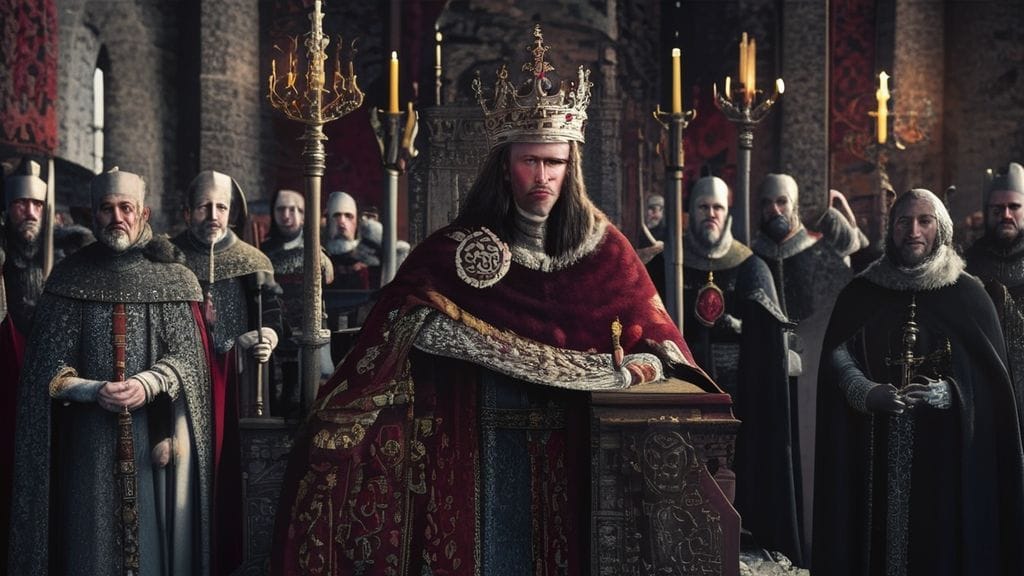
Imagine the scene: a church or royal chapel, perhaps at Soissons or another royal center, banners hanging limp in a dim interior lit by flickering candles. The bishops speak Latin prayers; the magnates of Austrasia and Neustria stand in heavy cloaks; at the center, a man still relatively young—Theuderic—kneels, his hair grown long in the ancient Merovingian manner. Oil is placed upon his head, a crown set upon his hair, and acclamation rises: “Vivat rex! Long live the king!” Yet behind the celebrations, another figure looms in silence: Charles Martel, the Mayor of the Palace, who already holds in his hands the force that shapes history—soldiers, land, and the loyalty of warlords.
Theuderic IV’s kingship was born in compromise, in necessity, and in the legal and spiritual structures that still demanded a king even as real power slipped from the royal grasp. It is within this tension, between the sunlight of ceremony and the shadows of political reality, that we will follow his life and times.
From Dagobert’s Glory to a Fading Dynasty
To understand the fragile crown that theuderic iv king of the franks would one day wear, we must return to the earlier, brighter age of Merovingian power. In the first half of the 7th century, kings like Clotaire II and Dagobert I commanded respect across the Frankish world. Dagobert I, ruling from 629 to 639, presided over a realm stretching from the North Sea to the Pyrenees, from the Atlantic coast deep into the heart of what had once been Roman Gaul and Germania. His court glittered with wealth; bishops and abbots negotiated with him; and foreign envoys crossed forests and rivers to kneel before his throne.
This was the high tide of Merovingian authority. The kings controlled large royal domains, commanded household warriors, and moved their courts from estate to estate, binding the aristocracy to them by distributing lands and favors. They were feared and celebrated in equal measure. According to later chroniclers, Dagobert was remembered as the last king to “rule by himself” before the rise of the mayors of the palace as uncontested masters of policy. After his death, the Merovingian house began a slow decline, weakened by frequent partitions of the kingdom, internal feuds, and the growing independence of regional nobility.
The Merovingian kings were more than political leaders; they were living symbols. Their long hair was not a trivial detail. It was believed to be a sign of sacred kingship—a visible token of their special, almost mystical status. When a Merovingian was deposed, his hair was often cut, a ritual humiliation stripping him of the aura of rule. Still, even as their practical power waned, the idea of the Merovingian king as the ordained ruler of the Franks remained deeply entrenched in law, custom, and religious imagination.
By the late 7th century, authority increasingly settled into the hands of the mayors of the palace, originally household officials charged with the management of royal estates and day-to-day governance. Men like Ebroin in Neustria and Pepin of Herstal in Austrasia realized that control of the palace and access to the king granted leverage over the entire realm. They raised armies, forged alliances, and used the royal figure as a legitimizing badge for their own ambitions. Over time, the mayoral office became hereditary in the hands of the Arnulfing-Pepinid family, the lineage from which the Carolingians would emerge.
By the time theuderic iv king of the franks was born, probably in the early 710s or slightly before, the legendary splendor of Dagobert’s age was already a memory evoked by older men around smoky hearths. The king was still revered, but more as a ritual center than as an active ruler. It was this fragile, almost hollowed-out monarchy that Theuderic would inherit—and it would shape every moment of his reign.
The Childhood of a Forgotten Prince
Theuderic’s early life is shrouded in silence, the kind of silence that often surrounds those whom history does not expect to matter. Our sources barely whisper his name until he emerges as king, and even then they say little. Yet we can, with cautious imagination grounded in what we know of the time, trace the contours of the youth who would one day be theuderic iv king of the franks.
He was almost certainly raised in a royal environment, amid lands traditionally linked to Austrasia, the eastern Frankish subkingdom. Some historians believe he was the son of Dagobert III, though medieval sources themselves are uncertain, and later genealogies might have tidied up a more complex situation for the sake of dynastic legitimacy. Whether as son or more distant kin, Theuderic grew up knowing that sacred blood ran through his veins. From infancy, servants would have addressed him with careful respect, his hair allowed to grow long, his movements watched and guarded.
A Merovingian royal child would not have lived surrounded by opulence in the modern sense. Frankish royal courts in the early 8th century were mobile, moving from estate to estate, each a complex of halls, wooden buildings, and sometimes stone remnants from Roman times. Theuderic would have known the heaviness of woolen tunics in winter, the feel of mud beneath his shoes, the looming darkness of forests that hemmed in clearings of settlement. His world echoed with Latin prayers in chapel and Germanic tongues in the hall, with the clatter of weapons at a warrior’s belt and the droning chant of psalms from gathered clergy.
Perhaps he watched older men speak in low voices at the edges of the hall—men who carried themselves with the quiet confidence of those who command armed followers. These were the magnates of the kingdom, the nobility whose support was necessary for any political order to stand. Even as a child, Theuderic must have sensed that the king was not alone in power, that others could resist or ignore royal wishes. In such an environment, a prince learned not only to be revered but also to be useful: as a focus for oaths, a symbol for propaganda, a bargaining chip in the ceaseless game of aristocratic rivalry.
It is tempting to imagine a sensitive boy, curious about the warriors training in the courtyard, yet kept at a distance from the lessons of command. Where a future Carolingian prince such as Charlemagne would be raised with clear expectation of wielding power, Theuderic’s model was more ambiguous. His Merovingian predecessors had increasingly ceded initiative to mayors of the palace and powerful dukes. When he looked at the world of his childhood, he saw kings on coins and in ceremonies, but he also saw other men—mayors, dukes, counts—ordering armies to march. Already, the balance was shifting decisively away from his lineage.
Still, in the eyes of many Frankish subjects, the mere existence of Theuderic was vital. The royal blood, the long hair, the name itself—Theuderic, echoing earlier kings—offered a sense of continuity. To frontier garrisons in the south and bishops in old Roman cities, the idea that “a king of the Franks” still lived and might one day be enthroned provided reassurance that their world remained, at least in principle, ordered under God and law.
Pepin of Herstal, Plectrude, and the Seeds of Civil War
Before theuderic iv king of the franks could ascend the throne, the ground beneath the monarchy was shaken by violent struggles within the ruling elite. The key figures were not Merovingian kings, but the Arnulfing-Pepinid house—especially Pepin of Herstal, his widow Plectrude, and his illegitimate yet formidable son Charles, later called Martel.
Pepin of Herstal, Mayor of the Palace in Austrasia, effectively ruled much of the Frankish realm at the end of the 7th century. His victory over Neustria at the Battle of Tertry in 687 had secured his family’s preeminence. Yet when he died in 714, the question of succession to his position, not the throne itself, plunged the kingdom into crisis. Plectrude, Pepin’s widow, sought to secure power for her grandsons—the legitimate line—against Charles, Pepin’s son by a concubine, who nevertheless had strong support among Austrasian warriors.
In this tense atmosphere, the Merovingian kingship was a tool. Plectrude kept the young king Dagobert III under close control in Cologne, trying to rule in his name. Charles, meanwhile, raised forces, escaped imprisonment, and began challenging both Neustria and Plectrude’s regime. The chaos weakened royal authority even further. The kings, nominally ruling, were shuttled between factions, each claiming to act for the good of the realm.
When Dagobert III died in 715 or 716, factions in Neustria raised another Merovingian, Chilperic II, to the throne, while Charles Martel, still consolidating his power, initially supported a different candidate. The conflict that followed was brutal: battles, raids, burned estates, and shifting loyalties. To ordinary people, it may have seemed as if the sky itself were tearing. Taxes and levies increased; young men were called to war under different banners; bishops worried about the sanctity of churches and the stability of their dioceses.
Amid this storm, the royal figure was both essential and tragically diminished. Everyone needed a king’s name on charters and in oaths, but few cared deeply which Merovingian sat on the throne—as long as he could be controlled. It was in this world of fractured authority and ruthless ambition that theuderic iv king of the franks was growing up, perhaps hidden away, perhaps quietly watched as a reserve option for some future political settlement.
The civil wars of the 710s ended with Charles Martel’s victory. By the late 710s and early 720s, he had defeated his Neustrian rivals, neutralized Plectrude, and established himself as undisputed Mayor of the Palace. Yet Charles could not, at that stage, simply seize the royal title. Frankish political culture, the Church, and long habit demanded that a Merovingian king continue to occupy the throne. When Chilperic II died around 721, a new royal figure was needed—someone of the blood, someone acceptable, someone controllable. Theuderic, still relatively young and politically inexperienced, fit the role perfectly.
Charles Martel’s Rise and the Silent Heir
By 721, Charles Martel had become the beating heart of Frankish power. His armies had crushed rivals in Neustria, contained threats from Frisia, and begun the long, grinding struggle along the frontiers with Muslim forces advancing from al-Andalus. He controlled vast estates, commanded the loyalty of key aristocrats, and had gained the wary respect of the Church by defending Christian territories, even as he appropriated ecclesiastical lands to reward his warriors.
Yet his position, formidable as it was, lacked one thing: the sacred hue of kingship. Charles Martel was the mayor, the “major domus”—the man behind the throne. To secure obedience across such a wide and diverse realm, he needed more than force. He needed continuity with the past, a framework of law and custom that people recognized. And that framework still revolved around the Merovingian king.
Enter theuderic iv king of the franks, summoned from the obscurity of private life into the blinding light of royal ceremony. Theuderic’s quiet years had prepared him, not for command, but for symbolic importance. He carried the blood of Clovis and Dagobert, a lineage that no other man could claim so directly. Charles Martel, for all his strength, could not invent a new kind of rule overnight. He had to cloak his authority in the traditional garments of monarchy, and Theuderic’s very existence made that possible.
We can imagine the negotiations among bishops and magnates: “We will recognize Charles as leader of the armies and manager of the realm, but we must have a king, a proper Merovingian, to crown in the old way.” Some may have feared that without a king, their oaths would lose coherence, their charters lose legitimacy. The Church, especially, was accustomed to dealing with kings as God’s anointed rulers on earth, even if, in private, many clerics knew where real power lay.
Thus Theuderic, perhaps with little say in the matter, became the pivot of a compromise. Charles could rule in fact; Theuderic would rule in name. The king’s face would appear on coins, his title on charters, his presence invoked in law courts. Behind him, Charles would move troops, appoint officials, and plot campaigns. The royal palace became, in effect, a carefully lit stage, upon which theuderic iv king of the franks played his part so that the audience—the Frankish people—could believe that the old drama of kingship still continued.
The Empty Throne After Chilperic II
When Chilperic II died, the Frankish throne did not, in practice, fall vacant. Charles Martel continued to govern, to collect revenues, to lead armies. Yet in the legal and spiritual imagination of the time, an unoccupied throne was unthinkable. Who would confirm grants of land? In whose name would justice be administered? To whom would bishops write when they sought royal protection?
For nearly every great decision in the Frankish world, some echo of royal assent was expected, even if that assent had become a formality. The “empty throne,” as later historians might call it, was a conceptual crisis more than a practical one. It opened the possibility of radical change: might the Franks abandon the Merovingian line altogether? Might a strongman like Charles declare himself king? In the 8th century, that step still seemed impossible, even sacrilegious. The mystique of the Merovingians, though tattered, endured.
Thus, the search for a suitable royal candidate settled on Theuderic. He was of the blood. He was presumably malleable. He had not been tainted by the recent civil wars to the same extent as Chilperic and other figures. Installing him as king allowed Charles to preserve the legal fiction of an intact monarchy, while keeping his own hands firmly on the levers of power.
At the same time, not everyone was content to let Charles monopolize the political stage. Some magnates might have hoped that a new Merovingian king, once enthroned, could eventually break free from mayoral control. They had not yet seen a ruler like Charlemagne, who would reshape the very idea of kingship; they still imagined that the old patterns might reassert themselves, that a theuderic iv king of the franks could grow into a Dagobert-like sovereign. Such hopes, though faint, may have whispered through corridors as the coronation preparations began.
721: Theuderic IV Crowned in a Kingdom He Did Not Rule
The coronation of Theuderic IV in 721 was likely a scene thick with symbolism and ritual. Though the exact location is debated—Soissons is often suggested—its broad contours would have followed established Frankish practice, adapted to the realities of the time. Bishops gathered, bearing relics and liturgical books. Noble warriors arrived with their retinues, cloaks clasped at the shoulder, swords at their belts, their faces weathered by campaigns in Neustria and along the frontier.
At the heart of the ceremony stood theuderic iv king of the franks, a man elevated more by lineage than by personal achievements. Yet in that moment, all eyes focused upon him. A crown was placed on his head, symbolizing the weight of the realm. Sacred oil, blessed and solemnly applied, marked him as chosen by God. The assembled magnates shouted acclamations, raising their weapons as a sign of the martial community that underpinned the kingdom. Choirs chanted in Latin, invoking the king as defensor ecclesiae—defender of the Church.
Yet behind the rich layers of ceremony lay an unspoken understanding shared by nearly everyone present: the real architect of the realm’s fortunes was Charles Martel. He may have stood nearby, his presence carefully choreographed. Too prominent, and it would be obvious who was truly king; too distant, and the choreography of hierarchy would falter. The balance had to be delicate. Theuderic embodied continuity; Charles embodied power.
Nevertheless, the coronation was far from an empty spectacle. In early medieval Europe, symbols had teeth. A king anointed and crowned could not simply be ignored. His name now carried legal consequences. Charters issued “in the year of our lord king Theuderic,” even if drafted at Charles’s command, wove the new monarch into the story of every grant, every land dispute, every monastic foundation. In time, people across the realm would come to know that “Theuderic” was the title under which their world was officially ordered.
For Theuderic himself, the day must have been overwhelming. One morning he was a high-born but politically marginal Merovingian; by evening, he was theuderic iv king of the franks, the latest in a line of monarchs whose deeds filled whatever historical memory the Franks possessed. Did he feel pride? Fear? Determination to make something more of his position than others expected? The sources are silent. Yet any sensitive observer standing close enough to see his eyes beneath the crown might have sensed the weight of a role imposed rather than chosen.
Once the shouts faded and the feasting began, the new king’s life settled into its strange pattern: ever-present in law, distant in policy; central in theory, marginal in practice. It was a role for which there were few precedents, and its consequences would ripple far beyond his own lifetime.
A King Without a Sword: Daily Life Under Theuderic IV
Theuderic’s reign, from 721 to 737, unfolded largely out of sight, a quiet counterpoint to the noisy campaigns and political maneuvers of Charles Martel. What did theuderic iv king of the franks actually do, day after repetitive day, as armies marched and frontiers burned without his command?
He presided over courts, at least in a formal sense. Royal assemblies still took place, gatherings where bishops, abbots, counts, and great lords came together to discuss matters of the realm. The king would appear, seated on a raised chair or throne, dressed in garments that signaled his rank. Petitioners would approach, legal cases would be presented, charters would be confirmed. Yet the real decisions were usually shaped beforehand by Charles and his circle. The king’s role was to embody judgment, to provide the solemn pronouncement that made a decision feel anchored in tradition and divine order.
He traveled, for like other Merovingian kings before him, Theuderic did not rule from a fixed capital. The Frankish monarchy was peripatetic, moving with its household and court. One month, the king might be at a villa near Reims, another at a palace in the Meuse region, then further west toward the Seine. Every journey was a moving theater of power. Banners and standards announced the royal presence long before he arrived; local elites hurried to prepare supplies and lodging; churches rang bells to greet the sovereign.
Within his private chambers, Theuderic lived a life shaped by piety and protocol. We can imagine him standing in a small, dim chapel early in the morning as a priest chanted Mass, the cold seeping through the stone floor into his feet. Afterward, he might confer with a few close attendants, men who managed his personal household and possessions—far smaller, by this time, than the estates controlled by Charles. Meals were taken in the great hall, but seating arrangements and the allocation of dishes subtly reminded everyone of the power imbalance between the king and his mayor.
Did Theuderic ever attempt to assert more authority? Some historians have speculated that the enduring need for his signature on charters, and the occasional mention of his presence at major events, suggests that he was not entirely a puppet. Yet even if he wished to rule more directly, his tools were limited. The networks of loyalty, the military resources, the financial base—all lay increasingly in Charles Martel’s hands. Theuderic might refuse a request or speak sharply, but any open conflict with Charles would have risked plunging the kingdom back into civil war, a prospect few elites desired after the bloodshed of the previous decade.
So theuderic iv king of the franks performed his role with patient, perhaps resigned endurance. Around him, scribes wrote in his name, monks prayed for his soul, and common people invoked his title when swearing oaths. His kingship was real in law and memory, but faint in initiative, like a distant star whose light still reaches us even as its core has faded.
Wars Fought in His Name: Aquitaine, Bavaria, and the Muslim Frontier
If Theuderic himself did not command armies, his regnal years were nonetheless marked by relentless warfare. Charles Martel spent much of theuderic iv king of the franks’s reign on campaign, securing the borders and disciplining semi-independent regions. Every battle, every campaign, was proclaimed as undertaken in service to the king, a legal and ideological fiction that both Charles and his enemies accepted—at least in public.
To the southwest, Aquitaine remained a perennial challenge. Its duke, Eudes (or Odo), pursued his own policy, balancing allegiance to the Franks with negotiations with Muslim forces entering the region from across the Pyrenees. In 721, the very year of Theuderic’s accession, Muslim armies laid siege to Toulouse; Duke Eudes’s victory there was celebrated across Christian Europe. Yet his independence worried Charles Martel, who sought to bind Aquitaine more firmly to Frankish authority. Conflicts erupted, marked by raids and punitive expeditions, their human cost measured in burned fields and displaced villagers.
In the east, Bavaria and Alamannia also resisted full integration. Dukes in these regions, though nominally under Frankish overlordship, often acted as semi-sovereign rulers. Charles’s campaigns there during Theuderic’s reign were aimed at tightening Frankish control, sometimes in alliance with missionary bishops who sought to extend Christian influence. Theuderic’s name gave these campaigns a veneer of imperial-style expansion: the king, through his mayor, was restoring order and orthodoxy at the fringes of his domain.
Most famously, the period saw intensifying pressure from Muslim forces advancing into Gaul from al-Andalus. Raids pushed ever further north, threatening cities and monasteries. Although the decisive Battle of Tours–Poitiers in 732 is more strongly associated with Charles Martel’s own reputation than with Theuderic’s, it took place under Theuderic’s regnal dating. Chroniclers like the anonymous author of the Continuations of Fredegar later presented Charles as the champion of Christendom, but they did so within a framework that still acknowledged Theuderic as king.
It is telling that when monks, decades later, wrote of Charles’s victories, they carefully dated them to the years of the reigning king. One might find in a charter or chronicle a line like: “In the Xth year of King Theuderic, Charles, mayor of the palace, defeated the Saracens…” (this is a paraphrase of the style, not a direct quotation). The effect was to inscribe theuderic iv king of the franks into the story of Christian resistance and Frankish expansion, even if he wielded no sword on the field.
For ordinary people, of course, the distinction likely mattered little. When Muslim raiders approached or when Frankish armies marched through their lands, they saw men in armor, horses, and banners—not constitutional nuances. Yet the legal fiction of a king in whose name wars were fought provided cohesion. It meant that when peace was restored, when land was redistributed, when churches were rebuilt, there was a stable point around which memory and obligation could be organized.
The Church, Relics, and the Aura of a Merovingian King
In a time when literacy was largely monopolized by the clergy, the alliance between kingship and the Church defined much of political life. Theuderic IV’s reign was no exception. Even a relatively weak Merovingian ruler remained important as a patron of monasteries, a confirmer of ecclesiastical privileges, and a focus of prayer.
Bishops needed a king to sign or at least endorse immunity charters—that is, documents exempting monasteries and churches from the interference of lay officials. Such charters often began with solemn invocations of the king’s authority and piety. While Charles Martel was the real power broker, he, too, saw advantage in acting through the king’s name, especially when dealing with institutions that derived much of their legitimacy from royal and divine sanction.
Theuderic, we may assume, participated in the rituals that bound king and Church: the procession of relics through a city, the solemn dedication of a new church, the granting of gifts to monastic communities. Even if the lands given sometimes came from properties recently confiscated by Charles from other churches—a practice that scandalized some chroniclers—the official narrative spoke of royal generosity, of the king’s care for the salvation of his people.
Inside monastic scriptoria, scribes carefully traced his name onto parchment: “Theudericus rex.” Each stroke of the quill reinforced the pattern by which the Frankish world understood itself. In annals like the Annales Mettenses priores, compiled somewhat later under Carolingian influence, Theuderic’s reign is mentioned briefly but significantly, serving as a chronological pillar in the story of the realm. One can almost see the monk, pausing for a heartbeat as he writes the familiar formula—“in the year of our lord king Theuderic”—before moving on to describe battles and councils that the king himself may never have directly ordered.
The Church, too, helped sustain the mystique of Merovingian blood. Stories circulated of earlier kings as saints or near-saints; shrines arose at their burial places. While Theuderic himself was never canonized or widely venerated, he inhabited an institution that still carried an aura of holiness. To touch the king, to receive a gift from his hands, was—for many of his contemporaries—to brush against a line of power thought to originate with God.
At the same time, cracks in this sacred image were widening. Charles Martel’s seizure of church lands to reward his followers provoked criticism from some ecclesiastical writers, who saw in it both sacrilege and a dangerous shift in the balance between spiritual and temporal power. Yet even they often framed their complaints not as a rejection of the king, but as a call for the monarch—Theuderic—to exercise more just oversight. The fiction of theuderic iv king of the franks as the ultimate guardian of the Church persisted, even as real control slipped to the man who commanded the armies.
Court Intrigues, Silent Chambers, and the Weight of Powerlessness
Every court is a theater of whispers. In the royal households of the Frankish kingdom during Theuderic’s reign, games of influence and proximity unfolded daily around a king who could not fully decide his own fate. Access to the monarch still mattered. A word in his ear, a chance to shape how he perceived a petition, could sway outcomes—if not dramatically, then at least at the margins.
Nobles who found themselves on the wrong side of Charles Martel might seek the king’s favor as a shield, hoping that Merovingian sanctity could soften the mayor’s wrath. Bishops, too, might appeal directly to Theuderic in disputes with regional counts or rival clerics. For such supplicants, the distinction between real and symbolic power blurred. If the king’s spoken support could tip a decision, did it matter that Charles held the greater force behind it?
We can imagine Theuderic walking through the corridors of a palace at dusk, the air thick with smoke from torches, tapestries stirring slightly in drafts, the quiet murmur of servants in the background. At his approach, voices fall silent; courtiers bow. Yet behind their gestures lies an unasked question: “Can he truly help us?” Theuderic’s own frustration is easy to picture—a man bred for sovereignty, aware of his sacred status, yet constantly checked by the harder realities of power that belong to his mayor.
Such a psychological burden must have left its mark. To be told from birth that one’s blood carries divine sanction, only to be reduced to approving decisions made by others, is a subtle form of imprisonment. Theuderic, like other late Merovingians, inhabited what might be called a golden cage of sanctity: honored, necessary, and yet ultimately constrained.
And yet, powerlessness is rarely absolute. In private conversations with trusted advisors, Theuderic could have voiced preferences, supported certain bishops over others, or quietly opposed some of Charles’s initiatives. Even small gestures—the granting of a symbolic gift, the appointment to a minor office—could ripple outward. If we think of history only in terms of grand decisions, Theuderic seems insignificant; but if we look at the textures of everyday political life, theuderic iv king of the franks emerges as a subtle, if limited, actor whose presence shaped the contours of authority.
The Long Shadow of Charles Martel Over the Frankish Crown
As the years passed, the relationship between Theuderic IV and Charles Martel hardened into a pattern that everyone could recognize, even if few said it aloud. Charles was the princeps in practice, the ruler of armies and distributor of benefices; Theuderic was the rex, the anointed king whose presence made Charles’s rule palatable within the inherited framework of Merovingian legitimacy.
Charles understood the value of this arrangement. He had no need to risk the shock of declaring himself king, a move that might provoke resistance from those loyal—either out of conviction or convenience—to the Merovingian line. By leaving Theuderic on the throne, he could present himself, officially, as the faithful servant of the monarchy, restoring order after the chaos of the early 8th century. This narrative would later be refined and expanded by Carolingian propagandists, who cast Charles and his descendants as the saviors of a kingdom weakened by ineffectual Merovingian rulers.
Yet this propaganda simplifies a more complex reality. Theuderic was not purely a “do-nothing king,” as later stereotypes suggest. His reign coincided with critical transformations: the strengthening of centralized military power under the mayors, the intensifying defense of the realm against external threats, and the consolidation of a vast network of loyalties that would later sustain Charlemagne’s empire. While Charles’s shadow fell across everything Theuderic did, the existence of a recognized, anointed king remained essential to the ideological foundation of that power.
Some modern historians have noted that the very potency of Carolingian rule later required them to denigrate their Merovingian predecessors. By portraying Theuderic and kings like him as weak, they could present the Carolingian takeover as an act of necessary rescue rather than ambitious usurpation. As one scholar has observed, “the last Merovingians served as a foil against which the Carolingians could project an image of heroic renewal” (paraphrasing a theme common in modern historiography).
In that light, theuderic iv king of the franks becomes not a mere footnote, but a crucial ingredient in the story the Carolingians told about themselves. Without his apparent weakness, their strength would shine less brightly. Without his existence, the very notion of legitimate kingship might have fractured, making the Carolingian leap to the crown far more contentious.
Death of Theuderic IV and the Deliberate Vacancy of the Throne
Theuderic IV died in 737, around sixteen years after his coronation. The sources mention his passing briefly, as they had his accession: a line or two in the annals, a shift in the regnal date formulas used in charters. No great laments are recorded, no civil war followed his death. Instead, something more remarkable occurred—Charles Martel chose not to replace him with another Merovingian king.
For the first time in generations, the Frankish kingdom continued without a crowned monarch. From 737 until Charles’s own death in 741, the throne remained officially vacant. Charles ruled openly as princeps, as the dominant political figure, without bothering to stage the old ritual of royal succession. The experiment that had defined theuderic iv king of the franks’s reign—the coexistence of symbolic kingship and mayoral control—came to an end.
Why did Charles not seek another Merovingian heir? Several explanations suggest themselves. Perhaps the suitable candidates were few, young, or politically inconvenient. Perhaps Charles felt secure enough that he no longer needed the cloak of royal legitimacy. Or perhaps, after years of practicing rule behind a ceremonial monarch, he wanted to test whether the kingdom could function without the old framework.
Whatever his motives, the consequences were profound. The latent question that had haunted Theuderic’s reign—does the kingdom truly need a Merovingian king?—was now being answered in practice. For four years, the answer seemed to be “no.” The apparatus of governance continued; wars were fought; charters were issued, now dated simply by the years of Charles’s rule rather than by a royal regnal year. The monarchy, once thought indispensable, was proved dispensable in fact.
Yet this interregnum also revealed the lingering power of tradition. When Charles died, his sons Carloman and Pepin the Short initially followed his example, ruling without a king. But within a few years, they felt the need to restore a Merovingian figure, Childeric III, to the throne—only to depose him later and have Pepin himself crowned with the blessing of the pope. Theuderic’s life and death thus belong to a transitional generation, in which the old monarchy is both used and tested to destruction, clearing the way for a new form of kingship.
From Merovingian Hair to Carolingian Steel: A Dynasty Fades
Theuderic IV’s reign sits at the hinge of a vast dynastic transformation. The Merovingians, with their long hair and sacral image, had ruled the Franks for over two centuries. Their identity was woven into the very fabric of Frankish law and memory. Yet by the 8th century, the substance of their power had largely drained away, leaving surfaces that men like Charles Martel could manipulate.
In the decades after Theuderic’s death, the process of dynastic replacement accelerated. Childeric III, likely another relative of theuderic iv king of the franks, was raised to the throne around 743 or 744, only to be deposed in 751 when Pepin the Short, Charles’s son, had himself anointed king with papal approval. The long-haired Merovingians were shorn, quite literally, of their aura; the Carolingians, bearing the name of Charlemagne’s grandfather, stepped into the role once thought inseparable from Merovingian blood.
Theuderic’s life offers a poignant window into how such a transition could occur without immediate social collapse. Because the monarchy under him had already become largely ceremonial, the shift to Carolingian rule, while momentous at the level of ritual and ideology, did not instantaneously transform everyday life for most people. Fields were still plowed, taxes still collected, wars still fought. What changed was the story that the elites and the Church told about who held ultimate, God-given authority to rule.
Theuderic’s very obscurity underscores his importance. He demonstrates that a king could exist more as a necessary symbol than as an active commander. Once that separation between symbol and substance had been fully worked out, another family could more easily step in and claim both. Theuderic and his fellow late Merovingians, in losing so much real power, inadvertently made it possible for the Carolingians to redefine kingship around military leadership, administrative reform, and a far more assertive partnership with the papacy.
In a sense, theuderic iv king of the franks presided over the quiet funeral of the old idea of sacral kingship even as he continued to embody it. His reign was a slow rehearsal for the radical moment when Pepin would have himself anointed not as a steward of the Merovingians, but as king in his own right. The heavy hair that once symbolized divine favor gave way to the hard steel of armies organized under a dynasty that took its legitimacy not from ancient blood alone, but from victory, reform, and papal blessing.
How Later Centuries Remembered—or Erased—Theuderic IV
Memory is rarely kind to those who occupy transitional spaces. In the grand narratives written under Carolingian patronage, Theuderic IV appears as little more than a name in a list, a placeholder between more impressive figures. Monastic chronicles, such as the Annales regni Francorum, pay far more attention to the deeds of Charles Martel and his descendants than to the kings under whom they technically served.
Later medieval writers, influenced by Carolingian propaganda, popularized the notion of the “rois fainéants”—the “do-nothing kings”—a phrase that paints theuderic iv king of the franks and his near contemporaries as idle, decadent, or simply incompetent. This stereotype, while containing a kernel of truth about the shift in power from king to mayor, obscures the structural forces that limited what any Merovingian monarch could do in the early 8th century. It reduces a complex political evolution to a moralistic tale of lazy rulers replaced by virtuous heroes.
In the emerging national histories of France centuries later, Theuderic received even less attention. Writers gravitated toward dramatic figures—Clovis, Charlemagne, Louis IX—whose reigns could easily be framed as turning points, as moral exemplars or cautionary examples. A king whose main significance was to be overshadowed by someone else did not fit comfortably into such stories.
Modern scholarship, however, has slowly rediscovered the value of looking more closely at figures like Theuderic. By examining charters, annals, and archeological evidence, historians have reconstructed a picture of a Frankish kingdom in which symbolic and practical power were disentangling, a process embodied in the reigns of late Merovingian kings. Theuderic’s importance lies not in bold actions but in the very constraints he faced, which illuminate the changing nature of early medieval kingship.
One historian has aptly noted that “the weakness of the last Merovingians was less a personal failing than the visible symptom of a deeper redistribution of power among the Frankish elite” (a paraphrased synthesis of contemporary scholarship). Seen in this light, theuderic iv king of the franks is not a mere curiosity but a lens through which we can understand how dynasties die: not with sudden collapse, but with gradual hollowing-out, stage-managed rituals, and the eventual quiet acceptance of a new order.
Theuderic IV in the Wider Story of Early Medieval Europe
Stepping back from the narrow focus on the Frankish court, Theuderic IV’s reign aligns with a broader pattern visible across early medieval Europe and the Mediterranean. Old imperial structures were gone, but their echoes persisted; local powers rose, yet often cloaked themselves in inherited symbols of legitimacy. In Byzantium, emperors fought iconoclast controversies even as provincial elites gained autonomy. In the Lombard kingdom of Italy, kings contended with powerful dukes and an assertive papacy. In Anglo-Saxon England, multiple small kingdoms jostled for dominance, each crafting its own blend of sacral and military kingship.
Within this mosaic, theuderic iv king of the franks stands as one example of how a polity navigated the tension between continuity and change. The Franks did not discard their old monarchy outright. Instead, they stretched and bent it, using Merovingian kings as ceremonial anchors while experimenting with new forms of practical authority. Only after decades of such improvisation did they feel ready to place a new dynasty firmly on the throne.
The period also witnessed the growing entanglement of secular and ecclesiastical power. Theuderic’s official role as defender of the Church, even when Charles made decisions about church lands and appointments, reflects a wider trend: rulers and would-be rulers increasingly sought legitimation through religious language and ritual. Pepin’s later alliance with the papacy, culminating in his own anointing, was a logical extension of this pattern, one that would culminate in Charlemagne’s imperial coronation in 800.
Thus, Theuderic’s subdued reign forms part of the prelude to the so-called Carolingian Renaissance, when reform, learning, and centralized authority briefly flourished in western Europe. The very fact that the Carolingians could portray themselves as renewers—of kingship, of culture, of religious life—depended on an earlier period, Theuderic’s period, in which the old forms still existed but their inner vigor had waned.
In that sense, theuderic iv king of the franks is both an ending and a beginning. He is among the last rulers to embody the ancestral mystique of the Merovingians, and among the first to reign in a world where that mystique no longer guaranteed actual power. His story reminds us that history often moves not through sudden revolutions alone, but through long seasons of ambiguity, where old and new intermingle, and where the most important figures are sometimes those who, at first glance, appear to do almost nothing at all.
Conclusion
Theuderic IV’s accession in 721, at first glance a minor event in the swirl of early medieval history, emerges upon closer inspection as a revealing moment in the evolution of European kingship. Raised to the throne not as a conqueror or reformer, but as a necessary symbol, theuderic iv king of the franks presided over a kingdom whose political center had already shifted to the hands of his mayor, Charles Martel. Yet his reign was far from irrelevant. By sustaining the ceremonial framework of Merovingian monarchy for sixteen more years, Theuderic allowed the Franks to transition gradually from an older, sacral model of rulership to the more militarized, institutionally ambitious kingship of the Carolingians.
His life illustrates how dynasties die: not in a single abrupt catastrophe, but in a prolonged negotiation between memory and necessity. Theuderic’s very powerlessness helped clarify where real authority lay, proving that a state could function, for a time, with a king who did not command armies or direct policy. When he died and Charles left the throne vacant, the experiment reached its logical conclusion. The eventual coronation of Pepin the Short, and the later glories of Charlemagne, rested on a foundation built in these quiet, ambiguous years.
In remembering Theuderic IV, we are invited to look beyond the heroic and the spectacular, to see history as a tapestry woven not only by great reformers and conquerors, but also by the shadowed figures whose constrained lives made larger transformations possible. He stands at the crossroads of decline and renewal, his long Merovingian hair concealing a crown already half-claimed by another family. Through him, we witness the moment when the idea of the king ceased to guarantee power, and when the path opened for a different kind of monarchy to define the future of the West.
FAQs
- Who was Theuderic IV?
Theuderic IV was a Merovingian king of the Franks who reigned from 721 to 737. Elevated to the throne as a descendant of the earlier Merovingian rulers, he served primarily as a ceremonial monarch while real political and military power was exercised by his mayor of the palace, Charles Martel. - Why is Theuderic IV often called a “do-nothing king”?
Later Carolingian and medieval writers portrayed Theuderic IV and other late Merovingians as “do-nothing kings” because they held the royal title but lacked effective control over governance and the army. This label reflects propaganda as much as reality: his power was limited by structural changes that favored mayors of the palace, rather than by sheer personal laziness. - What role did Charles Martel play during Theuderic IV’s reign?
Charles Martel, the Mayor of the Palace, was the de facto ruler of the Frankish kingdom during Theuderic IV’s reign. He led military campaigns, controlled major landholdings, negotiated with regional powers, and directed policy, while formally acting in the king’s name. - Did Theuderic IV lead any battles or major political initiatives?
There is no reliable evidence that Theuderic IV personally led armies or initiated major political reforms. Contemporary and later sources consistently credit Charles Martel with the military victories and political consolidations of the period, suggesting that Theuderic’s role was primarily symbolic and ceremonial. - Why was a king still needed if Charles Martel had all the power?
Frankish law, custom, and religious tradition still centered on the figure of an anointed king. A Merovingian king like theuderic iv king of the franks provided legal continuity, gave charters and assemblies formal legitimacy, and reassured elites and the Church that governance operated within established norms, even as real power shifted to the mayor. - What happened after Theuderic IV died?
When Theuderic IV died in 737, Charles Martel chose not to install a new Merovingian king. The throne remained vacant until after Charles’s own death in 741, during which time he ruled openly without a crowned monarch. A later Merovingian, Childeric III, was eventually installed and then deposed in 751 when Pepin the Short became king. - How did Theuderic IV’s reign influence the rise of the Carolingians?
Theuderic’s reign helped normalize a political structure in which the king was largely symbolic and the mayor of the palace wielded real authority. This separation of ceremonial and practical power made it easier for Pepin the Short, Charles Martel’s son, to justify taking the crown himself, thereby founding the Carolingian dynasty. - Where was Theuderic IV crowned king?
The exact location of Theuderic IV’s coronation is uncertain, but Soissons is often suggested as a likely site based on patterns of earlier Merovingian royal ceremonies. Wherever it took place, the ritual would have involved anointing by bishops, acclamation by the nobility, and the formal bestowal of the royal insignia. - How do historians know about Theuderic IV if sources are so limited?
Information about Theuderic IV comes mainly from brief references in annals and chronicles, such as the Continuations of Fredegar and later Carolingian texts, as well as from charters dated by his regnal years. By piecing together these sparse records and comparing them with broader political developments, historians reconstruct the contours of his reign. - Was Theuderic IV related to earlier famous Merovingian kings like Dagobert I?
Yes. Although the exact genealogy is debated, Theuderic IV was almost certainly part of the same Merovingian dynasty that included figures like Dagobert I and Clovis. His legitimacy as king depended heavily on this lineage, even if he did not rule with the same authority as his more powerful ancestors.
External Resource
Internal Link
Other Resources
- Encyclopaedia Britannica – general search for the exact subject
- Google Scholar – academic search for the exact subject
- Internet Archive – digital library search for the exact subject

