Table of Contents
- The Fall of the Empire: Paris on the Brink, September 1870
- The Siege of Paris: Starvation and Resolve
- The Role of the National Guard: Guardians of a Fragile City
- Collapse of Napoléon III: The End of an Era at Sedan
- The Outcry for Republicanism: Voices Rising Amidst Defeat
- The Proclamation of the Third Republic: A New Dawn in Hôtel de Ville
- The Key Figures Behind the Republic’s Birth
- The Paris Commune: Seeds Sown in the Shadow of Defeat
- The Role of Women and Civilians in Shaping the Republic
- International Reactions: Europe and Beyond
- The Republic’s Founding Principles and Political Landscape
- Challenges Ahead: War, Internal Strife, and Reconstruction
- The Legacy of the Third Republic on French Society
- Cultural Revival and Republican Symbols
- The Long March to Stability: From 1870 to the Early 20th Century
- Lessons from the Proclamation: Democracy Amidst Ruin
- Conclusion: The Triumph of Hope in the Ashes of Empire
- FAQs: Understanding the Third Republic’s Origins and Impact
- External Resource: Wikipedia Entry on the Third Republic
- Internal Link: Visit History Sphere
The Fall of the Empire: Paris on the Brink, September 1870
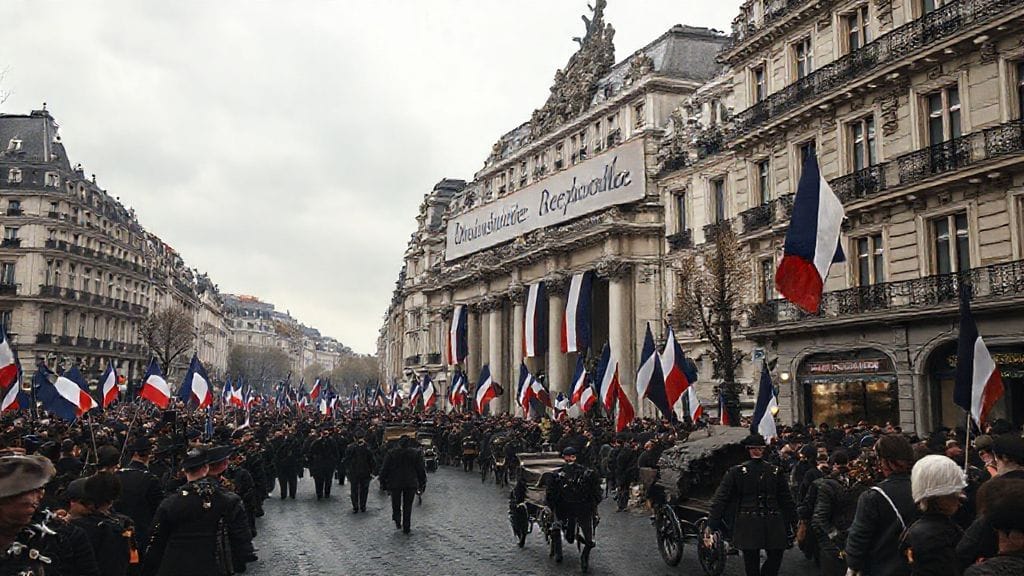
The dusk of September 4th, 1870, settled heavy and thick over Paris. The city pulsed with a mixture of despair, exhaustion, and a fiery hope that refused to be extinguished. Beneath the fading light, citizens – men and women alike – gathered in tense clusters outside the Hôtel de Ville. The great Second Empire of Napoleon III was no more; its collapse was not merely a political event but the shattering of a national dream. The roar of the crowd surged through the narrow cobbled streets, drowning out the distant sounds of artillery fire from the siege. A new chapter was about to begin: the Third Republic was proclaimed.
But this moment, pregnant with promise, was born from one of the darkest hours in French history.
The Siege of Paris: Starvation and Resolve
As summer waned into autumn, Paris found itself encircled by Prussian forces, their siege tightening like a noose. Food dwindled; meat was replaced by rats, horses, and even zoo animals. The city lived under an oppressive sky, starvation a constant specter. Yet, resilience characterized the Parisians. Day after day, messages slipped past enemy lines, newspapers printed defiantly, and debates raged in cafés and meeting halls.
The siege was a crucible that melted old certainties and forged new convictions. The empire could not save them. Only Paris, only France itself, might steer a course through chaos.
The Role of the National Guard: Guardians of a Fragile City
Unlike the professional army immobilized or defeated in open battle, the National Guard was a citizen militia representing every social class. Its members stood shoulder to shoulder during barricades and public rallies, determined to defend the homeland and its honor. This citizen force became a lodestar for republican ideals.
They imbibed a deep distrust of the imperial regime that had led France to this catastrophe. Their presence in the streets underscored a transition from imposed order to popular sovereignty, a shift that would crystallize with the fall of Napoleon III.
Collapse of Napoléon III: The End of an Era at Sedan
The crushing defeat of Napoléon III’s army at the Battle of Sedan on September 1st sealed the fate of the empire. Taken prisoner alongside thousands of soldiers, Napoleon’s humiliation was echoed by the nation’s shock. The emperor’s capture shattered the myth of imperial invincibility. The Second Empire collapsed in a matter of days, leaving a political vacuum as vast as the national humiliation.
This was more than a military loss; it was a psychological earthquake that shook the pillars of monarchy and empire alike.
The Outcry for Republicanism: Voices Rising Amidst Defeat
Defeat became a catalyst for political revolution. The Franco-Prussian War had exposed cracks deep within the French political order. The monarchy, the empire, no longer held legitimacy in the eyes of many. Republican leaders, intellectuals, and ordinary citizens began to envision a government founded not on pedigree, but on the will of the people.
In the streets, speeches called for freedom, justice, and the reestablishment of the République. Despite the surrounding chaos, the pulse of republicanism grew ever stronger.
The Proclamation of the Third Republic: A New Dawn in Hôtel de Ville
On the 4th of September, amid the tumult and the candlelight, the Hôtel de Ville became the stage for a profound transformation. Léon Gambetta, Jules Favre, and other republican luminaries orchestrated the proclamation of the Third Republic, seizing the moment to declare the fall of the empire and the birth of a government of the people.
The crowd erupted in cheers, brandishing tricolors and chanting liberty’s refrain. This declaration was not merely a political act; it was a renewed hope for a nation wounded yet defiant.
The Key Figures Behind the Republic’s Birth
Behind the scenes of the proclamation were men whose names would become inseparable from republican France. Léon Gambetta, a fiery orator who escaped besieged Paris by balloon to rally the provinces; Jules Favre, adept negotiator and defender of republican legitimacy; and Adolphe Thiers, whose political experience offered a bridge to stability.
These leaders embodied the mixture of idealism and pragmatism that would define the fledgling Republic.
The Paris Commune: Seeds Sown in the Shadow of Defeat
Yet, the birth of the Third Republic was not smooth. Deep divisions existed, particularly between the radical working classes and more moderate republicans. As the Republic struggled to negotiate peace with Prussia, tension erupted into the Paris Commune in 1871—a bold, and tumultuous, experiment in direct democracy and social reform.
The Commune was both a continuation of revolutionary spirit and a tragic conflict that exposed fractures within French society.
The Role of Women and Civilians in Shaping the Republic
Often overshadowed are the women and civilians whose efforts wove the social fabric of the new France. Women, from nurses on the front lines to organizers of supply convoys, played crucial roles during the siege and subsequent upheaval. Their courage and persistence challenged traditional gender roles and planted seeds of social transformation.
The city’s civilians endured horrors and shortages, demonstrating resilience that became a keystone of republican identity.
International Reactions: Europe and Beyond
Europe watched with fascination and concern. The upheaval in France reshaped the continent’s balance of power. Monarchies in Germany, Austria, and Russia viewed the fall of Napoleon III with wary eyes, while republicans elsewhere saw in Paris a beacon of hope.
The proclamation sent ripples through colonial empires and emerging nation-states, signaling not only the fall of an empire but the resilience of republican ideals.
The Republic’s Founding Principles and Political Landscape
The early Third Republic was imbued with principles of liberty, equality, and fraternity, yet its political landscape was fiercely contested. Monarchists, Bonapartists, moderate republicans, and radicals vied for influence. The struggle to draft a constitution that balanced power and ensured civil liberties was intense and fraught with compromise.
This political ferment set the tone for decades of republican governance shaped by dialogue and dissent.
Challenges Ahead: War, Internal Strife, and Reconstruction
Despite its proclamation, the Republic faced formidable challenges: ongoing war with Prussia, internal civil unrest, and the immense task of rebuilding a shattered nation. Paris lay battered, and rural France was scarred by conscription and loss.
The Republic’s survival depended on uniting divided populations, managing the peace settlement, and reviving economic life—all daunting tasks that would shape France’s modern identity.
The Legacy of the Third Republic on French Society
The Third Republic endured for over six decades, imprinting itself on political life, education, and culture. It codified secularism, expanded suffrage, and supported the arts and sciences. Its emphasis on civic duty and national pride influenced generations and became a cornerstone of modern French society.
Though tested by wars and crises, the Republic’s persistence proved the durability of democratic ideals.
Cultural Revival and Republican Symbols
The birth of the Republic ushered a cultural renaissance, with symbols like the Marianne bust, the tricolor flag, and “La Marseillaise” becoming emblems of national identity. Public monuments, schools, and ceremonies embedded republican values in everyday life.
Art and literature flourished, reflecting themes of liberty, justice, and the sorrow and hope of a nation reborn.
The Long March to Stability: From 1870 to the Early 20th Century
The Republic’s early decades were a mosaic of struggle and success, war and peace. The Franco-Prussian War’s conclusion, the Dreyfus Affair, colonial expansion, and the gradual democratization of political institutions defined this era.
Each challenge tested the Republic, but each also reinforced its foundational commitment to the people’s sovereignty.
Lessons from the Proclamation: Democracy Amidst Ruin
The proclamation of the Third Republic reveals enduring lessons about resilience, leadership, and the transformative power of democracy. Even in the shadow of defeat and disillusionment, a people can reclaim agency and rewrite their destiny.
It underscores how political change often emerges not from ideal conditions, but through perseverance in hardship.
Conclusion
The proclamation of the Third Republic on September 4, 1870, was far more than a mere declaration; it was a beacon of hope cast against the backdrop of military disaster, political collapse, and societal upheaval. Paris, under siege, hungry, and bruised, found in its citizens the resolve to reject monarchy and empire alike, choosing instead the uncertain path of republicanism.
This moment forged the identity of modern France—a nation where liberty, equality, and fraternity would become not abstract ideals, but living promises. The Third Republic’s birth was a testament to the power of the people to reinvent themselves, even when history seems to be closing its doors. And while the Republic would face trials and tribulations in the years ahead, its foundation remained a profound symbol of human endurance and the quest for self-determination.
FAQs
Q1: What led to the fall of the Second Empire and the proclamation of the Third Republic?
The Franco-Prussian War exposed the military weaknesses and political failures of the Second Empire. The defeat at Sedan and the capture of Napoleon III removed imperial authority, paving the way for republican forces to proclaim the Third Republic.
Q2: Who were the main leaders instrumental in proclaiming the Third Republic?
Léon Gambetta, Jules Favre, and Adolphe Thiers were key figures. Gambetta became known for his unyielding republicanism and organizational skills, while Favre and Thiers provided critical diplomatic and political leadership.
Q3: How did the Siege of Paris influence the birth of the Republic?
The siege created extreme hardship but also fostered solidarity and politicization among Parisians. The National Guard and civilians became active participants in expressing republican ideals amid the crisis.
Q4: What challenges did the Third Republic face immediately after its proclamation?
It had to manage ongoing war with Prussia, internal divisions culminating in the Paris Commune, political factionalism, and the immense task of national reconstruction.
Q5: What is the historical significance of the Paris Commune in relation to the Third Republic?
The Commune represented radical working-class discontent and an alternative vision of governance. Its brutal suppression highlighted the tensions within the early Republic and influenced debates on democracy and social justice.
Q6: How did the Third Republic shape French culture and society?
It promoted secularism, republican values, and education reform. Symbols like Marianne and "La Marseillaise" became national icons, while republican ideals permeated literature, art, and public life.
Q7: How did the international community react to the proclamation?
Monarchies in Europe viewed it warily, while republicans elsewhere saw it as a hopeful sign. The upheaval altered European diplomatic dynamics and inspired movements beyond France.
Q8: What lasting impact did the Third Republic have on modern France?
It established a durable democratic framework, championed civil liberties, and shaped France’s national identity for over six decades, influencing its political culture to this day.