Table of Contents
- The Dawn of a Relentless Conflict: The Outbreak of the Thirteen Years' War
- The Prussian Theater: Gdańsk and Toruń at the Epicenter
- Seeds of Discontent: Political and Economic Frictions in 15th Century Prussia
- The Teutonic Order: From Crusaders to Territorial Rulers
- The Kingdom of Poland’s Ambitions and Alliances
- The Prussian Confederation: A Rebellion Ignited
- The Spark at Gdańsk: Uprising Against the Teutonic Order
- Early Battles and Sieges: The Struggle for Control
- Toruń’s Siege: A City Caught in Crossfires
- Naval Warfare and the Baltic Front
- The Involvement of the Holy Roman Empire and Neighboring Powers
- The Role of the Papacy and Religious Legitimacy
- The Human Cost: Civilians, Soldiers, and Economic Devastation
- Shifting Loyalties and Internal Struggles Within the Teutonic Order
- The Turning Points: Key Battles and Political Maneuvers
- The War’s Prolonged Stalemate and Exhaustion of Resources
- The Treaty of Toruń (1466): The War’s Ultimate Resolution
- Consequences for Prussia: A Land Divided
- Impact on Polish Sovereignty and Expansion
- Decline of the Teutonic Order: From Power to Obsolescence
- Legacy and Memory: The Thirteen Years’ War in Central European History
- The War’s Influence on Future Conflicts in the Baltic Region
- Cultural and Economic Aftermath in Gdańsk, Toruń, and Beyond
- Reflections on Warfare, Identity, and Statehood in Late Medieval Europe
The Dawn of a Relentless Conflict: The Outbreak of the Thirteen Years' War
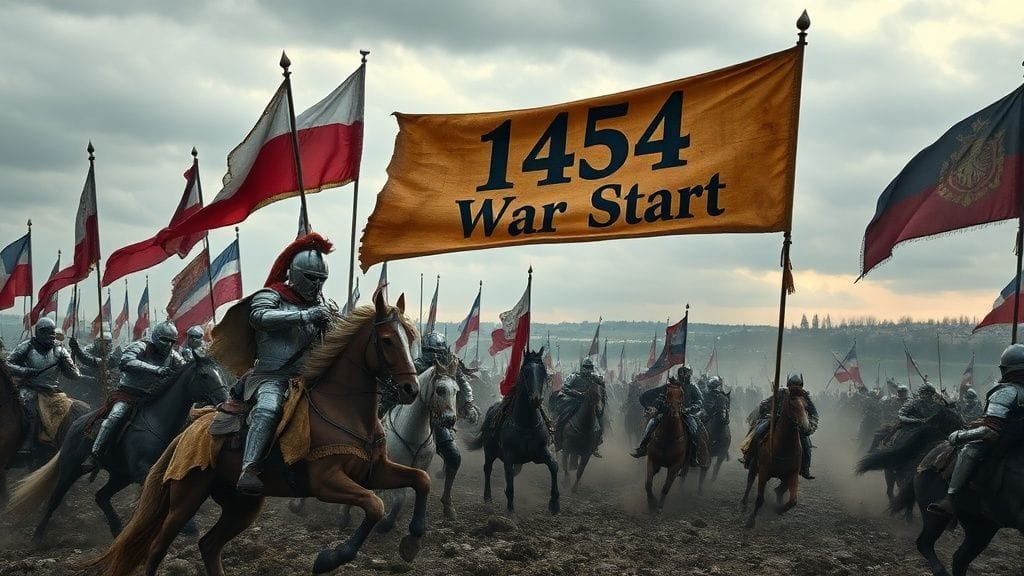
It was the spring of 1454, and the Baltic air was thick with tension. The bustling port city of Gdańsk, alive with merchant ships’ creaks and the clamour of marketplaces trading grain, amber, and iron, had become a powder keg ready to explode. Far to the south, the fortified city of Toruń, nestled on the Vistula River, braced for what was fast becoming something far greater than a regional dispute. Against this backdrop of commerce, faith, and feudal obligation, an ambitious rebellion was erupting—one that would embroil nations, shape borders, and echo through the centuries as the Thirteen Years’ War.
This was no ordinary medieval skirmish. It was a war born from a delicate mix of ethnic rivalry, political upheaval, economic strangleholds, and the fading legitimacy of militant ecclesiastical rulers. The centuries-old Teutonic Order, once hailed as crusaders against paganism, had transformed into a regional power whose iron grip chafed the diverse interests of the Prussian cities and the expanding Kingdom of Poland. When the Prussian Confederation rose up and formally pledged allegiance to King Casimir IV of Poland, their call to arms sparked a conflict destined to redefine power in the Baltic Sea region.
The Prussian Theater: Gdańsk and Toruń at the Epicenter
The Thirteen Years' War’s story cannot be told without sinking into the geography and spirit of its key cities. Gdańsk (then known by its German name, Danzig) was a thriving Hanseatic port, its docks lined with Hanse ships unloading exotic goods from the North Sea and the Mediterranean. The city’s prosperous merchants, fiercely protective of their economic freedoms, resented the Teutonic Order’s heavy taxes and autocratic rule. Nearby, Toruń (Thorn), with its imposing walls and strategic position on the Vistula River, was equally caught in political crosshairs. Both cities were hubs of resistance and clear symbols of defiance against Teutonic dominance.
Within the walls of these cities simmered a complex cultural tapestry. The population was mixed: Poles, Germans, Kashubians, and Prussians coexisted uneasily, often divided by language, faith, and loyalty. The Teutonic Knights, resolute in their mission of territorial control, faced increasing opposition not only from the cities but also from a shifting political landscape, including the influential Kingdom of Poland, which eyed the Order’s lands with an intent to reclaim or influence.
Seeds of Discontent: Political and Economic Frictions in 15th Century Prussia
To understand the explosion that was the Thirteen Years’ War, one must grasp the long-standing tensions in Prussia of the 15th century. The Teutonic Order, a monastic military order founded during the Crusades, had ruled much of Prussia for over two centuries. Their original aim—to Christianize pagan Prussians—had become overshadowed by their growing role as feudal lords, whose grip tightened on towns and noblemen alike.
The Order’s autocratic rule clashed with the burgeoning power of the towns and nobles who sought more autonomy. Economic hardships, exacerbated by expensive wars with Lithuania and internal corruption, fueled resentment. Particularly galling were the heavy taxes levied on the prosperous merchant class of cities like Gdańsk and Toruń—taxes that stifled trade and enriched the Knights’ coffers.
Moreover, the Knights’ attempts to enforce Germanization and Catholic orthodoxy in regions with mixed populations only heightened ethnic and religious friction. The Prussian nobility and burghers, many with commercial ties to Poland and the Hanseatic League, felt increasingly alienated by the Order’s policies.
The Teutonic Order: From Crusaders to Territorial Rulers
Once revered as the ideal Christian warriors of the Baltic Crusades, by the mid-15th century, the Teutonic Knights had morphed into something more complex—a powerful territorial power wielding religious authority as a cloak for feudal dominance. Their reputation was a double-edged sword; while some in Europe viewed them as defenders of Christendom, many locals regarded them as oppressive foreign overlords.
The Order’s Grand Master resided from Marienburg (Malbork Castle), a formidable Gothic fortress symbolizing both power and isolation. The Knights raised armies, minted their own currency, and administered laws—essentially acting as sovereign rulers. But their governing style was rigid, often dismissive of civic freedoms and local traditions, relying on a brutal enforcement mechanism to suppress dissidence.
Merchants and nobles who once saw the Order as protectors began to view them as obstacles to freedom and economic prosperity. This shifting perception was a tinderbox waiting to ignite.
The Kingdom of Poland’s Ambitions and Alliances
To the south, the Kingdom of Poland under King Casimir IV Jagiellon watched the unrest in Prussia with a mixture of opportunity and caution. Casimir was no mere observer; a shrewd and ambitious ruler, he sought to strengthen Poland’s position in Central and Eastern Europe.
The weakening of the Teutonic Order's grip offshore presented Casimir with a chance to extend his realm’s influence over Prussia, a region historically claimed but lost after the Order’s conquests in the 13th century. Political alliances, marriages, and shared interests with the Prussian Confederation—a coalition of cities and nobles chafing under the Order—further frayed the status quo.
Recognizing the potential, Casimir extended support to the rebellion, promising protection and eventual integration of Prussia into the Polish crown. This effectively internationalized the conflict, transforming it from a regional uprising into a full-scale war between two powers.
The Prussian Confederation: A Rebellion Ignited
The immediate catalyst was the formation of the Prussian Confederation in 1440, uniting disgruntled nobles, clergy, and free cities against the Teutonic Order’s overreach. This coalition's members shared a common grievance: the desire for greater autonomy, trade freedom, and self-governance.
Tensions reached a breaking point when the Confederation petitioned King Casimir to incorporate Prussia into the Polish kingdom, asking for protection against the Teutonic knights’ tyranny. Casimir willingly accepted, declaring the territory part of Poland in 1454—effectively an act of war.
This bold move emboldened cities like Gdańsk and Toruń to openly revolt, sparking sieges, political machinations, and violent confrontations. What followed would be a complex web of battles, alliances, and intrigue that would last over a decade.
The Spark at Gdańsk: Uprising Against the Teutonic Order
Gdańsk was the tinder that lit the flame. In early 1454, the citizens rose up, expelling the Teutonic officials and declaring loyalty to Poland. The port city’s strategic importance could not be overstated: control of Gdańsk meant dominance over Baltic trade routes and crucial access to the Vistula River.
The rebellion there spread rapidly—other cities and fortresses soon followed suit. The Order, taken aback by the scale and determination of the uprising, scrambled to regroup, but their forces were spread thin and plagued by internal dissent.
Gdańsk’s defiance was both symbolic and practical. It showed that the Order’s reign was not unbreakable and gave momentum to the Polish-supported insurgents.
Early Battles and Sieges: The Struggle for Control
War engulfed the region almost immediately. The Teutonic Order launched aggressive counterattacks, laying siege to rebel-held towns, engaging in pitched battles across Prussia’s countryside. Siege warfare became a grim hallmark, with countless towns like Kneiphof and Elbing enduring brutal blockades and starvation.
In particular, the siege of Toruń was a protracted and bloody affair. The city, loyal to the Prussian Confederation and supported by Polish forces, resisted fiercely, withstanding months of bombardment and assaults. Its staunch defense cemented its reputation as a bastion of resistance.
Meanwhile, Polish armies poured into the region, coordinated with local militias, and pushed the Knights back in some areas. The war’s early years were a seesaw of victories and defeats, attrition and stalemate.
Toruń’s Siege: A City Caught in Crossfires
Toruń held a vital strategic and symbolic role. Surrounded by wooden palisades and imposing stone walls, it was a prize coveted by both sides. The siege, beginning in 1454, tested the city’s endurance and the resolve of its defenders.
As starvation and disease took their toll inside the walls, the inhabitants faced not just physical threat but psychological torment. Letters from the besieged revealed desperation mingled with fierce hope. "We stand for the freedom of our homes and families," declared one sentry’s journal, capturing the human spirit beneath the iron resolve.
The siege lightened only after Polish relief forces engaged in skirmishes that forced the Knights to retreat temporarily, but it presaged the long attritional nature that would loom over the entire conflict.
Naval Warfare and the Baltic Front
Though much of the war was fought on land, control of the Baltic Sea was equally crucial. The Teutonic Order and the Prussian Confederation repeatedly clashed on the water, with privateers and naval contingents vying for supremacy.
Gdańsk’s fleet harassed Teutonic supply lines, disrupting grain shipments and military reinforcements. The Hanseatic League, whose merchants also had vested interests, found itself ensnared in a tangled web of diplomacy and conflict, sometimes siding with Poland to contain the Order’s threat to trade freedoms.
Naval engagements were brutal and decisive, shaping the flow and outcomes of sieges. The Baltic waters became a chessboard for power that added another layer of complexity to the Thirteen Years’ War.
The Involvement of the Holy Roman Empire and Neighboring Powers
The broader European context complicated the conflict further. The Holy Roman Empire, though officially a patchwork of states, had stakes in stabilizing the volatile Baltic region—and many of its nobles had ties to Prussian lands.
Political balancing acts saw some Imperial princes supporting the Teutonic Order for feudal or religious reasons, while others leaned toward the rising Polish influence. The Kingdom of Hungary and the Grand Duchy of Lithuania also eyed the region with interest, given their own struggles against rising regional powers.
This diplomatic tightrope influenced alliances, troop movements, and negotiations, though none of these wider powers engaged in full-scale campaigns, leaving the war primarily a duel between Poland and the Order.
The Role of the Papacy and Religious Legitimacy
The Teutonic Order, as a religious-military order, heavily relied on Papal support and the legitimacy it conferred. The Church condemned rebellion against the Order as heretical and provided spiritual justification for their cause.
However, Pope Nicholas V and his successors faced dilemmas. The Church was simultaneously concerned about preserving Christian unity and managing political alliances across Europe. At times, the papacy’s support wavered, and the legitimacy of rebellion by the mostly Catholic cities and nobles called into question notions of obedience and sovereignty.
Religious rhetoric permeated the war, influencing morale, propaganda, and even diplomacy, though material realities often overrode spiritual ideals.
The Human Cost: Civilians, Soldiers, and Economic Devastation
Beneath the grand narratives of kings, knights, and sieges lay the tragic human toll. Armies marched through villages, fields turned to ashes, and civilians were caught in the crossfire. Starvation, disease, and displacement accompanied battles that sometimes involved entire communities.
In Gdańsk and Toruń, the siege warfare devastated local populations; markets emptied, trade halted, and artisans saw their livelihoods evaporate. Soldiers, often conscripts from diverse backgrounds, faced brutal conditions and poor pay, adding layers of suffering to an already fractured society.
Economic dislocation was immense. The once blooming Baltic trade contracted under uncertainty, affecting not only Prussia but the entire Hanseatic network.
Shifting Loyalties and Internal Struggles Within the Teutonic Order
The Order itself was not immune to turmoil. As the war dragged on, cracks appeared within its leadership and ranks. Some commanders argued for negotiation and reform; others insisted on uncompromising resistance.
Financial strains left the Order scrambling for funds—mortgaging castles, levying harsher taxes, and recruiting mercenaries whose loyalty was uncertain. The morale of ordinary knights and local officials faltered, given dwindling resources and growing discontent even among their supporters.
These internal struggles not only weakened military effectiveness but also undermined the Order’s stature as a unified institution.
The Turning Points: Key Battles and Political Maneuvers
Certain battles and diplomatic moves proved decisive. The Battle of Chojnice in 1454 showcased the Order's still formidable military power, securing a tactical victory but failing to break the coalition.
Over time, Poland’s steady reinforcements, coupled with rebellions within Teutonic territories, shifted the balance. Diplomatic pressure from other European actors also mounted, encouraging negotiations.
Polish diplomatic skill, King Casimir’s steady leadership, and the Confederation’s resolve gradually eroded the Order’s hold, setting the stage for a negotiated peace.
The War’s Prolonged Stalemate and Exhaustion of Resources
The Thirteen Years’ War was exactly what it promised—a long, grinding conflict. Exhaustion became the defining condition for both sides. Armies fought fiercely, but no decisive victory emerged for years.
The siege warfare, raids, and limited naval action drained treasuries and sapped population vitality. Neither side could afford a prolonged war indefinitely, and war-weariness spread not only through soldiers but also the civilian populations bearing the brunt.
Ultimately, this deadlock made compromise more acceptable, opening the door to what would become one of the era’s most significant treaties.
The Treaty of Toruń (1466): The War’s Ultimate Resolution
In 1466, after thirteen long and brutal years, the war ended with the Second Peace of Toruń. This treaty reshaped the political map of Prussia and its relations with Poland.
Under its terms, the western part of Prussia—Royal Prussia—was incorporated directly into the Kingdom of Poland, enjoying considerable autonomy but acknowledging the Polish crown. The Teutonic Order retained eastern parts but as a vassal to Poland, a humiliating decline from sovereign rulers to subordinate landowners.
The treaty was hailed as a major diplomatic victory for Poland and the Prussian Confederation and a devastating blow to the Order’s standing.
Consequences for Prussia: A Land Divided
The immediate aftermath was a divided Prussia, with Royal Prussia flourishing under Polish administration, its cities growing richer and more autonomous. Meanwhile, the eastern territories under the Teutonic Knights grappled with economic hardship and political instability.
The division sowed seeds for future tensions but also introduced new political and economic dynamics, with Royal Prussia becoming a semi-independent region under Polish influence, fostering trade and cultural exchange.
Impact on Polish Sovereignty and Expansion
For Poland, the war marked a turning point. Not only did it regain important lands, but it also vastly enhanced its influence in the Baltic region. The war’s outcome shifted the balance of power in Central Europe, helping Poland to emerge as a major player.
King Casimir’s reign was solidified, and the Polish crown claimed a broader mantle of leadership over diverse peoples, adding complexity but also opportunity to the realm’s future.
Decline of the Teutonic Order: From Power to Obsolescence
The Order, once a mighty crusading force, entered a prolonged period of decline after the war. The loss of sovereignty and resources undermined its military and political stature. As the Renaissance dawned, the Order’s medieval model appeared increasingly anachronistic.
Over the next century, the Order would be compelled to secularize and eventually be absorbed within emerging state formations, ending its centuries-long role as a dominant power in the region.
Legacy and Memory: The Thirteen Years’ War in Central European History
The Thirteen Years' War remains a defining moment in the histories of Poland, Germany, and the Baltic states. It is remembered as a struggle for autonomy, national identity, and the decline of religious-military orders.
The war influenced the region’s political boundaries for centuries and became a symbol of resistance against tyranny for Polish and Prussian societies alike.
The War’s Influence on Future Conflicts in the Baltic Region
This war set precedents for state-building, alliance-building, and warfare in the Baltic and Central European theaters. It foreshadowed future conflicts involving rising nation-states and diminishing medieval institutions.
Ideas of sovereignty and national identity crystallized during this period, influencing the struggles and alliances of the Reformation and beyond.
Cultural and Economic Aftermath in Gdańsk, Toruń, and Beyond
Following the war, cities such as Gdańsk experienced a renaissance, expanding their commercial reach across the Baltic and Western Europe, while Toruń grew as a cultural and political center.
The war’s devastation was gradually healed through trade, civic development, and cultural integration, blending Polish, German, and local traditions into a unique Prussian identity.
Reflections on Warfare, Identity, and Statehood in Late Medieval Europe
The Thirteen Years’ War epitomizes the complex transformations of late medieval Europe: the midst of fading feudal empires, rising centralized monarchies, ethnic tensions, and changing notions of sovereignty.
It reveals how wars of independence and identity struggles could reshape not just borders but ideas about governance, allegiance, and community in a rapidly changing world.
Conclusion
The Thirteen Years’ War stands as far more than a medieval footnote or a chapter in regional conflict; it is a vivid testament to history’s capacity to intertwine human ambition, identity, and resilience. From the restless streets of Gdańsk to the fortress walls of Toruń, from the grand chambers of the Teutonic Order to the royal courts of Poland, this thirteen-year crucible forged new political realities and social fabrics.
It exposed the waning power of knightly orders and symbolized the ascendancy of centralized states fueled by commerce, allegiance, and nationalist ideals. Above all, it reflected the enduring struggle of communities yearning for self-determination amidst the shifting tides of power.
In the echoes of its sieges and treaties, we discern timeless themes: the clash between tradition and change, the human cost beneath political gains, and the intricate dance that has always defined history’s forward march.
FAQs
What caused the outbreak of the Thirteen Years’ War?
The war erupted due to long-standing grievances against the Teutonic Order’s oppressive rule, heavy taxation, ethnic tensions, and the rise of the Prussian Confederation seeking greater autonomy, which led them to ally with the Polish crown.
Who were the main combatants in the war?
The principal parties were the Kingdom of Poland and its Prussian allies (the Prussian Confederation), against the Teutonic Order, a monastic military order ruling much of Prussia.
Why were Gdańsk and Toruń significant in the conflict?
Both cities were economic and strategic hubs in Prussia. Their defiance and rebel uprisings were catalysts for the war, controlling key trade routes and asserting political autonomy.
What role did the Holy Roman Empire and the Papacy play?
They played indirect yet influential roles; the Empire was involved diplomatically with divided support, while the Papacy struggled over granting legitimacy, sometimes siding with the Order but also wary of destabilizing Christendom.
What were the major consequences of the war?
The war ended with the Treaty of Toruń, leading to the partition of Prussia, with Western Prussia becoming part of Poland and the Order’s eastern territory becoming a Polish vassal. This significantly shifted regional power balance.
How did the war impact the Teutonic Order?
It marked the beginning of the Order’s decline as a sovereign power, forced into vassalage and later secularization, eventually fading as a military and political force.
How is the Thirteen Years’ War remembered today?
It is viewed as a pivotal chapter in Central European history, symbolizing struggles for autonomy, national identity, and transition from medieval to modern political orders.
Did the war influence future conflicts in the Baltic?
Yes, it set precedents for sovereignty, alliance structures, and military conflict in the region, influencing subsequent wars and state formations in the Baltic and Central Europe.

