Table of Contents
- The Trembling Earth: A Prelude to Disaster
- Sulawesi in the 18th Century: A Land of Fire and Mystery
- The People of Mahawu: Guardians of Tradition and Nature
- Early Signs: The Whispers Beneath the Mountain
- April 1789: The Day the Sky Turned Dark
- The Eruption Unleashed: Fire, Smoke, and Chaos
- The Devastation: Landscape Transformed, Lives Altered
- Survivors’ Voices: Stories from the Ashes
- The Natural Fury Explained: Volcanology of Tondano’s Mahawu
- Socioeconomic Impact on Sulawesi’s Communities
- Colonial Context: Dutch East India Company’s Role and Response
- The Spiritual Dimension: Interpreting the Disaster through Local Beliefs
- Reconstruction and Recovery: From Ruin to Renewal
- The Eruption’s Echo Through Indonesian History
- Modern Legacy: Scientific Lessons and Cultural Memory
- The Mountain Today: Mahawu’s Vigil Over Its People
- Conclusion: Nature’s Power and Human Resilience
- FAQs: Understanding the 1789 Tondano Eruption
- External Resource
- Internal Link
The Trembling Earth: A Prelude to Disaster
It began with a subtle tremor, almost imperceptible underfoot—a warning whispered by the restless earth. The sky, once a tranquil canvas, darkened not from afternoon clouds but from an ominous plume of ash rising steadily into the heavens. In April 1789, the eruption of Mahawu, a stratovolcano perched in the heart of North Sulawesi, Indonesia, shattered the rhythm of life for the communities surrounding the great Lake Tondano. Sulawesi, often called the “Kaleidoscope Island” for its jagged peninsulas and volcanic peaks, was about to witness one of its most dramatic natural events of the 18th century—an eruption that would reshape both the land and the psyche of its people.
The catastrophe was not just a geological event; it was a human story marked by survival, myth, and resilience. The thick ash blanketed villages, fields withered under a suffocating sky, and the mountain seemed to roar in anger and sorrow. Yet amid the chaos, life clung tenaciously to hope, adapting to an altered world that had, for a brief moment, been conquered by the fury beneath.
Sulawesi in the 18th Century: A Land of Fire and Mystery
Sulawesi, situated in the fold of the Indonesian archipelago, has long been an intersection of cultures, trade routes, and natural extremes. In the late 1700s, this sprawling island with its spider-like peninsulas held a mosaic of indigenous kingdoms and communities, each with distinct languages and customs, yet all reverent of the fiery giants that dotted their horizons.
Mahawu Volcano, near the large freshwater expanse known as Lake Tondano, belonged not only to the physical landscape but to the spiritual and economic essence of the region. The mountain’s soil was fertile due to a long history of minor eruptions, enabling the cultivation of crops vital for local sustenance and trade. Yet beneath this blessing simmered latent threats—a reminder of nature’s duality.
The 18th century also witnessed growing Dutch colonial interest in the region, especially under the guise of the Dutch East India Company (VOC). Their influence was burgeoning yet still limited in many inland regions, such as those around Tondano, where local rulers maintained relative autonomy. The eruption would hence test not only the environment but the fragile human alliances bonded by trade, tradition, and emerging colonial pressures.
The People of Mahawu: Guardians of Tradition and Nature
For centuries, the communities around Mahawu lived in close relationship with the mountain’s moods. The inhabitants, primarily from the Minahasa ethnic group, blended deep animist beliefs with emerging Christian influences brought by missionaries in the preceding decades. To them, Mahawu was more than a mountain—it was a living spirit, a provider, and sometimes a punisher.
Oral histories in Minahasan villages describe the mountain’s moods through metaphorical narratives: sudden growls of the earth were warnings from ancestral spirits displeased by human misdeeds or omens signaling forthcoming hardship. Their calendar was marked by observations of animal behavior, changes in water levels of Lake Tondano, and the faintest whispers of tremors beneath the soil.
Daily life revolved around farming, fishing in the fertile lake, and maintaining the delicate balance between human ambitions and nature’s caprices. The eruption would test this balance, challenging the very heart of their identity and survival.
Early Signs: The Whispers Beneath the Mountain
In the months leading to the eruption, subtle signs began to disrupt the customary quiet of the region. Fishermen reported murkier waters in Lake Tondano, and farmers noted with concern that crops near the mountain grew weaker, their leaves curling wilting under an unseen stress. Villagers observed unusual bird flight paths, disturbed and erratic as they moved away from the mountain’s slopes.
More alarming, faint rumblings — akin to the distant roll of thunder — shook the earth sporadically. Although such phenomena were not unheard of, their increasing frequency and intensity created an undercurrent of anxiety. Local shamans and leaders convened, ascribed these disturbances to spiritual imbalance, and cautioned the populace through both ritual and warning.
Despite these efforts, many villagers hesitated to abandon their homes and lands—anchored as much by faith as by practical ties to their livelihoods. The mountain’s latent threat, while acknowledged, was still wrapped in layers of reverence and acceptance.
April 1789: The Day the Sky Turned Dark
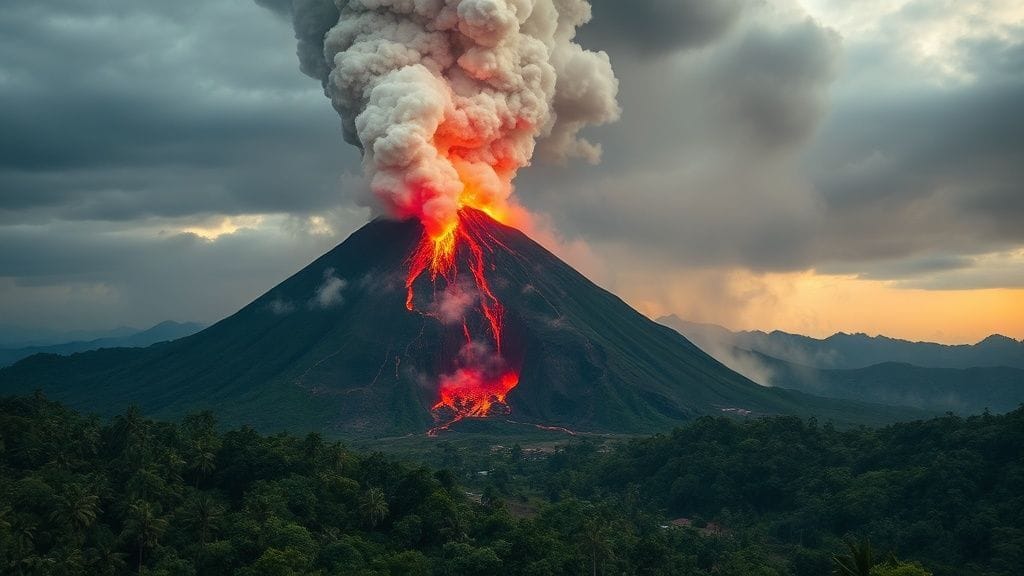
Then came the moment when waiting became impossible. On a day etched now in Sulawesi’s history as both tragic and transformative, the earth shattered its uneasy calm. It began with a deafening roar as the mountain’s vents violently expelled clouds of ash, gas, and glowing magma. The sky swiftly darkened, turning day into twilight.
Local accounts speak of a cataclysmic force—earthquakes toppled huts while a choking veil of ash and sulfurous smoke blinded and suffocated those caught in its path. Rivers and streams swelled with mudflows and debris, racing down the slopes in terrifying torrents. The mountain’s eruption column spiraled miles into the atmosphere, choking the sun and raining destruction for days.
This was no mere puff of volcanic activity; it was a full-scale upheaval of nature’s raw fury – a spectacle of destruction that captured awe and despair in equal measure.
The Eruption Unleashed: Fire, Smoke, and Chaos
As Mahawu erupted, the physical world around it transformed dramatically. Pyroclastic flows—fast-moving currents of hot gas and volcanic matter—raced down the mountain’s flanks, annihilating everything in their path. Villages, agricultural terraces, and sacred sites disintegrated under molten rain.
Ash blanketed the surrounding landscapes, turning green fields white, choking water supplies, and smothering the delicate ecosystems of Lake Tondano’s fringe. The air was filled with a toxic mix, causing respiratory distress and panic among the population.
One heartrending report from survivors recalls families fleeing in chaos, clutching children, and seeking refuge in caves or forests, desperately trying to escape the raining inferno. The loud explosions from the mountain’s vent echoed for miles, a terrifying symphony to the suffering below.
The Devastation: Landscape Transformed, Lives Altered
When the ash finally settled and the mountain’s roar abated, the damage was clear and immense. The fertile plains surrounding Lake Tondano lay buried under meters of volcanic debris. Roads and pathways had vanished, rivers were rerouted or clogged, and the mountain itself bore new scars—craters, fissures, and deposits marking the violence it had disgorged.
The human toll was devastating. Although precise records are scarce—owing to the limited means of documentation at the time—estimates suggest hundreds, perhaps thousands, were displaced or perished due to the eruption and subsequent hardships. Survivors faced not only immediate physical suffering but also the collapse of their agricultural base, upon which their sustenance relied.
Entire villages around Mahawu were washed away or rendered unlivable for years, forcing mass migrations and challenging the fabric of family and community structures.
Survivors’ Voices: Stories from the Ashes
Oral tradition, the primary historian of 18th-century Sulawesi, preserves haunting testimonials of the eruption. Grandmothers recount tales of hiding in dense forests, listening to the mountain’s angry breaths as the world burned. Some narratives tell of miraculous survivals—children saved by quick thinking parents, elders protected by spiritual intervention, and villages that rebuilt stronger on safer ground.
These stories also speak of deep sorrow: lost kin, destroyed homes, and faith severely tested. For many, the eruption was not only a physical disaster but an existential moment, questioning humanity’s place in the cosmic order.
One survivor’s lament echoes in the local memory: “The mountain has taken much, yet it also teaches us the price of disrespect and the need to live in harmony.” This poignant reflection captures the blend of loss and learning woven into Sulawesi’s volcanic history.
The Natural Fury Explained: Volcanology of Tondano’s Mahawu
Modern volcanic science illuminates the 1789 eruption’s nature with chilling clarity. Mahawu is a stratovolcano, a composite volcano built up by multiple eruptions of lava flows, ash, and pyroclastic materials. Its eruptions tend to be explosive rather than effusive, spewing ash and gas violently rather than gently oozing lava.
The 1789 eruption likely involved a building pressure of magma and volcanic gases trapped beneath the mountain’s solidified crust. Over time, this pressure reached a catastrophic threshold, resulting in a sudden release of energy that fragmented the rock above and unleashed the eruption’s destructive power.
This understanding places Mahawu among Indonesia’s noteworthy volcanic threats—a member of the famed Pacific “Ring of Fire,” where tectonic plates grind and subduct beneath each other, fueling such fiery phenomena.
Socioeconomic Impact on Sulawesi’s Communities
The eruption’s aftermath saw profound disruptions to Sulawesi’s economy. The ashfall smothered fertile lands critical for rice, spices, and other crops pivotal to local and regional trade. Fishing communities around Lake Tondano faced polluted waters and decreased fish stocks.
Trade routes slowed or rerouted as roads became impassable, and the Dutch East India Company’s limited control meant state relief was minimal or absent. Indigenous communities had to develop grassroots survival strategies—sharing resources, relocating settlements, and adjusting their agricultural practices to reconcile with the changed land.
This economic shock resonated beyond years, delaying developmental efforts and contributing to population shifts that would influence the region’s demographic and cultural composition.
Colonial Context: Dutch East India Company’s Role and Response
Indonesia in 1789 was a patchwork of indigenous polities and burgeoning colonial encroachments. The Dutch East India Company held commercial dominance but its influence in remote upland areas like Mahawu’s environs was tenuous.
Historical records suggest the VOC’s involvement in direct disaster relief was limited. Preoccupied with broader trading interests and political rivalries, the Dutch viewed natural disasters more as obstacles than humanitarian moments. Nonetheless, the eruption did provoke intermittent Dutch interest in the interior, spurring exploratory missions and attempts to assert more control over the affected regions.
This episode exemplifies the complex interplay of colonial power, natural disaster, and indigenous resilience—where external actors observed the chaos with detached calculation even as local lives were irreversibly altered.
The Spiritual Dimension: Interpreting the Disaster through Local Beliefs
For the Minahasa and other Sulawesi peoples, volcanic eruptions were not just physical catastrophes but manifestations of spiritual imbalance. The eruption of Mahawu in 1789 was interpreted as an expression of divine or ancestral displeasure, prompting renewed ritual activity.
Priests and shamans performed ceremonies aimed at appeasing the mountain spirit, casting offerings into the lake and volcanic vents in hopes of restoring harmony. Such spiritual frameworks framed the disaster less as senseless devastation and more as a narrative of moral and cosmic order.
These beliefs provided psychological solace and social cohesion, allowing communities to interpret suffering within a meaningful context and mobilize collective recovery efforts.
Reconstruction and Recovery: From Ruin to Renewal
Despite the overwhelming destruction, life after the eruption did not freeze in sorrow. The Minahasa people, rooted in their land and traditions, undertook remarkable reconstruction efforts. Villages were rebuilt, often on more secure sites; agricultural fields were cleared and slowly rejuvenated; and cultural practices adapted to incorporate the memory of the disaster.
This period of recovery spanned decades, marked by resilience and the gradual reweaving of social fabric. The eruption itself became a touchstone in community identity, a story passed through generations as both warning and inspiration.
By the early 19th century, the region had largely regained its vitality, though the scars of 1789 remained etched in landscape and lore.
The Eruption’s Echo Through Indonesian History
While the Tondano eruption did not alter the broader course of Indonesian history in the dramatic style of larger cataclysms like Tambora (1815), its echoes resonate locally and regionally. It underscored the persistent volatility of the archipelago’s environment and the intricate relationships between human settlements and natural hazards.
The event also highlighted the limitations of colonial governance in responding to indigenous crises, prefiguring future tensions and adaptations in the centuries to come. Its memory forms part of the geological and cultural tapestry that defines Sulawesi’s unique place within Indonesia’s complex history.
Modern Legacy: Scientific Lessons and Cultural Memory
Today, the Mahawu volcano is monitored by Indonesian geological services, its restless breath measured and analyzed with technologies unimaginable in 1789. Scientists study its patterns to forecast potential future eruptions, applying lessons drawn from history to protect lives.
Culturally, the eruption remains embedded in local tradition. Stories, songs, and rituals preserve not only the horror but the survival—reminding new generations of the mountain’s power and their enduring bond with the earth.
The Tondano eruption thus bridges past and present, a chapter in human interaction with nature’s unpredictable might.
The Mountain Today: Mahawu’s Vigil Over Its People
Mahawu stands today as a sentinel, its green slopes inviting trekkers and scientists alike, a paradox of beauty and danger. Its dormant quiet is both blessing and constant reminder.
The communities around Lake Tondano live with cautious respect, honoring the mountain through ceremonies and sustainable practices. Monitoring stations provide early warning systems, evidencing the synthesis of ancient wisdom and modern science.
Though centuries have passed, the 1789 eruption’s shadow encourages vigilance, adaptation, and humility before the forces shaping Sulawesi’s fate.
Conclusion: Nature’s Power and Human Resilience
The 1789 eruption of Mahawu near Tondano is more than an isolated geological episode—it is a vivid testament to the volatile power of our planet and the enduring spirit of those who live in its embrace. The blackened skies and shattered villages of that fateful spring evoke raw emotion: fear, loss, amazement, and ultimately, hope.
Through the ash and flame, humanity’s deep connection to the earth emerges—a story of vulnerability but also immense resilience. The people of Sulawesi faced destruction not as passive victims but as active participants in regenerating life from volcanic ruin.
This event, framed by the intimate narratives of survivors, the scientific insights of volcanology, and the spiritual interpretations of local belief, invites us to reflect on contemporary relationships with nature’s forces. It teaches patience, respect, and the indispensable role of memory in forging paths of survival.
Mahawu’s 1789 eruption stands as a monument carved in ash and time—a powerful narrative of destruction and rebirth resonating through the centuries.
FAQs: Understanding the 1789 Tondano Eruption
Q1: What caused the eruption of Mahawu in 1789?
A1: The eruption was caused by pressure buildup of magma and volcanic gases within the stratovolcano’s underground chambers. When this pressure exceeded the strength of the overlaying rock, an explosive eruption occurred, releasing ash, pyroclastic flows, and volcanic gas.
Q2: How did the eruption affect the local population?
A2: Hundreds to possibly thousands of people were displaced or killed, with many villages destroyed or rendered uninhabitable due to ashfall and mudflows. Survivors faced famine, water contamination, and economic hardship.
Q3: What role did the Dutch East India Company play during the disaster?
A3: The VOC’s involvement was minimal; their regional control was limited, and they were primarily focused on trade rather than relief. The disaster highlighted the limitations of colonial authority in dealing with local crises.
Q4: How was the eruption interpreted spiritually by local communities?
A4: The eruption was viewed as a manifestation of spiritual displeasure or cosmic imbalance. Rituals and offerings were used to appease the mountain spirits, integrating the disaster into a moral and cultural framework.
Q5: What scientific advances have been made in understanding Mahawu’s volcanic activity?
A5: Modern volcanology uses seismographs, gas sensors, and satellite imaging to monitor Mahawu, aiming to predict eruptions and mitigate risks through early warning systems.
Q6: How is the memory of the eruption preserved today?
A6: Through oral histories, rituals, and local folklore, the 1789 eruption remains a significant cultural touchstone. It is also studied academically to understand volcanic hazards in Indonesia.
Q7: Did the eruption have lasting economic impacts?
A7: Yes, the destruction of agricultural land and trade disruptions caused economic hardship that lasted for years, altering population distribution and development patterns.
Q8: Is Mahawu still considered an active volcano?
A8: Yes, Mahawu is classified as active but dormant, with its last major eruption occurring centuries ago. Continual monitoring helps manage the risk it poses.

