Table of Contents
- Shadows Over the Eternal City
- Rome Between Empires: The World Totila Inherited
- The Gothic War Unleashed: From Justinian’s Dream to Italy’s Nightmare
- Totila Rises: From Obscurity to King of the Ostrogoths
- Rome Before the Storm: A City Exhausted by War
- After the First Siege: Mercy, Strategy, and Missed Chances
- March to the Tiber: Totila’s 545 Campaign and the Road to Rome
- Encircled Again: The Totila Second Siege of Rome Begins
- Inside the Walls: Hunger, Fear, and the Politics of Survival
- The General and the Emperor: Belisarius, Justinian, and Distant Decisions
- Betrayal at the Gates: How the Eternal City Finally Fell
- Mercy and Ruin: Totila’s Rule Over Conquered Rome
- Lives in the Crossfire: Citizens, Soldiers, and Strangers
- Propaganda and Memory: How Rome Told the Story of Its Own Defeat
- From Siege to Shattered Kingdom: The Aftermath for the Ostrogoths
- The Long Echo: How the Second Siege Shaped Medieval Rome
- Historians, Sources, and the Search for Totila
- Conclusion
- FAQs
- External Resource
- Internal Link
Article Summary: In the mid-sixth century, the totila second siege of rome unfolded against a backdrop of imperial ambition, religious tension, and a city already scarred by years of war. This article follows the story of Totila, king of the Ostrogoths, as he surrounds the Eternal City in 545, intending not only to conquer but to reshape it. We move through the crumbling infrastructure of late antique Rome, into the desperate halls of Byzantine power, and onto the cold ramparts where starving defenders watch Gothic fires burn in the distance. Through narrative and analysis, we explore how this siege differed from the first, why it ended in betrayal rather than open assault, and what it meant for ordinary Romans caught between empire and invader. The totila second siege of rome was not just another military episode; it was a turning point marking the slow transformation of classical Rome into a medieval city. We examine the political calculations of Totila and Justinian, the role of Belisarius, and the propaganda that later framed Totila as either barbarian destroyer or tragic hero. By tracing social, economic, and cultural consequences, the article shows how this siege helped sever Rome’s living connection with its ancient imperial past. In doing so, it reveals why the totila second siege of rome still matters for understanding the fall of the ancient world and the birth of a new Europe.
Shadows Over the Eternal City
The year 545 dawned over Rome not with triumphal trumpets but with the creak of empty carts and the muffled echo of footsteps in half-abandoned streets. Once the unquestioned capital of the world, the city was now a worn veteran of disasters, its monuments cracked, its population shrunk to a fraction of its imperial peak. The totila second siege of rome would soon press against its ancient walls, but even before Gothic scouts appeared on the horizon, the Romans knew they were living inside a memory—inside a city that was neither fully ancient nor yet fully medieval. Columns still rose toward the sky, but the forums around them were choked with rubble and huts. Senatorial palaces stood silent, their marble floors echoing only the sounds of servants and soldiers.
Rome had been besieged before, of course. Alaric had sacked it in 410. The Vandals had plundered it in 455. In the generations since, famine, plague, and neglect had worked a more insidious siege from within. But what was about to unfold in 545, when Totila, king of the Ostrogoths, returned to encircle the city for a second time, would strike at the very continuity of Roman civilization in Italy. It would test whether the city could still command loyalty, whether its stones had any meaning beyond their value as fortress walls and raw material.
In taverns and churches, whispers ran ahead of the marching Goths. Totila, whose first siege had ended with an unexpected gesture of mercy, was coming again. Some remembered that he had spared the city when it lay at his feet, hoping perhaps to win the hearts of its people or to use it as a bargaining chip with distant Emperor Justinian in Constantinople. Others muttered that the emperor had rewarded this mercy only with renewed war, sending Belisarius back into Italy like a blade drawn once more from its sheath. Now, it seemed, the game would be played again, but with fewer resources, less hope, and more bitterness on all sides.
It is in this tension—between past glory and present desperation, between imperial dream and local survival—that the story of the totila second siege of rome must be told. For the siege was not a simple matter of one army surrounding one city; it was the visible surface of deeper struggles: over identity, faith, power, and the very meaning of Rome in a world that had moved beyond the old empire but could not yet let it go.
Rome Between Empires: The World Totila Inherited
To understand why Totila marched on Rome in 545, one must first step back into the shifting geography of power in the sixth century. Two visions of empire stood uneasily across the Mediterranean: the Eastern Roman Empire, ruled from Constantinople by Emperor Justinian I, and the Ostrogothic kingdom in Italy, heirs to Theoderic the Great. The city of Rome lay between them, no longer the seat of government but still the symbolic heart of what it meant to be Roman.
By Totila’s day, Italy had already been under Gothic rule for several decades. Theoderic had tried, with considerable skill, to balance Gothic military dominance with Roman administrative continuity. Senators still debated, legal systems still functioned, taxes were collected, and the population could almost pretend that the old order had merely shifted its colors, not its essence. But behind that façade, tensions simmered. The Goths were Arians, followers of a Christian creed condemned as heretical by the orthodox Nicene Church, to which most Romans adhered. And in Constantinople, Justinian looked westward and saw in Italy an opportunity: a chance to reunify the old Roman world under his authority and to clothe power in the garb of restoration.
The Gothic War, launched in 535, shattered whatever fragile balance remained. Sicily fell, then parts of southern Italy, and eventually even Ravenna, the Gothic capital. The imperial narrative, so carefully preserved in the writings of Justinian’s court historian Procopius, cast these campaigns as a noble recovery of lost provinces. Yet for those who lived in Italy, it was less a restoration than a prolonged catastrophe. Cities changed hands repeatedly, fields were burned, and the logistics of war consumed resources that might otherwise have sustained peace.
Within this landscape, Rome was a prize and a liability. It was strategically vital as a stronghold and symbolically invaluable as the ancient caput mundi. At the same time, maintaining it was expensive, feeding it was difficult, and controlling it required the cooperation or coercion of a population wary of all masters. When Totila became king of the Ostrogoths in 541, he did so in a realm already battered by Justinian’s ambitions and by internal dissension. The city he contemplated besieging had already felt the tremors of war and would soon feel the full force of his strategy.
The Gothic War Unleashed: From Justinian’s Dream to Italy’s Nightmare
The Gothic War began, at least in Justinian’s own rhetoric, as a limited expedition—an almost surgical intervention intended to remove a questionable regime and restore unity. The emperor sent Belisarius, famous for his victories against the Persians and the Vandals, to Italy with a relatively small but highly disciplined force. The early phases of the war, swift and decisive, may have encouraged the illusion that imperial arms could reshape the West with minimal disruption.
Yet war, once loosed, rarely follows the neat lines drawn in imperial palaces. The campaign dragged on, fronts multiplied, and the Goths proved more resilient than expected. Procopius, who served with Belisarius and later wrote an extensive history of the war, describes sieges, counter-sieges, and battles fought over roads, rivers, and half-ruined towns. Each victory carried a cost: harvests trampled by marching feet, bridges burned, aqueducts damaged, and civilians uprooted from ancestral lands.
Rome entered the war’s theater as both stage and actor. Belisarius captured it in 536, to Justinian’s delight, but soon found himself defending the city in a brutal siege led by the Gothic king Witiges. Water supplies were cut, famine took hold, and only through a combination of engineering, daring, and perhaps luck did the city ultimately hold. That siege had been harrowing, but it ended with Rome still in imperial hands and with a sense—however fragile—that Justinian’s dream was achievable.
By the time Totila rose to power, the aura of inevitability that had surrounded Constantinople’s armies had faded. Imperial forces were overstretched, and Justinian’s attention was divided by outbreaks of plague and renewed conflict in the East. The Gothic War had become an open wound, draining resources from both sides. Italy’s countryside, once rich with grain and olives, now offered too many fields of graves and too few stores of food. In such a context, the totila second siege of rome would be less a bold first move than a desperate but calculated attempt to shift the balance in a long and draining struggle.
Totila Rises: From Obscurity to King of the Ostrogoths
Totila did not begin his life as a king destined for legend. The sources, sparse as they are, suggest a man of noble Gothic lineage but not of the highest rank. His original name was probably Baduila, with “Totila” emerging as either a diminutive or a political name that later clung to him in memory. What stands out in the accounts of Procopius and others is his combination of courage, charisma, and flexibility—qualities that mattered greatly in a shattered kingdom searching for a leader.
In 541, as the Ostrogoths reeled from defeat and internal dispute, they chose Totila as king. It was a choice made under duress, but not a blind one. Here was a man who could talk to his warriors as a comrade in arms, who could also address Roman landowners with something approaching statesmanship. He understood, or at least intuited, that military victory alone would not restore Gothic control over Italy. He needed the economic cooperation and grudging acceptance of the Italian population, who still identified themselves as Romans even under Gothic rule.
Totila’s early campaigns demonstrated his strategic instincts. He moved swiftly, picking off isolated imperial garrisons, offering terms to cities that surrendered without a fight, and punishing those that resisted too stubbornly. At the same time, he cultivated an image of fairness. There are reports of him freeing slaves taken by imperial troops and reducing excessive taxes. Whether these gestures sprang from genuine idealism or cold calculation is impossible to say with certainty; what matters is that they made an impression. The figure of Totila that emerges from the record is not a crude marauder but a man who understood the power of image in war.
This understanding would shape his interactions with Rome itself. Totila knew that if he could take the city and treat it not as a spoil but as a partner, he might fracture the moral authority of Justinian’s campaign. The totila second siege of rome cannot be divorced from this broader political theater: it was a message to Constantinople and to every wavering Italian city that the Gothic king was not merely surviving but shaping the terms of engagement.
Rome Before the Storm: A City Exhausted by War
Before Totila’s armies reappeared on the Roman horizon, the city had already changed hands and character more than once during the Gothic War. Its population, which had perhaps reached a million in the high imperial period, had dwindled dramatically by the mid-sixth century—some estimates suggest fewer than 100,000 inhabitants remained, possibly far fewer. Great stretches of the city lay abandoned; the sound of craftsmen at work echoed in a fraction of the spaces that once bustled with life.
Yet Rome remained a place of intense symbolism. The bishop of Rome, increasingly referred to as the pope, resided there, and the city’s churches drew pilgrims from across Italy. The Senate still existed in a diminished form, its elderly aristocrats clinging to traditions that stretched back centuries. Imperial officials, when present, occupied converted palaces and supervised the collection of taxes and annona, the grain supplies that had once fed a vast urban population and now barely sustained the remnant within the walls.
Infrastructure bore the scars of conflict. Aqueducts, vital arteries that had long brought fresh water from distant hills, had been severed during earlier sieges. Some had been repaired; others lay in ruin, forcing residents to rely increasingly on wells and the polluted Tiber. The great baths, once the pride of Roman urban culture, largely stood dry and silent. Amphitheaters such as the Colosseum had already begun their long transformation from performance spaces into quarries, fortresses, and makeshift housing.
Politically, Rome in 545 was administered nominally in the name of Emperor Justinian, but reality was more complicated. Garrison commanders wielded significant power, often balancing imperial directives against local conditions. Grain shipments from Africa and Sicily were irregular, vulnerable to storms and Gothic raids. When grain did arrive, it was as much a tool of control as a relief measure: who ate and who starved became a political decision.
In this fragile equilibrium, news of Totila’s approach spread dread and hope in equal measure. Some Romans feared another siege, another round of famine and disease. Others, disillusioned with distant Constantinople, whispered that perhaps the Gothic king—who had shown unusual restraint in his first siege—might offer more stable rule. It is astonishing, isn’t it, that the citizens of Rome, heirs to an empire, now weighed their future between two masters, neither of whom truly called their city home?
After the First Siege: Mercy, Strategy, and Missed Chances
Totila’s first siege of Rome, which preceded the events of 545, casts a long shadow over the second. In that earlier encounter, the Gothic king had surrounded the city and brought it to the brink of capitulation. Supplies ran low, and morale crumbled. Yet at the critical moment, Totila chose not to storm the walls or subject the inhabitants to slaughter. Instead, he withdrew, offering Rome a reprieve that surprised contemporaries and has puzzled historians ever since.
Why did he do this? Some contemporaries interpreted the gesture as a sign of chivalry, an almost romantic reluctance to violate the sanctity of the ancient city. Others, including Procopius, framed it in more pragmatic terms: Totila hoped that by sparing Rome he could win its trust and encourage other cities to surrender without resistance. The Gospel-infused moral rhetoric of the age, echoed in later ecclesiastical writings, occasionally painted him as a man who preferred persuasion to bloodshed.
Yet behind the celebrations that followed his withdrawal lay a more sobering reality: Rome’s respite was purchased with nothing more than time. Justinian took Totila’s leniency as an opportunity to reinforce imperial positions in Italy, to reshuffle commanders, and to recall Belisarius for new tasks before eventually sending him back. The chance for a swift settlement between emperor and Gothic king—if it ever truly existed—slipped away in the labyrinth of imperial politics and ambition.
The first siege had revealed Rome’s vulnerabilities: its dependence on external grain, its limited garrison, and its aging fortifications. It had also revealed Totila’s problem: mercy did not necessarily translate into loyalty. When he returned in 545, the city was again in imperial hands. The totila second siege of rome would thus take place not as a cautious first probing but as a more hardened, more desperate gambit from a king who had learned the limits of magnanimity in war.
March to the Tiber: Totila’s 545 Campaign and the Road to Rome
In 545, Totila set in motion a campaign that would carry his banners back to the walls of the Eternal City. By then, the Ostrogothic king had reasserted control over much of the Italian peninsula, except for pockets of imperial resistance. His strategy was both military and economic: he aimed to isolate Rome, cut its supply lines, and demonstrate that Constantinople could no longer protect its distant possession.
Moving through central Italy, Totila captured fortresses and towns that controlled key roads and river crossings. He sent detachments to interdict grain shipments coming from Sicily and the African provinces. The sea, which had so often been Constantinople’s lifeline, became contested as Gothic ships, though inferior to the imperial navy, harassed merchant vessels and threatened ports loyal to Justinian.
The countryside felt the war’s full weight. Peasants fled their farms at the approach of either army, uncertain which would demand more in taxes, requisitions, or sheer plunder. Harvests went ungathered or were burned as scorched earth. Even monasteries, those islands of relative stability in a sea of chaos, found themselves drawn into the conflict. Some housed refugees; others saw their granaries seized by passing troops.
As Totila’s forces closed in on Rome, scouts reported on the condition of its defenses, the strength of its garrison, and the mood within the walls. Totila likely understood that a direct assault would be costly; the city’s ancient ramparts still presented a formidable barrier, especially if defended by determined troops. But he also knew that the city was fragile, dependent on external supplies and plagued by internal divisions. He trusted that time—and hunger—could do what battering rams might fail to achieve.
Thus, the approach to Rome in 545 was not a headlong rush but a tightening spiral. Each town that fell to Totila, each farm burned or occupied, each roadblock raised against imperial couriers, added another thread to the noose. By the time Gothic banners were seen from the city’s watchtowers, the siege had already begun in all but name.
Encircled Again: The Totila Second Siege of Rome Begins
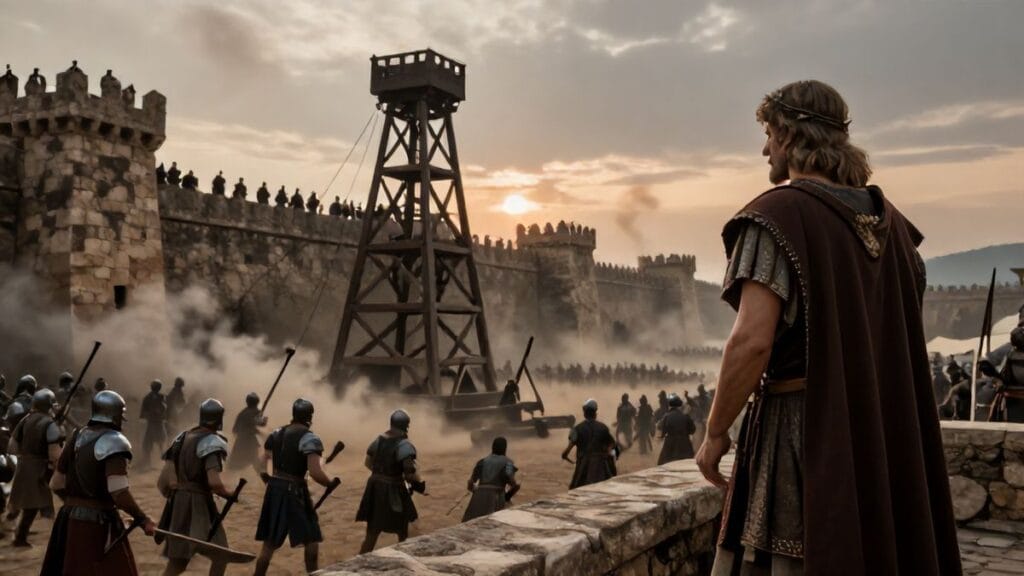
When Totila’s army finally arrayed itself around Rome in 545, the sight must have stirred memories of earlier terrors. Dust clouds from marching columns, the glitter of spearheads in winter light, the rhythm of hammers building siege works—all combined to tell the city that its reprieve was over. The totila second siege of rome had begun, this time with fewer illusions and far greater stakes.
Totila chose not to waste men in reckless frontal assaults. Instead, he implemented a blockade, cutting off land routes into the city and attempting, as best his resources allowed, to disrupt supplies coming by sea and river. He stationed troops at key gates, along the Via Appia and other major roads, and on high ground overlooking the Tiber’s approaches. The intention was clear: starve Rome into submission.
Within the camp, life followed the rough rhythms of a Gothic army on campaign. Warriors mended weapons, tended to horses, and shared stories around fires. Some had fought at Rome before; others knew it only as a distant legend, the city that had once ruled their ancestors’ homelands beyond the Danube. Now it stood before them as both prize and obstacle, its walls a jagged horizon of brick and stone.
Totila himself moved between encampments, conferring with his leaders, inspecting fortifications, and perhaps dispatching envoys to test the city’s will. He understood the power of psychological warfare. Rumors spread—some encouraged by Gothic agents—that the emperor had abandoned Rome, that no relief army would come, that resistance would bring only more suffering. It was a familiar pattern in siege warfare, but in a city already wearied by years of conflict, such rumors found fertile ground.
The totila second siege of rome, however, was not simply a military operation; it was a statement. By returning to the city he had once spared, Totila signaled his determination to force a resolution. He would no longer be content with gestures or half victories. Either Rome would fall into his hands and legitimize his rule over Italy, or it would perish as a symbol of Justinian’s failed reconquest.
Inside the Walls: Hunger, Fear, and the Politics of Survival
Inside the city, the arrival of Totila’s forces produced an immediate tightening of belts and tempers. Grain stores were inventoried, rations calculated, and the price of food began its relentless climb. Those with hoarded reserves saw an opportunity for profit; those without saw only the dark specter of hunger. The city’s leaders—military commanders, clergy, and a handful of senators—faced unenviable decisions about distribution and security.
Rome’s garrison was not large, and many of its soldiers were not locals. Some were Isaurians or Thracians, men from distant provinces who felt little personal tie to the city beyond their pay. Loyalty to Justinian and fear of punishment could keep them in line for a time, but as siege conditions worsened, the question of whether they would fight to the bitter end or seek accommodation with Totila loomed larger.
For ordinary citizens, daily life narrowed to essentials. Water had to be drawn and guarded. Food for children took precedence over everything else. The once-busy markets shrank to a few anxious gatherings where small quantities of goods changed hands at ruinous prices. Streets that had echoed with processions and festivals now echoed more often with the sound of cart wheels carrying bodies to hurried burials.
The clergy played a dual role. On the one hand, priests and monks offered spiritual consolation, organizing prayers and processions, reminding the faithful of previous times when God had preserved the city from disaster. On the other, church leaders possessed material resources—granaries, vineyards, and sometimes secret caches of wealth. Their decisions about how much to share, and with whom, could ease social tensions or ignite them.
Politics, as always, threaded through the suffering. Some influential Romans argued that the city should negotiate with Totila, pointing to his earlier leniency and to Constantinople’s apparent inability to provide timely help. Others insisted on unwavering loyalty to Justinian, fearing not only imperial reprisals but the moral stigma of betraying the emperor and the orthodox cause. In whispered conversations behind shuttered windows, families weighed not abstract ideals but the immediate survival of their children. As the totila second siege of rome dragged on, these internal divisions became as dangerous as any Gothic spear.
The General and the Emperor: Belisarius, Justinian, and Distant Decisions
No story of the siege can be told without considering the complicated triangle formed by Emperor Justinian, his general Belisarius, and the forces besieging and defending Rome. From Constantinople, Justinian viewed Italy as one front among many. He was engaged in a grueling struggle with the Sassanian Persians in the East, coping with the fiscal and demographic impact of the Justinianic Plague, and pursuing monumental building projects such as the great church of Hagia Sophia. Resources were finite, and priorities constantly shifted.
Belisarius, recalled and redeployed more than once, was both indispensable and suspect in Justinian’s eyes. His earlier military successes had made him famous, perhaps too famous for an emperor who guarded his authority jealously. When news of Rome’s renewed peril reached Constantinople, Justinian did respond, but not with the overwhelming force that might have decisively broken the siege. Instead, he dispatched Belisarius again to Italy, yet with limited troops, insufficient money, and ambiguous instructions.
From his base in the south, Belisarius attempted to relieve Rome through a combination of naval operations and overland marches. Procopius, who admired his former commander, describes daring efforts to run supplies into the city by sea and to harry Gothic positions along the coast. Nevertheless, the logistics worked against him. Gothic control of the hinterland made overland approaches dangerous, and storms or enemy ships could disrupt seaborne relief.
Communication between the general in the field and the emperor at the capital lagged by weeks or months. By the time Belisarius received one set of orders, conditions on the ground might have changed completely. Political intrigue in Constantinople did not stop at the water’s edge; rivals whispered that Belisarius was dragging out the war to preserve his own importance or even that he might aim at independent power in Italy. Such suspicions further constrained Justinian’s willingness to give his greatest general everything he needed.
Thus, as the totila second siege of rome tightened its grip, Rome became an unwitting hostage to the frictions within the very empire that claimed to be saving it. The defenders could look toward the sea and imagine sails carrying Belisarius to their rescue, but hope was tempered by the cold arithmetic of distance, politics, and competing imperial priorities.
Betrayal at the Gates: How the Eternal City Finally Fell
Starvation and time, more than battering rams, brought Rome to the breaking point. As weeks turned into months under siege, the defenders’ morale frayed. Desertions increased, and some soldiers quietly opened channels of communication with the besiegers. History is often shaped not only by great battles but by small, secret bargains made in the dark.
According to Procopius, the final fall of Rome to Totila in 546—after the totila second siege of rome had reached its desperate climax—came through betrayal more than open conquest. A group of Isaurian soldiers, stationed at one of the city’s gates, agreed to admit the Goths in exchange for promises of safety and reward. The conspirators chose a night when vigilance was low and hunger high. When the appointed hour came, Gothic warriors slipped silently into the city, fanning out along streets that had once hosted triumphal processions.
The transition from siege to capture was abrupt and disorienting. Some sections of the city woke to the clash of steel and the shouts of Germanic voices. Others saw little immediate violence, as Totila’s men moved quickly to secure key points: the walls, the main gates, the bridges over the Tiber. Resistance flared in pockets and then collapsed; there was no grand, unified defense, no last stand in the forums of old.
One might imagine the looks on the faces of Rome’s inhabitants as they saw Gothic soldiers, not imperial guards, at their doorways. For some, it must have been terror—visions of past sacks and mass killings. For others, particularly those who had come to resent imperial taxation and incompetence, it may have been something closer to wary relief. At least the siege was over. At least the gnawing hunger might soon ease.
Totila, riding into a city that had once defied him, now confronted a delicate choice. How would he treat the conquered? His decision would shape not only his own reputation but the future of Gothic rule in Italy.
Mercy and Ruin: Totila’s Rule Over Conquered Rome
Once in control of Rome, Totila acted with a blend of harshness and unexpected restraint. He ordered the city’s walls partially demolished, a symbolic and practical gesture intended to prevent it from serving easily as another imperial stronghold against him. In doing so, he quite literally broke the city’s defensive shell—a wound that would take years to repair and that signaled Rome’s diminishing military importance.
Yet he did not unleash a general massacre. There was looting, as there nearly always was when a city changed hands by force, but it was more controlled than in earlier legendary sacks. Totila spared many inhabitants and even attempted to repopulate the city, which had been nearly emptied by siege and starvation. He invited rural populations to move in and offered to restore lands to those who would accept his rule. This dual policy of dismantling fortifications while encouraging habitation reveals a mind thinking in terms of long-term control rather than short-term revenge.
Religious buildings, especially churches, became focal points. Totila, though an Arian Christian, understood the political importance of the Roman Church. He presented himself, at least outwardly, as a protector of clerics and sacred sites. Later papal chronicles, writing under the shadow of Byzantine authority, would cast him in a more negative light, but even they acknowledged moments of restraint. It was in his interest to avoid being remembered simply as a barbarian destroyer; he wanted to rule a functioning, if diminished, Rome.
Economically, Totila tried to reverse some of the damage inflicted by years of war and mismanagement. He reduced or suspended certain taxes, redistributed land, and sought to revive agriculture in surrounding regions. Some Italian landowners, weary of imperial exactions, may have found his terms attractive. Still, the devastation of the countryside and the fragility of trade networks placed hard limits on what any ruler, Gothic or imperial, could achieve.
The paradox of the totila second siege of rome thus becomes clear: the siege that brought Rome to its knees also opened a brief moment of possibility, where a Gothic ruler experimented with a different model of governance in Italy. But history was moving against him. Justinian had not abandoned his dream, and Totila’s foothold in Rome would not go uncontested for long.
Lives in the Crossfire: Citizens, Soldiers, and Strangers
Amid the grand strategies and royal decisions, the human stories of the siege unfold in quieter tones. Imagine a Roman family living in a cramped apartment carved into the shell of a once-luxurious insula. The father, a petty artisan, sees his income evaporate as customers vanish and materials become scarce. The mother trades personal belongings for dwindling quantities of food. Their children grow thin, their games giving way to listless waiting.
Or consider a soldier from distant Anatolia, brought to Italy by imperial orders. He has no love for Rome itself—it is simply his current post, a place where his pay is often late and the language unfamiliar. As hunger gnaws at him during the totila second siege of rome, he weighs the loyalty owed to an unseen emperor against the immediate offer of safety from the Gothic king outside the walls. When he hears whispers of a plan to open the gates, does he report it or listen in silence?
Clergy, too, walked a fine line. A deacon in a suburban church might decide to hide a portion of the grain stored for the poor, fearing what will happen when Gothic troops arrive, or when desperate townsfolk break down the doors. An abbot in a nearby monastery negotiates secretly with both sides, trying to ensure his community’s survival regardless of who ultimately prevails. Their choices, made in fear and faith, ripple outward through parishes and neighborhoods.
There were also strangers—refugees from the countryside, former slaves freed in the chaos, merchants stranded by disrupted trade. Rome, even in decline, remained a magnet for those seeking safety or opportunity. During the siege, these newcomers found themselves trapped in a city that could barely feed those who had lived there for generations. Their perspectives, largely absent from written records, remind us that the suffering of sieges rarely falls evenly. Those without established networks of kinship or patronage are usually the first to starve.
In this sense, the totila second siege of rome was a microcosm of late antique society under stress. Class, status, gender, and ethnicity all shaped how individuals experienced the crisis. Some found ways to profit or at least to endure; others disappeared into the anonymous mass of the dead, their names unrecorded, their stories lost except in the faint traces they left in the city’s archaeological layers.
Propaganda and Memory: How Rome Told the Story of Its Own Defeat
History is written not only in the moment of events but in the stories later told about them. The fall of Rome to Totila, after the second siege, quickly became fodder for competing narratives. In Constantinople and among imperial loyalists, the event was framed as a temporary misfortune, a setback in a righteous war that would eventually restore Roman rule. Procopius, writing his Wars, cast Totila as a formidable but ultimately doomed opponent, his successes overshadowed by the inevitability of imperial victory.
Ecclesiastical writers, particularly those close to the papacy, adopted a more moralizing tone. Some chronicles portrayed the siege as divine punishment for sins—whether of the Romans, the emperor, or the Gothic heretics, interpretations varied. Later hagiographic texts sometimes inserted miracles into the narrative: saints protecting churches, relics ensuring the survival of particular communities. These stories did not so much contradict the basic facts of siege and conquest as overlay them with a theological interpretation that gave suffering a cosmic meaning.
For the Goths themselves, few written records survive, but we can imagine how Totila’s supporters might have told the tale. Here was a king who defied the might of Constantinople, took Rome itself, and tried to rule with justice. In this light, the totila second siege of rome could be remembered not as an act of vandalism but as a moment of Gothic vindication—a chance to say that they, too, could claim the heritage of Romanitas.
Over time, as Byzantine control returned and then faded again, and as Rome slipped further into the medieval world, the precise contours of the siege blurred. Later generations remembered Totila mostly as a destroyer, a name associated with the city’s desolation in the sixth century. Yet modern historians, reading Procopius alongside archaeological evidence, have complicated this picture. As historian Bryan Ward-Perkins has argued in his work on the fall of Rome, the violence and disruption of this era were real and devastating, but they also gave rise to new forms of society that cannot be reduced to simple tales of barbarian invasion.
Memory, then, became another battleground. Whose Rome had been besieged—Justinian’s, the pope’s, the senators’, or the anonymous poor? And whose Rome emerged afterward, bearing scars that would shape the city for centuries to come?
From Siege to Shattered Kingdom: The Aftermath for the Ostrogoths
For Totila and his Ostrogothic followers, the capture of Rome was a high point, but it did not secure their future. The Gothic War continued, and Justinian, though slow, was relentless. Fresh imperial forces trickled into Italy, including troops under the Armenian general Narses, who would eventually replace Belisarius and lead a decisive campaign against the Goths.
Totila attempted to consolidate his gains, moving between Rome and other key cities, but he faced mounting pressures. Maintaining garrisons, paying soldiers, and feeding populations in a devastated land stretched his resources thin. Each new imperial offensive forced him to redeploy, risking the loss of control in recently won territories. The very effort to hold Rome—symbolically precious but strategically burdensome—may have contributed to the overstretch of his forces.
In 552, at the Battle of Taginae (also known as Busta Gallorum), Totila met Narses in a confrontation that would decide the fate of the Ostrogothic kingdom. Despite his personal courage, Totila was defeated and killed. With his death, the Gothic resistance in Italy rapidly unraveled. The kingdom that Theoderic had built and that Totila had tried to salvage disappeared, leaving only scattered Gothic communities and memories behind.
The irony is stark. The totila second siege of rome, intended to anchor Gothic authority by seizing the greatest city in the West, instead became a prelude to the kingdom’s destruction. By focusing so much effort on Rome, Totila tied his fortunes to a city that could not, in the end, serve as a secure base of power. Justinian’s empire regained formal control over Italy, though the victory would prove pyrrhic, as later Lombard invasions and internal weaknesses eroded Byzantine authority in the peninsula.
For the Goths themselves, the aftermath was dispersal and assimilation. Some joined imperial armies, others settled quietly as landowners or farmers, blending into the local population. Their distinctive identity, once proclaimed on battlefields and in royal courts, faded over generations. In that sense, the siege of Rome was not only a turning point for the city but also a hinge in the story of a people whose independent political existence in Italy came to an end.
The Long Echo: How the Second Siege Shaped Medieval Rome
The consequences of the siege did not end with Totila’s death or even with the formal close of the Gothic War. The physical and demographic damage inflicted on Rome during these years set the stage for its transformation into a very different kind of city. By the late sixth and seventh centuries, Rome’s population had shrunk dramatically, perhaps to as low as 30,000–40,000 inhabitants. Vast districts lay empty or were turned into fields and pastures.
The partial demolition of the walls under Totila, followed by hasty repairs under Byzantine and later papal authorities, symbolized this transition. The city’s defenses remained important, but the sheer scale of the ancient wall circuit was now mismatched to the resources available for its maintenance. Instead of a vast metropolis policing its empire, Rome became one fortified node among many in a fragmented Italy.
Economically, the disruption of long-distance trade and the decline of imperial administration forced the city to rely more heavily on the Church as a stabilizing institution. The bishop of Rome, whose authority had already been growing, emerged as the city’s most consistent leader. Popes negotiated with invading armies, organized food distribution, and sponsored repairs to churches and occasionally to civic infrastructure. As Peter Brown and other historians of late antiquity have shown, this period was less a sudden “fall” than a protracted reorientation, in which religious institutions gradually took on roles once held by imperial bureaucracies.
In cultural terms, the memory of sieges and invasions fostered a mentality of vulnerability and endurance. Medieval Roman pilgrims walked past ruins that still bore the scars of Totila’s time—the broken aqueduct arches, the neglected forums, the repurposed temples. The city’s Christian topography—its basilicas, shrines, and relics—came to overshadow the remnants of its pagan and imperial past, but the two remained intertwined. Stories of saintly protection during the Gothic War mingled with older tales of emperors and generals, creating a layered urban mythology.
Thus, the totila second siege of rome can be seen as one of those hinge events at which multiple trajectories intersect. It marked the effective end of Rome as an imperial political center in the West, even under Byzantine rule, and accelerated its evolution into a spiritual capital whose authority rested more on the memory of Peter and Paul than on legions and senates.
Historians, Sources, and the Search for Totila
Our knowledge of Totila and his sieges of Rome rests heavily on a small number of sources, foremost among them the historian Procopius of Caesarea. Serving as a legal adviser and secretary to Belisarius, Procopius witnessed many events of the Gothic War firsthand, though not every episode, and he supplemented his observations with reports from others. His Wars present Totila as a notable antagonist—brave, clever, at times even admirable—but ultimately an enemy of the empire.
Historians have long debated how to read Procopius. His official histories sometimes sit uneasily beside his infamous Secret History, a scathing, gossipy text that attacks Justinian, Theodora, and Belisarius with venom. The contrast raises questions about bias, genre, and the line between reportage and rhetoric. When Procopius describes the totila second siege of rome, is he offering a mostly accurate account colored by imperial ideology, or is he crafting a literary narrative that serves deeper political purposes?
Other sources, such as later papal biographies in the Liber Pontificalis, add details about the role of popes and churches during the war, but they too write from specific vantage points, emphasizing miracles and ecclesiastical heroism. Archaeological evidence—broken walls, burned layers, coin hoards, and changes in settlement patterns—provides an independent check on textual narratives. Excavations in Rome and its surroundings have increasingly confirmed the scale of sixth-century disruption while also revealing continuity in certain neighborhoods and institutions.
Modern historians, including scholars like J. B. Bury, Bryan Ward-Perkins, and Peter Heather, have reinterpreted Totila within broader discussions of the “fall of Rome” and the transformation of the Roman world. Some stress the brutality and long-term economic devastation of the Gothic War, arguing that Justinian’s reconquest did as much to destroy classical civilization in Italy as any so-called barbarian invasion. Others highlight the adaptive capacities of local societies that survived and reshaped their institutions in the war’s aftermath.
In this evolving historiographical landscape, Totila emerges not as a one-dimensional villain but as a complex figure: a king caught between collapsing imperial structures and emerging medieval orders. The siege he laid before Rome in 545 becomes not only a subject of military history but a lens through which we can examine the endurance and transformation of a city that refused to vanish, even when brought repeatedly to the edge of annihilation.
Conclusion
In the winter light of 545, as Totila’s forces gathered around the Tiber, the fate of Rome hung once more in the balance. The totila second siege of rome was at once a local calamity and a global turning point, the climax of a long struggle between a fading imperial order and a kingdom struggling to claim its place in history. Inside the walls, hunger and fear contested with loyalty and hope; outside, a Gothic king balanced mercy with ruthlessness, strategy with symbolism.
When the city finally fell, not to a thunderous assault but to betrayal and exhaustion, it marked the end of an era. The Rome that emerged under Totila’s control was smaller, weaker, and more dependent on ecclesiastical structures than the imperial metropolis of centuries past. Justinian’s eventual reconquest could not undo the damage. The walls broken, the aqueducts severed, and the populations dispersed during these years reshaped the city’s destiny, pushing it decisively toward the medieval world.
Yet Rome endured. It survived Totila, Justinian, and the Ostrogothic kingdom; it survived Lombard invasions, Carolingian politics, and countless later upheavals. The scars left by the siege became part of a palimpsest, layers of trauma and transformation written into the city’s fabric. For historians, the siege offers a vivid window into the lived experience of late antiquity—how ordinary people navigated the collapse and reconfiguration of power, how leaders tried to wield symbols even as the material world crumbled around them.
To walk through Rome today is to traverse landscapes shaped in part by those desperate months when Gothic camps ringed the city and imperial relief seemed a distant dream. The story of Totila and his second siege is not only about war and politics; it is about resilience and the ambiguous legacy of empire. It reminds us that even the mightiest cities can be brought low, that mercy and violence often intermingle in the choices of rulers, and that from the ruins of one world, another always begins to rise.
FAQs
- Who was Totila?
Totila, also known as Baduila, was king of the Ostrogoths from 541 to 552. Rising from relative obscurity, he revitalized Gothic resistance against Emperor Justinian’s reconquest of Italy, recapturing much of the peninsula and twice besieging Rome before being killed at the Battle of Taginae. - What was the totila second siege of rome?
The totila second siege of rome was the renewed encirclement and blockade of the city by Totila’s Ostrogothic forces beginning in 545. Unlike his first, more tentative siege, this one aimed decisively at capturing Rome, primarily through starvation and psychological pressure rather than direct assault, and it ultimately led to the city’s fall in 546. - Why was Rome so important in the Gothic War?
Rome, though no longer the political capital, remained the symbolic heart of the Roman world and a key strategic stronghold. Controlling it lent legitimacy to any claimant—whether Justinian’s empire or the Ostrogothic kingdom—and influenced the allegiance of other Italian cities and elites. - How did the siege affect ordinary Romans?
Ordinary Romans suffered severe hardship: food shortages, soaring prices, disease, and the constant fear of violence. Many died of hunger or fled, and social tensions rose as authorities struggled to distribute scarce resources. The siege dramatically reduced the city’s population and contributed to its long-term decline. - Did Belisarius try to relieve the siege?
Yes. Justinian sent his general Belisarius back to Italy with limited forces and resources to aid Rome. Belisarius attempted to supply the city by sea and harass Gothic positions, but logistical difficulties, political constraints, and inadequate reinforcements prevented a decisive relief of the siege. - How did Totila finally capture Rome?
Totila ultimately captured Rome through internal betrayal rather than a full-scale assault. A group of Isaurian soldiers guarding one of the city’s gates secretly agreed to admit Gothic troops. Under cover of darkness, Totila’s men entered, seized key positions, and brought the city under Gothic control. - Did Totila destroy Rome after taking it?
Totila ordered sections of Rome’s walls demolished to prevent its easy reuse as a fortress by imperial forces, and there was controlled looting. However, he did not raze the city outright. Instead, he tried to repopulate it and implement policies to revive agriculture and stabilize life under Gothic rule. - What happened to the Ostrogothic kingdom after the siege?
Despite Totila’s temporary successes, the Ostrogothic kingdom was eventually defeated by Byzantine forces under the general Narses. Totila died in battle in 552, and organized Gothic resistance collapsed, ending their kingdom in Italy, though Gothic individuals remained and gradually assimilated. - How reliable are our sources about the siege?
Our main narrative comes from Procopius, a contemporary historian with close ties to the imperial side, supplemented by ecclesiastical texts and archaeological evidence. His account is detailed but biased toward Justinian’s perspective, so modern historians read it critically, cross-checking it against material remains and later sources. - Why does the siege matter for understanding the fall of Rome?
The totila second siege of rome illustrates how the attempt to “restore” the empire in the West actually accelerated the decline of classical urban life in Italy. It shows how warfare, economic collapse, and shifting political structures combined to transform Rome from an imperial metropolis into a smaller, more fragile, and increasingly ecclesiastical city, marking a key stage in the transition from antiquity to the Middle Ages.
External Resource
Internal Link
Other Resources
- Encyclopaedia Britannica – general search for the exact subject
- Google Scholar – academic search for the exact subject
- Internet Archive – digital library search for the exact subject

