Table of Contents
- The Calm Before the Storm: Europe and the Ottoman Empire in the Early 19th Century
- Russia’s Southward Ambitions: The Geopolitical Chessboard
- Ottoman Decline: The Twilight of a Superpower
- The Greek War of Independence and Its Ripple Effects
- The Russo-Turkish War of 1828-1829: A Conflict Unfolding
- From Battlefield to Negotiating Table: The Path to Adrianople
- September 14, 1829: Signing the Treaty in Edirne
- Key Provisions of the Treaty: Redrawing Borders and Power
- The Significance of the Danube and Black Sea Access
- The Treaty’s Impact on Moldavia and Wallachia
- The Holy Places and Russian Influence in Ottoman Affairs
- Impact on the Greek Quest for Independence
- Reverberations Through the Balkans: Seeds of Nationalism
- European Powers React: Diplomacy and Balance of Power
- Economic Implications for the Ottoman Empire and Russia
- Cultural and Social Aftershocks in the Ottoman Realm
- The Role of Key Figures: From Tsar Nicholas I to Sultan Mahmud II
- The Treaty as a Catalyst for Reform or Decline?
- The Legacy of Adrianople in 19th Century Diplomacy
- Conclusion: A Treaty That Changed the Course of Empires
- FAQs
- External Resource
- Internal Link
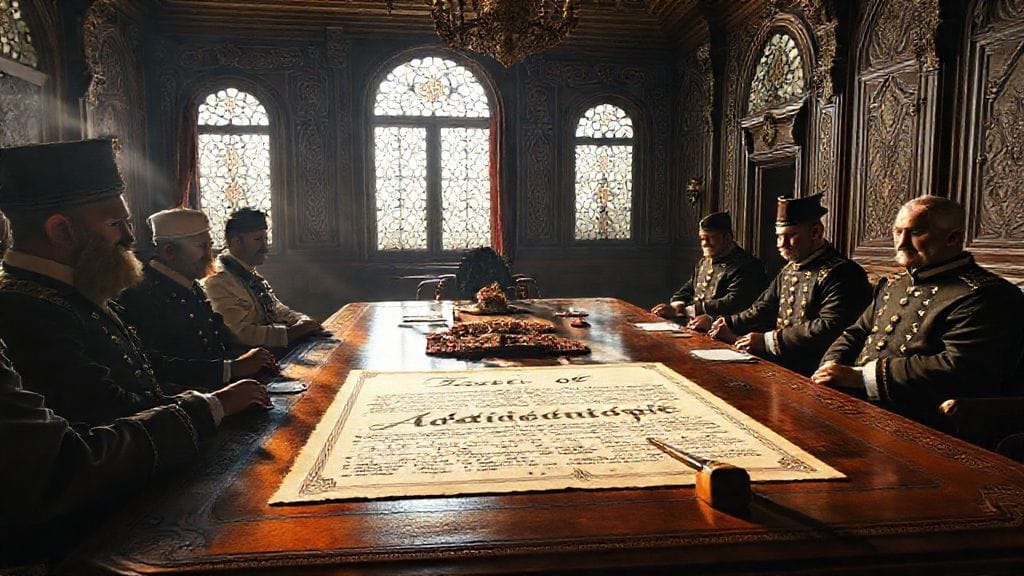
In the late summer of 1829, the air in Edirne, the Ottoman Empire’s proud city perched near Europe’s edge, was thick with uncertainty and cautious hope. Within its stately halls, long shadows of empire and ambition intertwined as two ancient adversaries—Russia and the Ottoman Empire—prepared to ink a treaty that would rearrange the geopolitical map of southeastern Europe. The Treaty of Adrianople, signed on September 14, 1829, would mark not simply the cessation of hostilities but also signal a transformative moment for empires on the edge of profound change.
The Calm Before the Storm: Europe and the Ottoman Empire in the Early 19th Century
The dawn of the 19th century found Europe deeply shaken. The Napoleonic wars had reconfigured alliances, shifted power balances, and seeded nationalist aspirations across the continent. Yet in Eastern Europe and the Near East, the mighty Ottoman Empire, once a dominant force stretching from North Africa to the heart of the Balkans, was grappling with erosion from within and pressure from rising neighbors.
For decades, the empire had been described as the “sick man of Europe,” a label borne out by systemic military weaknesses, bureaucratic inertia, and an inability to modernize effectively amid sweeping industrial transformations reshaping the West. Its territories in the Balkans and the Caucasus were simmering with unrest, and nationalist movements inspired by the ideals of the Enlightenment and French Revolution were stirring the pot of ethnic tensions.
Meanwhile, Russia, self-styled protector of Orthodox Christians and antagonist to Ottoman dominance, saw itself as the natural inheritor of influence over the Balkans and the Black Sea region. Having modernized under Catherine the Great and subsequent tsars, Russian ambitions were relentless — to secure warm water ports, expand southward, and assert control over territories teeming with Orthodox populations.
Russia’s Southward Ambitions: The Geopolitical Chessboard
Russian politics throughout the early 19th century were heavily influenced by the desire to secure access to the Black Sea and, ultimately, the Mediterranean. The Ottoman hold over the straits of Bosporus and Dardanelles was a strategic bottleneck that Russia yearned to unlock.
At the same time, the Russian Orthodox Church positioned itself as a guardian of Christian communities subjugated under Muslim Ottoman rule, legitimizing Moscow’s claim to intervene in Ottoman affairs. The mixture of religious fervor and cold strategy set the stage for inevitable confrontation.
The interplay of power in the region was complex. Britain and France, wary of expanding Russian influence, sought different balances of power, often supporting the Ottomans diplomatically while harboring their own imperial interests. Yet Europe’s politics were fragmentary and fluid, with the Great Powers cautiously watching, sometimes turning a blind eye, sometimes stepping into the fray.
Ottoman Decline: The Twilight of a Superpower
By the 1820s, the Ottoman Empire’s vast domains had frayed. Administrative inefficiencies plagued the empire: provincial governors defied Istanbul’s authority, armies were outdated, and economic systems lagged behind European counterparts.
Sultan Mahmud II, ascending the throne in 1808, recognized these challenges and pushed for reform—a precursor to what would later be known as the Tanzimat period. His efforts included disbanding the Janissaries in 1826, a force that had become both powerful and unruly, but systemic change was slow and met with resistance.
The empire’s vulnerability became glaringly apparent during the Greek War of Independence (1821–1829), a conflict that had drawn the attention and sympathy of Europe, and further incited nationalist agitation in the Balkans.
The Greek War of Independence and Its Ripple Effects
The Greek revolt against Ottoman rule triggered a series of international interventions and escalations. The brutal repression by Ottoman forces shocked many in Europe and galvanized the philhellenic movement—the passionate support for the Greek cause inspired by classical antiquity and romantic ideals.
Russia covertly backed Greek insurgents, while Britain and France oscillated between supporting independence movements and preserving the Ottoman balance as a bulwark against Russian expansionism. The Greek struggle exacerbated tensions further, making war between Russia and the Ottomans inevitable.
The Russo-Turkish War of 1828-1829: A Conflict Unfolding
Open war broke out in 1828 when diplomatic efforts to resolve tensions collapsed. The conflict saw Russian forces advancing on multiple fronts, including the Danube and Caucasus. Russian armies, partly galvanized by superior military reforms, made significant incursions into Ottoman territory.
Particularly spectacular was the siege and capture of key fortresses like Varna and significant progress in the Caucasus region. Despite fierce Ottoman resistance, the empire struggled to contain Russia’s momentum.
The war inflicted substantial casualties and devastated regions along the frontiers, further exposing Ottoman military weaknesses and the fractures within the empire’s social fabric.
From Battlefield to Negotiating Table: The Path to Adrianople
By mid-1829, the tides of war compelled the Ottomans to seek peace. Russia had demonstrated its strength and was in a commanding position to dictate terms.
Negotiations converged in Edirne (Adrianople), an ancient city symbolic of Ottoman power but increasingly vulnerable as the hammer and anvil of great powers came down upon it. Behind closed doors, diplomats and monarchs’ representatives wrestled with the fate of the empire and the balance of power in southeastern Europe.
September 14, 1829: Signing the Treaty in Edirne
The Treaty of Adrianople was signed on September 14, 1829. The document inked in the Ottoman palace in Edirne was more than a ceasefire; it was a roadmap for the reshaping of the region.
The atmosphere in Edirne was tense but resolute. Russian plenipotentiaries and Ottoman dignitaries alike understood the weight of the moment. For the Ottomans, it was a reluctant admission of their diminishing grip; for the Russians, a notable installment in their long-term expansionist strategy.
Key Provisions of the Treaty: Redrawing Borders and Power
The treaty’s text adjusted borders substantially. Russia gained access to the mouths of the Danube River, a critical commercial artery, and secured control over fortresses along the Black Sea coast, notably Akhaltsikhe and Anapa. It also guaranteed the navigation rights on the Danube to Russian ships.
Moldavia and Wallachia (modern-day Romania), Ottoman vassal states, were granted greater autonomy under Russian protection, effectively diminishing Ottoman influence.
Additionally, Russia gained the right to protect Orthodox Christians within the Ottoman Empire, enshrining a formal role that would be used repeatedly in later diplomacy.
The Significance of the Danube and Black Sea Access
The importance of this territorial gain cannot be overstated. Control of the Danube delta allowed Russia vital access to trade routes essential for its economic and military aspirations.
Moreover, dominance over key Black Sea fortresses weakened Ottoman defensive capabilities and paved the way for increased Russian naval operations in the region.
This territorial reconfiguration was a harbinger for future confrontations and a clear line in the sand for the Ottoman Empire’s waning influence.
The Treaty’s Impact on Moldavia and Wallachia
Moldavia and Wallachia stood at the crossroads of empire and identity. While still nominally Ottoman vassals, the treaty’s provisions granted them de facto Russian oversight.
This began a slow process of political and social change, with increased Russian advisers and influence on local administration and military affairs. The shift planted seeds for nationalist movements that would eventually push for independence, helping to redraw the map of Southeastern Europe.
The Holy Places and Russian Influence in Ottoman Affairs
A particularly sensitive issue was Russia’s status as protector of Orthodox Christians, including authority over the custodianship of Christian holy places in Jerusalem and Palestine.
This was not merely religious but also a political lever, which Russia wielded to extend influence inside Ottoman territories and often justified future interventions under the guise of protecting its co-religionists.
Impact on the Greek Quest for Independence
While the Treaty of Adrianople did not formally end the Greek War of Independence, it paved the way for Greece’s ultimate recognition.
By weakening Ottoman control and emboldening nationalist movements, the treaty indirectly facilitated European powers’ recognition of an independent Greece after years of conflict, notably with the Treaty of Constantinople in 1832.
Reverberations Through the Balkans: Seeds of Nationalism
The treaty’s rearrangements stirred nationalist aspirations among various ethnic groups in the Balkans: Serbs, Bulgarians, Aromanians, and others saw emerging possibilities for autonomy or independence.
For some, it was a beacon of hope; for the Ottoman authorities, a threat to stability. The 19th century Balkans would remain a powder keg, with this treaty as a milestone on the road to the upheavals that culminated in the 20th century.
European Powers React: Diplomacy and Balance of Power
The Great Powers of Europe watched with vigilance. Britain, France, and Austria-Hungary had interests that didn’t always align but shared concerns over unchecked Russian expansion.
The Treaty of Adrianople forced a recalibration of alliances and treaties. The Concert of Europe—an arrangement designed to maintain peace—was tested by the realities on the ground created by this treaty.
Economic Implications for the Ottoman Empire and Russia
The loss of territories and navigation rights affected Ottoman revenues, deepening fiscal crisis.
Conversely, Russia’s economy gained new routes and ports, enabling greater trade opportunities with Europe and the Middle East. However, for Russia, the cost of war had also been significant, requiring economic and military reforms to sustain its new holdings.
Cultural and Social Aftershocks in the Ottoman Realm
Inside the Ottoman domains, the treaty intensified questions about identity, governance, and modernization.
Discontent with heavy taxation to finance wars, the rise of ethnic nationalism, and the pressures to reform military and administrative systems compounded social strains that would erupt in the decades to come.
The Role of Key Figures: From Tsar Nicholas I to Sultan Mahmud II
Tsar Nicholas I, a determined and autocratic ruler, was a driving force behind Russia’s ambitions and the treaty’s harsh terms.
Sultan Mahmud II, celebrated for his attempts to modernize and centralize Ottoman power, was forced to accept the treaty’s terms, symbolizing the empire’s diminishing leverage.
Diplomats and generals on both sides played pivotal roles—shaping not only the battlefield outcomes but also the postwar political landscape.
The Treaty as a Catalyst for Reform or Decline?
While the treaty marked a clear Ottoman defeat, it also accelerated reform efforts.
Mahmud II’s successors would embark on more comprehensive reforms—the Tanzimat—that aimed at revitalizing the empire, though these would be fraught with challenges.
For Russia, the treaty was both a triumph and a test, necessitating continued modernization to hold and manage its expanded sphere of influence.
The Legacy of Adrianople in 19th Century Diplomacy
The Treaty of Adrianople stands as a defining moment illustrating the intersection of declining empire and emerging nationalism.
It exemplified the 19th-century struggle for power around religion, ethnicity, and territory—a struggle that foreshadowed the eventual dissolution of old empires and the birth of nation-states.
Conclusion
The Treaty of Adrianople in 1829 was far more than the ink on a document; it was a moment when empires confronted their limits and the shape of Europe’s future was forged in the crucible of war, diplomacy, and identity.
For the Ottoman Empire, it was both a symbol of loss and an impetus for desperately needed reform. For Russia, a bold step toward imperial destiny, opening new avenues for power and influence that would reverberate through the century.
The treaty rippled beyond the borders of Edirne, influencing politics, culture, and the lives of millions. It reminds us how history’s turning points often arise not just from battles won or lost, but from complex negotiations where kingdoms’ fates are balanced on fragile agreements.
FAQs
Q1: What triggered the Russo-Turkish War leading to the Treaty of Adrianople?
A1: The immediate causes were Russia’s desire to expand southward and protect Orthodox Christians, combined with Ottoman weakness exacerbated by the Greek War of Independence. Failed diplomacy led to war in 1828.
Q2: What were the main territorial changes resulting from the treaty?
A2: Russia gained control of key Black Sea fortresses, access to the Danube mouth, and the right to protect the Danubian Principalities (Moldavia and Wallachia), increasing its influence at the expense of Ottoman sovereignty.
Q3: How did the treaty affect the Ottoman Empire internally?
A3: It exposed the empire’s military and administrative weaknesses, intensified nationalist movements, and prompted further reforms, although it also deepened fiscal and social crises.
Q4: In what way did the Treaty of Adrianople impact Greek independence?
A4: Although the treaty did not directly grant Greek independence, it weakened Ottoman control and facilitated foreign support that led to Greece’s recognition a few years later.
Q5: What role did the European Great Powers play in the treaty’s aftermath?
A5: Britain, France, and Austria were cautious observers, balancing against Russian expansion to maintain their own interests and regional stability, while sometimes diplomatically supporting the Ottoman Empire.
Q6: How did the treaty reshape Russian foreign policy?
A6: It marked a significant expansion of Russian influence into the Balkans and the Black Sea, affirming its role as protector of Orthodox Christians and a major player in southeastern European affairs.
Q7: Who were the principal figures behind the treaty negotiations?
A7: Tsar Nicholas I of Russia and Sultan Mahmud II of the Ottoman Empire were key figures, alongside ambassadors and military leaders who shaped negotiations and outcomes.
Q8: What is the long-term historical significance of the Treaty of Adrianople?
A8: It illustrated the decline of Ottoman power, the rise of nationalism, and the shifting balance in Europe’s Eastern Question, setting patterns for future conflicts and diplomatic arrangements.