Table of Contents
- On the Eve of a Dividing Line: Europe Before Alcáçovas
- A Frontier Village and a World at Stake: Alcáçovas, 1479
- The War of Castilian Succession: Blood, Claims, and Oceans
- Isabella, Joanna, and Afonso V: Dynastic Chess Across Iberia
- Portugal’s Oceanic Gamble: From Ceuta to the Gulf of Guinea
- Castile Looks West: Dreams of Islands Beyond the Horizon
- Negotiating a Divided Sea: The Road to the Treaty of Alcáçovas
- Inside the Articles: How Alcáçovas Shared the Known Atlantic
- Princes, Marriages, and Hostages: The Human Price of Peace
- Guinea, Gold, and Captives: Economic Worlds Shaped by the Treaty
- Winds of Discontent: Castilian Navigators and the Limits of Alcáçovas
- From Alcáçovas to Tordesillas: Redrawing the Invisible Lines
- Africa Enclosed, America Awaiting: Global Consequences of a Local Pact
- Memory, Silence, and Empire: How Historians Read Alcáçovas
- Echoes on the Atlantic Shore: Human Lives Under the New Order
- Conclusion
- FAQs
- External Resource
- Internal Link
Article Summary: On 4 September 1479, in the quiet Portuguese village of Alcáçovas, a handful of diplomats and princes concluded the treaty of alcacovas, a compact that silently rearranged the future of the globe. Born from the bitter War of Castilian Succession, it ended conflict on land while opening a new, more far‑reaching struggle over the sea. The treaty of alcacovas confirmed Portugal’s control over much of the Atlantic and African coasts, while narrowing Castile’s aspirations to the Canary Islands and to a still‑unknown western horizon. This article follows the story from the crumbling walls of medieval Iberia to the windswept Atlantic, showing how dynastic marriages, naval raids, and whispered negotiations converged in Alcáçovas. It explores the clauses and secret understandings of the treaty of alcacovas and traces their impact on trade, slavery, and empire-building in Africa and beyond. Along the way, it reveals the human voices—envoys, sailors, captives, and rulers—who lived with the consequences of a line drawn on maps but enforced on coasts and in markets. By examining both the letter and the spirit of the treaty of alcacovas, the narrative uncovers how one seemingly regional agreement helped set the stage for the Age of Discovery, the rise of European colonial empires, and the enduring inequalities of the Atlantic world.
On the Eve of a Dividing Line: Europe Before Alcáçovas
In the late fifteenth century, Europe was a continent of frayed borders and expanding horizons. Kingdoms rose and fell within a few generations, dynastic marriages kept the peace for a season and then plunged entire realms into war, and along the ocean’s edge a new kind of power was awakening—a power born of ships, charts, and winds rather than armies of knights. Into this shifting world the treaty of alcacovas would arrive, quiet in its language yet thunderous in its implications. But to understand why a treaty signed in a modest Portuguese town in 1479 mattered, we must first step into the anxious, feverish atmosphere of pre‑modern Iberia.
On the Iberian Peninsula, four major Christian powers—Castile, Aragon, Portugal, and Navarre—shared space with the waning yet still potent Nasrid Emirate of Granada. For centuries, the so‑called Reconquista had pushed Christian frontiers southward. Castile had grown large and inward-looking, its energies drawn to vast interior plains and ongoing wars against Granada. Portugal, smaller and leaner, had turned outward to the ocean, chasing trade winds and rumors of gold along the West African coast. Aragon, rich in Mediterranean ports, looked east and south, its gaze fixed on Sicily, Naples, and the restless Italian seas.
Europe itself was in transition. The Hundred Years’ War had ended only a few decades earlier, leaving France and England exhausted but hardened. The Ottoman Empire had taken Constantinople in 1453, severing many of the traditional land routes that had carried spices, silk, and precious goods from Asia to the Mediterranean. Italian merchants scrambled for alternatives; princes listened to bold navigators who spoke of reaching the Indies by sea. Cartographers, working in candlelit rooms, stitched together fragments of information from fishermen, Arab pilots, and adventurous captains into new visions of the world. Yet for most rulers, thoughts of the ocean remained a gamble—and few were as determined to wager on it as the kings of Portugal.
It is against this backdrop that the treaty of alcacovas begins to make sense. It was not an isolated act of diplomacy but part of a larger continental shift: from feudal land wars to maritime rivalries, from crusading ideals to commercial empires. As the 1470s opened, tension between Castile and Portugal simmered over borders, trade, and dynastic claims. At stake was not merely the crown of Castile but also what lay beyond the horizon: islands, coasts, markets, and countless lives that would soon be entangled in Europe’s outward push.
To most ordinary people in Iberia—peasants tilling thin soil, artisans in cramped city quarters, sailors wondering if their next voyage would be their last—the politics of kings felt distant. And yet, decisions made in courts and council chambers would shape where they could trade, whom they could raid, and whom they could marry. The lines soon to be drawn at Alcáçovas would not only guide navigators; they would penetrate village economies and personal destinies. The world of 1479 was smaller than ours, but its fractures and ambitions were already global in their echo.
A Frontier Village and a World at Stake: Alcáçovas, 1479
Alcáçovas itself seemed, at first glance, an unlikely stage for history. A small settlement in the Alentejo region of Portugal, it lay surrounded by rolling fields, olive trees, and the slow rhythms of rural life. Donkeys trudged along dusty paths; church bells marked the hours; villagers spoke of harvests and taxes more than of distant seas. Yet in September 1479, Alcáçovas swelled with a new kind of activity. Couriers rode in with sealed letters, and cortege after cortege of nobles arrived with their retinues, banners fluttering in the fierce Iberian sun.
It was here that envoys of Portugal and Castile chose to sit down and attempt to end not only a recent war but a longer, more volatile rivalry. The treaty of alcacovas, signed on 4 September 1479, would be the outcome of these tense sessions: a document inked on parchment that would reverberate across the Atlantic and along the African coast. Locals might have watched from a careful distance as foreign riders clattered through the streets, sensing that something important was afoot but unable to fathom that future continents—unknown to them—were being silently influenced by what unfurled inside the manors and halls of their small town.
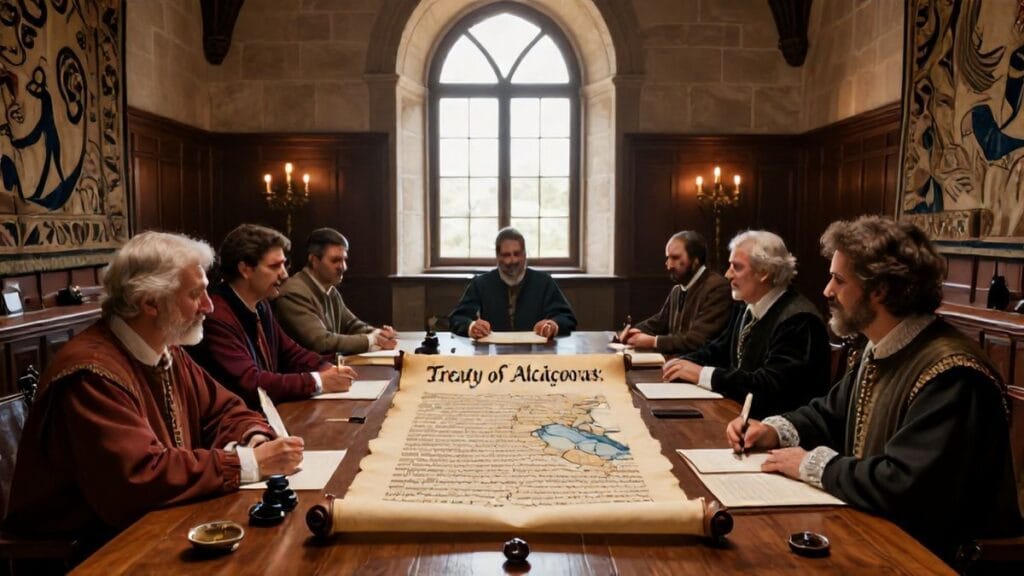
Inside those chambers, the air was thick with incense and calculation. At long wooden tables, the Portuguese and Castilian delegations faced one another, their scribes ready with quills, their notaries prepared to authenticate every phrase. The conversations were layered: an end to the War of Castilian Succession, the adjustment of borders, the fate of rebellious nobles, and then, as if casually—but never truly casually—questions about islands, coasts, and “the Guinea sea.” Those words contained the weight of gold, ivory, slaves, and future plantations.
Alcáçovas had been chosen in part because it lay within Portuguese territory yet close enough to Castile to ease logistics. It was neutral enough for negotiation, but its setting also made symbolic sense: a frontier space within a kingdom that had defined itself by pushing its frontiers outward into the Atlantic. The village became, for a fleeting moment, a crossroads between an older medieval Iberia and a newer, ocean‑oriented age. When the treaty of alcacovas was finally sealed, the bells of nearby churches likely rang, ostensibly to celebrate peace between Christian kingdoms. Yet behind that ringing hid a quieter transformation: Europe was formalizing its first great division of maritime spheres of influence.
For the men and women of Alcáçovas, the days of negotiation may have brought minor inconveniences and sudden profits. Inns filled with visitors; merchants sold more wine and bread; rumors spread through the market square that a great war was ending. No one yet knew that their village name would be spoken in future centuries by historians trying to understand how European powers first carved up the Atlantic world. What unfolded there on 4 September 1479 was both intensely local and profoundly global: a pact with roots in Iberian politics and branches that would reach all the way to West Africa and, in time, the Americas.
The War of Castilian Succession: Blood, Claims, and Oceans
The treaty of alcacovas emerged from war, not from a neutral desire for stability. In 1474, the death of King Henry IV of Castile plunged his kingdom into a bitter dispute over succession. On one side stood his half‑sister, Isabella, married to Ferdinand of Aragon—a couple whose union promised to knit together vast territories in central and eastern Iberia. On the other stood Henry’s daughter, Joanna, known derisively by her enemies as “la Beltraneja,” whose legitimacy many questioned, whispering that she was not Henry’s true child.
A power struggle over a single throne might, in other circumstances, have been contained within Castile’s borders. But Joanna’s claim was not merely supported by Castilian nobles; it was championed by King Afonso V of Portugal, who advanced his own interests by marrying her and pressing her rights. For Afonso, this was a gamble of spectacular proportions: if he prevailed, he would unite Castile and Portugal under one crown, placing Portugal at the heart of a vast Iberian realm rather than at its fragile western edge.
The resulting conflict, the War of Castilian Succession (1475–1479), unfolded across fields, fortresses, and coasts. Armies clashed in battles such as the crucial encounter at Toro in 1476, whose outcome both sides claimed as a form of victory. But the war was more than a land struggle. At sea, Portuguese and Castilian forces contested control of Atlantic routes, privateering each other’s ships, raiding islands, and probing the limits of each kingdom’s power. Guinea—the general term used then for the West African coasts and seas—became both prize and battleground.
In these years, Castilian captains began venturing further south, flirting with areas that the Portuguese already considered their sphere. Lisbon, fearing encirclement and the loss of its hard‑won monopoly on African trade, grew restless. The war thus served as an outlet for deeper anxieties: if Castile won not only on land but also at sea, Portugal’s pioneering Atlantic project could be strangled in its cradle.
The war was also a test of alliances. France, England, Aragon, and Burgundy watched closely, sometimes offering support, sometimes waiting for opportunities to exploit Iberian weakness. Isabella and Ferdinand courted the backing of Castilian cities and ecclesiastical authorities, presenting themselves as defenders of order and orthodoxy. Joanna and Afonso, meanwhile, tried to mobilize discontented nobles and those who feared the growing might of an eventual union between Castile and Aragon.
By the late 1470s, the conflict had dragged on long enough to exhaust treasuries and populations. The prospects of a decisive, crushing victory faded. What remained was negotiation—drafted in the language of peace but shadowed by the outcome of campaigns and by who held which castles and ports at the moment talks began. It was in this atmosphere, shaped by years of bloodshed and by mounting competition on the water, that the treaty of alcacovas took form as both an end to civil war and a blueprint for maritime division.
Isabella, Joanna, and Afonso V: Dynastic Chess Across Iberia
At the center of the drama stood three powerful and complex figures: Isabella of Castile, Joanna of Castile, and Afonso V of Portugal. Their names echo throughout the documents and diplomatic letters that led to the treaty of alcacovas, and their struggles illuminate the deeply personal nature of what later appears as impersonal “statecraft.” Dynastic politics in fifteenth‑century Iberia were as much about bodies—marriages, births, and alleged adulteries—as about borders and taxes.
Isabella, later famed as “la Católica,” had shown a remarkable political instinct even before she ascended the throne. Refusing a series of marriage arrangements that would have sidelined her, she chose Ferdinand of Aragon, understanding that their union could consolidate power within Spain. When her half‑brother Henry IV died, she moved quickly, having herself proclaimed queen in Segovia, asserting her legitimacy before rivals could fully organize. It was an audacious move that set her on a collision course with Joanna and Afonso V.
Joanna, for her part, was caught between rumor and ambition. Whispered doubts about her paternity—whether fair or not—undermined her claim from the outset. Yet she was the daughter Henry had publicly recognized, and many nobles rallied to her name, some out of loyalty, others out of calculation that Afonso of Portugal would be easier to control than the steely Isabella. For Joanna, the war and its aftermath meant a life largely devoid of agency, her fate used as a bargaining chip across negotiating tables she did not control.
Afonso V embodied an older, crusading vision of kingship interwoven with Portugal’s newer maritime ambitions. He had led campaigns against the remaining Muslim states in North Africa, hungry for glory and plunder. Marrying Joanna and claiming the Castilian throne appeared to him a logical extension of his mission: uniting Christian Iberia under leadership sympathetic to Portuguese goals at sea. Yet the war revealed the limits of his power, and as the years progressed and Castile’s position on land strengthened under Isabella and Ferdinand, Afonso faced a stark choice—prolong a costly conflict with dwindling odds or seek terms that would salvage Portugal’s maritime supremacy even as he relinquished dreams of ruling Castile.
The treaty of alcacovas, in its dynastic clauses, records the consequences of their intertwined destinies. Isabella’s claim to the Castilian throne was effectively recognized, while Joanna—still legally a queen in the eyes of her supporters—was gently pushed aside into a life overshadowed by convent walls and political oblivion. Afonso V had to bow to realities on the ground. In exchange for abandoning Joanna’s cause and acknowledging Isabella and Ferdinand as the legitimate rulers of Castile, he sought guarantees that would protect what Portugal prized most: its monopoly over the routes to Guinea and the Atlantic islands beyond the Canaries.
These concessions were wrapped in the language of Christian concord and family reconciliation. Marriages were arranged, oaths sworn, and solemn ceremonies staged to give the appearance of harmony after discord. Yet beneath the surface ran a current of resignation, especially for Joanna. The victors framed the outcome as providential; the losers, when they dared speak, described betrayal and lost opportunity. This mixture of triumph and quiet tragedy, of personal sacrifice folded into geopolitical calculations, lies at the heart of the story that culminated in Alcáçovas.
Portugal’s Oceanic Gamble: From Ceuta to the Gulf of Guinea
To grasp why the treaty of alcacovas put such weight on the Atlantic and on “the land of Guinea,” one must trace the bold arc of Portuguese expansion over the preceding decades. In 1415, under King João I, Portuguese forces had captured Ceuta on the North African coast, inaugurating a new era in which the kingdom would seek wealth and prestige not only on the peninsula but across the sea. The king’s son, Infante Henrique—known to history as Prince Henry the Navigator—became the driving force behind a series of ventures that pushed ever further along the Atlantic coast of Africa.
From their base at Sagres and the port of Lagos, Portuguese captains set sail in small but sturdy caravels, experimenting with wind patterns, coastal pilotage, and new forms of navigation. Each promontory rounded and each new stretch of coastline charted represented both risk and promise. By the mid‑fifteenth century they had reached Cape Verde and beyond, discovering islands such as Madeira and the Azores and establishing trading relationships along the West African shore.
The rewards were substantial. From the region broadly labeled “Guinea” came gold dust that entered European markets, ivory prized for sculpture and luxury goods, and human captives who would be integrated into slave systems in Iberia and, in time, across the Atlantic. The Portuguese crown claimed a monopoly over this commerce, issuing licenses and demanding duties. Any intruder—whether foreign or domestic—who traded without royal authorization risked being branded a pirate or smuggler.
For Portugal, then, the ocean was not simply an unknown wilderness but a carefully structured economic frontier. Portuguese diplomats invested immense energy in securing papal bulls, such as Dum Diversas (1452) and Romanus Pontifex (1455), which granted the crown spiritual and legal sanction to explore, conquer, and trade in lands held by non‑Christians. These documents, rarely read outside specialist circles today, were in their time seen as crucial endorsements. They framed Portugal’s expansion as a kind of maritime crusade wrapped around a commercial core.
When Castilian ships began appearing more frequently in the waters Portugal claimed as its own, tension rose. From Lisbon’s perspective, Castile’s interest in the Atlantic threatened not only profits but legitimacy. If another Christian kingdom could simply ignore papal grants and treaties, what prevented France, England, or Aragon from doing the same? Protecting the African trade became a matter of state survival as much as of income.
This is why, when negotiations opened at Alcáçovas, Portugal’s delegation remained unyielding on one point: Guinea and the Atlantic islands south of the Canaries must remain exclusively Portuguese. The treaty of alcacovas, while ostensibly about ending a succession war, provided the ideal vehicle to codify a division that Lisbon had long sought—one that would lock Castile out of the African routes and thus secure Portugal’s hard‑won lead in the Age of Discovery.
Castile Looks West: Dreams of Islands Beyond the Horizon
If Portugal looked south along the African coast, Castile looked both inward and, increasingly, west. Its long Atlantic frontage included ports like Seville and Cádiz, gateways to trade and privateering. Fishermen had for generations ventured into the ocean in search of rich grounds, returning with tales of strong currents, strange birds, and occasional glimpses of land where no map showed islands. These rumors—part fact, part imagination—fed a growing sense that the Atlantic held not just routes to known lands but entirely new worlds.
By the mid‑fifteenth century, Castile had established a foothold in the Canary Islands, an archipelago whose indigenous inhabitants, collectively called Guanches, resisted fiercely. Castilian noble families received islands as grants, which they attempted to conquer and colonize, often in bitter rivalry with one another. The Canaries became both a testing ground for conquest and plantation models and a point of friction with Portugal, which also eyed the islands but never succeeded in fully dislodging Castilian claims.
Seville, in particular, harbored a class of merchants and mariners who chafed at Portuguese restrictions in the south. They watched with a mixture of envy and admiration as Lisbon’s caravels returned loaded with gold and slaves. Portuguese envoys insisted that the entire sweep of the African-Atlantic coast belonged to their king. Castilian adventurers, reluctant to accept such sweeping claims, searched for ways around them—either by disputing Portugal’s exclusive rights or by proposing alternative routes that would not, on paper at least, violate those rights.
Behind the walls of counting houses and guild halls, speculative conversations flourished. What if, some argued, one sailed not down the African shore but straight west? Might one reach Asia by another path and thus sidestep both Muslim middlemen in the eastern Mediterranean and Portuguese guardians of the African cape routes? Mariners like the Genoese Christopher Columbus would later come to embody this line of thought, but the seeds were sown in these years when the treaty of alcacovas was being contemplated.
The Canaries offered a partial outlet. Under any settlement, Castilian leaders insisted, their rights there must be recognized. The islands provided not only fertile land for sugar cultivation but also a staging point deeper into the ocean, a halfway house of sorts between Europe and whatever lay beyond. Thus, during the talks at Alcáçovas, Castile bargained hard to have its sovereignty over the archipelago confirmed, even as it accepted painful restrictions elsewhere.
Still, acceptance did not mean contentment. Many in Castile believed the agreement would be temporary or could be reinterpreted. Few rulers in the era of early empires imagined that legal lines on a map could permanently confine their ambitions. It is within this tension—between formal recognition and simmering desire to break the constraints—that the long-term legacy of the treaty of alcacovas must be read. Castile might agree, for a time, to respect Portuguese primacy to the south, but its eyes were already roaming toward the west, toward seas that the 1479 treaty barely understood.
Negotiating a Divided Sea: The Road to the Treaty of Alcáçovas
Negotiations that culminated in the treaty of alcacovas did not begin in a single dramatic moment. They unfolded through months of correspondence, preliminary talks, and cautious feelers sent by intermediaries. Both sides were exhausted by war but determined not to squander what they had fought for. The challenge lay in crafting an agreement that each could present at home as a victory—or at the very least, as an honorable compromise.
The diaries and letters of the period, though often fragmentary, give us glimpses of these convoluted talks. Envoys weighed each phrase, mindful that imprecise wording could be exploited later. A Portuguese chronicler evokes one such atmosphere, describing how “the lords did much debate concerning the lands of Guinea and the islands, for thereon did rest much of the wealth and honor of the realms.” These words, whether embellished or not, capture the sense of a negotiation where parchment carried the potential to redirect entire streams of trade.
Among the key negotiators on the Portuguese side was João II, then prince but already the sharp mind behind much of his kingdom’s policy. Later remembered as “the Perfect Prince,” João brought a cold calculus to the table. He knew Portugal could not win a protracted land war against a larger Castile. But he also understood that at sea, and in knowledge of the Atlantic routes, his realm held a stronger position. Better, then, to trade away claims in Castilian politics in exchange for written confirmation of what Portugal had acquired in practice along the African coast.
On the Castilian side, the envoys of Isabella and Ferdinand had to balance several imperatives. They needed the war to end so they could redirect their energies toward Granada and internal consolidation. They sought full recognition of Isabella’s right to the Castilian throne—a non‑negotiable point for their camp. At the same time, they were unwilling to concede everything at sea, for fear of handing Portugal too free a hand and appearing weak to their own navigating communities.
Layers of issues interlocked: dynastic disputes, border fortresses, aristocratic rebellions, maritime rights, and even the status of certain nobles who had supported the losing side. Alcáçovas became the site where these layers were sorted, prioritized, and, in some cases, deliberately blurred. Some matters would be resolved publicly; others would be handled in secret attachments, verbal understandings, or through subsequent arrangements.
As the days of bargaining stretched on, tempers surely flared. Yet there was also a shared culture that eased communication. Both courts spoke a similar romance language, worshipped in the same Catholic rites, and operated within familiar legal frameworks. They referenced canon law, royal precedents, and even papal bulls as they hammered out terms. One can imagine candles burning late into the night as envoys, tired yet unwilling to show weakness, reviewed draft clauses and instructed their scribes to insert or remove a single critical word.
By early September 1479, the broad outlines of a pact had crystallized. Castile would gain recognition of Isabella as queen and keep the Canaries; Portugal would secure everything else of importance in the Atlantic south of that point. There were still details to settle—compensation, hostage arrangements, and guarantees. But the spine of what would become the treaty of alcacovas was in place: a line, not drawn on a chart but inscribed in legal language, dividing two visions of the ocean.
Inside the Articles: How Alcáçovas Shared the Known Atlantic
The final text of the treaty of alcacovas, confirmed in Alcáçovas in 1479 and solemnly ratified in Toledo the following year, reads at first like many medieval agreements: a litany of oaths, formulas of peace, and invocations of God’s will. Yet hidden within these conventional phrases lie some of the earliest explicit attempts to partition maritime space between European powers. The core of the treaty turns on two intertwined themes: dynastic legitimacy and Atlantic domination.
On the dynastic front, the treaty declared that Afonso V of Portugal renounced any claim to the Castilian throne and recognized Isabella and Ferdinand as the rightful sovereigns. Joanna’s cause, though not named as such, was effectively abandoned. In return, Castile agreed to cease hostilities and accept peace. Certain border adjustments were made, and mutual amnesties were declared for many nobles, though some rebels paid with confiscations or exile.
It is in the clauses concerning the seas, however, that the treaty of alcacovas becomes truly distinctive. Castile formally recognized Portugal’s exclusive rights to explore, conquer, and trade in all lands and seas “discovered and to be discovered” south of the Canary Islands in the Atlantic, especially in Guinea. These words were broad by design. They encompassed not only already frequented areas but any future discoveries in that general direction. The Portuguese crown, in effect, obtained a legal shield for its past and future ventures along the African-Atlantic coast.
In exchange, Portugal recognized Castilian sovereignty over the Canary Islands, withdrawing earlier objections and claims. The Canaries thus became Castile’s indisputable Atlantic frontier. While this might seem, at first glance, a modest concession, its significance grew in hindsight. From these islands would depart future voyages that probed the western ocean, culminating famously—in defiance of earlier understandings—in Columbus’s expedition of 1492 under Castilian patronage.
The treaty also touched on the contentious issue of raids and privateering. Both sides pledged to cease attacks on each other’s shipping and to return certain captured fortresses and goods. Yet enforcement proved difficult. Along the coasts of Guinea and the Atlantic islands, captains operating at the edge of royal control sometimes continued predatory practices, testing how far the legal boundaries agreed at Alcáçovas could be bent without incurring severe punishment.
Another crucial, if less often noted, aspect involved the trade in captives. By recognizing Portuguese prerogatives in Guinea, the treaty tacitly endorsed the crown’s existing practices in organizing and taxing the seizure and sale of enslaved Africans. There was little sense, among the signatories, that this commerce required moral debate. It was treated as one more category of goods flowing through the channels the treaty sought to regulate. In one contemporary account, a Portuguese chronicler even praised the agreement for “assuring to our lord the king the revenues of the lands of the blacks,” a chilling reminder of how normalized slavery had become in imperial policy.
In sum, the treaty of alcacovas did more than settle a succession crisis. It created what some historians have called a “maritime constitution” for the Iberian powers, at least for a generation. Guinea, Madeira, the Azores, Cape Verde, and any other lands to the south and east fell firmly within Portugal’s legal sphere; the Canaries stood as Castile’s lone acknowledged oceanic possession. The rest of the ocean remained unspoken, a silence that would matter immensely when navigators began to push westward into waters no one at Alcáçovas could fully imagine.
Princes, Marriages, and Hostages: The Human Price of Peace
Like many treaties of its time, the treaty of alcacovas was not only a set of legal articles but also a web of marital and dynastic arrangements designed to cement the new order. The most emblematic of these was the betrothal of Isabella and Ferdinand’s eldest daughter, the Infanta Isabella of Castile, to Afonso, prince of Portugal and heir to João II. In theory, this union promised to transform recent enemies into family, knitting the two houses together in bonds of blood.
As part of the agreement, the young Infanta was to be sent to Portugal when the time came, living there at the Portuguese court until marriageable age. In practice, this made her a kind of high‑status hostage, a living guarantee that the terms of peace would be respected. Such practices were common in medieval and early modern diplomacy, but they extract a heavy emotional toll. For a child, it meant leaving her homeland, her language habits, and familiar faces behind, entrusted to the care of a court that had only recently been at war with her parents.
The dowry attached to this alliance was enormous, including sums of money meant to compensate Portugal for relinquishing certain claims and to ensure its acceptance of Isabelline rule in Castile. These financial flows, often dismissed as mere accounting, could make or break royal treasuries already strained by warfare. They also signaled publicly that peace was not simply a truce but a re‑binding of relations at the highest level.
Other individuals bore quieter burdens. Nobles who had fought for Joanna and Afonso found themselves pardoned on paper but distrusted in practice, their estates diminished, their sons and daughters maybe married into less prestigious lines. Portuguese captains who had tasted the profits of raiding Castilian ships had to adjust to stricter royal oversight. Castilian sailors who had briefly ventured toward Guinea retreated, grumbling, now confined legally to narrower avenues of trade.
In convents and monasteries, prayers were said in celebration of the peace, yet some voices must have murmured petitions for those whose fortunes had fallen. Joanna herself, sidelined and eventually taking religious vows, became a specter of what might have been. In her story, the human underside of the treaty of alcacovas becomes palpable: a woman branded illegitimate by her rivals, used as a banner in war, and then set aside when the calculations of kings required it.
The emotional complexity of these arrangements is easy to overlook in official narratives. The stilted Latin and legal Castilian of the texts mask the fear of parents sending children across borders, the resentment of courtiers who found themselves displaced, the relief of common soldiers suddenly released from service, and the anxiety of merchants unsure how the new rules would affect their fortunes. Yet without acknowledging these experiences, the treaty risks appearing as a bloodless document, rather than as what it truly was: a reweaving of lives as well as of lines on maps.
Guinea, Gold, and Captives: Economic Worlds Shaped by the Treaty
If one follows the trail of money and goods after 1479, the significance of the treaty of alcacovas grows clearer still. By firmly recognizing Portugal’s monopoly over Guinea, the agreement channeled vast resources into Lisbon’s coffers. Caravels continued to sail from Portuguese ports to the West African coast, where they exchanged textiles, metals, and manufactured goods for gold dust, ivory, pepper, and human lives.
The gold from Guinea played a measurable role in stabilizing Portuguese coinage and in funding further exploration. With increased revenue, the crown could sponsor voyages beyond previous limits, pushing past the Gulf of Guinea and eventually, under João II and later Manuel I, toward the Cape of Good Hope. This chain of events—financial security enabling exploratory risk—would ultimately link Alcáçovas to Vasco da Gama’s arrival in India in 1498, a connection not always made explicit but grounded in economic reality.
The trade in captives was equally transformative, though in a far darker register. Enslaved Africans were transported to Portugal itself, where they labored in households, on farms near Lisbon, and in urban workshops. Others were re‑exported to Castile and to islands like Madeira, where sugar plantations devoured labor. The treaty of alcacovas, by excluding Castile from direct access to Guinea, effectively concentrated the early Atlantic slave trade under Portuguese administration. It is an unsettling irony that an agreement celebrated in its own time for bringing Christian peace underwrote systems of violence and exploitation on African shores.
For West African societies, the implications were profound. Some coastal polities used trade with the Portuguese to strengthen themselves, acquiring firearms and luxury goods. Others were destabilized by raids and by the emerging incentives for warfare and captive‑taking. The presence of European ships, backed by the legal authority the treaty of alcacovas claimed to confer, altered power balances in regions that had their own long histories of complex politics.
Within Europe, markets adjusted to Portugal’s ascendancy in the south. Merchants in Seville, barred from Guinea, focused more on the Canaries and on other Mediterranean and North African routes, while watching with interest—and impatience—as news of Portuguese successes filtered north. Italian financiers, always attuned to profit, extended credit to both Portuguese and Castilian enterprises, hedging their bets between competing crowns.
Economic historians sometimes single out the treaty as a cornerstone in the emergence of what would become a “proto‑colonial” system: territories overseas defined less by formal annexation than by exclusive trading rights guarded by military force. The legal recognition of Portugal’s sphere gave investors greater confidence to back voyages, while signaling to rival crowns that open interference would mean violating a solemn pact. The result was a thickening of commercial and human flows along certain corridors and a relative closure of others—a pattern born in Alcáçovas and extended, through subsequent agreements, across growing portions of the globe.
Winds of Discontent: Castilian Navigators and the Limits of Alcáçovas
Not everyone in Castile accepted the constraints imposed by the treaty of alcacovas with equanimity. Among merchants, pilots, and shipowners based in Atlantic ports, the settlement felt like a cage. Some had already begun to nibble at the edges of Guinea commerce; others simply resented that a neighboring kingdom could claim vast stretches of ocean as its private domain. Conversations in Seville’s taverns and along its quays must have crackled with frustration and with what‑ifs.
In these circles, the treaty’s silence on lands to the far west became a point of fixation. If Castile had explicitly recognized Portugal’s rights south and east of the Canaries, what of the empty quadrants of the Atlantic beyond? Were they free to all? Could a clever navigator find a route that, at least on parchment, did not infringe on Portuguese monopolies? These questions were not purely theoretical. They provided fertile ground for a figure like Christopher Columbus, who arrived at the Castilian court in the 1480s with bold proposals to reach Asia by sailing west.
Columbus himself, though more associated with the later Treaty of Tordesillas, lived in the world that Alcáçovas had made. As several historians have noted, including in studies gathered by Charles Verlinden and others, his advocacy of a western route owed something to the fact that the southern path around Africa seemed effectively closed to Castile by agreement. If Portugal had locked up the gate to the Indies via the Cape, then perhaps the key lay not in opposing that gate directly but in seeking another door entirely, through waters that the treaty of alcacovas had left undefined.
Within the Castilian court, opinion was divided. Some counselors of Isabella and Ferdinand feared antagonizing Portugal or contradicting the spirit of the 1479 pact. Others argued that the kingdom could not forever remain a junior player in Atlantic affairs. The Reconquista was nearing completion; Granada would fall in 1492. What then? Peace and piety were virtues, but glory and wealth still beckoned beyond the horizon.
Even while respecting the letter of Alcáçovas, Castile tested its limits. Occasional voyages skirted Portuguese claims; disputes flared when ships from the two kingdoms met near contested waters. Diplomats were dispatched to smooth ruffled feathers, invoking or interpreting the treaty according to their side’s needs. In this contested space of practice and interpretation, Alcáçovas functioned less as an unbreakable law than as a baseline from which new bargains would be struck—culminating, in due course, in the more famous division codified at Tordesillas in 1494.
From Alcáçovas to Tordesillas: Redrawing the Invisible Lines
The link between the treaty of alcacovas and the later Treaty of Tordesillas forms one of the crucial threads in the tapestry of early modern global history. Alcáçovas established the principle that European Christian powers could, by mutual agreement, divide maritime spaces and claims to lands not yet conquered. Tordesillas took that principle and applied it on a grander scale, projecting a longitudinal line across the Atlantic to split future discoveries between Spain (Castile) and Portugal.
In the years immediately following Alcáçovas, Portugal pressed hard along the African coast, gradually edging around the continent’s southern tip. Castile, meanwhile, consolidated its hold over the Canaries and focused on the final assault on Granada. When Columbus returned from his first voyage in 1493, reporting lands across the western ocean, both crowns sensed that the quiet silence of Alcáçovas about that direction had become explosive. Each moved swiftly to secure papal backing for its claims.
Pope Alexander VI, himself of Spanish origin, issued a series of bulls granting Castile dominion over lands west of a particular meridian. Portugal protested, arguing that earlier papal grants and treaties, including the treaty of alcacovas, had recognized its broader rights. The resulting diplomatic wrangling led to direct negotiations that culminated in the Treaty of Tordesillas in 1494, shifting the papal line further west and granting Portugal what would eventually include Brazil.
In this sense, Tordesillas did not overturn Alcáçovas so much as extend its logic. The basic idea—that oceans and continents could be partitioned between Christian monarchies by lines no inhabitant of those lands had drawn—remained untouched. What changed were the specific coordinates, now adapted to take account of the startling reality of lands to the west as well as routes around Africa to the east.
Some historians, such as Anthony Pagden, have pointed out that these treaties formed part of a broader Iberian legal culture that sought to domesticate the unknown through concepts of “title,” “donation,” and “discovery.” The treaty of alcacovas was a formative moment in this process, articulating for the first time in a relatively precise way that one kingdom’s navigators would have privileged rights along certain coasts and in certain seas, with the backing of both royal authority and the Church.
By the time Tordesillas was signed, the cast of characters had shifted: João II now reigned in Portugal; Isabella and Ferdinand had become “the Catholic Monarchs” in full. Yet their horizon of thinking still bore the imprint of that September day in Alcáçovas. Empires would henceforth grow not only through conquest but through treaties that tried to freeze ambition in ink, even as the movement of ships and people constantly threatened to dissolve those lines in the saltwater of the Atlantic.
Africa Enclosed, America Awaiting: Global Consequences of a Local Pact
The global consequences of the treaty of alcacovas become starkly visible when one looks beyond Iberia to Africa and, by extension, to the Americas. In Africa, the treaty reinforced and legitimized a system in which a single European power, Portugal, acted as primary broker of coastal trade and as gatekeeper for other Christian kingdoms. This quasi‑monopoly meant that the patterns of early contact, conversion, and exploitation were filtered through Portuguese priorities, shaping which African polities received European weapons, missionaries, and merchants, and on what terms.
For societies along the Upper Guinea Coast, in regions corresponding to modern‑day Senegal, Gambia, Guinea‑Bissau, and Sierra Leone, contact intensified. Fortified trading posts such as Elmina, established in 1482 on the Gold Coast (in present‑day Ghana), anchored Portugal’s presence. From these points radiated networks of alliances and rivalries that would feed not only the gold trade but the growing traffic in enslaved people. While African actors retained agency and bargaining power, the direction and intensity of this commerce were undeniably conditioned by the legal framework that the treaty of alcacovas had bolstered.
In the longer run, this concentration of early Atlantic experience in Portuguese hands had an ironic byproduct. When Spain (Castile) later needed expertise to manage its own burgeoning American colonies and slave plantations, it often turned to Portuguese merchants and shipowners. The skills and contacts honed under the regime of Alcáçovas thus migrated westward into the Caribbean and Brazil, helping to fuse what historians now call the “Atlantic world” into a single, interlinked system of labor, commodities, and cultural exchange—albeit one structured around profound inequalities.
Meanwhile, the Americas themselves, though scarcely imagined in 1479, were already being written into existence by the categories the treaty used. Lands could be divided into spheres of influence before their inhabitants even knew such spheres existed. The peoples of the Caribbean, of the American mainland, and of countless islands had no voice in these arragements. When Europeans arrived in greater numbers after 1492, they came armed not only with steel and gunpowder but with treaties and bulls that they believed legitimized their claims.
The idea that oceans and distant shores were legitimate subjects of interstate partition would underpin subsequent European ventures, from the Spanish and Portuguese rivalry in Asia to Dutch and English charters for East and West India companies. Alcáçovas stands near the beginning of this legal‑imperial tradition, prefiguring the many later conferences, treaties, and “scrambles” in which distant peoples found their fates debated and decided in European halls.
It’s astonishing, isn’t it, to consider that a gathering in a small Portuguese town—convened to settle what seemed a regional dynastic conflict—helped establish patterns that would influence the enslavement of millions, the spread of new crops and diseases across continents, and the redrawing of global power balances? This is the paradox of Alcáçovas: its participants could not foresee the full cascade of consequences, yet they were already thinking on a larger scale than their ancestors, imagining seas and coasts as integral parts of their kingdoms’ futures.
Memory, Silence, and Empire: How Historians Read Alcáçovas
Despite its importance, the treaty of alcacovas has often lived in the shadow of later, more famous agreements like Tordesillas. Textbooks might mention it in passing as a precursor, a preliminary sketch before the “real” division of the world in 1494. Yet modern scholarship has slowly restored Alcáçovas to its rightful place as a foundational moment in the making of Iberian and Atlantic empires.
Part of the earlier neglect stemmed from the treaty’s dual character. For many centuries, historians of Spain focused primarily on the consolidation of the monarchy, the conquest of Granada, and the American conquests. In that narrative, Alcáçovas appeared as just another stage in Isabella’s rise, notable more for confirming her title than for its maritime aspects. Portuguese historians, conversely, often highlighted heroic voyages and royal patronage while treating treaties as background. Only when the lens widened to encompass the entire Atlantic world did scholars perceive how central that 1479 pact truly was.
In the twentieth century, archival research brought more of the treaty’s documentary context to light. Historians such as Vitorino Magalhães Godinho and Luís Filipe Thomaz, among others, examined the interplay of trade statistics, royal correspondence, and diplomatic records to show how deeply the agreement structured early Portuguese maritime policy. On the Spanish side, studies of Seville’s commercial elite and of Columbus’s negotiations with the Catholic Monarchs underscored how Alcáçovas framed the horizon of possibilities for Castilian expansion.
Citations in broader syntheses, like Fernand Braudel’s work on the Mediterranean and the early modern world-economy, also echoed Alcáçovas as part of a “first wave” of global partitioning. As Braudel famously wrote, “The sea is not just distance; it is also relation,” a line that applies elegantly to the way treaties like Alcáçovas turned distance into organized relationships of power and exchange.
Yet there remain silences. The voices of African leaders who encountered Portuguese envoys in the wake of the treaty are mostly missing from the written record. The perspectives of enslaved people taken from coasts circumscribed by Alcáçovas are preserved only in fragments, if at all. Even within Iberia, the feelings of villagers conscripted into naval expeditions, of women who saw sons and husbands vanish into “Guinea,” of artisans whose crafts catered to new Atlantic tastes, are rarely captured in the surviving documents.
Contemporary historians try, as best they can, to read these absences critically. Treaties are not just what they say; they are what they enable and what they erase. The treaty of alcacovas, by projecting royal intentions across the sea, turned countless unnamed individuals into actors within a system they never consented to join. Recognizing this helps us move beyond seeing the pact as merely a diplomatic milestone, and instead as an instrument in the longue durée story of empire, inequality, and resistance.
Echoes on the Atlantic Shore: Human Lives Under the New Order
To end the story where it began—in the daily lives of those who lived under the order established by the treaty of alcacovas—we must return to the ports, markets, and coasts that felt its touch most keenly. In Lisbon and Lagos, shipyards hummed with work as carpenters, caulkers, and rope‑makers prepared vessels for Guinea runs. Young men, many from modest backgrounds, signed on to crews, driven by necessity or by restless dreams. They knew little of Alcáçovas by name, yet their voyages were possible, and profitable, because it existed.
In Seville and Cádiz, others watched these departures with mixed feelings. Some found employment provisioning seasonal expeditions to the Canaries, or later to the Indies; others migrated inland, seeking fortunes in expanding Castilian cities rather than on a sea whose most lucrative avenues were closed to them by treaty. Occasional news of shipwrecks, pirate attacks, or great hauls of gold and slaves reached them, feeding a culture in which the ocean stood as both opportunity and threat.
Along the West African littoral, communities adjusted as well. Some rulers integrated Portuguese goods into their political economies, using them to strengthen their rule or to wage war on rivals. Coastal brokers, experts in language and cross‑cultural negotiation, emerged as essential mediators between aboard ship and inland societies. At the same time, stories spread of villages burned in slaving raids, of kin never seen again, of Europeans invoking their “rights” under far‑off treaties that no African ruler had ever signed.
On the Canary Islands, the Guanches experienced the tightening grip of Castilian authority that Alcáçovas had helped confirm. Resistance flared sporadically, but over time, the combination of military conquest, disease, and resettlement policies eroded indigenous autonomy. New landscapes of sugar plantations and livestock ranches replaced older ways of life. Here, too, the treaty turned from ink into fences, from phrases into fields worked under new masters.
In monasteries and churches across Iberia, masses were sometimes still offered in gratitude for the end of the Castilian succession war. Yet as decades passed, few congregants remembered that their peace owed something to a pact signed in Alcáçovas. The treaty’s name faded from popular memory even as its structures persisted in the background of their world, shaping trade routes, patterns of enslavement, and the strategies of kings.
Thus the echoes of that September day in 1479 spread outward and onward. They traveled not only in official dispatches but in lullabies hummed by women of mixed African and Iberian heritage in Lisbon streets, in the salt‑stiffened hands of sailors gazing at unfamiliar stars, in the anxious calculations of African chiefs confronted with armed strangers who claimed exclusive “friendship” backed by distant monarchs. The treaty of alcacovas was a hinge—creaking, perhaps, in the moment, but later recognized as the joint on which doors to entire oceans swung open and shut.
Conclusion
The treaty of alcacovas, signed in a modest village in Portugal on 4 September 1479, stands at the crossroads of medieval and modern history. Born of a dynastic crisis in Castile and a war that had exhausted both Portugal and Castile, it settled the question of who would wear the Castilian crown and who would control the known Atlantic. On the surface, it closed a chapter of internecine conflict; beneath that surface, it opened an era in which empires would be mapped and argued over before they were built.
By recognizing Portugal’s exclusive rights in Guinea and in the Atlantic south of the Canaries, and by confirming Castile’s hold over that archipelago, the treaty did more than reorder Iberian politics. It established a precedent: that European Christian monarchs could, by mutual consent and with papal blessing, divide seas and shores they did not yet possess, shaping the future of millions who had no seat at the table. From Lisbon’s gold‑laden fleets to Seville’s frustrated navigators, from African communities drawn into Atlantic trade and slavery to the islands that became stepping stones for conquest, Alcáçovas left its imprint across a growing world.
Its legacy also reminds us that international law and empire emerged together, hardening ambitions into lines and clauses. Later pacts, especially the Treaty of Tordesillas, extended the logic first articulated at Alcáçovas, projecting invisible meridians across oceans. Yet without the 1479 agreement, the trajectories of Portuguese and Spanish expansion—and thus the contours of the early Atlantic world—would have looked very different. To study the treaty of alcacovas, then, is to see how a seemingly regional settlement helped anchor a global transformation, marrying legal formality to ships and cannon, and turning a village’s name into a quiet milestone on the road to empire.
FAQs
- What was the Treaty of Alcáçovas?
The Treaty of Alcáçovas was a peace agreement concluded on 4 September 1479 between the crowns of Castile and Portugal. It ended the War of Castilian Succession by recognizing Isabella and Ferdinand as rulers of Castile and, crucially, divided the known Atlantic into spheres of influence, with Portugal gaining exclusive rights over Guinea and most Atlantic islands south of the Canaries. - Why was the treaty significant for Atlantic exploration?
The treaty formalized Portugal’s monopoly over exploration and trade along the West African coast, giving it secure access to gold, ivory, and enslaved Africans. This legal security underpinned Portugal’s further voyages around Africa and indirectly pushed Castilian interest westward, setting the stage for Columbus’s later expedition and the so‑called “discovery” of the Americas. - How did the Treaty of Alcáçovas affect the Canary Islands?
The treaty confirmed Castile’s sovereignty over the Canary Islands, ending Portuguese challenges to Castilian claims there. This recognition allowed Castile to consolidate its conquest and colonization of the archipelago, which became an important base for later Atlantic voyages and sugar plantations. - What role did dynastic politics play in the treaty?
Dynastic politics were central. The treaty resolved the rival claims of Isabella of Castile and Joanna “la Beltraneja” by having Portugal abandon Joanna’s cause and recognize Isabella and Ferdinand as legitimate sovereigns. It also included a marriage arrangement between the Castilian infanta Isabella and the Portuguese heir Afonso, using family ties to reinforce the new peace. - Did the treaty address the slave trade?
The treaty did not mention slavery explicitly, but by granting Portugal exclusive rights in Guinea and related Atlantic regions, it effectively endorsed and protected the Portuguese crown’s role in the early Atlantic slave trade. Enslaved Africans captured or purchased along the West African coast were transported under a system strengthened by Alcáçovas. - How is the Treaty of Alcáçovas related to the Treaty of Tordesillas?
The Treaty of Alcáçovas established the principle that European powers could divide overseas territories and spheres of influence through bilateral agreements. The later Treaty of Tordesillas (1494) extended this principle by drawing a longitudinal line across the Atlantic to apportion future discoveries between Spain and Portugal. Tordesillas thus built on the foundations laid at Alcáçovas. - Where was the treaty negotiated and ratified?
The core negotiations took place in the Portuguese village of Alcáçovas, where the treaty was signed on 4 September 1479. It was later ratified in Toledo in 1480, giving it full legal force within Castile and reinforcing its status as a binding international agreement between the two crowns. - How did contemporaries view the treaty?
Contemporaries in ruling circles largely celebrated the treaty as a restoration of peace and order after a draining war. Portuguese chroniclers emphasized the protection it gave to their Atlantic enterprises, while Castilian writers highlighted the confirmation of Isabella’s legitimacy. Few at the time openly questioned its implications for African societies or for the emerging systems of coercive labor overseas.
External Resource
Internal Link
Other Resources
- Encyclopaedia Britannica – general search for the exact subject
- Google Scholar – academic search for the exact subject
- Internet Archive – digital library search for the exact subject

