Table of Contents
- The Treaty of Anagni: A Beacon Amidst Mediterranean Turbulence
- The Sicilian Question: Origins of a Bitter Divide
- The Aftermath of the Sicilian Vespers and the Fragmented Kingdoms
- The Players on the Chessboard: Aragon, Naples, and the Papacy
- Pope Boniface VIII and Papal Diplomacy in a Divided Europe
- The Road to Anagni: Negotiations, Dilemmas, and Delays
- June 1295: The Signing of the Treaty in the Papal Palace
- Provisions at the Heart of the Treaty: Territory, Sovereignty, and Tribute
- Reactions from Sicily and Aragon: Hopes and Reservations
- Charles II of Naples: The Reconquest Dream Reignited
- Frederick III of Sicily: Defiance and Realpolitik
- The Treaty’s Fragile Peace: A Temporary Truce in Hostile Waters
- How the Treaty Influenced Mediterranean Trade and Alliances
- Papal Authority Reasserted or Overstretched?
- The Longer Shadow: The Sicilian Question after Anagni
- Legacy of the Treaty of Anagni in Mediterranean Diplomacy
- Conclusion: The Elusive Quest for Peace and Stability
- FAQs: Unpacking the Treaty’s Complexities
- External Resource: Wikipedia on Treaty of Anagni
- Internal Link: Visit History Sphere
The Treaty of Anagni: A Beacon Amidst Mediterranean Turbulence
It was the summer of 1295 in the ancient town of Anagni, nestled within the rolling hills of the Papal States. The air pulsed with a tenuous hope; after decades of violent discord, fragile negotiations were about to culminate in a treaty that promised the restoration of peace over one of medieval Europe's most volatile conflicts—the Sicilian Question. Beneath the frescoed walls and vaulted chambers of the papal palace, kings and envoys huddled, their faces weighed with the burdens of war and weary from relentless bargaining. Outside, the townsfolk went about their lives, unaware that history was being forged within those marbled halls, a story of ambition, faith, rebellion, and the ever-shifting balance of power in the Mediterranean.
The Treaty of Anagni would come to symbolize both the hope and limitations of diplomacy in an age marked by dynastic struggles and crusading zeal. Yet, to truly grasp its significance, one must dive deep into the saga of Sicily—an island coveted for its strategic and economic value, a crossroads of civilizations, and a battlefield for empires.
The Sicilian Question: Origins of a Bitter Divide
The "Sicilian Question" was not a sudden dispute, but rather the culmination of a tangled history stretching back decades—an entangled web of dynastic claims, popular rebellions, and international intrigue. Sicily, prized for its fertile lands, bustling ports, and commanding position between Africa and Europe, was part of the Kingdom of Sicily established under the Hauteville Normans. In the 13th century, this kingdom became a prize fiercely fought over.
The spark igniting the current strife was the War of the Sicilian Vespers in 1282, a popular uprising fueled by resentment of Angevin rule from the French dynasty ruling Naples. The rebellion expelled Charles of Anjou’s rule from the island, inviting Peter III of Aragon to claim the Sicilian throne. Thus, the Kingdom of Sicily split between the mainland Kingdom of Naples under Angevin control and the rebellious island ruled by Aragonese monarchy—a division that festered into decades of hostilities.
The Aftermath of the Sicilian Vespers and the Fragmented Kingdoms
The aftermath of the Sicilian Vespers resembled a knife lodged deep into the heart of Mediterranean politics. The island’s inhabitants saw the Aragonese as liberators, while Naples and the Papacy labeled them as usurpers. The war unleashed cycles of violence, raids, naval battles, and economic hardship, fracturing alliances and threatening the trade networks that supported city-states around the Tyrrhenian and Adriatic seas.
The Papacy, ostensibly a spiritual authority, found itself entangled in this temporal conflict. Popes sought to arbitrate while simultaneously leveraging their moral authority to influence the outcome. Yet, the longer the conflict endured, the more diplomatic efforts seemed trapped in an endless loop of negotiations, broken truces, and renewed violence.
The Players on the Chessboard: Aragon, Naples, and the Papacy
The conflict was not merely territorial but emblematic of clashing ambitions. Charles II of Naples, son of Charles I, was desperate to reclaim Sicily and restore the glory and unity of the Angevin kingdom. His claim was sanctioned by the Pope, who sought to uphold what he considered legitimate monarchic succession and curtail the expansion of Aragonese influence.
On the other side stood Frederick III of Sicily, Peter III’s son, who embodied the islanders’ will to autonomy. Frederick’s resistance was both a matter of survival and a symbol of defiance against foreign domination.
Watching closely was Pope Boniface VIII, a pontiff known for his assertiveness and strong-willed personality. His goal was to restore unity under the Church’s aegis, prevent further bloodshed, and reassert papal influence, which had waned amid the protracted conflicts.
Pope Boniface VIII and Papal Diplomacy in a Divided Europe
Ascending to the Papacy in 1294, Boniface VIII faced a fractured Christendom. The Sicilian conflict was but one of many challenges. From his papal seat in Anagni—a favored residence often called the "City of Popes"—he embarked on a vigorous diplomatic campaign.
The Pope believed in the papal office as a supreme arbitrator, vested with the divine duty to maintain peace and order among Christian rulers. Yet, balancing justice and power was precarious. His vision demanded that the rival kings submit to papal judgment, a notion accepted in theory but hardwired with political risk.
Boniface’s efforts culminated in the call for a congress to settle the Sicilian dispute. The Treaty of Anagni was the diplomatic fruit of that ambition.
The Road to Anagni: Negotiations, Dilemmas, and Delays
Negotiations were tortuous and volatile, spanning months of deliberate talks shadowed by threats of renewed hostilities. Envoys from Naples, Aragon, and the Papacy exchanged proposals, each laden with conditions reflecting their precarious position.
Charles II pressed for full restoration of Angevin rights over Sicily, with the island’s sovereignty annexed to Naples. Frederick III demanded recognition of his reign or at least terms that secured Sicilian autonomy.
Behind the scenes, there were also considerations of alliances, dowries, and tribute, as well as the looming threat of other powers such as the Kingdom of France and the Holy Roman Empire, whose interests intersected with the outcome.
Finally, at the summer of 1295, these complex negotiations would find their moment in Anagni.
June 1295: The Signing of the Treaty in the Papal Palace
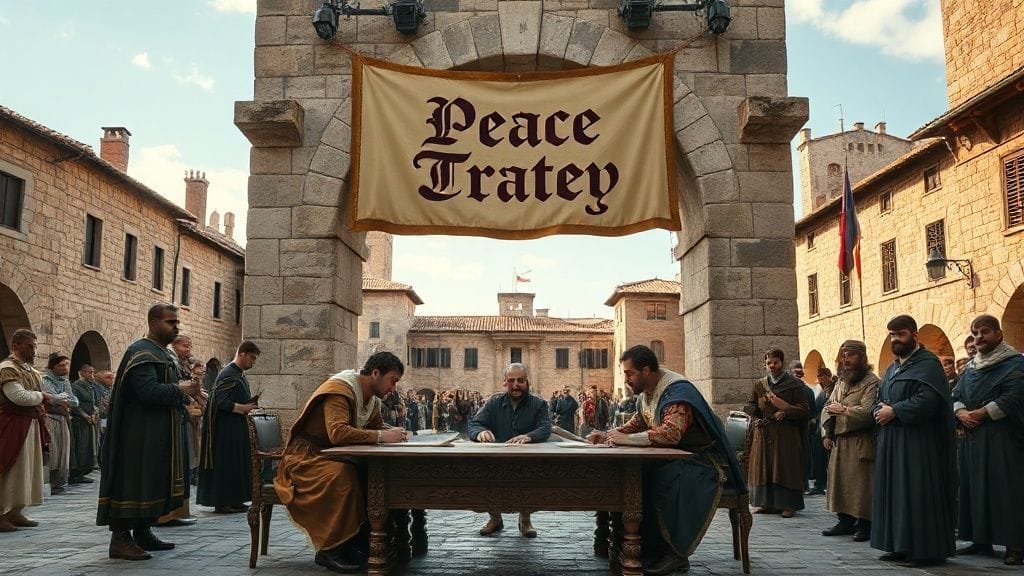
On a radiant June day, within the solemn grandeur of Anagni’s papal chambers, the Treaty of Anagni was signed. The document was more than dry legal text; it was a fragile pact of hope, charged with the collective yearning for peace and stability.
The treaty recognized the Aragonese renunciation of claims over Sicily in favor of Charles II, while promising certain guarantees for the Sicilians and compensations for the rulers involved. It laid out terms for tribute payments to the Papal States and mutual obligations to halt hostilities.
Witnessed by church dignitaries, royal envoys, and scribes, the treaty was both a diplomatic victory and the start of a frail peace.
Provisions at the Heart of the Treaty: Territory, Sovereignty, and Tribute
At its core, the Treaty of Anagni attempted to reconcile conflicting claims while preserving the prestige of the Papacy. Among its main provisions:
- The Kingdom of Sicily was to return formally to Angevin control, thus reuniting Naples and the island under Charles II’s crown.
- Frederick III was required to relinquish his claim, in return receiving amnesty and honorable terms.
- Aragon pledged to pay tribute to the Pope for Sicily, recognizing papal sovereignty.
- Arrangements for marriages and alliances were discussed to cement peace.
- An obligation to cease all hostilities was decreed.
These terms reflected a delicate balancing act between realpolitik and spiritual authority.
Reactions from Sicily and Aragon: Hopes and Reservations
Despite the treaty’s promises, its reception in Sicily and Aragon was mixed, to say the least. The Sicilian populace, emboldened by years of self-rule and after the bloody memories of the Vespers, viewed it as a betrayal and a threat to their autonomy.
Frederick III himself, while bound by the treaty, harbored deep reservations. For his rule was rooted in popular support and military resilience, not papal decrees. In Aragon, the political elite debated the cost of backtracking on such a consequential claim.
Local resistance simmered, foreshadowing future conflicts—a bitter reminder that treaties forged on paper could struggle to command loyalty across the waves and mountains.
Charles II of Naples: The Reconquest Dream Reignited
For Charles II, the Treaty of Anagni was a diplomatic triumph, rekindling his dream of reconquest. After decades in exile and struggles to secure his mainland kingdom, he now had the Pope’s blessing and a formal claim on Sicily.
His court in Naples buzzed with anticipation, preparations for military campaigns rekindled, and alliances sought to ensure the task’s success.
Yet, Charles was no stranger to the challenges of war and diplomacy, aware that paper agreements were but the first step in reclaiming an island that refused to submit easily.
Frederick III of Sicily: Defiance and Realpolitik
The treaty shackled Frederick III with obligations he was reluctant to accept. However, he was a consummate strategist—he accepted the terms publicly but kept his options open.
The island’s rugged terrain, loyal barons, and his own military acumen provided leverage. Frederick would continue to govern Sicily with practical autonomy, resisting Naples’ encroachments and the Pope’s interference.
For Frederick, survival meant balancing formal submission with actual independence—crafting a political stance that stretched the treaty’s limits while avoiding open war.
The Treaty’s Fragile Peace: A Temporary Truce in Hostile Waters
The Treaty of Anagni ushered in a period of uneasy calm rather than lasting peace. The Mediterranean in the late 13th century was a cauldron of rival ambitions, and underlying tensions remained.
Pirate raids continued, border skirmishes flared, and diplomatic intrigues abounded. The treaty served more as a temporary truce, a pause to reassess and prepare for the inevitable next phase in this extended saga.
European kings and popes watched closely, knowing that the Sicilian Question still cast a long shadow over regional stability.
How the Treaty Influenced Mediterranean Trade and Alliances
The treaty’s impact extended beyond politics; it also shaped commerce and diplomacy. Sicily’s ports were vital hubs in Mediterranean trade routes connecting Europe, Africa, and the Levant.
A cessation of open warfare promised safer seas and revived trade, benefiting merchants from Genoa, Venice, and Catalonia. New alliances and marriages sought through the treaty aimed to create a network of stability, though with mixed success.
The treaty also influenced alliances in Aragon and Naples, realigning their positions within the complex waltz of medieval European diplomacy.
Papal Authority Reasserted or Overstretched?
Pope Boniface VIII emerged from Anagni with renewed prestige as a peacemaker, but also exposed the limits of papal power. His role in enforcing the treaty revealed the complex relationship between spiritual authority and temporal realities.
While the Pope claimed sovereignty over Sicily and mediated the dispute, enforcing these claims required realpolitik beyond spiritual mandates.
In the coming years, this balancing act would define relations between church and state, highlighting both papal influence and vulnerability.
The Longer Shadow: The Sicilian Question after Anagni
The Treaty of Anagni did not end the Sicilian Question. Within a few years, renewed conflict erupted—the island remained effectively under Aragonese control, Frederick III rejected full submission, and the simmering war morphed into the War of the Sicilian Vespers’ protracted continuation.
The treaty was but a chapter in a longer narrative of contested sovereignty, identity, and power struggles that would reshape the Mediterranean map for decades.
Legacy of the Treaty of Anagni in Mediterranean Diplomacy
Despite its ephemeral peace, the Treaty of Anagni set important precedents. It demonstrated the increasing role of papal diplomacy in resolving secular conflicts and the importance of negotiated treaties in medieval international relations.
It also underscored the limitations faced by any single actor—be it king or pope—in imposing peace on fiercely divided realms.
The treaty's story echoes down to modern times as an early example of peace-making attempts amid competing nationalisms and territorial ambitions, reminding us that history is often written in uneasy compromises.
Conclusion: The Elusive Quest for Peace and Stability
The Treaty of Anagni of 1295 stands as a testament to the complex dance between war and diplomacy in medieval Europe. Born out of months of fraught negotiations amid the shadow of violent rebellions and dynastic claims, it embodied the yearning of rulers and populations alike to forge peace in turbulent times.
Yet, as history shows, true peace is elusive when penned on parchment but contested on battlefields and hearts alike. The Sicilian Question persisted beyond the treaty’s promises, revealing the challenges inherent in reconciling legitimacy, popular will, and power.
In this story of Anagni, we witness the human dimensions of political ambition—the hopes, fears, sacrifices, and fragile accords that shape the course of history, reminding us that peace is a process, never a given.
FAQs
1. What was the main cause of the Sicilian Question that the Treaty of Anagni sought to resolve?
The Sicilian Question originated from the War of the Sicilian Vespers in 1282, when Sicilians rebelled against Angevin (French) rule and invited the Aragonese to take the throne, splitting the Kingdom of Sicily into mainland Naples and the island under rival control.
2. Who were the key figures involved in the Treaty of Anagni?
King Charles II of Naples, King Frederick III of Sicily, and Pope Boniface VIII were principal figures, with envoys and diplomats representing Aragonese and Angevin interests.
3. Did the Treaty of Anagni fully end the conflict over Sicily?
No, the treaty established a fragile peace but did not end hostilities. Frederick III maintained practical control over Sicily, and warfare resumed shortly after.
4. How did the Papacy influence the treaty negotiations?
The Papacy, through Pope Boniface VIII, acted as a mediator asserting spiritual and temporal authority, aiming to reassert papal influence and restore unity under Christian rule.
5. What impact did the treaty have on Mediterranean trade?
The tentative peace allowed for safer trading routes, benefiting Mediterranean merchants and encouraging alliances that aimed to stabilize regional commerce.
6. Why was the treaty considered fragile?
Because underlying tensions, claims, and local resistance in Sicily and Aragon remained strong, and enforcement depended on political will and military power beyond diplomatic words.
7. How is the Treaty of Anagni remembered in history?
As a significant but ultimately temporary diplomatic effort to resolve a complex conflict that illustrates the challenges of medieval peace-making.
8. What lessons does the treaty offer on the relationship between church and state?
It reveals the limitations and ambitions of papal authority in temporal conflicts, showing that spiritual power alone cannot guarantee political settlements.

