Table of Contents
- The Treaty of Arras: A Turning Point in the Hundred Years’ War
- France and Burgundy: From Allies to Adversaries
- The Political Landscape of Early 15th Century Europe
- Charles VII’s Struggles: The Dauphin in Exile and the Shadow of English Domination
- The Rise of the Duke of Burgundy: Power, Ambition, and Calculated Independence
- Prelude to Peace: The Exhaustion of War and the Need for Reconciliation
- The Negotiations in Arras: A Delicate Dance of Diplomacy
- The Role of Key Figures: Philip the Good, Charles VII, and the Mediators
- The Terms of the Treaty: Concessions, Promises, and Guarantees
- Immediate Reactions: Joy, Skepticism, and Political Maneuvering
- How the Treaty Redrew the Map of Power in France
- The Decline of English Influence Following the Agreement
- Burgundy’s Shifting Loyalties: From English Ally to Royal French Vassal
- The Treaty’s Cultural and Symbolic Resonance in the Late Middle Ages
- The Treaty of Arras and Joan of Arc: Context and Consequences
- Long-Term Impact: Foundations for the End of the Hundred Years’ War
- Legacy of the Treaty in French National Identity
- Reflections by Contemporary Chroniclers and Diplomats
- Anecdotes and Human Stories from Arras’ Negotiation Hall
- How Modern Historians View the Treaty and Its Importance
- Conclusion: The Treaty of Arras as a Testament to the Power of Reconciliation
- FAQs: Unraveling the Intricacies of the Treaty of Arras
- External Resource: Further Reading on the Treaty of Arras
- Internal Link: Explore More at History Sphere
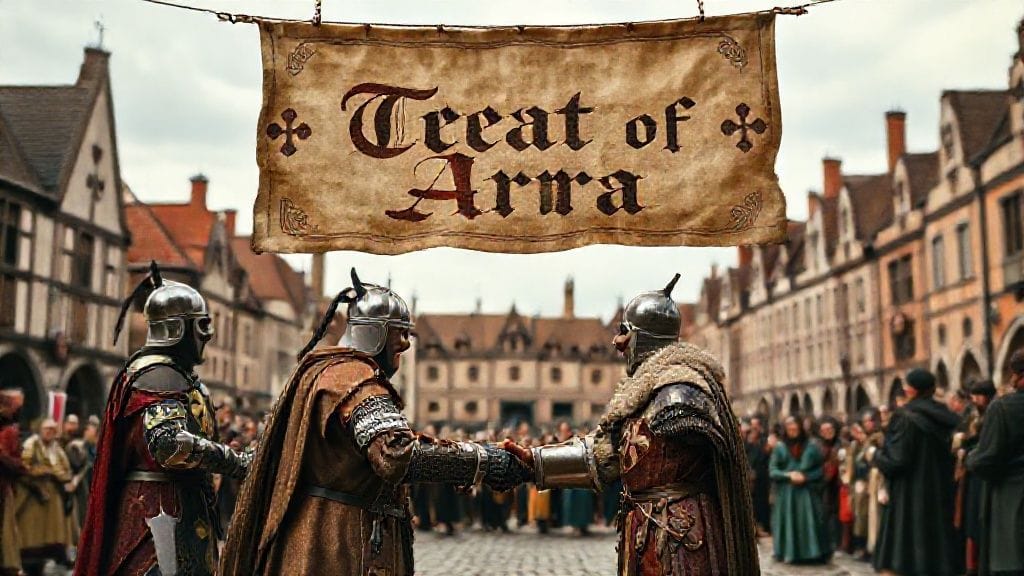
On September 21, 1435, the fraught city of Arras bore witness to a quiet yet monumental moment in medieval history. The grand halls buzzed, not with the clamor of battle, but with the weighty words of peace. Inside, weary yet resolute leaders from two of Europe’s most powerful — and obstinately opposed — factions leaned into cautious negotiation, seeking to unravel decades of bloodshed. The Treaty of Arras would come to symbolize not only political realignment but a profound reshaping of medieval Europe’s fate. Its ink dried over the fragile reconciliation between France and Burgundy, signaling a turning point in the long, brutal conflict known as the Hundred Years’ War.
The Treaty of Arras: A Turning Point in the Hundred Years’ War
The Hundred Years’ War was less a single war than a protracted saga of dynastic ambition, territorial claims, and political intrigue stretching across generations. By 1435, the conflict had exacted a devastating toll on both France and England, with French unity nowhere to be seen and the English crown entrenched in significant continental holdings. Into this fractured landscape, the Treaty of Arras emerged as a beacon — a diplomatic breakthrough that irrevocably altered alliances and power structures, offering France a glimmer of hope for restoration.
France and Burgundy: From Allies to Adversaries
The Duchy of Burgundy had long wielded considerable influence, its dukes torn between their roles as French vassals and independent power players seeking wider dominance. Originally, Burgundy had sided with the English against the French crown, a deadly fracture that prolonged the war and fragmented France’s resolve. The assassination of Duke John the Fearless in 1419 only deepened the animosity between Burgundy and the French royal house.
Yet, by the 1430s, the pragmatic winds of political self-interest began to shift. Philip the Good, Duke of Burgundy, understood that clinging to English allegiance might no longer serve Burgundy’s ambitions. The heavy price of war and the growing strength of Charles VII’s French court incentivized a reconsideration of stances. Reconciliation — though fraught with suspicion — began to dawn as a necessary step.
The Political Landscape of Early 15th Century Europe
Europe in the early 1400s was a patchwork of conflicting loyalties and explosive territorial ambitions. France, devastated by civil strife and English invasions, was struggling internally between factions loyal to the dauphin Charles and those supporting the English-backed King Henry VI.
The Duchy of Burgundy stood astride the strategic crossroads between France and the Holy Roman Empire, controlling critical trade routes, wealth, and formidable military resources. Its ruler Philip the Good balanced courtly finesse and battlefield prowess, all while navigating the labyrinth of shifting allegiances.
Meanwhile, England’s grip on French soil — from Calais to Normandy — seemed formidable but was vulnerable, worn thin by expensive campaigns and fractious noble support at home.
Charles VII’s Struggles: The Dauphin in Exile and the Shadow of English Domination
Charles VII’s rise to the French throne was anything but assured. Declared illegitimate by parts of the French nobility due to the Treaty of Troyes (1420) — which disinherited him in favor of Henry V of England — Charles seemed destined for obscurity.
But the Dauphin’s resilience, bolstered by loyalists, surviving armies, and inspirational figures like Joan of Arc, kept alive the hope of French resurgence. The Treaty of Arras did not just promise peace with Burgundy; it symbolized a crucial step toward regaining French unity and reclaiming lost lands.
The Rise of the Duke of Burgundy: Power, Ambition, and Calculated Independence
Philip the Good’s rise was a study in masterful realpolitik. Inheriting a prosperous and strategically positioned duchy, he wielded enormous influence that sometimes rivaled the French crown. His initial alliance with England reflected a tactical effort to weaken France and increase Burgundy’s autonomy.
However, Philip’s ambition was clear: to maximize Burgundian power, whether aligned with England or France. The Treaty of Arras showed his willingness to negotiate pragmatically, even if it meant severing ties with former allies when the cost outweighed the benefit.
Prelude to Peace: The Exhaustion of War and the Need for Reconciliation
Decades of warfare had left the French countryside ravaged, commerce disrupted, and noble houses impoverished or divided. Both Burgundy and France were fatigued — the common thread of devastation prompting a search for peace.
Moreover, the changing political currents — including the waning English position due to internal struggles and losses on the battlefield — made alliance shifts increasingly attractive. The groundwork for the Treaty was laid upon this pragmatic recognition that survival, prestige, and future prosperity demanded compromise.
The Negotiations in Arras: A Delicate Dance of Diplomacy
Negotiations convened in the solemn chambers of the Hôtel de Ville in Arras, a city famed for diplomacy and commerce. Representatives moved delicately, aware that centuries of mistrust and violence could easily unravel any fragile accord.
The talks were tense, riddled with carefully parsed language, and punctuated by moments of near-breakdown. Yet, the shared desire to end hostilities propelled diplomats forward. The atmosphere alternated between cordial exchanges and simmering suspicion — a testament to the high stakes involved.
The Role of Key Figures: Philip the Good, Charles VII, and the Mediators
The Treaty was shaped profoundly by its principal actors. Philip the Good, with his noble bearing and political acumen, sought assurances of Burgundy’s autonomy and territorial rights.
Charles VII, conscious of his tenuous legitimacy, offered significant concessions but demanded allegiance — seeking to mend the fractured kingdom.
Mediators, including ecclesiastics and envoys from neighboring powers, lent diplomatic weight and facilitated communication, highlighting the widespread interest in peace.
The Terms of the Treaty: Concessions, Promises, and Guarantees
The craftsmanship of the Treaty’s clauses demonstrated both sides’ mutual compromises. Burgundy recognized Charles VII as the legitimate King of France and renounced its alliance with England.
In exchange, Burgundy received formal recognition of its territorial sovereignty over key lands such as Picardy and Artois, and strong guarantees protecting its privileges.
The Treaty forbade Burgundy from assisting England militarily and required the severing of previous hostile ties against France. Embedded within the text were vows to respect religious and noble rights, a critical measure to restore internal harmony.
Immediate Reactions: Joy, Skepticism, and Political Maneuvering
Upon public announcement, reactions were swift and varied. French loyalists celebrated what they saw as a vital step toward reclaiming France’s unity and weakening English influence.
However, some skeptics on both sides questioned the durability of such an agreement — wary that old enmities might reignite or that promises could be broken if convenient.
English representatives viewed this realignment as a serious blow, recognizing that their foothold in France was now more isolated and fragile than before.
How the Treaty Redrew the Map of Power in France
The realignment prompted by the Treaty shifted the balance within France sharply. Burgundy, once the outward antagonist, now repositioned as a vassal within the French royal fold.
This enabled Charles VII to focus military efforts against England without fearing a two-front war. Burgundy's withdrawal from active hostility effectively weakened English strategic options in northern France.
This reconfiguration did more than affect politics; it laid the foundation for a gradual, though arduous, reunification of France.
The Decline of English Influence Following the Agreement
The Treaty of Arras sealed a diminishing English role on the continent. Deprived of Burgundy’s military and logistical support, English campaigns increasingly faltered.
Within two decades, England would lose virtually all its significant French holdings except for Calais, marking the near-end of its ambitions in France.
The treaty, though diplomatic rather than martial, thus played a decisive role in the eventual conclusion of the Hundred Years’ War, which officially ended in 1453.
Burgundy’s Shifting Loyalties: From English Ally to Royal French Vassal
Philip the Good’s pivot reflected a broader pattern in medieval European politics, where survival meant adaptability. Burgundy retained significant autonomy and even grew in wealth and prestige post-Treaty, avoiding decades of destructive warfare.
Loyalty to the French crown was always qualified by Burgundy’s self-interest, but this new alliance fostered decades of relative peace and prospering cultural achievements in the region.
The Treaty’s Cultural and Symbolic Resonance in the Late Middle Ages
Beyond immediate politics, the Treaty of Arras resonated symbolically. It represented a rare instance where reason and pragmatism overcame entrenched feuds in a period often characterized by violence and betrayal.
The ceremony in Arras was richly imbued with symbolism — oaths sworn on relics, feasts attended by nobility, and proclamations broadcast to the public — all designed to restore not only political order but social and moral legitimacy.
The Treaty of Arras and Joan of Arc: Context and Consequences
Joan of Arc’s earlier campaigns had revitalized French hopes and military momentum but had not single-handedly resolved the broader political fractures.
The Treaty of Arras, coming two years after her death, can be seen as the diplomatic complement to her martial efforts — a recognition that peace required negotiated settlements, not just battlefield heroics.
The treaty helped cement the political conditions that allowed Charles VII to consolidate power following Joan’s martyrdom.
Long-Term Impact: Foundations for the End of the Hundred Years’ War
In hindsight, the Treaty of Arras was a cornerstone in dismantling England’s continental ambitions and restoring French sovereignty.
It allowed Charles VII to reassert control, reform governance, and eventually push the English entirely out of most French territory.
Thus, the Treaty’s significance goes far beyond a signed parchment — it was a fulcrum around which medieval geopolitics pivoted.
Legacy of the Treaty in French National Identity
For France, the Treaty symbolizes the moment when fragmented loyalties began knitting together into a more coherent nation-state.
Historians have long credited it as a foundational event in the eventual emergence of modern France, showing how diplomacy and compromise shaped national destiny alongside military valor.
Reflections by Contemporary Chroniclers and Diplomats
Chroniclers like Jean Chartier and Pol de Courcy recorded the Treaty with a mix of cautious optimism and recognition of its fragile nature.
Many diplomats saw it as a hard-won success, born from exhaustion and mutual necessity more than genuine reconciliation.
Yet, these writings preserve the human drama beneath dry politics — distrust made palpable, but hope quietly rekindled.
Anecdotes and Human Stories from Arras’ Negotiation Hall
Accounts tell of Philip the Good arriving with a retinue of richly clad nobles, his demeanor regal yet guarded.
Charles VII’s envoys reportedly brought gifts — including fine textiles and relics — to soften negotiations, blending ritual with realpolitik.
Tales of heated debates, secret meetings, and uneasy truces humanize this grand political event, showing that history is made not just by kings, but by negotiation and compromise.
How Modern Historians View the Treaty and Its Importance
Today, scholars praise the Treaty of Arras as an exemplar of medieval diplomacy and conflict resolution.
They highlight its role in stabilizing France, ending internecine conflict, and enabling broader European shifts.
At the same time, the Treaty reminds us of the tentative nature of peace — a delicate balance of power constantly in flux.
Conclusion
The Treaty of Arras stands as a testament to the power of diplomacy amid the calamitous chaos of war. On a crisp September day in 1435, frayed enemies dared to find common ground, shifting the tides of history and mending a fragmented France. It reminds us that even in eras defined by swords and battle cries, the pen can redraw destinies. Its echoes reverberate through the ages, illuminating the delicate dance between ambition and reconciliation, conflict and peace. The Treaty of Arras was not just a ceasefire; it was the forging of a future where fractured voices could sing together once more. It teaches a timeless lesson — that even deep wounds can heal when courage meets compromise.
FAQs
1. Why was the Treaty of Arras necessary in 1435?
The Treaty was necessary to end protracted hostilities between France and Burgundy, which had prolonged the Hundred Years’ War and fragmented French unity. Both sides were exhausted and sought stability amid shifting power balances.
2. Who were the main figures involved in the Treaty?
Philip the Good, Duke of Burgundy, and Charles VII, King of France, were central. Numerous mediators and envoys helped facilitate dialogue between the antagonists.
3. What were the key terms of the Treaty?
Burgundy recognized Charles VII as the legitimate king and ended its alliance with England. In return, it secured recognition of its territorial rights and privileges within France.
4. How did the Treaty affect the English position in France?
The Treaty weakened the English by depriving them of Burgundy’s support, accelerating their territorial losses and ultimately contributing to the end of the Hundred Years’ War.
5. How did the Treaty relate to Joan of Arc’s legacy?
Though Joan had died two years prior, the Treaty complemented her military efforts by politically reconciling French factions, allowing Charles VII to consolidate power.
6. What was Burgundy’s motivation for signing the Treaty?
Philip the Good sought to preserve and enhance Burgundy’s autonomy and wealth, recognizing that continued alignment with England was less advantageous.
7. What is the Treaty’s significance in French history?
It marked the beginning of French reunification, undermined English ambitions, and laid the groundwork for the rise of a centralized French state.
8. How do modern historians view the Treaty?
Historians regard it as a masterstroke of medieval diplomacy that altered the trajectory of European conflicts and exemplified the complex balance of power politics.

