Table of Contents
- On the Road to Cateau-Cambrésis: Europe on the Edge of Exhaustion
- The Long Shadow of the Italian Wars
- Kings, Queens, and Cardinals: The Human Drama Behind the Negotiations
- A Village Becomes a Stage: Le Cateau-Cambrésis in the Spring of 1559
- Behind Closed Doors: How the Peace Was Negotiated
- The Text of Peace: What the Treaty of Cateau-Cambrésis Actually Said
- Italy Abandoned: The End of French Dreams Beyond the Alps
- Spain Ascendant: Philip II and the Architecture of Habsburg Power
- England at the Table: From Calais to a New European Role
- Marriage, Hostages, and Symbols: The Human Guarantees of Peace
- The Joyous Entries and Sudden Tragedies of 1559
- Winners, Losers, and the Illusion of Victory
- From Foreign War to Civil War: France After Cateau-Cambrésis
- Religious Fault Lines: Peace on the Map, Conflict in the Soul
- The People’s Peace: Soldiers, Merchants, Peasants, and Widows
- Diplomatic Ripples: How the Treaty Reshaped the European System
- Remembering and Forgetting: Historians Confront the Treaty
- Conclusion
- FAQs
- External Resource
- Internal Link
Article Summary: In early April 1559, in the modest town of Le Cateau-Cambrésis in northern France, European diplomats signed the treaty of cateau cambrésis, formally ending the brutal cycle of conflicts known as the Italian Wars. This article follows the story of how decades of rivalry between the Valois and Habsburg dynasties had bled the continent dry and forced kings and ministers to choose compromise over glory. It describes the tense atmosphere in the negotiation halls, explores the precise terms of the peace, and shows how the treaty of cateau cambrésis reshaped the political map of Italy and Europe. Yet behind its clauses about duchies and cities lay personal dramas—dynastic marriages, royal ambitions, and tragic accidents—that gave this diplomatic document a deeply human dimension. The narrative then turns to the consequences, showing how the treaty of cateau cambrésis quelled one kind of war but unwittingly opened the door to others, especially France’s religious conflicts. Across the article, the treaty of cateau cambrésis emerges as both an end and a beginning: the conclusion of a medieval-style dynastic struggle and the threshold of a more modern, confessionally divided Europe. By weaving anecdote, analysis, and testimony from the period, the piece reveals why this seemingly technical diplomatic settlement still matters. It is a story of war weariness, fragile peace, and the price of exhaustion.
On the Road to Cateau-Cambrésis: Europe on the Edge of Exhaustion
On a damp spring morning in 1559, couriers thundered along the mud-slick roads of northern France, their horses flecked with sweat, their saddlebags heavy with sealed letters. They rode toward a small town not far from Cambrai, Le Cateau-Cambrésis, which for a few turbulent weeks would host one of the most decisive diplomatic gatherings of the sixteenth century. In their satchels lay draft proposals, coded instructions from kings, and carefully worded demands for territory and honor. Behind each folded sheet of parchment stood decades of suffering: ruined harvests, burned villages, sacked cities, and the bones of thousands of anonymous soldiers buried in Italian soil.
The treaty of cateau cambrésis did not emerge from a single brilliant idea or a sudden desire for peace. It was the last resort of powers that had been at each other’s throats for more than sixty years, struggling over the same prize: dominance in Italy and, through Italy, dominance in Europe. France and Spain, joined at times by the Holy Roman Empire and England and surrounded by nervous Italian states, had exhausted their treasuries and their patience. The spring of 1559 found them all drained of coin, men, and credibility. Kings spoke of honor and God’s will, but in private they confronted ledgers filled with red ink and reports from commanders begging for pay and reinforcements that never arrived.
In this atmosphere of strain, Le Cateau-Cambrésis was chosen less for its grandeur than for its relative safety, neutrality, and proximity to both French and Habsburg-controlled lands. The little town, accustomed mostly to local markets and regional disputes, suddenly had to accommodate a swarm of nobles, clerics, interpreters, servants, cooks, guards, horses, and wary onlookers. Inns overflowed. Barns were converted to dormitories. Prices soared, to the irritation of the inhabitants, who muttered that they had not asked to become the crossroads of Europe.
Yet this was only the beginning. The road to the treaty ran back not simply through the campaigns of the 1550s but through the long series of wars that had torn Italy apart since the closing years of the fifteenth century. To understand what happened in Le Cateau-Cambrésis, and why the treaty of cateau cambrésis reshaped the destiny of nations, we must first return to the early days of the Italian Wars, when kings dreamed of crowns they did not yet possess and human lives were pawns in a larger game.
The Long Shadow of the Italian Wars
The story that culminates at Le Cateau-Cambrésis begins in 1494, when Charles VIII of France marched his army across the Alps to claim the throne of Naples. It was a bold invasion, more a statement of dynastic entitlement than a carefully calculated conquest. Charles’ campaign unleashed something Europe had never seen on such a scale: mobile artillery pounding city walls into dust, mercenary companies changing sides for cash, and alliances that dissolved as quickly as they were formed. Italy became the chessboard on which the Valois kings of France and the Habsburg rulers of Spain and the Holy Roman Empire played out their ambitions.
Over the decades, names and faces changed—Charles VIII gave way to Louis XII and then to Francis I, Emperor Maximilian I to Charles V, and finally Charles to his son Philip II. But the structure of the conflict remained grotesquely familiar. Armies swarmed across Lombardy, clashed at Marignano (1515), Pavia (1525), and Ceresole (1544), and trampled vineyards and fields wherever they went. Cities like Milan, Naples, and Florence became bargaining chips, exchanged in treaties, retaken on battlefields, and mortgaged to mercenaries.
Contemporaries sometimes spoke of the war as if it were a natural disaster. One Florentine chronicler lamented that “Italy has become the anvil on which foreign princes hammer,” and his words echoed from generation to generation. To the rulers, however, the battles were about prestige and legitimacy: who could claim to be the true defender of Christendom, who could boast the most territories, whose coat of arms would preside over which duchy.
The war also evolved. By the mid-sixteenth century, what had begun as a French bid for the Kingdom of Naples had grown into a struggle for European hegemony. The same imperial structures that allowed Charles V to field armies in Lombardy tied Spain to endless commitments in Germany, the Low Countries, and the Mediterranean. France, surrounded by Habsburg territories, saw in Italy a crucial counterweight to encirclement. The conflict spilled into the seas with battles against the Ottomans, into North Africa, and into the Low Countries. By the 1550s, it was difficult to say where the “Italian Wars” ended and the broader “Habsburg–Valois rivalry” began.
As the 1550s wore on, the weight of history bore down on new rulers. Henry II of France, son of the chivalrous but ill-fated Francis I, inherited his father’s obsession with Italy and his hatred of Habsburg power. On the other side, Philip II of Spain, more austere and calculating than his father Charles V, governed a global empire straining under its own victories. Both men had been shaped by decades of conflict; both came to the throne convinced that backing down would be dishonorable, even sinful. And yet behind them stretched a long, bloody tally of failures and Pyrrhic successes that made any fresh campaign feel like a repetition rather than a novation.
The long shadow of these wars would fall across the conference tables at Le Cateau-Cambrésis. Every ambassador carried not only his current instructions but also a memory of previous betrayals, broken promises, and solemn oaths conveniently forgotten. The treaty of cateau cambrésis would have to overcome more than current hostility; it would need to bury six decades of rivalry so entrenched that many doubted whether it could ever truly end.
Kings, Queens, and Cardinals: The Human Drama Behind the Negotiations
Behind the formal titles—“Most Christian King,” “Catholic King,” “Serene Queen”—stood very human figures driven by fear, pride, and hope. At the French court, Henry II personified knightly valor. Tall, energetic, and passionate, he had been shaped by his father’s humiliating captivity after the defeat at Pavia, and by his own years as a hostage in Spain. Those experiences forged a deep resentment of the Habsburgs. For Henry, the Italian campaigns were not only about territory; they were about reclaiming his family’s honor.
Beside him moved Catherine de’ Medici, the Florentine-born queen whose Italian heritage gave her a particular sensitivity to the peninsula’s politics. In public, she played the role of dutiful consort, but in private she observed everything, storing names, alliances, and slights for later use. Her Medici ancestry bound her emotionally to Italy, yet as Queen of France she could see how much the wars had cost her adopted kingdom. Later in life, Catherine would become synonymous with political calculation, but in 1559 she was still slowly entering the center of power, seeing in the peace negotiations both a diplomatic necessity and a personal turning point.
On the Spanish side stood Philip II, recently widowed from his English wife, Mary Tudor, and already notorious for his seriousness and caution. Philip was not the flamboyant warrior his father Charles V had been; he preferred dispatches to battlefields, marginal notes to impromptu speeches. Yet he ruled an empire that brimmed with restless soldiers and commanders eager for action. He bore responsibility for Spain, Naples, Milan, the Low Countries, and a growing transatlantic realm. His decisions at Le Cateau-Cambrésis would reverberate from Lombardy to Mexico City.
The English position added another layer of complexity. Queen Mary I, Philip’s consort until her death in November 1558, had lost Calais—the last English foothold on the continent—to the French that same year. The loss stung deeply. Mary’s successor, Elizabeth I, a young queen facing internal religious turmoil and international suspicion, entered the negotiations with limited leverage but a keen sense of what public opinion in England would tolerate. Elizabeth’s ministers knew that any agreement confirming the loss of Calais would be condemned at home. Yet they also recognized that England was too fragile to plunge back into continental war simply to preserve a patch of foreign soil.
Cardinals, bishops, and seasoned diplomats completed the mosaic. Chief among them was Cardinal Carlo Carafa, representing the Papal States and the interests of his uncle, Pope Paul IV. Carafa, ambitious and volatile, had previously encouraged France to continue the fight against the Habsburgs, envisioning a more independent papal Italy. But the tides of war had turned, and now he, too, had to reckon with Habsburg power.
All these individuals—Henry, Catherine, Philip, Elizabeth, Carafa, and many lesser envoys—brought their personal histories into the cramped rooms of Le Cateau-Cambrésis. They were not abstract symbols but flesh-and-blood figures, some suffering from gout, others distracted by dynastic worries or love affairs, each haunted by failure and tempted by glory. The treaty of cateau cambrésis would emerge not from some ideal of “reason of state” alone but from this tangled interplay of character and circumstance.
A Village Becomes a Stage: Le Cateau-Cambrésis in the Spring of 1559
Le Cateau-Cambrésis was not built for world history. It was a modest town in the County of Cambrai, lying in a landscape of gentle fields, mills, and hedges, whose regular rhythms were dictated less by politics than by harvests and holy days. Yet for a few weeks in 1559 it became a bustling theater where the fate of Italy and, indirectly, of Europe was discussed in stuffy chambers scented with wax and damp wool.
Contemporary descriptions of the town during the negotiations mention overcrowded inns, wine that grew steadily more expensive, and a constant clatter of hooves and boots on the cobbles. Houses were requisitioned for noble delegations. Tapestries and banners bearing lilies, eagles, and lions adorned façades, hastily hung to give some veneer of splendor to what remained a provincial setting. Local merchants did brisk business selling food, fodder, ink, and parchment. Washerwomen worked late into the night, laundering the shirts and linens of men who seemed always to be waiting.
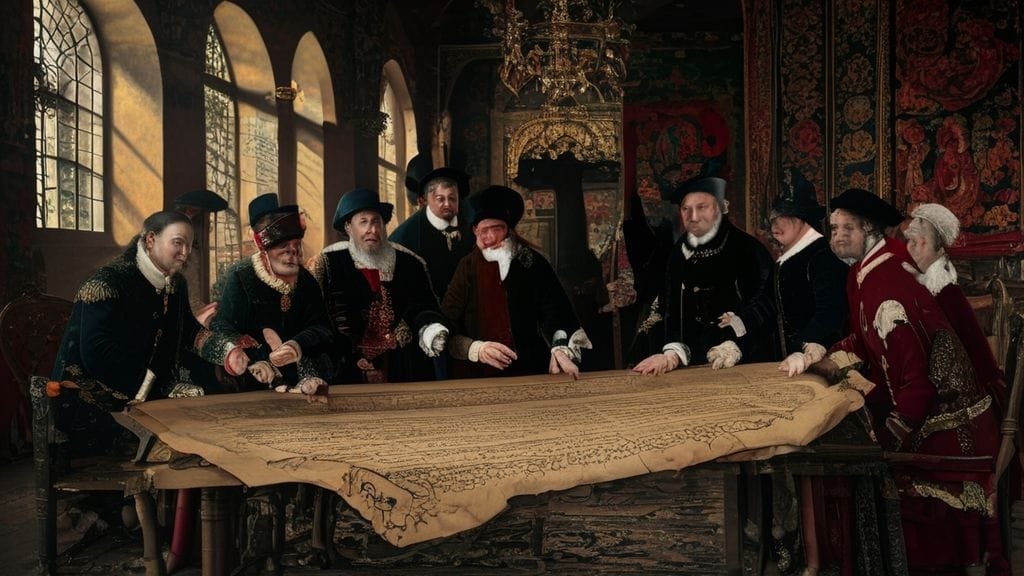
Security was tight, though never absolute. Guards checked the movements of strangers; secretaries carried coded notes; spies tried to overhear conversations in corridors and churches. Each party feared assassination or abduction. Memories of previous diplomatic catastrophes—like the imprisonment of Francis I after Pavia—lingered, and none wished to give their rivals an opening. Yet the negotiations demanded proximity. Ambassadors had to meet, to walk short distances from one building to another, to pass in the streets and tip their hats.
Inside the main residences commandeered for talks, the atmosphere was a strange blend of ceremony and fatigue. Candles burned low as scribes copied yet another version of a proposed clause. Fires smoked. The air was thick with Latin, French, Italian, Spanish, and English—a Babel of ambition. If one listened closely, one might have heard the scraping of quills, the rustle of velvet sleeves, the muttered oaths of frustrated negotiators. Outside, meanwhile, peasants continued to plow their fields, children played by the streams, and the church bells marked the hours as they always had.
Le Cateau-Cambrésis did not choose its role; it was chosen, a relatively neutral point where delegations could converge without immediately feeling that they had entered enemy territory. But by a twist of fate, this unassuming town would lend its name to the treaty that finally brought a measure of closure to the Italian Wars. The treaty of cateau cambrésis would forever tie its name to a peace fashioned from exhaustion as much as from diplomacy.
Behind Closed Doors: How the Peace Was Negotiated
The negotiations themselves unfolded in phases, each marked by advances, reversals, and carefully choreographed threats. No single “conference” produced the final text; rather, it was a long, grinding process of exchanging drafts, proposing concessions, and testing the limits of each side’s patience. Historians have reconstructed these steps from dispatches sent home by ambassadors and from scattered minutes of conversations that survived in archives.
From the outset, the Habsburg representatives had a stronger bargaining position. On the battlefield, Spain and its allies had recently won crucial victories, particularly at St. Quentin in 1557 and Gravelines in 1558, which left France reeling. French finances were in shambles; tax revolts simmered; noble commanders were weary. Henry II’s ministers knew that continuing the war risked internal collapse. Yet they also understood that a peace perceived as humiliation could destroy the king’s authority.
Spain, too, had limits. Philip II was acutely aware of the costs of constant warfare, costs that stretched from Italy to the Low Countries and the Atlantic. He needed peace to consolidate his territories, reform administration, and deal with mounting religious unrest in the Netherlands. But he was determined to lock in Spanish predominance in Italy and to prevent France from emerging with even a symbolic victory.
The English position was more delicate. Elizabeth I’s envoys sought to salvage something from the loss of Calais, ideally its eventual return or at least compensation. France, triumphant in that particular theater, showed little inclination to give back what it had just gained. Spain, allied to England through Philip’s recent marriage to Mary Tudor but no longer bound by that personal tie, balanced its loyalties carefully, wishing to avoid alienating Elizabeth while also pursuing its own interests.
Within the negotiation rooms, tempers flared as often as they cooled. Delegates employed familiar tactics: feigned indignation, strategic delays, sudden offers of generosity contingent on immediate acceptance. At times, the atmosphere was almost theatrical. One envoy would stalk out, slamming the door, only to be coaxed back by a colleague hours later. Another would produce an unexpected document, claiming some ancient legal right to a duchy, in an attempt to reframe a discussion. Yet beneath the theatrics lay serious arithmetic: lists of garrisons to be withdrawn, cities to be handed over, hostages to be exchanged.
Cardinal Carafa, representing the Pope, oscillated between encouraging French intransigence and preparing to accommodate inevitable Habsburg dominance. His presence reminded everyone that the Italian peninsula was not a blank map but a patchwork of duchies, republics, and ecclesiastical states with their own interests and fears. Venice, Florence, and smaller powers followed events from a distance, terrified that a Franco-Spanish peace might come at their expense.
Gradually, a framework emerged. France would renounce its claims in Italy, Spain would return certain territories in northern France, and dynastic marriages would bind the houses of Valois and Habsburg. It sounds clean when summarized; in reality, every phrase was contested. One ambassador recorded in his dispatch that “we wrangle over every comma, for in this peace, a comma may cost a province.” That remark, preserved in a later collection of letters, captures the microscopic scale at which major decisions were shaped.
By late March 1559, the outlines of a comprehensive agreement were in place. The participants understood that they were on the brink of something historic, not because they wished to end the Italian Wars—that desire had existed many times before—but because circumstances finally forced them to do so. The treaty of cateau cambrésis would not emerge as a beacon of mutual understanding, but as a carefully patched compromise stitched together by fatigue, necessity, and shrewdness.
The Text of Peace: What the Treaty of Cateau-Cambrésis Actually Said
The treaty of cateau cambrésis was in fact two main treaties—one between France and England (signed 2 April 1559) and another between France and Spain (signed 3 April 1559)—supported by a web of subsidiary letters and conventions. Taken together, they constituted a general peace that brought the Italian Wars to an official close.
At the heart of the Franco-Spanish settlement lay a stark bargain: France abandoned almost all its claims in Italy, while Spain returned certain territories in France and confirmed others in exchange. The French crown recognized Spanish and Imperial control over the Duchy of Milan, the Kingdom of Naples, and Sicily, as well as over other Italian possessions. The dream that had propelled Charles VIII across the Alps in 1494—the idea that a French king might wear the crown of Naples as his own—was formally and publicly surrendered.
In return, Spain agreed to restore several towns and fortresses in northern France that it had seized in recent campaigns. The details of these restitutions mattered enormously to local populations, who had endured occupation and feared permanent transfer to foreign rule. Yet geopolitically, the most decisive element remained the French withdrawal from Italy. It cemented Spanish hegemony on the peninsula and effectively ended the era in which multiple foreign powers fought pitched battles on Italian soil for direct dominion.
The treaty with England revolved around Calais. France retained the port, while agreeing, at least in theory, to a clause that left open the possibility of its eventual return to England after eight years, upon the payment of a very large sum. In practice, this “option” functioned as a face-saving device for Elizabeth I, allowing her to claim that she had not irretrievably relinquished Calais, even though events would prove that it was gone for good. One English chronicler would later remark bitterly that “Calais was lost in the time of Mary, and the hope of Calais in that of Elizabeth.”
The treaties also specified the fate of key Italian territories outside the immediate orbit of Milan and Naples. The Duchy of Savoy, long contested and partially occupied, was largely restored to Duke Emmanuel Philibert, who was engaged to Henry II’s sister, Marguerite of France. The Duchy of Lorraine, which had seen its autonomy eroded, recovered some of its position between the great powers. In this way, the treaty of cateau cambrésis both ratified Habsburg dominance in central and southern Italy and attempted to stabilize the complex buffer zones in the Alpine and Rhine regions.
Finally, the documents included a series of provisions that we might today call “confidence-building measures”: mutual amnesties, the release of prisoners, the removal of troops from certain fortresses, and the promise to respect the liberties and properties of subjects in transferred territories. Such clauses were often aspirational, more a statement of ideal conduct than a guarantee of behavior. Nevertheless, they signaled an intention, at least on paper, to transition from the logic of relentless conquest to one of recognized borders.
Thus, the treaty of cateau cambrésis looked backward and forward at once. It closed the door on one pattern of warfare—the grand dynastic contest over Italy—and opened a new era in which the map of Europe, though not frozen, was far more clearly defined. The ink that dried in Le Cateau-Cambrésis traced the contours of a geopolitical order that would last, in its broad lines, for more than a century.
Italy Abandoned: The End of French Dreams Beyond the Alps
For France, the treaty struck at the core of a long-cherished aspiration. Since the days of Charles VIII and Louis XII, French kings had envisioned themselves not only as rulers of their own kingdom but as rightful lords of at least part of Italy. French culture, language, and money had flowed into Milan, Naples, and beyond; French nobles had married into Italian dynasties; French officers had patiently learned the topography of Lombard plains and Apennine passes.
To make peace now, Henry II had to let go of these dreams, or at least tuck them away into the realm of nostalgia. The surrender of claims did not erase the memory of French exploits in Italy, but it did draw a legal line under them. Ambassadors wrote of the king’s visible discomfort when these renunciations were read aloud, and of the painful silence that followed in the French camp. Yet it is telling that Henry accepted them nonetheless. The price of continuing the war seemed higher than the humiliation of abandoning castles and cities that few French subjects would ever see.
Italian observers were divided in their reactions. Some, especially in areas devastated by repeated campaigns, welcomed the end of French intervention as the lifting of a curse. Others, particularly among elites who had tied their fortunes to French protection, mourned the shift. A Milanese noble who had prospered under French occupation might now face Spanish suspicion; a Neapolitan official who had hoped for a change of masters was forced to reconcile himself to continued Habsburg rule.
The withdrawal of France also altered the internal balance among Italian states. With one great foreign power effectively out of contention, the remaining states—Venice, Florence (by then dominated by the Medici dukes), the Papal States, Savoy, and others—had fewer options for playing larger forces against each other. Many found themselves ever more dependent on Spain, whose garrisons and viceroys now cast a long shadow.
Yet behind this geopolitical realignment lay personal stories. French captains who had spent their entire careers fighting in Italy now returned home to uncertain futures. Young noblemen who had dreamed of proving themselves under the Lombard sun faced the more prosaic prospect of domestic service or courtly intrigue. The historian Francesco Guicciardini, who had already chronicled earlier phases of the wars, might have looked upon these men and observed—as he did elsewhere—that “fortune turns her wheel, and princes must learn when to stop pushing against it.”
In that sense, the treaty of cateau cambrésis was not only a political act but a cultural turning point. It marked the moment when France refocused its primary energies within its borders and toward the Atlantic and the north, leaving Italy largely to the Habsburg sphere. The echo of drums in Lombardy faded, replaced, in decades to come, by different sounds: Protestant psalms in French valleys, cannon in the Netherlands, and eventually colonial ventures beyond Europe.
Spain Ascendant: Philip II and the Architecture of Habsburg Power
If France left Italy chastened, Spain emerged from Le Cateau-Cambrésis as the acknowledged master of the peninsula. Under Philip II, Spanish authority extended over Naples, Sicily, Sardinia, Milan, and a network of strategic fortresses and client states. The treaty of cateau cambrésis did not create this dominance, but it confirmed and consolidated it, giving Philip legal and diplomatic backing for a position his armies already largely held by force.
For Philip, the timing was critical. His father, Charles V, had abdicated a few years earlier, dividing the vast Habsburg inheritance between the Spanish and Austrian branches. Spain, with its Italian possessions and the Low Countries, had become Philip’s core concern. He saw himself as both a Catholic monarch defending the faith and as a careful administrator tasked with holding together a polyglot composite monarchy.
The new peace allowed him to turn from constant campaigning to what he did best: governing from behind a mountain of papers. With French ambitions in Italy checked, Philip could focus on strengthening Spanish control. He financed fortifications, adjusted taxation systems, and placed trusted viceroys in key cities. Italian elites, especially those in Naples and Milan, cultivated close ties to Madrid, sending their sons to Spanish universities and seeking favor in the royal councils.
Yet Spanish ascendancy carried its own burdens. Maintaining garrisons across Italy required money, and the monarchy’s seemingly endless resources were, in fact, finite. Silver from the Americas flowed into royal coffers but often passed straight through to creditors. The peace of 1559 reduced expenses on the battlefield but did not erase debts accumulated over decades. Moreover, subjects in the Low Countries grew uneasy at signs that Philip might try to impose the same kind of centralized, militant Catholic rule there that he held in Italy and Spain.
Nonetheless, from the vantage point of 1559, Spain appeared triumphant. A Spanish chronicler exulted that “Italy now acknowledges the hand of our king,” an assertion that captured both the reality of Habsburg power and the imperial arrogance that accompanied it. The treaty of cateau cambrésis gave this triumph a formal diplomatic framework. By accepting Spanish rights in Italy, France and its allies signaled to the rest of Europe that contesting Habsburg control there would now mean defying not just cannons but treaties.
This moment of hegemony would not last forever. In the long run, Spain’s overstretched commitments contributed to later crises. Yet the peace established in Le Cateau-Cambrésis allowed Philip II to preside, for a time, over a Mediterranean and Italian order shaped to Spanish advantage—a “Spanish Italy” that would endure, in different forms, until the eighteenth century.
England at the Table: From Calais to a New European Role
England arrived at Le Cateau-Cambrésis in a position of unusual vulnerability. The death of Mary Tudor and the accession of Elizabeth I had disrupted existing alliances. Under Mary, England had been drawn into Habsburg conflicts and had lost Calais, a humiliation that many saw as the final chapter in a long retreat from continental ambitions originally rooted in the medieval Angevin empire. Elizabeth, a Protestant queen in a Europe still dominated by Catholic monarchies, had to navigate both external suspicion and internal division.
English diplomats hoped to recover Calais or, failing that, to secure terms that would make its loss palatable to Parliament and the political nation. The French, fresh from victory, were determined to keep the port, which gave them not only strategic advantage on the Channel but also a symbolic reversal of centuries of English presence on French soil. Negotiations over Calais thus became as emotional as they were technical.
The compromise reached—France retained Calais but acknowledged, in theory, a future English claim contingent on large payments—was recognized by most present as a legal fiction. The French had no intention of returning the town, and the English lacked the means and will to fight another major war for it in the near future. Nevertheless, the clause served its purpose, allowing Elizabeth’s counselors to say that they had not simply surrendered the port without recourse.
In a way, the treaty of cateau cambrésis nudged England toward a new understanding of its place in Europe. By accepting the loss of Calais, however reluctantly, the English political elite began to detach their country’s identity from medieval-style claims to continental territory. Over time, England—and then Britain—would orient itself more toward maritime power, commercial expansion, and the balance-of-power politics that came with observing European struggles from just offshore.
Contemporary English reactions were mixed. Some lamented the end of England’s last continental foothold; others, particularly merchants who saw new opportunities in peace, welcomed the respite from the costly wars of Mary’s reign. Elizabeth herself, pragmatic and cautious, seems to have understood that her realm could not afford the kind of large-scale continental entanglements that had ruined so many of her predecessors. In this sense, the treaty of cateau cambrésis was a hinge, closing one chapter of English history and quietly opening another, less territorial, more maritime, and eventually imperial in a different way.
Marriage, Hostages, and Symbols: The Human Guarantees of Peace
Sixteenth-century peace was not sealed by signatures alone. Dynastic marriages, the exchange of hostages, and solemn ceremonies acted as living guarantees that the words on parchment would hold. The treaty of cateau cambrésis was no exception. Its most spectacular “clause,” in this sense, was the marriage arranged between Henry II’s daughter, Elisabeth of Valois, and Philip II of Spain.
Elisabeth was very young, still in her early teens, when she was bound to a man two decades older who had already buried several wives. The match symbolized reconciliation between Valois and Habsburg, presenting to Europe an image of two great Houses joined by bonds of kinship rather than sundered by war. Court poets and artists celebrated the union with allegories of peace: olive branches, doves, Europe personified as a serene matron. But behind the allegories lay a human reality: a girl leaving her homeland, language, and family to live in a foreign, rigidly ceremonial court where everything from her gestures to her wardrobe became political.
Elisabeth was not the only one whose body became a pledge. Another French princess, Marguerite of France, was married to Emmanuel Philibert, Duke of Savoy, whose lands had been battlegrounds and bargaining chips throughout the wars. This union aided the restoration of Savoyard territory and symbolized a shift from enmity to alliance. In such marriages, affection, if it came at all, arrived after duty.
There were also hostages of a more straightforward nature. In some cases, nobles or royal kin were required to reside in the territory of another power for a time, serving as tangible proof that their home court would respect the agreement. Henry II’s own memories of youthful captivity in Spain underscored the emotional weight such arrangements carried. Even when not formally denominated as “hostages,” the presence of high-born individuals at foreign courts served a similar function, binding rulers together through the shared awareness that any return to open war would put these precious persons in danger.
Ceremony played its part, too. Across France and Spain, public Te Deum services were held to give thanks for the peace. Bells rang; cannons fired salutes; processions wound through city streets. Chroniclers tell us of crowds gathered to see royal couples appear on balconies, of tapestries depicting victories and allegorical virtues unfurled in palaces. The spectacle suggested closure, as if the very act of jubilation could wash away years of bloodshed.
Yet behind the celebrations, some were uneasy. Veterans wondered what place there would be for them in peacetime. Religious minorities, in both France and the Low Countries, watched anxiously, fearing that rulers freed from external enemies might now turn their energies inward against dissent. The human guarantees of the treaty of cateau cambrésis were thus double-edged: they proclaimed trust and unity at the top, but they also hinted at the possibility that, should the peace falter, human lives placed as pledges could once more become bargaining chips.
The Joyous Entries and Sudden Tragedies of 1559
In the months that followed the signing of the treaty, French court life erupted in a blaze of festivals, tournaments, and ceremonial “joyous entries” designed to present the peace as a new golden age. Henry II moved through his realm enveloped in displays of loyalty and relief. In Paris, Lyon, and other cities, triumphal arches were erected, their painted inscriptions hailing him as the prince who had finally put an end to interminable wars.
One of the most famous of these celebrations would, however, end in disaster. In late June 1559, in Paris, a tournament was organized to mark both the recent peace and the dynastic marriages that accompanied it. Henry II, always eager to prove his chivalric prowess, insisted on jousting personally. Despite warnings from his physicians and counselors, he donned armor and took up the lance. The event drew crowds and foreign envoys eager to witness the spectacle of a victorious king displaying his courage in peacetime sport.
During one of the passes, Henry faced Gabriel de Lorges, Count of Montgomery, captain of his Scottish Guard. Their lances splintered on impact; a jagged fragment from Montgomery’s lance pierced the king’s helmet and entered his eye, driving deep into his brain. The festive atmosphere dissolved instantly into panic. Henry was carried, bleeding and unconscious, to his chambers; surgeons attempted desperate remedies, guided in part by the anatomical observations of the celebrated physician Ambroise Paré, but their efforts could not reverse the damage.
After days of agony, Henry II died on 10 July 1559. The king who had signed the peace and presided over its first celebrations did not live to see its longer-term consequences. His death, shocking and abrupt, cast a pall over the very order that the treaty of cateau cambrésis sought to establish. Power now passed to his son Francis II, a frail adolescent heavily influenced by the powerful Guise family. Catherine de’ Medici, until then overshadowed by her husband, was propelled toward the center of governance as queen mother and, effectively, regent.
This tragic twist gave the peace of 1559 a haunting undertone. It seemed to some contemporaries almost as if fate—or, in their language, divine providence—had intervened to mark the transition. One anonymous Parisian diarist, quoted in a modern edition of sixteenth-century chronicles, wrote that “God allowed the peace to be signed, but would not permit the king who made it to enjoy it.” Such interpretations reflected a mindset in which political events and personal fates were deeply intertwined, each read as a sign of higher designs.
The tournament accident did not undo the treaty, but it weakened the French monarchy at the precise moment when it needed steadiness to navigate the shift from foreign war to internal tension. Thus, even as fireworks faded and arches were dismantled, France entered a period of fragility that would test the durability of the peace won at Le Cateau-Cambrésis.
Winners, Losers, and the Illusion of Victory
Who, then, “won” at Le Cateau-Cambrésis? On paper, Spain clearly emerged as the principal victor, securing its hold over Italy and confirming its role as the leading Catholic power in Europe. France, forced to renounce its Italian ambitions, looked like the loser, compensated only by the recovery of certain territories and by the dynastic prestige of royal marriages. England, having effectively lost Calais, could hardly claim triumph. Italian states, subject to foreign hegemony, seemed at best to have escaped worse fates.
Yet the reality was less straightforward. Spain’s victory came with heavy costs: overstretched resources, increased dependence on American silver, and a network of obligations that would eventually strain the monarchy to the breaking point. French “defeat” freed the kingdom from a ruinous foreign commitment and, at least theoretically, created space for internal consolidation and reform. England’s loss of Calais, as noted, nudged it toward a more sustainable strategy of maritime and commercial expansion.
Moreover, the sense of winning or losing in 1559 did not always align with the verdict of history. In the short term, Philip II’s court could revel in its achievements, and French nobles might grumble over ceded claims. In the long term, however, historians have often seen the treaty of cateau cambrésis as a kind of necessary correction, an admission by multiple powers that a particular pattern of warfare had exhausted its possibilities. It was less a victory for one side than a recognition that the game, as it had been played, could no longer continue.
On the human level, the categories of winner and loser blurred even further. For the peasant whose fields lay alongside a former front line, peace—any peace—was a victory. For veterans suddenly discharged with no pay and no prospects, it could feel like betrayal. Urban merchants who had profited from wartime supply contracts lost lucrative customers; others, who had watched their trade disrupted by blockades, welcomed the reopening of routes. Widows of fallen soldiers received no retroactive justice from treaties that treated their husbands’ lives as spent and beyond accounting.
In diplomatic salons, envoys returned home to mixed receptions. Some were praised as skilled negotiators; others were blamed for concessions made under duress. Courts rewrote the story of the peace to suit their needs, emphasizing their own cleverness and downplaying their adversaries’. Over time, official narratives hardened, teaching subjects to remember the treaty of cateau cambrésis as either wise prudence or shameful capitulation, depending on their political camp.
If there was one shared illusion, it was the hope that this peace, once signed, would usher in a stable, harmonious Christendom. The ink was barely dry before religious tensions within kingdoms—not between them—began to flare more dangerously. Victory and defeat, it turned out, were not the end of the story, only its transformation.
From Foreign War to Civil War: France After Cateau-Cambrésis
For France, the years immediately following the peace of 1559 were anything but tranquil. Released from the drain of external war, the kingdom soon faced a more intimate and devastating conflict: the Wars of Religion. These struggles between Catholics and Protestants (Huguenots) would ravage France for decades, claiming far more French lives than the Italian campaigns ever had.
The treaty of cateau cambrésis did not cause this internal strife; religious tensions had been building for years, as Protestant ideas spread among urban elites, parts of the nobility, and even sections of the royal administration. But the peace altered the political calculus. With the external enemy no longer providing a unifying focus, rival factions within the French elite turned their energy inward. The death of Henry II created a leadership vacuum, as his weak sons—Francis II, Charles IX, and Henry III—rotated through the throne under the shadow of powerful noble families.
The Guise family, staunchly Catholic and militarily strong, positioned itself as the defender of orthodoxy and royal authority. Opposing them were Protestant and politique nobles, including figures like Admiral Gaspard de Coligny and members of the Bourbon branch of the royal house. Catherine de’ Medici, as queen mother, tried to balance these forces, sometimes tolerating limited Protestant worship, at other times sanctioning repression, always seeking above all to preserve the royal dynasty.
Freed from constant campaigning in Italy, many French nobles found themselves back in their provinces, where local grievances and religious loyalties combined into volatile mixtures. Armies that had once marched across Lombardy now formed, on a smaller and more chaotic scale, within France itself. The skills acquired in foreign service—fortification, siegecraft, cavalry tactics—were turned against fellow subjects.
One could say, grimly, that the treaty of cateau cambrésis allowed France to redirect its violence rather than extinguish it. A foreign conflict with clear fronts and identifiable adversaries gave way to a murkier struggle in which neighbors and even family members stood on opposite sides. Massacres like that of Vassy in 1562, and later the infamous St. Bartholomew’s Day Massacre of 1572, horrified even hardened contemporaries who had witnessed the sack of Italian cities.
Yet the memory of the Italian Wars and their costly futility influenced some French thinkers who sought another path. Politique writers argued that the kingdom could not survive if rulers tried to impose religious uniformity by force, and they sometimes invoked the disasters of past wars as cautionary tales. As historian Mack P. Holt notes in his study of the French Wars of Religion, the experience of prolonged conflict created a weariness that, decades later, would make possible more pragmatic compromises like the Edict of Nantes. Thus the shadow of Le Cateau-Cambrésis fell, indirectly, on the debates about tolerance and sovereignty that would shape modern political thought.
Religious Fault Lines: Peace on the Map, Conflict in the Soul
Though the treaty of cateau cambrésis was not explicitly a religious settlement, it unfolded in an age when confessional identities were sharpening across Europe. Luther’s Reformation, Calvin’s teaching, and the Catholic Church’s own internal reforms all converged in the mid-sixteenth century to produce a more polarized religious landscape. Diplomats in Le Cateau-Cambrésis could assign duchies and ports, but they could not so easily control sermons, pamphlets, or private consciences.
In France, as seen, Protestantism grew among parts of the elite and urban populations. In the Spanish realms, including Italy, authorities moved to clamp down on dissent, using the tools of the Inquisition and strict censorship to limit the spread of heretical ideas. In the Holy Roman Empire, the Peace of Augsburg (1555) had already attempted to stabilize the religious situation by allowing princes to choose between Catholicism and Lutheranism, but tensions remained, especially with the rise of more radical Protestant currents.
From this perspective, the peace of 1559 may be seen as part of a broader rearrangement: foreign dynastic wars giving way to confessional struggles within and between states. Rulers like Philip II viewed the suppression of heresy as an extension of their role as defenders of order and truth. Others, like Elizabeth I, navigated more ambiguous paths, crafting settlements that blended political necessity with doctrinal conviction. The map redrawn at Le Cateau-Cambrésis would, in subsequent decades, be overlaid with another, less visible map of faith and practice.
Contemporaries were aware of these overlapping conflicts. A Venetian ambassador, observing events in France and Spain after the treaty, remarked that “the princes have made peace with their neighbors, but not yet with their own subjects.” His words captured a central paradox of the age: external war and internal conflict could not be neatly separated. The resources freed by one might be redirected toward the other; the rhetoric used to justify campaigns abroad could as easily be turned upon dissenters at home.
In Italy itself, where Spanish rule had been confirmed, religious uniformity was more strictly enforced than in some northern regions, but that did not mean spiritual tranquility. Mystical movements, debates over reform, and the cautious circulation of prohibited texts all persisted beneath the watchful eyes of bishops and inquisitors. The Council of Trent, which concluded in 1563 only a few years after the treaty of cateau cambrésis, codified Catholic doctrine and discipline in ways that would shape the peninsula for centuries.
Thus, while the cannons along the Po and the Tiber fell silent, another battle—slower, more intimate, often invisible—continued in hearts, parishes, and printing houses. For many ordinary believers, the cessation of foreign war did not alleviate the sense of living in tumultuous times. The peace signed at Le Cateau-Cambrésis drew boundaries on the earth, but the spiritual boundaries of Europe were still in flux.
The People’s Peace: Soldiers, Merchants, Peasants, and Widows
Diplomatic history tends to follow kings and envoys, but the treaty of cateau cambrésis also had a quieter history lived out in workshops, taverns, fields, and convents. When news of the peace spread, reactions ranged from jubilation to skepticism, shaped by local realities far removed from courtly celebrations.
For soldiers, especially those in the lower ranks, the end of the Italian Wars meant discharge, uncertainty, and, for some, relief. Mercenaries who had made a living in campaigns from Piedmont to Naples now had to seek new employers or return to rural communities that might look upon them with a mix of admiration and fear. Their scars and stories were reminders of a world beyond the village horizon, but employers valued plow hands more than pikemen in peacetime. Some drifted toward banditry; others hired out to fight in new conflicts as Europe’s pattern of warfare shifted inward.
Merchants generally welcomed the re-opening of trade routes. Caravans that had avoided certain passes because of marauding troops could now resume shorter, cheaper paths. Cities like Lyon and Antwerp, hubs in continental trade networks, benefited from the reduced risk of convoys being seized as spoils of war. Italian banking families, who had financed both sides in different phases, recalculated their investments in light of a more stable political map. The peace, imperfect as it was, created conditions under which commerce could breathe again.
Peasants and smallholders experienced the treaty most directly as the gradual absence of requisitions and raids. Fewer foreign soldiers quartered in their homes, fewer crops trampled by cavalry, fewer barns emptied by foraging parties. Tax burdens remained heavy—states had debts to pay—but the immediate terror of sudden violence receded in many regions. In letters and local chronicles, one occasionally finds simple expressions of gratitude that “the soldiers have gone,” a sentiment that says more about lived experience than any official proclamation.
Widows and orphans, however, saw no miraculous restoration. The dead of the Italian Wars did not return because borders had shifted and monarchs had shaken hands. Pensions for veterans and their families were meager and often delayed. Churches continued to say masses for souls lost at Pavia, Mühlberg, and Ceresole. In the long run, some families adapted, remarrying, redistributing responsibilities, or moving to cities. But the personal cost of six decades of conflict could not be erased by the flourish of a royal signature.
Among the educated urban classes, the peace inspired a different kind of reflection. Humanist scholars and jurists debated the meaning of just war and legitimate sovereignty in treatises that cited both classical authors and recent events. In one such text, a French jurist argued that “no prince may pursue a war without end, for the realm itself must be preserved above all,” a statement that, though not explicitly about Le Cateau-Cambrésis, echoed the logic that had made the treaty necessary. These quieter intellectual shifts would, over time, contribute to the emergence of modern ideas about international law and statecraft.
Thus the people’s peace was many things at once: a respite, a disappointment, a cautious hope, a continuation of hardship under slightly altered forms. If we listen closely to the murmur of voices beneath the grand narratives, we hear not a single chorus but a polyphony of experiences, each inflected by class, region, confession, and memory.
Diplomatic Ripples: How the Treaty Reshaped the European System
Beyond its immediate territorial settlements, the treaty of cateau cambrésis marked a shift in the larger European diplomatic system. By closing the book on the Italian Wars, it signaled the end of one particular pattern of alliance and enmity and the beginning of another, more complex and fluid arrangement fueled by confessional divides and balance-of-power considerations.
First, the treaty acknowledged, implicitly, that no single power could dominate the continent entirely. Spain might hold Italy, but France remained a formidable monarchy astride key land routes between the Mediterranean and the Low Countries. England, though weakened on land, possessed naval capabilities and an increasingly assertive merchant marine. The Holy Roman Empire, fractured as always, still provided a vast arena in which the ambitions of rulers like the Habsburgs, the Wittelsbachs, and various electors could intersect.
Second, the settlement created a kind of “Spanish Lake” in the western Mediterranean, with Spanish and Spanish-aligned positions ringing much of the coast from Naples to the Iberian Peninsula and North Africa. This rebalanced attention toward conflicts with the Ottoman Empire and the defense of sea lanes against both Muslim navies and privateers. The same resources once poured into Lombard campaigns were redirected toward galleys and coastal fortresses.
Third, and perhaps most subtly, the treaty encouraged a new kind of diplomatic thinking. Rather than pursuing single-minded dynastic claims for generations, statesmen began more consciously to think in terms of “equilibrium.” Even as rulers stayed committed to confessional identities, they recognized the danger of allowing any one power to acquire overwhelming advantage. Over the next century, this sensibility would increasingly guide policies, most famously in the way Protestant and Catholic states alike formed shifting coalitions during the Thirty Years’ War.
In this sense, Le Cateau-Cambrésis stands as a precursor to later “general settlements” such as the Peace of Westphalia (1648) or the Treaty of Utrecht (1713). It did not articulate a fully developed doctrine of sovereign equality or non-interference, but it moved Europe a step away from the older logic of inheritance claims and feudal overlordship toward a world where clearly defined borders and recognized spheres of influence mattered more.
Modern historians, drawing on diplomatic correspondence and state papers, have emphasized the pragmatic, even cynical, basis of many of these calculations. As one historian has succinctly put it, “the treaty of Cateau-Cambrésis did not invent the modern state system, but it presupposed it.” The old medieval dream of a unified Christendom under a single emperor or papacy was, by 1559, visibly untenable. What emerged instead was a Europe of competing but mutually acknowledged states—a system born not from theory but from the hard lessons of protracted war.
Remembering and Forgetting: Historians Confront the Treaty
Over the centuries, the treaty of cateau cambrésis has moved in and out of historical spotlight. For Italian historians of the eighteenth and nineteenth centuries, it often appeared as a symbol of foreign domination, a date that marked the definitive subordination of the peninsula to Spanish and, later, Austrian influence. For French historians, it could represent either the end of a misguided expansionist fantasy or a tragic moment of lost opportunity, depending on their ideological bent.
In the nineteenth century, amid rising nationalism, scholars sometimes cast the treaty in stark moral terms: heroic nations betrayed by shortsighted rulers, or wise kings saving their people from senseless carnage. Romantic narratives dwelt on charismatic figures—warrior kings, tragic queens, brilliant or devious cardinals—using the peace negotiations as a stage for moral drama. The complexity of the archival record was often compressed into simpler tales of glory and shame.
Twentieth-century historians approached the subject with different questions. Interested in structures of power, economic systems, and long-term social change, they examined the treaty of cateau cambrésis as part of broader transformations: the rise of fiscal-military states, the development of professional diplomacy, and the shifting balance between center and periphery in early modern monarchies. They drew on account books, legal records, and diplomatic codes to reconstruct the pressures that had pushed rulers toward peace.
Some recent scholarship has paid special attention to the cultural and psychological dimensions of the peace. How did contemporaries experience “the end of a war” when, for many, war had been a constant background to their lives? How did memory of the Italian Wars shape later debates about sovereignty, legitimacy, and religious toleration? In these studies, the treaty becomes less a discrete event and more a node in a web of meanings that extend far beyond 1559.
Primary sources, too, offer revealing glimpses. A letter from a French noblewoman, written shortly after the peace, expressed relief that her sons would no longer have to “pursue their fortune under the shadow of Mount Vesuvius,” an evocative line that reminds us how concretely Italy, and its dangers, loomed in aristocratic imagination. Meanwhile, a Spanish clerk, copying out the final text of the treaty, appended in the margin a simple note: “May God grant that this writing holds.” That marginal prayer, preserved in a Madrid archive, is among the most poignant testimonies to the fragile hope that accompanied the settlement.
Today, the treaty of cateau cambrésis rarely occupies the public imagination the way later treaties do. Yet for historians of early modern Europe, it remains a crucial pivot point, the hinge between the age of Italian dynastic wars and the era of religious conflict and state consolidation that followed. To study it is to confront questions that still resonate: How do societies end wars? What compromises are acceptable when exhaustion replaces enthusiasm? And how do we live with the knowledge that peace, once achieved, will never be complete or permanent?
Conclusion
Le Cateau-Cambrésis, in April 1559, was a small stage for an immense drama. In its cramped chambers and crowded streets, ambassadors and envoys labored to bring an end to a cycle of wars that had outlived the kings who started them. The treaty of cateau cambrésis was the fruit of their efforts: a dense fabric of clauses and concessions that did not yield utopia, but did, at last, close a bloody chapter of European history.
In doing so, it reshaped the political map of Italy, confirming Spanish ascendancy and forcing France to abandon a dream it had pursued for more than half a century. It dealt a blow to English continental ambitions while nudging that kingdom toward a different, maritime path. It offered merchants and peasants a measure of relief, even as it disappointed veterans and did nothing to revive the dead. It redirected, rather than extinguished, violence, as France soon descended into its own religious civil wars and other parts of Europe grappled with the disruptive power of the Reformation and Counter-Reformation.
Yet the treaty’s significance goes beyond the distribution of cities and duchies. It marks a moment when rulers and their counselors, faced with the limits of their resources and the weariness of their peoples, accepted that some ambitions had to be set aside. It reflects the emergence of a more modern diplomatic sensibility, in which states with defined borders and durable interests negotiated, compromised, and sought balance rather than final, total victory.
To read the story of Le Cateau-Cambrésis today is to see familiar patterns in a distant mirror. The language has changed, the actors are long gone, but the questions remain: When does pursuit of honor become self-destruction? How do enemies learn, however reluctantly, to coexist? And what hidden costs does every peace carry for those who must live with its consequences? In answering these questions for their own age, the makers of the treaty of cateau cambrésis left a legacy of caution and complexity—a reminder that even in triumph or defeat, the work of building a livable order is always unfinished.
FAQs
- What was the Treaty of Cateau-Cambrésis?
The Treaty of Cateau-Cambrésis was a set of peace agreements signed in early April 1559 in the town of Le Cateau-Cambrésis, in northern France. It ended the long series of conflicts known as the Italian Wars, primarily between France and Spain (and their respective allies), and redrew the political map of Italy in favor of Spanish dominance. - Which powers were involved in the treaty?
The main signatories were France, Spain, and England, supported by a wider constellation of Italian states and the Papacy. The Franco-Spanish treaty was signed on 3 April 1559, while a separate but related treaty between France and England was concluded on 2 April 1559, collectively known under the umbrella of the treaty of cateau cambrésis. - What did France lose and gain in the settlement?
France formally renounced its claims to major Italian territories, including Milan and Naples, effectively withdrawing from the Italian peninsula as a military power. In return, it recovered certain towns and fortresses in northern France that had been captured by Spanish forces, and it secured prestige through dynastic marriages, such as the union of Elisabeth of Valois with Philip II of Spain. - How did the treaty affect Spain and its position in Europe?
The treaty confirmed Spanish hegemony in Italy, granting Philip II control over Naples, Sicily, Milan, and other key territories. This consolidation of power allowed Spain to focus on internal administration and other theaters of conflict, such as the Mediterranean struggle against the Ottomans and the growing tensions in the Low Countries. - What happened to England’s claim to Calais?
Under the terms of the treaty between France and England, France retained Calais, which it had seized in 1558. While the text included a face-saving clause suggesting that Calais might be restored to England after eight years in exchange for a large payment, in practice the loss was permanent, and Calais remained French. - Did the treaty bring lasting peace to Europe?
The treaty ended the Italian Wars and brought a degree of stability to the political map of Italy and western Europe, but it did not usher in a general or lasting peace. Within a few years, France plunged into the Wars of Religion, the Low Countries faced rebellion against Spanish rule, and religious conflicts intensified across the continent. - Why is the Treaty of Cateau-Cambrésis historically important?
It is significant because it closed the era of large-scale dynastic wars over Italy and marked the rise of a more clearly defined system of European states, with Spain dominant in Italy and France forced to refocus inward. Many historians see it as a pivot between medieval-style succession wars and the more modern politics of balance of power and confessional conflict. - Where can I read more about the treaty and the Italian Wars?
You can consult specialized histories of the Italian Wars and early modern diplomacy, as well as scholarly articles on the reigns of Henry II of France and Philip II of Spain. A useful starting point for general readers is the article on the Treaty of Cateau-Cambrésis in major encyclopedias and academic reference works.
External Resource
Internal Link
Other Resources
- Encyclopaedia Britannica – general search for the exact subject
- Google Scholar – academic search for the exact subject
- Internet Archive – digital library search for the exact subject

