Table of Contents
- The Italian Summer of 1183: A World Pauses for Peace
- Before Constance: The Long Shadow of Imperial Ambition in Italy
- Cities in Revolt: The Rise of the Lombard League
- Frederick Barbarossa’s Italian Dream and the Road to Disaster
- From Legnano to Negotiation: Defeat, Humility, and New Calculations
- The Road to the Lake: Envoys, Intrigues, and the Choice of Constance
- June 25, 1183: Inside the Hall Where the Treaty of Constance Was Signed
- The Articles of Peace: What the Treaty of Constance Actually Said
- Emperor and Cities Reimagined: Shared Power in the Holy Roman Empire
- Winners, Losers, and the Price of Compromise
- Merchants, Craftsmen, and Pilgrims: Everyday Lives after Constance
- The Papacy Watches: Rome’s Quiet Victory and New Anxieties
- Barbarossa’s Legacy: From Constance to the Crusades
- Italian Communes After 1183: Freedom, Conflict, and Fragile Unity
- Echoes Across Centuries: Why the Treaty of Constance Still Matters
- Conclusion
- FAQs
- External Resource
- Internal Link
Article Summary: On 25 June 1183, on the shores of a tranquil lake far from the battlefields of Lombardy, the Holy Roman Emperor Frederick I Barbarossa and a coalition of rebellious Italian cities sealed a peace that would reshape medieval Europe: the treaty of constance. This article follows the decades of imperial ambition, urban resistance, and bloody war that culminated in that single day. It explores the rise of the Lombard League, the devastating imperial campaigns, and the turning point at the Battle of Legnano. Through narrative scenes and historical analysis, it reconstructs the negotiations that led to the treaty of constance and unpacks each of its key provisions. The story then follows its political, social, and economic consequences for merchants, artisans, bishops, and emperors alike. Finally, it traces how the treaty of constance influenced the evolution of communal liberties in Italy, the balance of power in the Holy Roman Empire, and later ideas of urban autonomy and shared sovereignty that still echo in modern Europe.
The Italian Summer of 1183: A World Pauses for Peace
The summer air over the lake was heavy, the kind of warm stillness that makes sound travel farther than it should. On 25 June 1183, in the imperial city of Constance on the shores of the Bodensee, messengers hurried through narrow streets, their cloaks brushing against shopfronts and open doorways, their voices carrying fragments of languages—German, Latin, the rolling accents of northern Italy. At the heart of the city, in a hall hung with imperial banners and city standards, men who had once tried to kill one another through steel and fire now prepared to sign their names to lines of ink. The Treaty of Constance was not just parchment and wax. It was an exhausted sigh from a world wearied by war.
Frederick I, known to his admirers and enemies alike as Barbarossa—“Red Beard”—had come to Constance not as a conquering hero but as an aging ruler who had seen his Italian ambitions repeatedly broken against the stone walls of proud cities. Before him stood the representatives of those very cities: Milan, Cremona, Brescia, Bergamo, Mantua, and others of the Lombard League. They carried with them memories of siege and starvation, of cathedrals toppled, of fields burned. Yet they also carried an idea, still fragile but powerful: that cities could stand together against an emperor and survive.
It is astonishing, isn’t it, to imagine the silence that must have fallen when the final terms were read aloud—Latin phrases describing rights, jurisdictions, oaths of fidelity, and the delicate balance between imperial overlordship and communal self-government. Behind the carefully measured words lay decades of bloodshed. The treaty of constance did not erase those memories. But it promised something rare for the age: a structured peace and a recognition, however limited, that power was no longer the emperor’s alone to define.
Yet this was only the beginning. To understand why such a treaty could be signed at all, and why it mattered so deeply, one has to move backward, into the tangled politics of the Holy Roman Empire, the booming life of Italian communes, and the hard roads that connected them. The hall at Constance was just the final theater of a long drama whose earliest acts began years before, in imperial diets, papal chancelleries, and city assemblies where merchants and knights argued over tolls, coinage, and honor.
And so the narrative must rewind—from the glassy surface of the lake in 1183, from Barbarossa’s weary but unbent figure, from the ink slowly drying on the parchment of the treaty of constance—back to the world that made such a moment necessary.
Before Constance: The Long Shadow of Imperial Ambition in Italy
When Frederick Barbarossa was elected King of the Romans in 1152 and crowned Emperor in 1155, the Holy Roman Empire was as much an aspiration as a defined state. It stretched from the North Sea to central Italy, a mosaic of duchies, bishoprics, free cities, and princely territories. Imperial authority was acknowledged everywhere in theory and contested almost everywhere in practice. Italy, in particular, was both the jewel and the torment of emperors. To rule the Italian peninsula was to control a web of rich cities, fertile plains, and ancient Roman prestige—but also to invite endless quarrels with popes and communes.
Frederick’s predecessors had left him a complicated legacy. The Investiture Controversy, that great conflict over whether emperors or popes could appoint bishops, had scarred the eleventh and early twelfth centuries. By the time Frederick came to power, an uneasy settlement with the papacy had been reached. But the question of who truly governed in northern Italy remained painfully open. Many imperial charters claimed authority over Italian cities; many cities, for their part, claimed ancient liberties or practical independence. Taxes were sporadically paid or openly refused. Imperial officials, when they attempted to exercise their jurisdiction, found city gates shut, or worse, found themselves pelted with stones.
Frederick was not a man to ignore such slights. Educated in the traditions of Roman law and imperial restoration, he saw himself as the legitimate heir to Charlemagne and the Caesars. To him, Italy was not a distant province but a natural field of imperial action. Chroniclers suggest that from the earliest days of his reign, Barbarossa spoke of “reaffirming the rights of the empire in Italy,” a phrase that carried with it a promise of reform—and a threat of war. As the modern historian Heinrich Fichtenau once observed, “the emperor’s gaze, when it turned to Italy, rarely overlooked the glow of gold behind the glow of glory.” Italy was prosperous; to tighten control over its cities was to enrich the empire.
Yet the Italy Barbarossa marched into was not a passive land waiting to be organized. It was a patchwork of dynamic communes—Milan, Verona, Pisa, Genoa, Venice, Cremona, and many others—where merchants and local elites had begun to govern themselves through councils and assemblies, often in the absence of strong feudal lords. These communes collected taxes, raised militias, built walls, and carved out mini-empires in the countryside. They were competitive, jealous, and frequently at war with one another. But they shared one instinct: resistance to any power that threatened their growing autonomy.
In this combustible landscape, the seeds of the treaty of constance were sown long before anyone imagined peace. Every imperial demand, every communal refusal, every papal intrigue edged the continent closer to a confrontation that would eventually force both emperor and cities to the negotiating table.
Cities in Revolt: The Rise of the Lombard League
To appreciate the shock of the Lombard League, one has to imagine northern Italy in the mid-twelfth century as a chorus of competing voices. Milan, already powerful and populous, sought to extend its influence over neighboring towns and rural territories. Cremona, Pavia, Lodi, and others resented Milanese dominance and sometimes looked to the emperor as a counterweight. Venice, hovering at the edge of these quarrels, played its own maritime game. In this cacophony, unity seemed improbable.
Barbarossa’s early Italian expeditions exploited these rivalries. When he summoned cities to provide troops for his campaigns or to recognize his appointed officials, he could count on some cities siding with him simply to gain advantage over their neighbors. At first, it worked. Milan, the most assertive of the communes, became the prime target. Imperial campaigns in the 1150s and early 1160s resulted in sieges and humiliating treaties. By 1162, after a prolonged siege, Milan capitulated. Its walls were razed, its people scattered to neighboring settlements; imperial chroniclers wrote of a city “broken and made to know its master.”
Yet behind the celebrations, a deep fear began to grow among other cities. If the emperor could reduce mighty Milan to rubble, what guarantee was there for any city’s liberties? Imperial justice, once seen as a possible shield against local rivals, now looked like a sword aimed at all communal autonomy. Step by step, the mood changed. Cities that had rejoiced at Milan’s misfortune started to question whether their alignment with Barbarossa might one day lead to their own downfall.
So, in the 1160s, new alliances formed. At first they were tentative—bilateral pacts promising mutual aid in the face of imperial aggression. But as Barbarossa prepared yet another Italian expedition and as conflicts with Pope Alexander III strained his position, a more ambitious project emerged. In 1167, a formal alliance was concluded among multiple northern Italian communes. They met, they swore oaths, and they promised to defend each other against imperial overreach. This was the Lombard League.
The League was not a modern federation; it was messy, contingent, based on changing interests. But it represented something new: a coordinated urban front against the emperor. The cities even founded a new fortified settlement, Alessandria—named pointedly after Pope Alexander III—as a symbol of resistance. For Barbarossa, this was a dangerous development. The emperor was accustomed to dealing with cities one by one, exploiting their rivalries. Now he faced a collective enemy that could pool resources, unite militias, and negotiate from a position of strength.
The rise of the Lombard League thus marked a decisive turning point in the road that would lead to the treaty of constance. The balance of power in Italy was shifting, and the emperor, once the arbiter of Italian disputes, would soon find himself treated as just another party in a larger conflict.
Frederick Barbarossa’s Italian Dream and the Road to Disaster
Frederick’s Italian policy, especially after the mid-1160s, was driven by equal parts conviction and necessity. His authority within the German lands was strong but never absolute; the princes of Saxony, Swabia, and Bavaria guarded their rights jealously. The prestige of ruling Italy—and crucially, the revenue from Italian tolls, markets, and imperial rights—offered a way to bolster his overall power. To leave Italy to its own devices would have been, in his view, to abandon the legacy of the empire.
Yet the more Frederick tried to assert that legacy, the more resistance he provoked. His insistence that imperial rights, some reaching back to the Carolingian period, be fully enforced clashed with decades of de facto communal self-rule. Attempts to impose imperial podestà (officials) over cities that had grown used to electing their own magistrates were seen as an affront. Demands for back taxes or increased payments were resented by merchant elites already struggling to finance wars against neighboring cities.
The conflict escalated in cycles. Barbarossa would descend with an army, punish a rebellious city, impose a settlement, and leave. As soon as he was back across the Alps, the realities of local power reasserted themselves. Oaths were quietly ignored; the emperor’s men were obstructed. Letters flew between Lombard councils and the papal curia, between imperial chanceries and loyalist bishops. The papacy, locked in its own struggle against Frederick, often encouraged the communes as a way to weaken the emperor’s grip on Italy.
What neither side fully grasped—at least not at first—was the cumulative effect of this grind. Italian campaigns were expensive. German princes grew weary of endless journeys south, where diseases and heat felled knights as surely as swords. Italian cities, for their part, saw trade disrupted, fields trampled, and tax burdens increased to pay for walls, mercenaries, and alliances. By the early 1170s, what had begun as a contest over rights and honor had become a war of attrition.
And then came the disaster that would make the treaty of constance not merely possible but necessary: the Battle of Legnano in 1176. If earlier defeats and stalemates had shaken imperial confidence, Legnano would strike it at the root.
From Legnano to Negotiation: Defeat, Humility, and New Calculations
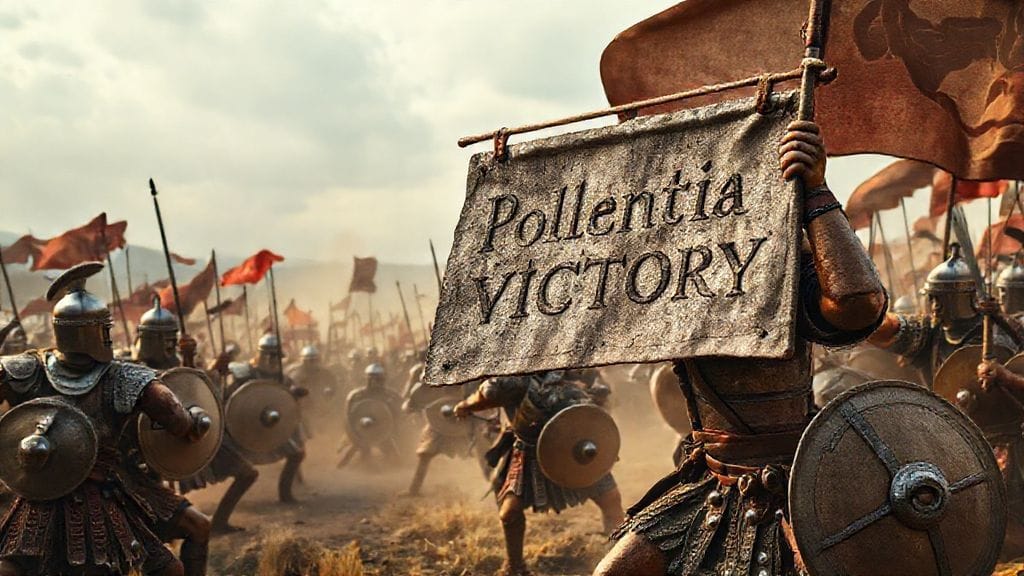
On 29 May 1176, near the small town of Legnano in Lombardy, the armies of the Holy Roman Empire met the combined forces of the Lombard League. The emperor had chosen, or perhaps been compelled, to force a decisive battle. He believed that crushing the League in open combat would restore his authority and break the back of urban resistance. Instead, the day would pass into legend as a triumph of citizen militias over imperial knights.
The Lombard League had prepared carefully. Each city sent contingents of infantry and cavalry, but the heart of their army was a symbolic and tactical center: the Carroccio, a great ceremonial wagon carrying a city’s banner and altar. At Legnano, Milan’s Carroccio became the rallying point. Chroniclers describe how urban infantry—artisans, merchants, younger sons of noble families—stood stubbornly around it, forming a human fortress. When imperial cavalry charged, expecting the usual rout of foot soldiers, they found instead a wall of shields and spears that broke their momentum.
As the battle dragged on, confusion spread in the imperial ranks. In the melee, it was even rumored that Barbarossa himself had fallen. Although he survived, the psychological blow was severe. The emperor who had razed Milan now saw his army repulsed by that same city’s citizen-soldiers, fighting under the League’s banner. The defeat at Legnano did not annihilate the imperial army, but it shattered the illusion of invincibility that had surrounded Frederick’s Italian campaigns.
After Legnano, the logic of the Italian war changed. Barbarossa could no longer hope for a quick, crushing victory that would compel unconditional submission. At the same time, the Lombard League, for all its triumph, was not strong enough to expel the empire entirely from Italy. Both sides were bleeding resources. The pope, Alexander III, whose own struggle with Frederick had taken him into exile and back, saw an opening for mediation.
Over the next six years, diplomacy, rather than battle, increasingly shaped events. In 1177, the Treaty of Venice brought a temporary peace between Frederick and Alexander III. The emperor recognized the pope; the pope, in turn, lifted excommunications and acknowledged Frederick’s imperial title. But the question of the communes remained unsettled. The papal-imperial peace made it easier to address the Italian issue in isolation. Yet it also removed one of the League’s strongest rhetorical justifications—defense of the “true pope” against an imperial antipope.
It is in this context—post-Legnano, post-Venice—that the earliest serious talks about what would become the treaty of constance began. Fear, fatigue, and pragmatism were converging. Barbarossa needed a stable Italy to focus on other concerns, including relations with German princes and the rising call for crusade. The communes wanted their freedoms recognized, not just in practice but in law. The path to Constance was opening, paved by defeat but guided by a new kind of calculation.
The Road to the Lake: Envoys, Intrigues, and the Choice of Constance
Negotiations rarely leave the same dramatic imprint on historical memory as battles, but the years between Legnano and 1183 were filled with quiet drama. Envoys rode back and forth across the Alps. Imperial legates appeared in city squares and communal palaces, offering terms, seeking to test the League’s unity. City representatives traveled to imperial diets, speaking in careful Latin on behalf of bustling Italian streets. Not all these journeys were peaceful; some envoys were detained, others intimidated. Yet, slowly, trust—perhaps too strong a word—gave way to a kind of mutual recognition.
Why Constance? The city, situated on the shore of Lake Constance (Bodensee), was a long-standing imperial center in the German lands, but not one steeped in the immediate rivalries of northern Italy. It was a borderland of sorts: close enough for Italian communes to reach, yet firmly within imperial territory. Holding the peace conference there was a subtle statement. The emperor would not come as a supplicant begging for forgiveness in Italian cities that had resisted him; the Italian envoys would cross into his realm to negotiate.
Preparations for what would become the treaty of constance involved endless wrangling over protocol. Who would enter the hall first? Whose banners would be displayed, and where? Which titles would be used in addressing the emperor and the communal representatives? While such details may seem trivial to a modern reader, they carried profound symbolic weight in the twelfth century. To recognize a commune’s chosen officers, to allow its flag to stand beside imperial insignia, was already to acknowledge its political identity.
Behind these public rituals, the real bargaining unfolded. The Lombard League insisted on recognition of their rights to elect consuls, administer justice, and control local taxation. Barbarossa, determined not to appear weak, insisted on the preservation of imperial overlordship, on formal oaths of fidelity, and on financial compensation for the losses and offenses of past decades. According to one narrative preserved in later legal commentaries, imperial jurists worked intensely to frame clauses that would seem to grant much while, on parchment at least, maintaining the theoretical supremacy of the emperor.
By early 1183, the outlines of a settlement were emerging. The communes would acknowledge the emperor’s formal sovereignty and pay certain sums; in exchange, their communal institutions would be recognized, their jurisdiction in many matters confirmed. It was, in essence, a compromise between empire and city, between hierarchy and autonomy. The question was whether both sides would be willing—and able—to live with the ambiguities it contained.
June 25, 1183: Inside the Hall Where the Treaty of Constance Was Signed
On the day itself, Constance must have been a spectacle. Imagine the processions: German nobles in heavy cloaks, their shields and helmets carried by squires; Italian envoys, some in rich city robes, others armored and accompanied by retinues, their accents and gestures marking them as outsiders in a German town. Clerics moved among them, robes swishing, parchment rolls and ink-horns hanging from their belts. Outside, townspeople craned their necks, children squeezed between adults to glimpse the spectacle of an emperor and foreign lords gathering in their city.
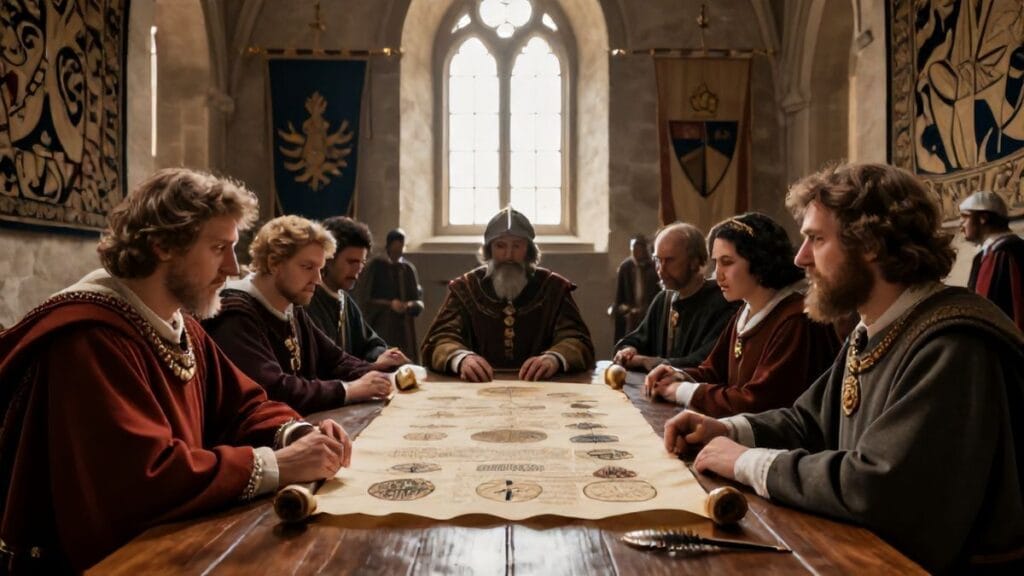
Inside the hall chosen for the ceremony, an order had been carefully choreographed. At one end, under a canopy, the emperor sat on a raised seat, flanked by princes and bishops. Facing him, on lower benches, were the representatives of the Lombard League: consuls from Milan, Brescia, Cremona, Bergamo, Mantua, and others; envoys from cities whose names tumble down the centuries like a litany of independence. The atmosphere was tense but not hostile. These men had fought each other, directly or indirectly, for more than twenty years. Now they were attempting something genuinely new.
The terms of the treaty of constance were read aloud, likely in Latin, perhaps with explanations offered in the vernacular afterward. The language was formal and legalistic. Phrases invoking “the honor of the empire” alternated with clauses recognizing “the customs and liberties” of the cities. Churchmen present would later praise the agreement as a victory for peace, some framing it as a miracle of God’s grace working upon hardened hearts. More skeptical observers might have seen, instead, the simple exhaustion of men who had finally realized that neither side could afford endless war.
Witness lists in medieval treaties are often overlooked by casual readers, but they are small windows into the moment. Bishops of Constance and neighboring dioceses, German princes, Italian communal leaders all affixed their names or marks. Seals were attached: the double-headed eagle of the empire, the emblems of cities—a cross here, a serpent there, a tower elsewhere. Each seal was both a promise and a threat. Breaking the treaty would not simply anger an abstract “other party”; it would dishonor these specific individuals and communities.
As the ceremony concluded, the hall buzzed with low conversations. Some delegates no doubt congratulated themselves on a hard bargain struck; others worried that they had conceded too much. But in that fleeting afternoon, with the summer light streaming through high windows and reflecting off wax and metal, a new arrangement between empire and cities took a definitive, written form. The treaty of constance was born not in triumph or abasement, but in a fragile equilibrium.
The Articles of Peace: What the Treaty of Constance Actually Said
The emotional drama of Constance can only be fully appreciated when one looks closely at the substance of the agreement. What did the treaty actually stipulate? Medieval treaties are intricate documents, and the treaty of constance was no exception. Its clauses sought to weave together imperial theory and urban reality, using the precise vocabulary of twelfth-century law.
First, the cities of the Lombard League formally recognized the overlordship of the emperor. They acknowledged Frederick and his successors as their legitimate lords and promised fidelity. This was not mere flattery; it restored an important piece of imperial honor that had been shattered in the wars. The communes agreed to pay a lump sum—essentially an indemnity—to compensate the emperor for damages and to underline their continued place within the empire’s legal framework.
But the concessions they received in return were significant. The treaty confirmed that the Italian communes could continue to elect their own consuls and other magistrates. Local governments, in other words, were not to be replaced wholesale by imperial appointees. In many judicial matters—especially civil disputes and local criminal cases—the cities retained jurisdiction. Imperial officials would not, in principle, interfere in the everyday legal life of the communes, so long as the emperor’s overarching rights were acknowledged.
Economically, too, the treaty recognized communal prerogatives. Cities could continue to regulate markets, tolls, and roads within their territories, subject to some broader imperial frameworks. They were permitted to maintain and expand their walls, an explicit admission that they might need to defend themselves—though now presumably not against the emperor. The countryside surrounding many cities, over which they had asserted dominance, was recognized as part of their sphere of control, though ultimate sovereignty remained with the empire.
Importantly, the treaty of constance also addressed the League itself. While it did not wholly forbid urban alliances, it constrained the capacity of cities to form pacts that were explicitly hostile to the emperor. On paper, this dismantled the Lombard League as a wartime coalition. In practice, the bonds forged over years of common struggle did not vanish overnight, but they were now subject to imperial scrutiny.
The text’s language navigated a careful line. Imperial rights were reaffirmed in broad, almost majestic terms, invoking antiquity and divine order. Communal rights were spelled out in more concrete, day-to-day terms—jurisdiction, offices, finances. As one modern historian has noted, the treaty managed to be “both a capitulation and a victory, depending on which clauses one chooses to emphasize.” That duality would define its legacy.
Emperor and Cities Reimagined: Shared Power in the Holy Roman Empire
At first glance, the treaty of constance might appear to be a local Italian settlement, a compromise between an emperor and a cluster of rebellious cities. But its implications were far broader. By conceding that communes could exercise extensive self-government while still remaining under the empire’s umbrella, Barbarossa and his advisors were acknowledging a new political reality: power in the Holy Roman Empire would henceforth be shared, negotiated, and compartmentalized in unprecedented ways.
For centuries, emperors had claimed, at least rhetorically, a kind of universal authority, borrowing from Roman and Carolingian ideals. While everyone understood that practical power was limited, it was rare to see that limitation formally admitted in writing. The treaty of constance did just that. It stabilized relations in northern Italy by accepting that cities were no longer mere administrative units but political actors with their own legal identities.
This shift had subtle but far-reaching effects. When German princes looked southward and saw Italian communes winning recognition of their liberties, they could not help but draw comparisons with their own struggles against central authority. Conversely, Italian cities, basking in their newly confirmed rights, might view imperial demands with slightly less fear and slightly more calculation. The empire was still the empire; Barbarossa was still an immensely powerful ruler. But he was no longer an unquestioned overlord.
In the longer term, the treaty of constance contributed to what some historians call the “pluralization” of the empire. It was part of a broader trend—alongside the rise of territorial principalities, episcopal lordships, and other corporate bodies—that transformed the empire from an imagined unitary monarchy into a constellation of semi-autonomous powers bound together by legal ties and mutual interests. The Holy Roman Empire would remain, as Voltaire later quipped, neither holy, nor Roman, nor quite an empire in the classical sense. But in the twelfth century, such complexity was not yet a joke; it was a delicate achievement.
And yet behind the legalistic satisfaction lay quieter human stories. Officials trained in Roman law now had to interpret and apply the treaty’s clauses. City scribes added copies of the treaty to their archives, referencing it in disputes with neighboring lords. Imperial envoys traveling through Italy adjusted their expectations; where once they might have demanded obedience, they now argued about interpretations. The treaty of constance, like all political agreements, lived or died through the men and women who invoked it in the years that followed.
Winners, Losers, and the Price of Compromise
So who truly “won” at Constance? Some chroniclers sympathetic to Barbarossa framed the treaty as a magnanimous act by a victorious emperor who, secure in his power, chose to grant generous liberties to his Italian subjects. Others, especially in Italy, treated it as the moment when communal courage finally broke imperial tyranny. As often happens, the reality lies somewhere in between.
Barbarossa did not emerge from the treaty of constance as the invincible conqueror he had once aspired to be. He had failed to bring northern Italy under tight imperial administration. The dream of fully subordinating the communes, of turning their consuls into obedient imperial officers, was gone. Legnano had seen to that. He had also, implicitly, accepted that his authority had limits that could be spelled out in legal terms.
Yet he preserved what was, for him, essential. He retained the imperial title, the theoretical overlordship, and the right to receive oaths and payments from the cities. The communes did not secede from the empire or become completely independent republics. The empire’s honor, so crucial in medieval political culture, was visibly restored. Frederick had not been driven from Italy in chains; he had negotiated a settlement on his own soil, in an imperial city, on terms that emphasized his dignity.
The communes, on their side, paid a heavy price in treasure but preserved their most cherished asset: their internal self-government. Their councils, assemblies, and consular colleges survived. Their citizens continued to decide on wars, taxes, and alliances. The walls they had built in fear of imperial siege now stood as permanent monuments to their tenacity. For urban elites—merchant families, local nobles, leading guilds—the treaty meant that their political experiments could continue with imperial recognition, not in defiance of it.
Of course, not everyone gained. Former imperial partisans in Italy who had bet heavily on Barbarossa’s unrestrained victory found themselves sidelined. Some bishops who had hoped for stronger imperial backing against assertive communes now faced municipally dominated church politics. Within cities, some factions complained that the treaty conceded too much money or too many symbolic honors to the emperor. Compromise is rarely celebrated by purists.
The price of peace was paid in coin and pride. Yet for a generation that had grown up under the shadow of war—children who had seen their homes burned, merchants whose caravans had been ambushed, peasants whose fields had been trampled—the cost must have seemed worth it. The treaty of constance did not inaugurate an age of perfect harmony, but it created a framework within which conflicts could, at least sometimes, be managed without resorting to total war.
Merchants, Craftsmen, and Pilgrims: Everyday Lives after Constance
Treaties are often written from above, but their consequences unfold below, in crowded markets and narrow streets. After 1183, northern Italy slowly shifted from the rhythms of siege and campaign back to those of commerce and craft. Caravans that had once diverted around conflict zones now resumed more direct routes. Merchants from Milan or Cremona could travel with a little more confidence, their wagons laden with cloth, grain, salt, wine, and luxury goods from as far as the Levant.
For artisans, the return of relative peace meant steadier work. Smiths once pressed into weapon-making could turn again to tools and domestic goods. Builders and stonemasons found employment not only in repairing war damage but in ambitious new communal projects: town halls, churches, towers—a physical assertion of civic pride. Markets swelled. Fair days, often tied to religious festivals, regained their full vibrancy, drawing villagers and townspeople into spaces of negotiation and exchange.
One can imagine a cloth merchant from Milan, who as a young man had marched behind the Carroccio at Legnano, now standing in a Constance marketplace inspecting northern dyes, or negotiating in a German inn using a mix of Italian, German, and Latin phrases. The treaty of constance had allowed such encounters to become more frequent, embedding political compromise into the fabric of daily life.
Pilgrims and clerics, too, benefited. With major military campaigns paused, the roads became slightly safer. Devout travelers journeyed to Rome, to German shrines, even to the Holy Land, sometimes passing through cities whose names had once been synonymous with war. In monasteries and cathedral schools, scholars debated the implications of the treaty. Canon lawyers in Bologna, the burgeoning center of legal studies, analyzed its clauses, using it as a case study in the evolving relationship between secular and communal authorities. One early commentator even cited the treaty as an example of how positive law could mediate between princes and peoples, a strikingly modern-sounding observation for the late twelfth century.
Yet behind the surface calm lay new tensions. Greater prosperity sharpened social distinctions. Wealthy merchant families, enriched by trade, consolidated their grip on communal offices. Lesser artisans and laborers sometimes felt excluded from decisions. The very liberties that the treaty of constance confirmed could become tools for oligarchic domination within the cities. Freedom from the emperor did not always translate into freedom within the commune. But that, too, is part of the treaty’s legacy: by stabilizing the external framework, it allowed the internal politics of cities to develop in all their complexity.
The Papacy Watches: Rome’s Quiet Victory and New Anxieties
Throughout this entire drama, the papacy hovered in the background, sometimes as an open antagonist of Barbarossa, sometimes as an arbiter, always as a concerned observer. Pope Alexander III had suffered exile, intrigue, and war during his conflict with Frederick. The papal victory in the Treaty of Venice in 1177, where Barbarossa recognized Alexander as the legitimate pope, marked a major triumph. The settlement at Constance, though primarily an imperial-communal affair, continued this trend.
From Rome’s perspective, the weakening of direct imperial control in northern Italy was welcome. Strong, independent-minded communes could serve as a buffer between the papal states and the empire. They could also, when aligned with papal interests, counterbalance the influence of pro-imperial bishops and nobles. The papacy had long championed, at least rhetorically, the idea that emperors could not treat the church—or Christendom at large—as their private dominion. In this sense, the treaty of constance contributed to a broader papal vision of a plural Christian society with multiple centers of authority.
Yet papal satisfaction was tinged with anxiety. The same urban liberties that constrained imperial power could also challenge ecclesiastical privileges. Communes sometimes clashed with bishops over jurisdiction, tithes, and ecclesiastical courts. In some cities, cathedral chapters found themselves overshadowed by communal councils. The growth of lay participation in governance—so clearly upheld by the treaty—could foster a spirit of independence that did not always stop at the church door.
Moreover, as the twelfth century closed and the thirteenth opened, new conflicts emerged. The heirs of Barbarossa, particularly Emperor Frederick II, would revive imperial-papal antagonism with renewed vigor. Italian cities, armed with the legal and institutional tools that the treaty of constance had confirmed, would play a central role in those struggles, sometimes siding with popes, sometimes with emperors, often with themselves alone. The papacy, in supporting communal liberties against the empire, had helped create actors it could not fully control.
Still, looking back from the vantage point of Rome, the settlement of 1183 must have seemed a validation of long-term strategy. The empire had been forced to recognize limits; the pope had not. As one later papal chronicler remarked, with not a little satisfaction, “the haughty neck of Caesar was bowed, and the cities of Italy breathed more freely.” The line may exaggerate—but like most exaggerations, it contains an essential truth.
Barbarossa’s Legacy: From Constance to the Crusades
For Frederick Barbarossa personally, the treaty of constance was not the final chapter. After settling the Italian question, he turned his attention outward, toward the great religious and political project of his age: the crusades. In 1187, news reached Europe that Jerusalem had fallen to Saladin. Shock reverberated through courts and churches. Pope Gregory VIII called for a new crusade, and Barbarossa, now an older man but still vigorous, took the cross.
It is no accident that he could do so with some confidence only after the Italian situation had been stabilized by the treaty of constance. An emperor embroiled in a grinding urban war could not easily lead a massive expedition to the eastern Mediterranean. Constance gave Frederick the breathing room to present himself not as a regional warlord but as a Christian monarch ready to defend the Holy Land. German princes, less anxious about being dragged repeatedly into Italian campaigns, were more willing to accompany him east.
In 1189, Barbarossa set out on what would be his final journey. He marched across Hungary, through Byzantine lands, and into Asia Minor, commanding one of the most formidable crusading armies of his time. Then, in June 1190, near the Saleph River (modern Göksu in Turkey), tragedy struck. The emperor drowned—accounts vary whether in the river itself or a nearby tributary—perhaps attempting to ford the stream in armor, perhaps after being thrown from his horse. His death sent shockwaves through the crusading host, many of whom turned back.
The emperor who had signed the treaty of constance, who had once razed Milan and then recognized its liberties, who had balanced between papacy and princes, now lay far from the Alps and the Po valley. His body, some sources say, was boiled so that his bones could be carried onward to the Holy Land, but even those plans were disrupted. In a sense, his end was as fragmented as his empire: a grand design broken by the unpredictable forces of circumstance.
Yet Barbarossa’s posthumous reputation in German lands grew into legend. Songs and later tales portrayed him as a sleeping emperor in the Kyffhäuser mountain, his beard growing through a stone table, waiting to return when his people needed him. In Italy, memories were more ambivalent: he was both the destroyer of cities and the reluctant guarantor of their freedoms. The treaty of constance became part of that complex legacy, a reminder that even the strongest rulers are eventually compelled to compromise with the realities they cannot extinguish.
Italian Communes After 1183: Freedom, Conflict, and Fragile Unity
The signing of the treaty of constance did not freeze the political map of northern Italy. On the contrary, the decades that followed were as dynamic—and at times as violent—as those that had preceded it. But the framework had changed. With their communal institutions legally recognized, Italian cities embarked on a new phase of experimentation in self-rule.
Internally, many communes shifted from consular governments dominated by local noble families to systems led by a podestà, an often foreign-appointed chief magistrate who theoretically stood above local factions. This change was connected, indirectly, to the treaty: by confirming communal autonomy while also demanding a degree of order, the agreement incentivized cities to seek new ways of controlling internal feuds. Hiring an outsider as podestà—someone who owed his position to the city as a whole, not to a single party—was seen as a possible solution.
Externally, rivalries flared. Milan and Cremona still eyed each other warily; Pisa and Genoa battled for maritime supremacy; Venice looked both inland and eastward. The imperial-communal equilibrium did not prevent cities from warring among themselves. Indeed, some of the energy once directed against Barbarossa was now channeled into inter-urban conflict. Alliances formed and dissolved; the very skills that had been honed in the Lombard League—negotiation, military coordination, propaganda—were redeployed in new contests.
Yet there was also a slow, transformative undercurrent. Communal governance deepened. Statutes were drafted, copied, and revised, sometimes explicitly referencing the rights confirmed by the treaty of constance. Urban identities crystallized; people spoke not only as Christians or imperial subjects, but as Bolognese, Milanese, Pisans, Venetians, with a civic pride tied to institutions, not just walls or patron saints.
Scholars have often pointed to this period as one of the crucibles of European urban republicanism. While the term “republic” would only later be fully applied, the idea that a city’s affairs could be managed by elected magistrates, assemblies, and rotating offices—in a framework recognized by higher powers—was gaining firm ground. The treaty had not created this trend, but it had endorsed and stabilized it in crucial ways.
Of course, nothing in medieval Italy remained stable for long. By the early thirteenth century, new alignments known as the Guelphs (papal supporters) and Ghibellines (imperial supporters) would split cities and families, and emperors like Frederick II would attempt again to assert control. Yet even in those later storms, the memory and legal precedent of the treaty of constance remained a reference point—a reminder that cities had once successfully forced an emperor to negotiate and codify their freedoms.
Echoes Across Centuries: Why the Treaty of Constance Still Matters
Looking back from the twenty-first century, it may be tempting to consign the treaty of constance to the dusty shelves of medieval diplomatic history, a niche subject for specialists. But the questions it grappled with are uncannily familiar. How can powerful central authorities coexist with strong, self-governing local communities? How can shared sovereignty be organized without collapsing into chaos? What happens when theoretical hierarchies collide with practical autonomy?
At Constance in 1183, the answers were tentative and incomplete, but they were nonetheless significant. The treaty represented one of the earliest large-scale, formal recognitions in medieval Europe that cities—corporate bodies of citizens—could possess rights and jurisdictions not merely by custom but by law. It acknowledged that political legitimacy did not flow in only one direction, from emperor downward, but could also rise from communities upward.
Some historians have even drawn parallels between the treaty and later constitutional developments. While it would be anachronistic to call it a constitution, the treaty of constance did establish a framework of shared governance and mutual obligations that transcended personal rule. As the legal historian Brian Tierney noted in another context, the twelfth century saw “the slow, fitful emergence of ideas of corporate right and limited authority,” and Constance is part of that story.
The treaty also challenges simplistic narratives about medieval despotism and modern liberty. Here we have a twelfth-century emperor, forged in war, accepting on parchment what he had denied on the battlefield: that his power had boundaries. And here we have medieval cities, often portrayed as chaotic and violent, engaging in sophisticated diplomacy and legal argument to secure their place in a wider political order. The world that produced the treaty of constance was not a dark age stumbling blindly toward modernity. It was a complex, self-aware society negotiating its own forms of order.
Finally, the treaty invites reflection on the nature of “victory.” No side at Constance achieved everything it wanted. The emperor’s prestige was salvaged but constrained; the communes’ autonomy was confirmed but not absolute. Yet in the space between total triumph and total defeat, a durable peace was crafted, one that allowed Italy and the empire to redirect their energies for a generation. In an era like ours, when conflicts often appear irreconcilable, the willingness to accept such imperfect settlements may be one of the most relevant lessons Constance can offer.
Conclusion
On that June day in 1183, as the last seals were affixed and the hall at Constance slowly emptied, few of the participants can have fully grasped what they had set in motion. For them, the treaty of constance was an end to a long and exhausting struggle, a pragmatic arrangement struck between wearied enemies. Yet from the vantage point of history, it stands as a milestone in the evolving relationship between power and community, between empire and city.
We have traced the path to Constance from Barbarossa’s early ambitions through the devastation of Milan, the rising courage of the Lombard League, the shock of Legnano, and the patient diplomacy that followed. We have seen how the treaty’s clauses balanced imperial honor with communal liberties, and how that balance reverberated through the lives of merchants, craftsmen, clerics, and princes. We have followed its echoes into the papal court, the crusading movement, and the internal politics of Italian communes.
In many ways, the story of the treaty of constance is the story of medieval Europe’s gradual move away from monolithic visions of power toward a more layered, negotiated order. Cities, once viewed as rebellious pockets to be tamed, emerged as acknowledged partners. The empire, once imagined as a single, indivisible authority, became more openly a patchwork of autonomous entities held together by law, ritual, and common interest. The peace at Constance did not end conflict, but it changed the rules by which future conflicts would be fought and resolved.
Perhaps the most enduring image is not of Barbarossa’s throne or the cities’ banners, but of the parchment itself: ink lines carefully penned, words chosen and debated, a text meant to bind the future. In those austere Latin phrases lies a quiet, stubborn faith in the power of negotiation over annihilation. More than eight centuries later, that faith remains as fragile—and as necessary—as ever.
FAQs
- What was the Treaty of Constance in 1183?
The treaty of constance was a peace agreement signed on 25 June 1183 in the imperial city of Constance between Holy Roman Emperor Frederick I Barbarossa and the cities of the Lombard League in northern Italy. It ended decades of conflict by recognizing the emperor’s overlordship while confirming extensive self-government rights for the Italian communes, especially in matters of local justice, administration, and taxation. - Why did Frederick Barbarossa agree to the Treaty of Constance?
Barbarossa agreed to the treaty of constance largely because his attempts to subdue northern Italy by force had failed, most notably at the Battle of Legnano in 1176. Prolonged war was draining imperial resources and alienating German princes. By 1183, he needed a stable settlement in Italy to preserve his honor, secure revenue, and free himself to address other priorities, including crusading and internal imperial politics. - What did the Italian cities gain from the treaty?
The Italian communes gained formal legal recognition of their autonomy. The treaty confirmed their right to elect their own magistrates, administer local justice, regulate economic life, and maintain their defenses. Although they remained under imperial sovereignty and had to pay indemnities and swear fidelity, they preserved the essential structures of communal self-rule that had emerged over previous decades. - How did the Treaty of Constance affect the Holy Roman Empire as a whole?
The treaty of constance contributed to a broader shift in the empire toward a plural, negotiated political order. By acknowledging the rights of cities in writing, it set a precedent for recognizing corporate bodies—communes, principalities, and ecclesiastical territories—as semi-autonomous actors within the imperial framework. This helped shape the Holy Roman Empire into a constellation of powers bound together by law and custom rather than a tightly centralized state. - Did the treaty end all conflicts in northern Italy?
No. While the treaty of constance ended the specific war between Barbarossa and the Lombard League and reduced the risk of large-scale imperial invasions for a time, it did not eliminate inter-city rivalries or internal communal strife. Italian cities continued to fight each other, and later conflicts between popes and emperors—especially under Frederick II—would again draw them into broader struggles. - How is the Treaty of Constance viewed by modern historians?
Modern historians generally view the treaty of constance as a key moment in the development of medieval urban autonomy and constitutional thinking. It is often cited as an example of how legal agreements could balance central authority and local liberties. While opinions vary on whether the emperor or the communes gained more, most scholars agree that the treaty marked a turning point in the relationship between empire and city in Europe.
External Resource
Internal Link
Other Resources
- Encyclopaedia Britannica – general search for the exact subject
- Google Scholar – academic search for the exact subject
- Internet Archive – digital library search for the exact subject