Table of Contents
- The Treaty of Corbeil: A Defining Moment in Medieval Diplomacy
- The Crossroads of Power: Europe in the Mid-13th Century
- Seeds of Discord: Historical Rivalries Between Aragon and France
- The Kingdom of Aragon: Ambitions and Alliances
- The French Crown: Centralization and Expansion
- Tensions on the Frontier: Conflicts and Negotiations Before 1258
- The Players Behind the Treaty: James I of Aragon and Louis IX of France
- Corbeil, 1258: A Gathering Charged with Political Weight
- The Negotiation Table: Stakes, Strategy, and Statesmanship
- The Articles of Peace: Defining Borders and Sovereignties
- The Abandonment of Claims: Aragon and France Reshape Their Futures
- Reactions Across the Kingdoms: Nobles, Clergy, and Commoners
- The Impact on Catalonia and Occitania
- The Role of the Papacy and European Powers
- Economic and Cultural Consequences Along the Border
- The Treaty’s Influence on Future Franco-Aragonese Relations
- Border Peace and Its Limits: Skirmishes and Alliances Post-Treaty
- Legal Legacy: Territorial Sovereignty in the Middle Ages
- The Treaty in Retrospect: Historians’ Views Through the Centuries
- Lessons from Corbeil: Diplomacy Amidst Rival Kingdoms
The Treaty of Corbeil: A Defining Moment in Medieval Diplomacy
Spring was blooming across the French countryside on May 11, 1258, when two rival monarchs met in the quiet town of Corbeil to sign an accord that would quietly redraw the political map of southwestern Europe. The air was filled with the fragrance of freshly opened flowers and the murmurs of bustling courtiers — yet beneath this calm, momentous decisions were about to reshape centuries of territorial ambitions and conflicts. Far from the dramatic clash of sword and shield, diplomacy flared here, crafting a new order on the borderlands between the Kingdom of France and the Kingdom of Aragon. The Treaty of Corbeil, often overshadowed by larger medieval conflicts, was more than a peace agreement: it was a deliberate act of boundary-setting and mutual recognition whose echoes would resound through European politics for generations.
The Crossroads of Power: Europe in the Mid-13th Century
The mid-1200s were a pivotal period in European history: monarchies were consolidating power, feudal loyalties were shifting, and the medieval world was beginning to feel the stirrings of modern statecraft. France had emerged from the chaos of the Capetian restoration with a steady and ambitious king, Louis IX — later canonized as Saint Louis — who dreamed of a just and orderly realm under strong royal governance. Southward, the Crown of Aragon under James I ("the Conqueror") was extending its influence across the Iberian Peninsula and Mediterranean islands, mixing crusader zeal with savvy political expansion.
Europe was a patchwork of overlapping claims, fragmented sovereignties, and contested borderlands. Territories not only belonged to kings but also to local lords, church authorities, and even communes. In this volatile jigsaw puzzle, the border between France and Aragon became a critical flashpoint.
Seeds of Discord: Historical Rivalries Between Aragon and France
Tensions between France and Aragon did not spring up overnight. The dynasties had long tangled over the border regions of Occitania and Catalonia, lands rich in culture, commerce, and strategic value. For centuries, Occitan-speaking lords aligned variably with French or Aragonese interests—sometimes hostile, sometimes allied—depending on broader political winds.
The Albigensian Crusade early in the century had complicated matters, severely weakening Occitan nobility but drawing Aragonese attention southward. Although their ambitions often overlapped, France and Aragon had never fully reconciled the question of sovereignty in these regions. By the 1250s, it was clear that a formal agreement was necessary to avoid open conflict and to stabilize the frontier.
The Kingdom of Aragon: Ambitions and Alliances
James I of Aragon was no ordinary monarch. Known as "the Conqueror," he had extended Aragonese rule over Mallorca and Valencia with visionary zeal. Yet his realm remained vulnerable: a mosaic of diverse peoples, languages, and feudal loyalties that required delicate balancing.
The king understood that his ambitions to consolidate and expand his domain had limits, especially facing a centralized power like France. The western frontier was a tapestry of valleys, towns, and fortresses that could be a gateway or a battleground. Forging peace with France was not merely a choice—it was a strategic imperative to focus Aragon’s energy on the Reconquista and Mediterranean enterprises.
The French Crown: Centralization and Expansion
Louis IX epitomized the ideal of a just and pious monarch, with a deeply held vision of order and Christian kingship. His efforts to strengthen royal authority often brought him into conflict with the great feudal lords, but also reinforced the very foundations of the French state.
The southern regions, however, presented unique challenges. The cultural distinctiveness of Occitania and their historical ties to Aragonese power complicated direct French control. Louis’s diplomacy aimed to clarify sovereignties, curb noble rebellions, and extend his influence without resorting to costly wars.
The Treaty of Corbeil, therefore, was part of a broader vision to create a lasting peace that would enable the French kingdom to develop internally and project power outward in a more cohesive manner.
Tensions on the Frontier: Conflicts and Negotiations Before 1258
The years leading up to the treaty were marked by skirmishes, shifting alliances, and ever-present suspicion. Border lords sometimes raided across boundaries; rebellions flared in towns caught between competing sovereignties; and the church’s dual allegiances added complexity.
Negotiations began tentatively, hindered by lingering mistrust. Yet both sides showed pragmatic awareness that continued conflict was futile. It was a diplomatic dance ultimately aimed at defining clear frontiers — physical and political — to reduce friction.
James and Louis recognized that a formal treaty was the tool to cement this understanding and avoid the costly wars that had plagued the region for decades.
The Players Behind the Treaty: James I of Aragon and Louis IX of France
Two kings, both devout and determined, took center stage. James I brought to the table his experience as a seasoned conqueror and administrator, tempered by the challenges of governing a multi-ethnic realm. He was keenly aware of the limits of military power and valued a diplomatic resolution.
Louis IX, a model of medieval chivalry and sanctity, was motivated by a desire for justice and peace in his realm. His personal piety would later lead him on crusades to the Holy Land, but in 1258, his priority was stabilizing France’s southern borders.
Their mutual respect, though sometimes uneasy, laid the foundation for a treaty that reflected their shared commitment to orderly governance.
Corbeil, 1258: A Gathering Charged with Political Weight
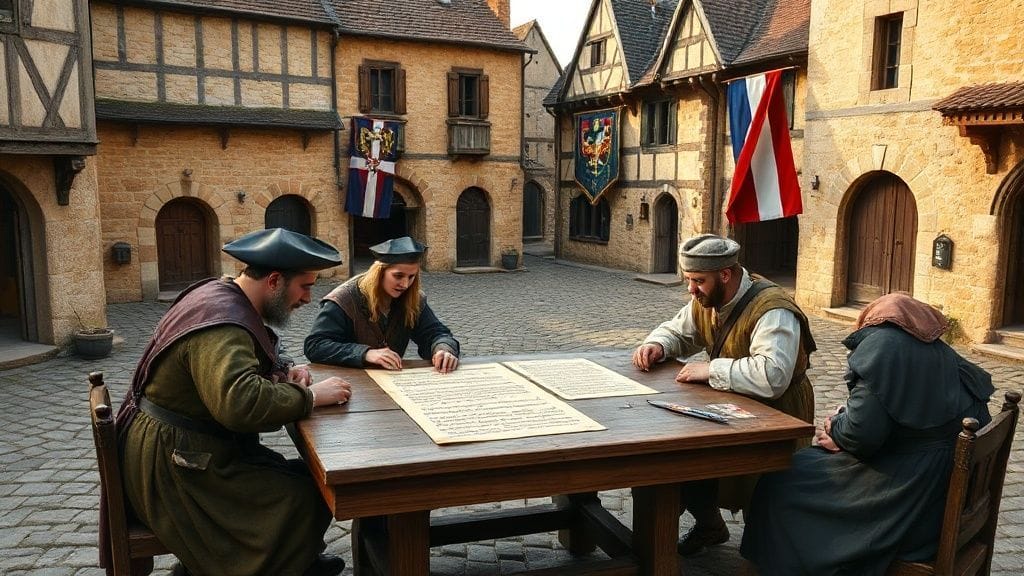
Corbeil, a town nestled on the Seine’s banks, was chosen as neutral ground. The atmosphere was formal yet expectant. Courtiers, envoys, clerics, and scribes gathered, each aware that history watched.
The meeting rooms, adorned with tapestries and guarded by armed retinues, resonated with whispered negotiations and the rustle of parchment. Behind the scenes, advisors debated wording; outside, rumors stirred among local inhabitants about the outcome.
This was a moment when words wielded as much power as swords, and diplomacy could redefine kingdoms.
The Negotiation Table: Stakes, Strategy, and Statesmanship
Negotiations unfolded over weeks, with tensions high and patience tested. The main issue: territorial claims and the legitimacy of sovereignty in contested areas, especially along the Pyrenean foothills and Occitan territories.
Both kings had to carefully balance domestic pressures with international considerations. James conceded certain claims in Languedoc, while Louis relinquished interest in Catalan lands north of the Pyrenees.
Behind these compromises were intricate calculations: preserving honor, securing peace, and positioning for future advantages.
The treaty was not merely a legal document but a symbol of mature statecraft in a complex medieval world.
The Articles of Peace: Defining Borders and Sovereignties
The text of the Treaty of Corbeil formalized a mutual renunciation of claims: France gave up rights to territories in Catalonia, while Aragon relinquished claims over regions in Languedoc and Provence.
Borders were drawn with precise care — rivers, mountain ridges, and castles delineated the limits of each kingdom. This clarity was vital: it would reduce disputes, provide a foundation for administration, and stimulate commerce by reducing uncertainty.
The treaty also addressed issues of vassalage, feudal obligations, and ecclesiastical dependencies, weaving a complex web of legal and political agreements that made the accord both comprehensive and delicate.
The Abandonment of Claims: Aragon and France Reshape Their Futures
For many medieval rulers, renouncing claims was unthinkable, equated with weakness. But here, both kings saw pragmatic wisdom.
For Aragon, focusing on Iberian conquests and controlling Mallorca and Valencia without French interference was crucial. For France, clarifying its borders enabled stronger integration of its southern territories.
This mutual concession was innovative for its time: a recognition that peace and stability sometimes demanded sacrifice and trust.
Reactions Across the Kingdoms: Nobles, Clergy, and Commoners
News of the treaty sparked a mixture of relief, skepticism, and quiet celebration. Nobles who had benefited from border ambiguities feared loss of influence, while merchants welcomed the prospects of safer trade routes.
Clerics hailed the accord as a Christian demonstration of peace-making — a rarity in a century often marked by brutal warfare. Yet among the common folk, daily life carried on, sometimes oblivious to grand politics, but the peace mattered deeply.
For border communities, the treaty promised stability after decades of uncertainty—a chance for prosperity and security.
The Impact on Catalonia and Occitania
For these culturally rich regions, the treaty was transformative. Catalonia consolidated under Aragonese sovereignty, fostering political coherence and cultural blossoming.
Occitania, deeply affected by the Albigensian Crusade, saw a gradual integration into the French realm, but retained a distinct identity that would influence regional politics for centuries.
The treaty delineated spheres of influence that shaped languages, laws, and loyalties, crafting the cultural map of southern Europe.
The Role of the Papacy and European Powers
Though primarily a bilateral agreement, the Treaty of Corbeil had reverberations beyond France and Aragon.
The papacy, ever vigilant about Christendom’s unity, welcomed the peaceful resolution. The Pope viewed such treaties as instruments to strengthen Christian monarchs against internal heresies and external threats.
Other European powers, including Castile and England, observed cautiously, calculating how the stabilized Franco-Aragonese border might shift power balances and alliances.
Economic and Cultural Consequences Along the Border
Stable borders encouraged trade routes across the Pyrenees; fairs and markets flourished. The free movement of goods and people strengthened economic ties and cultural exchanges.
Artists, troubadours, and scholars traveled more freely, blending Occitan and Catalan traditions. Architectural styles reflected cross-border influences, visible in churches and castles dotting the region.
Economic prosperity and cultural vitality often bloom in peace’s wake—and Corbeil ushered such an era.
The Treaty’s Influence on Future Franco-Aragonese Relations
The 1258 Treaty laid groundwork for decades of relative peace, even if occasional disputes followed.
It set a precedent that borders could be negotiated, not just wrenched by war. Later treaties and marriages would build on Corbeil, constructing a framework for coexistence that foreshadowed modern diplomacy.
This accord diminished open hostilities, fostering a competitive but constructive rivalry rather than violent confrontation.
Border Peace and Its Limits: Skirmishes and Alliances Post-Treaty
Though the treaty was honored officially, border disputes and local skirmishes did not vanish overnight. Feudal lords sometimes ignored royal decrees; banditry persisted.
Yet joint alliances against common enemies, such as Muslim kingdoms in the south or rebellious vassals, demonstrated the treaty’s role in channeling conflicts into coordinated efforts.
The peace was dynamic, fragile, but largely successful—a medieval balancing act.
Legal Legacy: Territorial Sovereignty in the Middle Ages
The Treaty of Corbeil is often studied as an early exemplar of territorial sovereignty — a recognition that duly demarcated borders and mutual renunciations could stabilize kingdoms.
It contributed to evolving medieval legal thought about states, vassalage, and the limits of royal power. These ideas would mature over centuries into the modern nation-state concept.
Corbeil represents a milestone in the architecture of international law, grounded in medieval realities.
The Treaty in Retrospect: Historians’ Views Through the Centuries
Historians have long debated the treaty’s significance. Some stress its pragmatic diplomacy amid stubborn medieval rivalries; others lament the loss of autonomy for border communities.
Modern scholarship appreciates Corbeil as a political triumph in an age before institutionalized diplomacy, revealing the complex interplay of war, negotiation, and statecraft.
Its legacy endures as a testament to the art of peace-making.
Lessons from Corbeil: Diplomacy Amidst Rival Kingdoms
The Treaty of Corbeil teaches us about the power of dialogue, the courage to compromise, and the necessity of clear agreements in a fractured world.
It reminds us that great historical changes often begin not with dramatic conquests but with thoughtful negotiation and mutual respect.
In a world perennially on the edge of conflict, the lessons of Corbeil remain strikingly relevant.
Conclusion
The quiet town of Corbeil witnessed a defining moment where two medieval kings, each wielding ambition and faith, chose peace over perpetual war. The Treaty of Corbeil was not merely a territorial agreement: it was a foundational act of political maturation that helped shape southern Europe’s future. Beyond borders and claims, the treaty embodied the human capacity to negotiate, to bind old wounds through law rather than sword, and to envision a more stable order amid division.
As we look back, this episode resonates far beyond its era, inviting us to appreciate the delicate craft of diplomacy as a force for enduring peace. It is a testament to the power of dialogue and the timeless aspiration for coexistence beneath the shifting shadows of power.
FAQs
Q1: What triggered the need for the Treaty of Corbeil in 1258?
A1: The ongoing territorial disputes, border skirmishes, and overlapping claims between the Kingdom of France and the Kingdom of Aragon necessitated a formal agreement to stabilize relations and prevent further conflict.
Q2: Who were the main signatories of the treaty?
A2: The treaty was signed by King Louis IX of France and King James I of Aragon, both powerful monarchs seeking to define borders and renounce competing claims.
Q3: How did the treaty affect the regions of Catalonia and Occitania?
A3: Catalonia was consolidated under Aragonese sovereignty, allowing for political cohesion, while Occitania came under French influence, though it retained a distinct cultural identity.
Q4: Did the Treaty of Corbeil eliminate all conflicts between France and Aragon?
A4: While it significantly reduced large-scale conflicts and formalized borders, smaller local disputes and skirmishes persisted, reflecting the complexities of medieval feudal societies.
Q5: What role did the church and the papacy play in the Treaty of Corbeil?
A5: The papacy endorsed the treaty as a Christian act of peace-making, supporting efforts to stabilize Christendom and reduce regional hostilities.
Q6: Why is the Treaty of Corbeil considered important for medieval diplomacy?
A6: It represents one of the early instances of clearly demarcated territorial sovereignty agreed upon diplomatically, marking progress toward modern notions of nation-states and international law.
Q7: How did the treaty influence future Franco-Aragonese relations?
A7: It laid a foundation for peaceful coexistence, established precedents for future negotiations, and helped both kingdoms focus on other political and military ambitions.
Q8: Can the Treaty of Corbeil be seen as a model for modern conflict resolution?
A8: In many ways, yes. It shows the value of dialogue, compromise, and legal frameworks in resolving territorial disputes—principles still relevant in contemporary diplomacy.

