Table of Contents
- The Smoke of Battle Clears: Dara at Dawn, 562
- The Empire of Empires: Byzantium and Persia’s Endless Rivalry
- The Geopolitical Chessboard of Mesopotamia
- Justinian’s Vision and the Weight of Eternal Conflict
- The War Ignites: From Skirmishes to Full-Scale Conflagration
- The Siege That Shattered: Dara Under Fire
- Persian Ambitions and Byzantine Defenses
- The Costs of War: Casualties, Devastation, and Exhaustion
- Into the Diplomatic Fray: The Road to Negotiations
- The Treaty of Dara: Terms and Conditions Unfold
- Emperor Justinian and King Khosrow: Leaders at a Crossroads
- The Strategic Concessions and Their Hidden Meanings
- Beyond Borders: The Treaty’s Impact on Mesopotamian Stability
- Cultural Exchanges Behind the Lines of Conflict
- Aftermath and Respite: A Fragile Peace Restored
- Legacy of the Treaty: Prelude to Future Clashes
- The Memory of Dara in Byzantine and Persian Chronicles
- The War in the Shadow of the Eternal City
- Reflections on Diplomacy: War’s Bitter Lesson
- Conclusion
The year was 562. The ancient city of Dara, nestled in Mesopotamia’s unforgiving plains, lay quiet, though its stones bore the scars of a siege that had tested the mettle of empires. Smoke hung in the air like a ghostly veil, and the dawn’s first light cast long shadows over battlements battered by relentless Persian assaults and Byzantine resistance. What few knew then was that this calm was but the fragile prelude to a historic accord — a treaty that would momentarily draw the curtains on decades of bruising warfare between two of the ancient world’s greatest powers: the Byzantine Empire and the Sasanian Persian Empire.
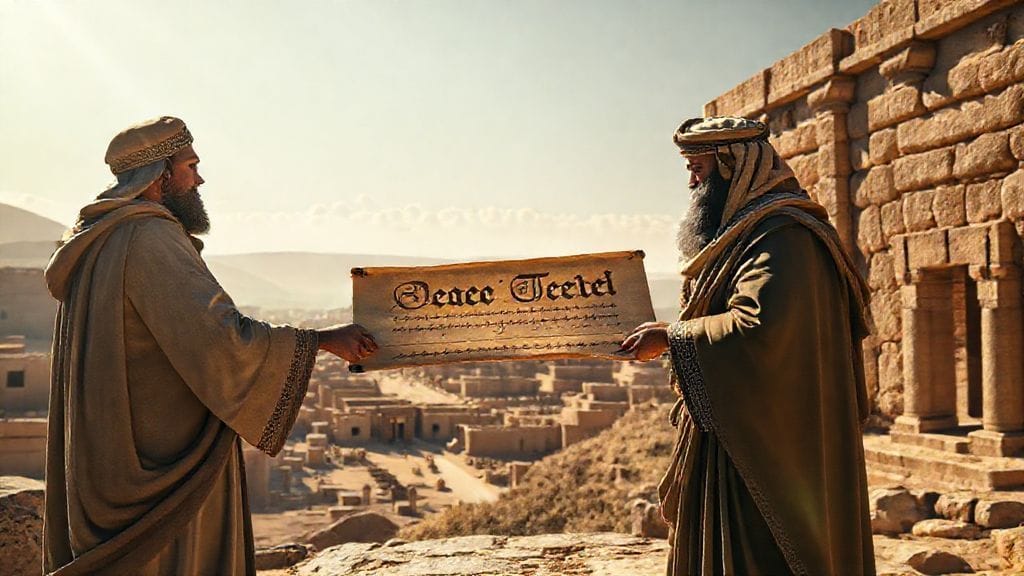
The Treaty of Dara was more than just an agreement; it was the end of an epoch steeped in blood, strategy, and unyielding rivalry. It was signed in the very heart of the embattled lands where neither side had yet succumbed, embodying a complex mix of power, pragmatism, and mutual exhaustion. This treaty would ripple far beyond the quiet towns and barren fields of Mesopotamia, influencing the fates of nations and cultures for generations to come.
The Empire of Empires: Byzantium and Persia’s Endless Rivalry
To understand the significance of the Treaty of Dara, one must delve deep into the molten core of the 6th century’s power dynamics. Byzantium and Persia were empires at their zenith, yet forever locked in an uneasy dance of dominance. They were neighbors bound by a volatile border stretching from the rugged Caucasus to the deserts of Arabia, a line that bore witness to countless wars, each skirmish a flicker of the greater flame ignited centuries before.
Byzantium, heir to the Roman legacy, sought to uphold its ancient supremacy, while Persia, under the Sasanian dynasty, aspired to reclaim its past glory, commanding a force that rivaled Rome's finest legions. The ideological differences—Christianity versus Zoroastrianism—were mere undercurrents beneath the tangible struggle for control over trade routes, fertile lands, and political influence.
The Geopolitical Chessboard of Mesopotamia
Mesopotamia was the prize and the battlefield. Fertile and rich, a cradle of civilizations, it was coveted not only for its agricultural wealth but also as a gateway between East and West. Dara, a fortress city founded by Emperor Justinian on the empire’s eastern frontier, symbolized Byzantine resolve to hold this contested region. It was a bulwark against Persian expansion, the linchpin of a defensive strategy.
The Sahanshah (King of Kings), Khosrow I, known as Anushiravan ("the Immortal Soul"), viewed Mesopotamia not merely as territory but as the key to Persia’s destiny in the eternal struggle with Byzantium. Dara was more than a city—it was a symbol, a prize that shaped the ambitions of emperors and kings.
Justinian’s Vision and the Weight of Eternal Conflict
Emperor Justinian I, the ambitious and visionary ruler of Byzantium, viewed the ongoing war as a test of imperial fortitude and divine favor. His reign sought to restore Roman law, architecture, and frontiers to their former glory. Yet, the wars with Persia tested even his iron will. While Justinian's conquests in the West dazzled, the eastern front remained a grinding saga of siege and counter-siege—the clash of titans overshadowed by mutual suffering.
For Justinian, peace was not only an end to bloodshed but an opportunity to redirect imperial energies towards consolidation at home and beyond, particularly in Italy and North Africa. Yet, the balance of power was delicate, the cost of continuing war unbearable.
The War Ignites: From Skirmishes to Full-Scale Conflagration
The conflict erupted anew in the early 550s, fueled by incessant provocations and border disputes. Skirmishes quickly escalated into full-scale war. Both empires mobilized thousands of troops, fielding cavalry, and heavy infantry. Their clash was brutal—sieges, raids, and battles marked by shifting tactical innovations. Dara endured heavy bombardment, its walls tested by Persian engines of war.
From northern Mesopotamia to the Pontic steppes, the war influenced politics and societies. Local populations suffered amid forced conscriptions, famine, and destruction. Soldiers faced relentless hardship, yet both sides wielded the war like a blunt instrument of diplomacy to enforce their will.
The Siege That Shattered: Dara Under Fire
Dara's defense became emblematic—a city standing firm despite immense pressure. The Persian army, commanded by generals loyal to Khosrow, launched multiple assaults, each repelled by Byzantine defenders bolstered by ingenuity and determination. The city's superb fortifications, a masterpiece of Roman engineering, held strong, showcasing the interplay of military architecture and human courage.
But even the strongest walls cannot endure forever. Dara would suffer, its people scarred by hunger, disease, and fear. The siege revealed the limits of military power, forcing both empires toward the difficult choice of reconciliation.
Persian Ambitions and Byzantine Defenses
Khosrow understood that raw force alone would not guarantee victory. He sought to portray Persia as a legitimate regional power, capable not only of conquest but of diplomacy. Byzantium, prideful yet mindful of its vulnerabilities, responded in kind. Both empires weighed their losses against long-term goals, striving to salvage dignity while preventing total collapse.
The terrain itself was a player—rivers, deserts, and fortresses channeled movements and shaped decisions. Neither side could afford unchecked advances; each held ground with fierce tenacity.
The Costs of War: Casualties, Devastation, and Exhaustion
Beyond statistics lay human tragedy. Tens of thousands of soldiers had perished, civilians endured famine, and entire districts lay razed. The economies of both empires spiraled under wartime strain, their tax coffers depleted. The shadow war of espionage, intrigue, and shifting alliances in borderlands compounded the misery.
Eyewitness accounts spoke of despair as common folk sought refuge behind city walls. Meanwhile, leaders understood that only an end to the conflict could restore hope and order—even if that meant painful compromises.
Into the Diplomatic Fray: The Road to Negotiations
By late 561, after years of indecisive fighting, the drums of diplomacy began to resonate. Envoys, cloaked in cautious optimism, crossed the rugged borderlands. The stakes were clear: a protracted war threatened to render both empires weak against other foes—nomads, internal revolts, or perhaps new emergent powers.
Negotiations unfolded through intricate channels—secret talks, exchange of gifts, and pointed demands. Both sides sought to secure gains without appearing to capitulate. The city of Dara itself witnessed the mingling of Byzantine and Persian delegations, each aware of the heavy eyes of their sovereigns.
The Treaty of Dara: Terms and Conditions Unfold
In November 562, the Treaty of Dara was signed. Anchored upon decades of conflict and compromise, its clauses reflected a delicate balance.
The treaty reaffirmed indemnities, exchanged prisoners, and demilitarized key border fortresses. It established a truce lasting several decades, with precise delineations of spheres of influence. Trade routes were reopened under mutually agreeable conditions, fostering economic revival. The treaty explicitly affirmed respect for each empire’s sovereignty, halting expansionist dreams for a time.
Emperor Justinian and King Khosrow: Leaders at a Crossroads
The treaty embodied the shared pragmatism and exhaustion of Justinian and Khosrow I. While adversaries, both were statesmen of remarkable acumen. Justinian's legal reforms and architectural triumphs echoed in the halls of Constantinople; Khosrow’s administrative genius revived Persia's prestige.
Their correspondence revealed mutual acknowledgement—neither a victor, neither vanquished. This rare moment of reciprocity hinted at a complex relationship beyond mere enmity, a grudging respect forged in the fires of combat.
The Strategic Concessions and Their Hidden Meanings
Though ostensibly a peace treaty, subtle concessions betrayed underlying calculations. Byzantium relinquished certain contested fortresses but gained guarantees on other fronts. Persia accepted limits on incursions but ensured recognition as an equal counterpart.
These terms set the stage not only for peace but for covert maneuverings. The treaty was as much about future stability as it was about preserving political capital in capitals far from the battlefield.
Beyond Borders: The Treaty’s Impact on Mesopotamian Stability
Mesopotamia’s weary inhabitants cautiously embraced peace. Markets reopened; farmers returned to fields; churches and fire temples resumed quiet rites. The borderlands remained tense but no longer a theatre of ceaseless death.
Local rulers adapted to new diplomatic realities, sometimes allying with one empire or the other, sometimes seeking autonomy. The treaty fostered a rare period of economic revival, with trade flowing along ancient routes once again.
Cultural Exchanges Behind the Lines of Conflict
Interestingly, despite hostility, years of contact—both hostile and diplomatic—encouraged cultural cross-pollination. Byzantine artisans, Persian scholars, and merchants exchanged ideas, goods, and customs. Architectural motifs, religious philosophies, and even culinary traditions bore traces of this encounter.
Dara itself stood as a monument—its stones telling stories of siege and survival, of cultural resilience amidst rivalry.
Aftermath and Respite: A Fragile Peace Restored
The Treaty of Dara brought nearly four decades of relative peace between Byzantium and Persia. This respite allowed both empires to redirect attention internally—Byzantium towards reconquering the West, Persia towards consolidating its eastern borders.
Yet peace was a fragile flower, grown in the fertile soil of war-weary rulers and exhausted peoples. The balance struggled under the weight of ambition and past grievances, as history would soon remind.
Legacy of the Treaty: Prelude to Future Clashes
Though the treaty held, it was an armistice, not a solution to the deeper, systemic rivalry. Its fragile fabric eventually unraveled amid new generations of rulers and shifting political landscapes.
The Treaty of Dara remains a milestone in Byzantine-Sasanian relations—an emblem of how exhaustion and pragmatism can impose peace, even among the most bitter opponents. It presaged the great conflicts that would later erupt, including the emergence of new powers on the horizon.
The Memory of Dara in Byzantine and Persian Chronicles
Chroniclers from both sides documented Dara’s siege and the treaty with evocative language—sometimes as a triumph of endurance, at others as a painful but necessary concession. These narratives shaped the collective memory, blending fact and legend.
The city appeared in epic poetry, religious texts, and official histories, symbolizing the harsh realities and fleeting hopes of balance between East and West.
The War in the Shadow of the Eternal City
Far from Dara, in Constantinople’s marble halls, the war’s echoes shaped imperial policies and court intrigues. Justinian’s court balanced war and peace with domestic challenges—the plague, internal revolts, and ambitious building projects.
Meanwhile, in Ctesiphon and Persepolis, Khosrow's court pondered the future of Persia, wary of both Roman ambitions and nomadic threats. The treaty allowed a breathing space in these capitals but kept tensions simmering beneath.
Reflections on Diplomacy: War’s Bitter Lesson
The Treaty of Dara reminds us that diplomacy is often the hard-won prize of relentless conflict. It reveals the human cost behind political strategies and the thin line between triumph and tragedy.
For the peoples of Mesopotamia, the treaty brought relief and renewal—however temporary. For the empires, it was a strategic pause, a vivid testament to the limits of power and the endurance of hope amidst devastation.
Conclusion
The Treaty of Dara marks a poignant chapter in the endless Byzantine-Persian saga—a moment when two rivals, bound by geography and history, chose peace over perpetual war. It embodies the paradox of conflict, where destruction paves the way for dialogue, and where the scars of battle forge unlikely moments of understanding.
In the end, the treaty was not merely a document but a mirror reflecting the complexity of empire, the resilience of human spirit, and the eternal hope that even amidst the devastations of war, peace, however fragile, remains possible.
The stones of Dara, silent witnesses to centuries of bloodshed and diplomacy, remind us that history is less about the victories of arms than about the quiet courage of compromise and reconciliation.
FAQs
Q1: What triggered the war leading to the Treaty of Dara in 562?
The war was sparked by longstanding territorial disputes along the Byzantine-Persian border, exacerbated by religious tensions and competition for control over Mesopotamia—a crucial economic and strategic region.
Q2: Who were the key figures involved in the treaty negotiations?
Emperor Justinian I of Byzantium and King Khosrow I of Persia were the principal leaders whose broader policies and priorities steered the negotiations, although numerous diplomats and generals also played critical roles.
Q3: What were the main terms of the Treaty of Dara?
The treaty stipulated a ceasefire, prisoner exchanges, demilitarization of border fortresses, and the reopening of trade routes, aiming to establish a lasting peace and stable border zones.
Q4: How did the treaty affect the local population in Mesopotamia?
It allowed a period of recovery from the devastation of war, with the restoration of agriculture, trade, and relative security, though it maintained a tense peace due to ongoing empire rivalries.
Q5: Did the Treaty of Dara bring permanent peace between Byzantium and Persia?
No, the treaty brought nearly four decades of relative peace but was ultimately a temporary measure within a larger and more enduring conflict between the two empires.
Q6: What cultural impacts emerged from the Byzantine-Persian conflicts?
Despite hostilities, the wars facilitated exchanges of art, architecture, religious thought, and commerce, enriching both civilizations across their shared borders.
Q7: How is the Treaty of Dara remembered in historical sources?
Byzantine and Persian chronicles often depict the treaty as a pragmatic end to a grueling war, reflecting themes of endurance, diplomacy, and the bittersweet nature of compromise.
Q8: What lessons does the Treaty of Dara offer modern readers?
It highlights how war, though destructive, can lead to diplomacy and peace through mutual exhaustion and recognition of shared humanity—an enduring lesson in realpolitik and the human cost of conflict.

