Table of Contents
- A Quiet February Morning in 1848: Signing the Treaty That Changed a Continent
- The American Dream Meets the Mexican Reality: Context Before the Treaty
- The Mexican-American War: Prelude to Defeat
- Political Turmoil in Both Capitals: Leaders Under Pressure
- The Road to Guadalupe Hidalgo: Negotiations and Stakes
- Signing the Treaty: The Ceremony and Its Atmosphere
- Cartography of Conquest: Redrawing the Map of North America
- The Price of Peace: Terms That Shocked Societies
- Human Stories in the Wake of Borders Shifted
- The U.S. Perspective: Expansion, Manifest Destiny, and Doubts
- Mexico’s Loss: National Trauma and Political Fallout
- The Treaty’s Impact on Indigenous Communities
- Economic Transformations: From Ranchos to Railroads
- The Aftermath in California: Gold Rush and New States
- Long Shadows: The Treaty’s Role in American Politics
- Historical Debates: Was the Treaty Just or Imperialist?
- Remembering Guadalupe Hidalgo: Memory and Monuments
- Modern Echoes: The Treaty in Mexican-American Relations Today
- Conclusion: A Treaty Etched in Blood and Hope
- FAQs
- External Resource
- Internal Link
1. A Quiet February Morning in 1848: Signing the Treaty That Changed a Continent
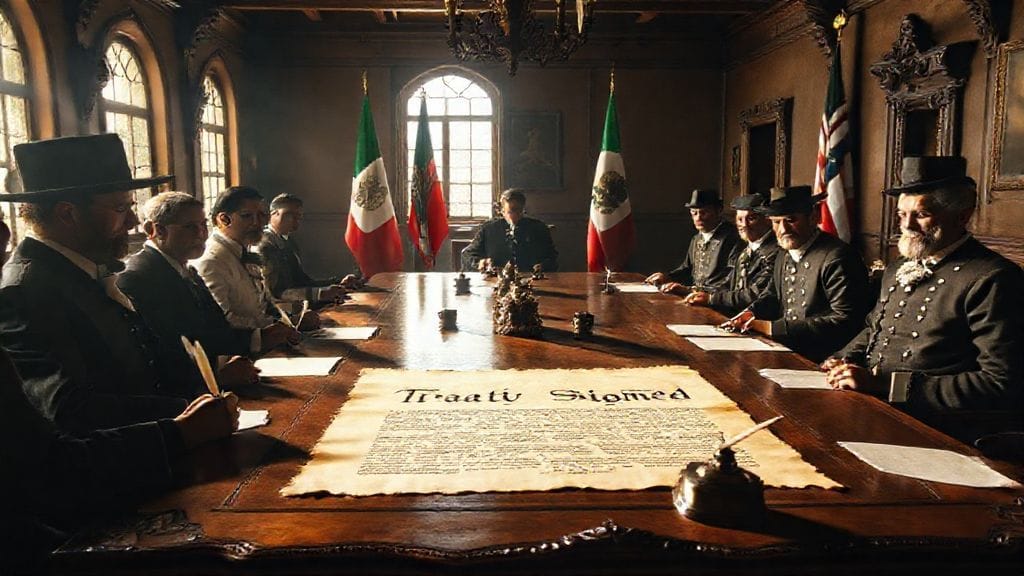
On the crisp morning of February 2, 1848, in a modest adobe building in the small town of Guadalupe Hidalgo, just outside Mexico City, two delegations met to seal an agreement that would redraw the future of North America. The air was thick with tension, memory, and reluctant acceptance. As ink met parchment, beyond that quiet room, the ripples of this moment would soon wash over vast landscapes—from the deserts of the Southwest to the burgeoning cities of the Pacific Coast. This was the signing of the Treaty of Guadalupe Hidalgo, the fragile peace that ended the Mexican-American War but began a new chapter of conquest, loss, and transformation that still shapes the continent.
The atmosphere was far from celebratory. Mexican negotiators, bearing the weight of a country fractured and defeated, were acutely aware that they were about to relinquish nearly half their territory to the United States. American representatives, driven by Manifest Destiny’s fervor, seized this moment of victory but faced their own uncertainties about the expanded republic and the seeds of sectional conflict they had planted.
This quiet signing masked the storm beneath—a conflict between nations, cultures, and visions for the continent’s destiny that had played out in months of brutal war. The Treaty of Guadalupe Hidalgo was not just a legal document; it was a turning point that would shape identities, economies, and geopolitics for generations.
2. The American Dream Meets the Mexican Reality: Context Before the Treaty
To understand why the Treaty of Guadalupe Hidalgo was so monumental, we must first peer into the world before its ink dried. The early 1840s were a decade of dreams and despair, for two neighboring nations sharing a long border yet vastly different futures.
The United States in the 1840s was a young, energetic republic obsessed with expansion. The doctrine known as Manifest Destiny—the belief that the U.S. was destined to stretch from the Atlantic to the Pacific—had taken root among politicians, settlers, and the press. Driven by ambition, they eyed the sparse lands westward, imagining farms, towns, mines, and railroads. Yet, this vision collided with reality: much of that land belonged to Mexico, a nation also trying to stabilize after decades of wars of independence and internal strife.
Mexico, on the other hand, was fragile and fractured. Having achieved independence from Spain less than three decades prior, it faced political chaos, economic hardship, and ongoing conflicts with indigenous peoples and regional factions. The northern territories—California, New Mexico, Texas—were loosely governed, vast, and difficult to control. Settlers from the U.S. and other nations trickled in, sometimes with permission, often without.
Tensions over Texas were the first spark. The Republic of Texas had declared independence from Mexico in 1836, and the U.S.’s annexation of Texas in 1845 ignited a fierce dispute. Mexico refused to recognize Texas’s independence or its annexation, leading inevitably to armed clashes along poorly defined borders. The question was no longer if war would erupt, but when.
3. The Mexican-American War: Prelude to Defeat
In April 1846, the inevitable happened. After a series of border skirmishes and political brinkmanship, President James K. Polk declared war on Mexico. For the U.S., the war was justified as a measure to secure its borders and expand "from sea to shining sea." For Mexico, it was an invasion—a brutal assault on sovereign territory.
The war would last 18 months, but it was a decisive one. Key battles at Palo Alto, Monterrey, Buena Vista, and the amphibious assault on Veracruz demonstrated the superiority of the well-organized and equipped U.S. forces. American General Zachary Taylor became a national hero, and General Winfield Scott pushed inland eventually reaching Mexico City itself.
Mexico's military effort was valiant but hampered by poor communication, limited resources, and internal divisions. The taking of the capital in September 1847 was a profound shock. American troops marched into the heart of Mexico, and the Mexican government was left with no choice but to negotiate peace—the conditions dictated largely by the conqueror.
4. Political Turmoil in Both Capitals: Leaders Under Pressure
Behind the scenes, the leaders in Washington and Mexico City wrestled with the consequences of war and peace.
In the United States, James K. Polk was determined to use victory to fulfill Manifest Destiny. Yet his administration faced dissent from abolitionists and critics wary of the war’s morality and consequences. The question of whether new territories would allow slavery was beginning to sow seeds of discord.
In Mexico, the government was unstable, with successive presidents and military leaders struggling to manage defeat and maintain order. President José Joaquín de Herrera was replaced by Manuel de la Peña y Peña in the midst of talks, each leader confronting rising public anger and despair. Mexico’s negotiators—led by Nicholas Trist, an American diplomat sent by Polk but increasingly sympathetic to Mexico’s plight—walked a diplomatic tightrope.
The political weight on these men’s shoulders was immense. A wrong move could inflame conflict, destroy hopes for peace, or deepen national humiliation.
5. The Road to Guadalupe Hidalgo: Negotiations and Stakes
Negotiations began in late 1847, with Trist playing a crucial and controversial role. Although recalled by Polk who wanted harsher terms, Trist defied orders and stayed in Mexico, believing a peaceful settlement was vital.
The U.S. sought not only the recognition of Texas to the Rio Grande but also vast tracts of Mexico’s northern territories: California, New Mexico, Arizona, Nevada, Utah, and parts of Colorado and Wyoming. This would represent roughly 55% of Mexico’s land—a staggering loss.
Mexico resisted but faced the grim reality of military defeat and economic collapse. The nation was bankrupt and demoralized; continuing war was untenable.
The negotiations stretched over months, fraught with mistrust. Trist pushed for a treaty that would secure peace while offering some financial compensation—$15 million to Mexico and the U.S. government's assumption of debts owed by Mexico to American citizens. Mexico reluctantly accepted.
6. Signing the Treaty: The Ceremony and Its Atmosphere
Finally, on February 2, 1848, the Treaty of Guadalupe Hidalgo was signed in the quiet village of Guadalupe Hidalgo—a symbolic yet unassuming locale.
The ceremony was somber. Mexican officials wore dark suits and carried expressions heavy with resignation. American diplomats, while victorious, did not display triumphalism. The treaty embodied a reluctant peace—one born of conquest and compromise.
The treaty had fourteen articles, covering borders, rights of inhabitants, protection of property, and future commercial relations. Despite the gravity, the formalities were brief, and many participants would reflect in later years on the bitterness of the moment.
7. Cartography of Conquest: Redrawing the Map of North America
The treaty altered the map of the continent with startling clarity. The Rio Grande was confirmed as the boundary for Texas, but the real transformation was the cession of the “Mexican Cession”—an enormous region acquired by the U.S.
This land acquisition stretched over 500,000 square miles, doubling the U.S. territory. Carrying deserts, mountains, fertile valleys, and a Pacific coastline, it laid the foundation for future states like California, Nevada, and Utah.
Maps, once filled with blank spaces or marked ‘unknown’ suddenly had new borders, names, and potential. This cartographic revolution would underpin economic development, migration, and geopolitical power in the decades that followed.
8. The Price of Peace: Terms That Shocked Societies
The terms were harsh by Mexico’s standards. Besides territorial loss, Mexico was compensated $15 million—a paltry sum for such an expanse. The treaty also guaranteed that the property and civil rights of Mexican inhabitants in ceded areas would be respected, a promise often broken in practice.
For Mexico, the treaty was a national wound. It was seen as a symbol of humiliation and betrayal by foreign powers, sparking bitter debates about sovereignty and national identity.
In the U.S., the treaty stirred divisive questions: Would the new territories permit slavery? Could a republic with rapidly expanding borders maintain cohesion? These debates preluded the violent crises that erupted over the coming decades.
9. Human Stories in the Wake of Borders Shifted
Beyond maps and politics, the treaty shaped lives. Indigenous peoples, Mexican citizens, Anglo settlers, and displaced communities faced upheaval.
Many Mexicans found themselves suddenly living under a new government, often without choice. Language, law, and cultural customs clashed as American authorities imposed new systems. Some adapted, others resisted. Land disputes skyrocketed, with many Mexican landowners losing property as new legal frameworks favored Anglo settlers.
Indigenous nations, often ignored in the treaty, continued to face displacement and marginalization. Their presence and rights were largely unacknowledged, sowing conflict and injustice.
10. The U.S. Perspective: Expansion, Manifest Destiny, and Doubts
For many in the United States, the treaty was a triumph—a fulfillment of destiny and a testament to military and political prowess.
Yet the acquisition also came with a cost. Polks’s victory reignited sectional tensions over slavery’s expansion. The Wilmot Proviso, a congressional proposal to ban slavery in new territories, emerged in direct response, deepening national divisions.
Some Americans questioned the morality of the war and the treatment of Mexico, fearing imperial overreach would backfire. Yet the majority perceived the treaty as a step towards the United States’ rightful place as a continental power.
11. Mexico’s Loss: National Trauma and Political Fallout
In Mexico, the treaty was a bitter pill and a cause for profound national reflection.
Leaders debated whether the defeat was due to internal failings, foreign aggression, or a mix of both. Political instability continued, with factions blaming each other for the loss.
The territory loss fueled a deep sense of betrayal and loss that resonated in literature, art, and collective memory. For many Mexicans, the treaty underscored a crisis of identity, sovereignty, and future direction.
12. The Treaty’s Impact on Indigenous Communities
Though largely sidelined, the Indigenous peoples of the ceded territories were dramatically affected.
They now found themselves under U.S. jurisdiction, with little consultation or recognition of their autonomy. The U.S. government’s expansionist policies soon sought to open lands for settlers, leading to forced removals, violent conflicts, and cultural disruption.
For Native nations, a treaty between imperial powers was no source of peace but a prelude to further dispossession.
13. Economic Transformations: From Ranchos to Railroads
The treaty’s land cession triggered economic transformation. American entrepreneurs envisioned ranches, farms, mines, and railroads carving through the once remote territories.
The discovery of gold in California in 1848, shortly after the treaty, sent waves of settlers westward. New cities grew rapidly, and transportation networks expanded.
For Mexico, the economic loss was profound, weakening an already fragile economy. For the U.S., it was the dawn of industrial and agricultural boom in the West.
14. The Aftermath in California: Gold Rush and New States
California’s sudden transformation was perhaps the treaty’s most dramatic consequence.
Gold was discovered at Sutter’s Mill just weeks after the treaty was signed, sparking the famous Gold Rush. Thousands poured into this vast new land with dreams of fortune.
California rapidly grew and was admitted as a state in 1850. Its multicultural population, including Mexican Californios, Native Americans, and immigrants, faced new challenges and opportunities.
15. Long Shadows: The Treaty’s Role in American Politics
Beyond territorial gains, the treaty influenced U.S. domestic politics.
The question of slavery in the new territories became a flashpoint leading to the Compromise of 1850. Debates about citizenship, rights, and governance echoed the divisions the treaty had exposed.
The Mexican-American War and this treaty are often viewed as precursors to the American Civil War, highlighting the limits of expansion without internal unity.
16. Historical Debates: Was the Treaty Just or Imperialist?
Historians continue to debate the treaty’s legacy. Was it a pragmatic peace or an act of imperialism?
From Mexico’s perspective, the treaty epitomized coercion and loss. From the U.S. view, it was a necessary step in nation-building.
Modern scholarship tends to emphasize the complexities, acknowledging both the war’s human cost and the treaty’s deep impact on shaping two nations’ destinies.
17. Remembering Guadalupe Hidalgo: Memory and Monuments
In both Mexico and the U.S., the treaty’s memory has been shaped by nationalism, politics, and reconciliation efforts.
In Mexico, it remains a symbol of loss and resilience, commemorated in literature and history education. In the U.S., it often marks the beginning of the American West’s transformation.
Contemporary efforts seek to remember the treaty with nuance, honoring the stories of all peoples affected.
18. Modern Echoes: The Treaty in Mexican-American Relations Today
The treaty still resonates in the 21st century, influencing border issues, immigration debates, and cultural ties.
Cross-border communities remember shared histories, and dialogue about rights and identity continues.
The Treaty of Guadalupe Hidalgo remains a foundational event in understanding Mexican-American relations and the complexities of borderlands.
19. Conclusion: A Treaty Etched in Blood and Hope
The Treaty of Guadalupe Hidalgo was more than a document: it was a crossroads of conflict, ambition, and human cost. It forged a new America, expanded a republic westward, and reshaped an entire continent.
Yet, beneath the legal language lay stories of loss, resilience, and transformation. The treaty carved boundaries not just on maps but in hearts, communities, and national consciousness.
Its legacy invites us to consider how peace agreements, victories, and defeats echo long after the signatures fade—reminding us, poignantly, of the interwoven fates of neighbors, empires, and peoples.
FAQs
Q1: What triggered the Mexican-American War that led to the Treaty of Guadalupe Hidalgo?
A1: The war was primarily triggered by the U.S. annexation of Texas in 1845, a territory Mexico still claimed, and disputes over its southern border. Skirmishes along the Rio Grande escalated, leading to formal declarations of war.
Q2: What were the main territorial changes brought by the Treaty?
A2: Mexico ceded nearly half of its territory to the U.S., including present-day California, Nevada, Utah, Arizona, and parts of several other states, expanding the U.S. significantly westward.
Q3: How did the treaty affect the people living in the ceded territories?
A3: Mexican citizens suddenly living under U.S. rule faced cultural, legal, and economic challenges. Indigenous peoples also suffered displacement and loss of autonomy. Many lost lands and status in the new regime.
Q4: What was the United States’ justification for the war and subsequent treaty?
A4: U.S. leaders cited Manifest Destiny, the belief in expanding civilization and democracy across the continent, along with the defense of Texas’s annexation, as key reasons for war and territorial claims.
Q5: How is the Treaty of Guadalupe Hidalgo remembered in Mexico?
A5: It is remembered as a national trauma—a symbol of loss and foreign aggression—but also as a defining moment of resilience and identity in Mexican history.
Q6: Did the treaty resolve all border disputes between the two countries?
A6: While it defined major borders, some disputes lingered, resolved in later treaties like the Gadsden Purchase in 1854. Issues of border security and management remain complex today.
Q7: How did the treaty influence the issue of slavery in the U.S.?
A7: The vast new territories renewed intense debates over whether slavery would be allowed, contributing to sectional tensions that culminated in the Civil War.
Q8: Is the Treaty of Guadalupe Hidalgo still relevant today?
A8: Absolutely. It shapes U.S.-Mexico relations, border policies, and cultural identities in the Southwest, reminding us of how past conflicts continue to inform present realities.