Table of Contents
- A Spring of Hope and Tension: Europe on the Brink, May 1913
- The Balkan Cauldron: Roots of Conflict and Rivalry
- The First Balkan War Ignites: An Unfolding Drama
- Alliances and Ambitions: The Players on the Balkan Stage
- The Ceasefire and The Road to London
- The Treaty of London: Setting the Stage in a British Capital
- The Day of Signing: May 30, 1913 — Atmosphere and Expectations
- Key Provisions: Carving Up the Spoils of War
- Securing Albania: A New State Amid Great Power Interests
- Dividing Macedonia: Contested Lands and Discontent
- The War’s Aftermath: National Triumphs and Bitter Resentments
- The Ottoman Empire’s Retreat: Losses and Legacy
- Bulgaria’s Dissatisfaction: The Seeds of a Second War
- The Treaty’s Place in European Diplomacy Before World War I
- Voices from the Negotiating Table: Diplomats, Leaders, and Observers
- Popular Reactions Across the Balkans and Europe
- The Human Cost: Refugees, Soldiers, and Civilians in the Wake of Peace
- The Legacy of the Treaty of London in Modern Geopolitics
- Lessons in Diplomacy and the Fragility of Peace
- Conclusion: Treaty of London, a Precarious Peace on the Eve of Global War
- FAQs: Understanding the Treaty’s Complex Implications
- External Resource: Wikipedia Link on the Treaty of London
- Internal Link: Visit History Sphere
1. A Spring of Hope and Tension: Europe on the Brink, May 1913
The streets of London in late May 1913 were buzzing with an uneasy sense of anticipation. The weather—mild, almost summery—belied the cold calculation underway behind the closed doors of stately government buildings. Diplomats swirled through corridors, their faces taut, eyes flickering with the weight of an uneasy hope. The First Balkan War had ended, but peace remained fragile.
To many European capitals, the Treaty of London represented a moment of relief—a formal ending to hostilities that had shaken the southeast of the continent. Yet for those in the Balkans, the treaty would become a tipping point, an uneasy balance sheet of territorial gains and losses that sowed new discord.
On that May day, as the ink dried on treaties in a grand room halfway across the world from the bloodied fields of the Balkan Peninsula, the urgent question remained: would peace hold, or was this simply the silence before the storm?
2. The Balkan Cauldron: Roots of Conflict and Rivalry
To understand the Treaty of London, one must first grasp the volatile history that exploded into the First Balkan War. The Balkans—an intricate mosaic of ethnicities, languages, and religions—had long been under the fading shadow of the Ottoman Empire. By the early 20th century, the Ottoman grip was tenuous, weakened by internal strife and external pressure.
Nationalist movements surged, demanding liberation and self-determination. The rise of Serbia, Bulgaria, Greece, and Montenegro emboldened local populations. Yet these aspirations often collided, sparking rivalries fueled by historic grievances and dreams of larger empires.
The “Eastern Question” haunted European diplomats: How to manage the retreat of Ottoman authority without provoking wider conflict? Meanwhile, Austria-Hungary eyed the region with suspicion, wary of Slavic expansion threatening its multi-ethnic empire.
The tinderbox was set.
3. The First Balkan War Ignites: An Unfolding Drama
October 1912 saw the Balkan League—comprising Serbia, Bulgaria, Greece, and Montenegro—launch a coordinated attack on the weakening Ottoman Empire. The war unfolded rapidly, with a series of fierce, often brutal battles. The Coalition pressed hard, capturing vast swathes of territory.
Yet, amid the military advances lay deep fractures. Although united against a common enemy, the Balkan allies harbored divergent aims, especially regarding the spoils of war—regions like Macedonia and Thrace, rich in history and strategic value, were fiercely contested.
The Ottoman Empire, meanwhile, struggled to stem the tide but was forced back continually, its troops retreating under pressure, turmoil brewing at home.
4. Alliances and Ambitions: The Players on the Balkan Stage
Each Balkan state entered the war driven by its own vision. Serbia, emboldened by nationalist fervor, sought to expand south and access the Adriatic Sea, asserting itself as a leading Slavic power. Bulgaria, backed by a recent military buildup, claimed entitlement to large parts of Macedonia. Greece, strategically located, aimed to regain islands and lands under Ottoman control, often ignoring rival claims. Montenegro, the smallest but proud ally, seized its chance to enlarge borders.
Opposing them in London was the Ottoman Empire, trying to salvage its remnants, while the Great Powers—Britain, France, Russia, Germany, and Austria-Hungary—scoured maps and agendas to protect their interests.
5. The Ceasefire and The Road to London
By May 1913, with Ottoman forces pushed far back, the conflict drew to a close. Exhausted and wary, both sides agreed to negotiate. The Great Powers, eager to prevent escalation, convened in London to hammer out a peace acceptable to all.
The London Conference became a diplomatic battlefield. Each delegate, armed with national instructions and personal ambitions, sought to craft a treaty that would stabilize the region—yet satisfy none entirely.
6. The Treaty of London: Setting the Stage in a British Capital
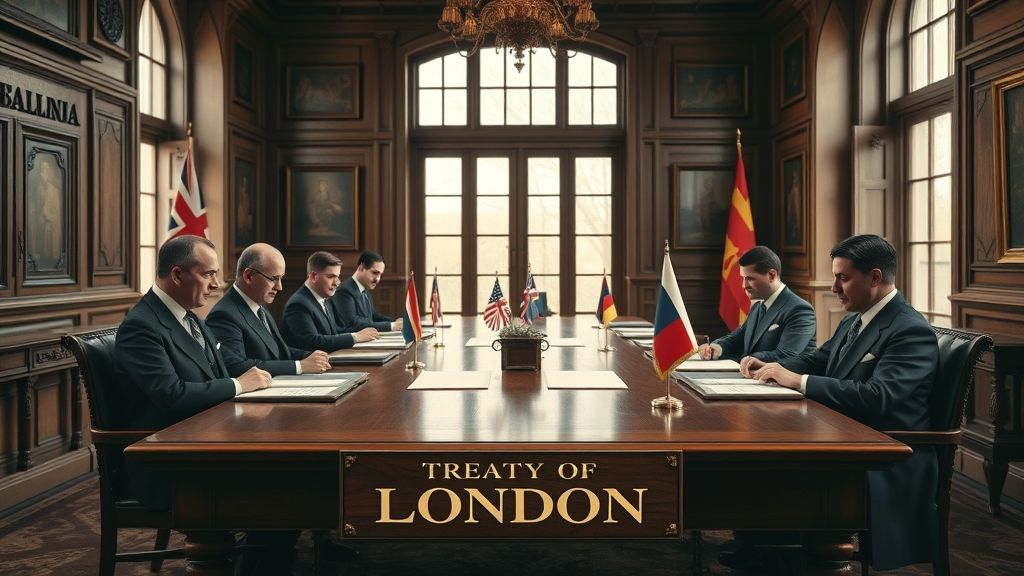
London’s stately salons and parliamentary chambers provided a solemn backdrop. On May 30, 1913, representatives gathered to finalize terms. The city, a global imperial capital, seemed an odd place to resolve such a local but incendiary dispute. Yet it symbolized a broader European role in Balkan affairs.
The treaty, at its heart, was a document of compromise: drawing new borders, recognizing Albania, limiting Ottoman territory, and attempting to suppress further conflict. But beneath the legal prose lay unresolved tensions.
7. The Day of Signing: May 30, 1913 — Atmosphere and Expectations
On that spring day, photographs captured the formal handshakes and exchanged documents. Diplomats, wary and exhausted, sought to project confidence. Newsreels would later show solemn faces, a contrast to the jubilation and despair brewing thousands of miles away.
Expectations were high for peace, but many whisperings foretold a new struggle.
8. Key Provisions: Carving Up the Spoils of War
The treaty drastically curtailed the Ottoman presence in Europe, ceding vast territories to the Balkan states. Albania was recognized as an independent principality, a move born more of Great Power calculations than ethnic realities.
Macedonia was divided between Serbia, Greece, and Bulgaria, albeit with considerable dissatisfaction from all sides, especially Bulgaria.
The Ottomans retained a small foothold around Constantinople, barely a shadow of their former dominion.
9. Securing Albania: A New State Amid Great Power Interests
Albania’s recognition was a pivotal clause. The Great Powers—concerned about a Serbian-Greek coalescence disrupting the balance—favored a neutral Albanian state. Yet Albania itself was fragmented, politically weak, with clans and regions divided.
The creation of this new entity, while stabilizing in theory, provoked ire especially in Serbia, which saw coastal access denied.
10. Dividing Macedonia: Contested Lands and Discontent
Macedonia’s division became emblematic of Balkan complexity. Bulgaria, which had expected a larger share based on pre-war agreements, felt betrayed. Serbia and Greece had no intention of retreating from occupied zones.
Ethnic tensions fueled by this arbitrary partition ignited nationalist outrage, planting the seeds for the Second Balkan War.
11. The War’s Aftermath: National Triumphs and Bitter Resentments
The Balkan states emerged militarily victorious but politically fractured. Victories at great human cost—thousands dead, civilians displaced—did little to appease deep-seated rivalries.
Bulgaria’s bitterness turned into renewed aggression, Serbia’s stature grew, and Greece consolidated new territories with pride and suspicion.
12. The Ottoman Empire’s Retreat: Losses and Legacy
For the Ottomans, the Treaty of London was a stark admission of decline. Once a sprawling empire, their European domains were vanishing.
But the loss also galvanized reformists and hardliners alike, setting the stage for further upheaval internally and on the continent.
13. Bulgaria’s Dissatisfaction: The Seeds of a Second War
Perhaps the most immediate consequence was Bulgaria’s rage. Expecting Macedonia to be largely hers, the treaty’s terms felt like a slap. Within weeks, Bulgaria launched a new conflict against its former allies, triggering the Second Balkan War.
14. The Treaty’s Place in European Diplomacy Before World War I
The Treaty of London epitomized the volatile balance of power that defined Europe pre-1914. The Great Powers’ efforts to manage the Balkans revealed the complexities and fragilities of diplomacy.
The treaty was a prelude—a foreshadowing of the catastrophic conflicts soon to engulf the continent.
15. Voices from the Negotiating Table: Diplomats, Leaders, and Observers
British Foreign Secretary Sir Edward Grey was a key figure, embodying reluctant diplomacy. His private notes reveal a mixture of hope and dread. Bulgarian Prime Minister Vasil Radoslavov decried the treaty’s terms as unjust.
Observers sensed a peace born not of reconciliation, but of exhaustion.
16. Popular Reactions Across the Balkans and Europe
In the Balkans, celebrations were paired with protests. Serbia basked in victory; Bulgaria simmered with resentment; Greeks cheered recovered lands; Albanians faced uncertainty.
Across Europe, newspapers balanced relief with unease—the “powder keg” was temporarily capped.
17. The Human Cost: Refugees, Soldiers, and Civilians in the Wake of Peace
Behind geopolitical talks lay stories of suffering—villages destroyed, families uprooted, refugees crossing hostile lines.
Humanity often appears as collateral in grand maps, but these lives echo through history.
18. The Legacy of the Treaty of London in Modern Geopolitics
The treaty’s impact resonates today. Borders drawn then inform many national identities and conflicts in Southeast Europe. It highlights the dangers of imposed peace without local consensus.
19. Lessons in Diplomacy and the Fragility of Peace
The Treaty of London teaches us about the intricate dance of diplomacy, where power, pride, and principle collide. It warns that peace can be both a goal and a fragile illusion.
20. Conclusion: Treaty of London, a Precarious Peace on the Eve of Global War
The Treaty of London in May 1913 closed one brutal chapter but opened another. It embodied a transient hope—ambitious terms shadowed by distrust and unfinished business. It was, above all, a mirror of a Europe hurtling toward the abyss of the Great War. The echoes of those negotiations continue to shape the continent, a testament to history’s enduring complexities.
Conclusion
The Treaty of London stands as a monument to the arduous quest for peace in a land riddled with strife. It reminds us how fragile resolutions can be when built on competing nationalisms and the heavy hand of external powers. As the ink dried that May day in London, few could predict that within months, smoke would rise again over the Balkans, a grim prelude to the conflagration engulfing the world.
Yet from the tumult emerged new nations, new identities, and a deeper understanding of the dangers embedded in the dance of empires and ethnicities. The Treaty of London, thus, is more than a diplomatic document—it is a chapter in the human story of hope, conflict, and the eternal search for peace.
FAQs
Q1: What triggered the First Balkan War leading to the Treaty of London?
The First Balkan War was triggered by the Balkan League's attempt to seize territories from the weakening Ottoman Empire, driven by nationalist ambitions and the decline of Ottoman control in Europe.
Q2: Why was the Treaty of London signed in the United Kingdom?
The Great Powers convened in London to manage the conflict and impose a peace settlement, viewing Britain as neutral ground and a major diplomatic hub capable of mediating tensions.
Q3: How did the Treaty of London affect Albania?
The treaty recognized Albania as an independent principality, carving out a new state intended as a buffer, though it faced internal divisions and was a source of regional tension.
Q4: Why was Bulgaria dissatisfied with the Treaty?
Bulgaria felt cheated by the division of Macedonia, expecting a larger share based on previous agreements, which bred resentment leading to the Second Balkan War.
Q5: What was the impact of the treaty on the Ottoman Empire?
The treaty marked the loss of the Ottoman Empire’s European territories except for a small area near Constantinople, signaling a considerable decline.
Q6: Did the Treaty of London ensure lasting peace in the Balkans?
No, while it ended the First Balkan War, the treaty’s terms sowed discord, leading to the Second Balkan War and contributing to the broader instability preceding World War I.
Q7: How did the Great Powers influence the treaty terms?
Great Powers aimed to maintain a balance, preventing any single Balkan state from dominating, while pursuing their own geopolitical interests, often imposing solutions without full local consent.
Q8: What legacy does the Treaty of London leave in modern geopolitics?
It set borders and political realities in the Balkans that still influence national identities and conflicts today, illustrating the challenges of peace imposed from outside.