Table of Contents
- A Winter Morning in Paris: The Day the Quills Tamed the Cannons
- An Empire’s Gamble: How the Seven Years’ War Set the Stage
- Rival Visions of the World: Britain, France, and Spain Before 1763
- Behind Closed Doors: Diplomats, Intrigue, and the Road to Paris
- The City as Witness: Paris in the Shadow of Defeat
- Signing Away a Continent: Inside the Treaty Room
- Lines on a Map: Territorial Changes in Europe and the Wider World
- North America Redrawn: From New France to British Dominion
- The Caribbean and Beyond: Sugar Islands, Slave Routes, and Silent Costs
- India and the Eastern Seas: The Global Reach of a European Treaty
- Winners, Losers, and the Illusion of Victory
- On the Ground: Indigenous Nations and the Price of Paper Peace
- Colonial Discontent: How 1763 Lit the Fuse of Revolution
- Voices from the Metropoles: Parisian Disillusion and London’s Uneasy Triumph
- A New Imperial Logic: Debt, Taxation, and Governance After 1763
- Memory, Myth, and the Making of Modern Nations
- Echoes Through Centuries: Why the Treaty Still Matters Today
- Conclusion
- FAQs
- External Resource
- Internal Link
Article Summary: On 10 February 1763, in a cold Paris still reeling from military setbacks, diplomats from Britain, France, and Spain gathered to sign what became known as the treaty of paris 1763, a document that reshaped much of the world. This article follows the story from the fires of the Seven Years’ War to the hushed scrape of quills on parchment in the French capital, tracing how victory and defeat were translated into borders and clauses. It examines how Britain emerged with a global empire seemingly unmatched, while France surrendered vast territories yet preserved a different kind of power. Beneath the neat diplomatic prose lay the silenced voices of Indigenous nations, enslaved peoples, and colonists whose futures were decided without their consent. The narrative shows how the treaty of paris 1763 created a North America dominated by Britain, but also sowed the resentment that moved American colonists toward revolution. By walking through Parisian streets, British counting houses, Indigenous councils, and colonial taverns, the article reveals the emotional and human dimensions of this diplomatic turning point. Ultimately, it argues that the treaty of paris 1763 did not end a struggle so much as transform it, pushing conflict into new arenas and laying the foundations of the modern Atlantic world. The story of this treaty is therefore not just a chapter in imperial rivalry, but a preface to independence movements and global shifts that still echo today.
A Winter Morning in Paris: The Day the Quills Tamed the Cannons
On the morning of 10 February 1763, Paris wore a color that did not appear on any map: a gray that blended ash, fog, and resignation. The Seine moved sluggishly under low clouds, carts rattled over the cobblestones, and the breath of horses steamed in the cold air. In the salons, fireplaces snapped with dry wood, but warmth was scarce in the corridors of power. There, among ink-stained desks and rolled maps, men prepared to transform twelve years of global bloodshed into sentences. The treaty of paris 1763, though not yet called by that name, was about to take tangible form.
Inside one of the grand hôtels particuliers where negotiations had been unfolding, the atmosphere was heavy with a very different kind of smoke—the lingering tension of compromise and the acrid aftertaste of defeat. French officials, faces lined beyond their years, had grown used to dispatches reporting distant disasters: Quebec fallen, fleets scattered, colonies occupied. The British, for their part, arrived with the stiffer posture of victors, confident yet anxious, knowing that every line they secured would have to be defended in gold and blood. Spanish envoys, still smarting from late but costly involvement in the war, walked a carefully measured line between humiliation and hope.
It’s astonishing, isn’t it, that so vast a war—stretching from the forests of North America to the plains of Europe, from Caribbean sugar islands to Indian trading posts—could be distilled into a few dozen pages. Outside, ordinary Parisians went about their routines, gossiping about scarcity, about lost sons and rising bread prices, about rumors that their monarch had yielded too much. Yet few of them understood that on this day the geography of their world was being quietly rewritten. While cannons cooled in distant forts and ships lay moored, the true battle had moved indoors, into the realm of ink, clauses, and carefully weighed phrases.
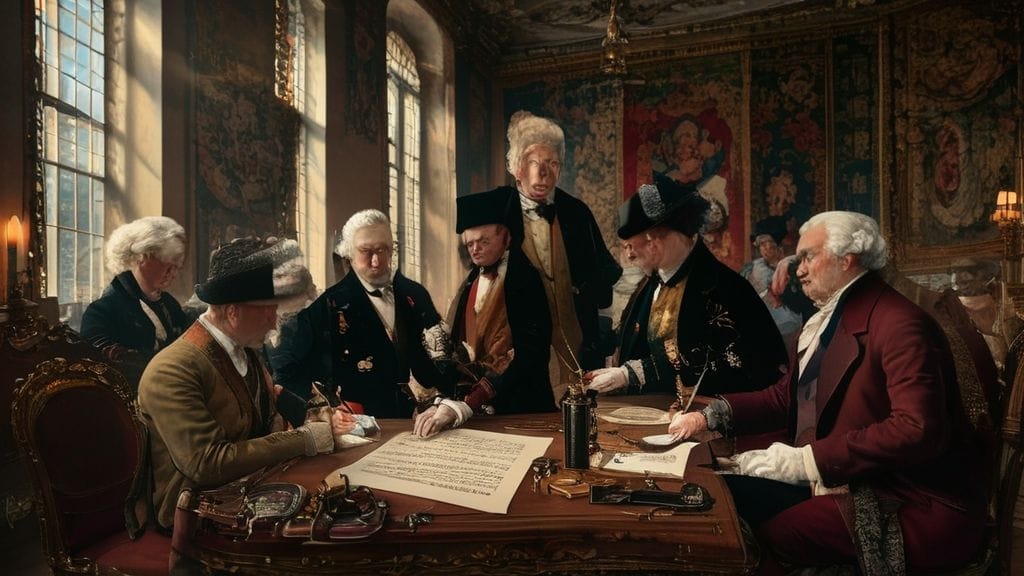
In one room, cartographers laid out maps like operating tables, the scars of war visible in little red and blue marks. Around a long table, diplomats exchanged final glances over the text. The silence before the signatures was deep and fragile. Each man understood, in his own way, that what he was about to endorse would outlive him, shaping the fates of millions who would never know his name. Then quills were dipped, hands steadied, and the treaty of paris 1763 was signed—its date, 10 February, stamped onto history. The roar of the cannons had been replaced by a quieter sound: the scratch of pen on paper, binding empires to a new order they only dimly grasped.
An Empire’s Gamble: How the Seven Years’ War Set the Stage
To grasp what this treaty meant, one has to step back from that February day and look at the inferno that preceded it: the Seven Years’ War, sometimes called, with grim accuracy, the first true world war. The conflict formally began in 1756, but its sparks were lit earlier in contested valleys west of the Appalachians, where French, British, and Indigenous forces clashed over who would command the interior of North America. At stake was more than forest or fur; it was the future framework of empire itself.
In Europe, the war rearranged old alliances. Britain stood with Prussia, France with Austria and eventually Spain; all believed the coming struggle could secure a definitive advantage. Governments on both sides gambled that crushing debts would be justified by future gains in land, trade, and prestige. A British pamphleteer, observing the frenzy, wrote with bitter irony that “we stake upon this throw the fortune of the nation entire.” His words, preserved in a London archive, now read like a commentary on the very logic that led to the treaty of paris 1763.
Battles raged on several continents. In Europe, Frederick the Great’s Prussia fought for survival in a war of attrition. In India, rival trading companies—backed by British and French arms—turned commercial rivalries into sieges and massacres. In the Caribbean, sugar islands were blockaded and seized, their economies of enslaved labor treated like chips at a table. In North America, the war was brutal and intimate. Ill-equipped provincial militiamen tramped through snow and mud, while Indigenous warriors weighed their alliances with hard-eyed pragmatism, aware that any victor could threaten their lands.
By 1759–1760, a pattern had emerged. Britain, drawing on its navy and financial system, was winning. The fall of Quebec in 1759, followed by the capitulation of Montreal in 1760, tore the heart out of New France. French garrisons in the Caribbean and India struggled to hold on under blockade. Spanish entry into the war late in 1761 only compounded Bourbon losses as British forces targeted Havana and Manila. Yet behind every British victory lay mounting costs: subsidies to allies, unprecedented naval expenditures, and credit stretched to its limit. The peace to come, whatever form it took, would be written not just in glory but in ledgers.
Rival Visions of the World: Britain, France, and Spain Before 1763
Long before the treaty of paris 1763, the three principal signatories had developed different visions of empire, shaped by geography, culture, and historical experience. Britain, an island nation with a powerful navy and a vibrant commercial culture, had increasingly bet its future on sea power and overseas trade. Its colonies along the eastern seaboard of North America were already home to more than a million settlers by mid-century, their economies ranging from tobacco to shipbuilding, their towns buzzing with printers, taverns, and assemblies. The Atlantic to them was not a barrier but a highway.
France, by contrast, had cultivated a more dispersed but sophisticated imperial network. New France stretched like a crescent from the Gulf of St. Lawrence down the Mississippi to Louisiana, its population much smaller but its strategic position formidable. Rather than overwhelming Indigenous nations with numbers, French administrators built alliances, trading relationships, and missionary networks. In the Caribbean, French sugar islands were among the richest pieces of real estate on earth, their wealth extracted at a horrific human cost from enslaved Africans. In India, the French presence competed fiercely with British merchants for influence over local rulers.
Spain’s empire was the oldest of the three, vast and in some ways brittle. Holding most of Central and South America, along with parts of North America and key Caribbean territories, Spain governed through intricate bureaucratic systems, a deeply entrenched Catholic Church, and long-distance convoys. Silver from the mines of New Spain and Peru flowed to Madrid, but so too did tales of corruption, inefficiency, and smuggling. When Spain joined its Bourbon cousin France in the Seven Years’ War, it did so to defend an empire that had grown difficult to reform yet impossible to relinquish.
Each of these powers arrived at the negotiating table in Paris in 1763 carrying not just battle reports but an entire mental map of what empire should be. For Britain, colonies were engines of trade and consumption, markets for manufactured goods, sources of raw materials. For France, overseas possessions were levers in a European balance-of-power game, valuable but ultimately secondary to the continental theater. For Spain, empire was a matter of dynastic legacy and spiritual mission as well as economics. The treaty would force all three to redefine these visions—whether they wished to or not.
Behind Closed Doors: Diplomats, Intrigue, and the Road to Paris
Peace does not arrive on a battlefield; it emerges from months of letters, hints, and secret feelers. Even as cannons roared, negotiators were probing for exits. By 1761, exhausted by losses and fearful of further humiliation, France signaled its willingness to explore terms. The first steps occurred not in public forums but in the shadows—through envoys in neutral courts, unofficial intermediaries, and encrypted correspondence that crossed the Channel under assumed names.
One of the pivotal figures in this diplomatic dance was Étienne-François de Choiseul, France’s foreign minister, who understood the need to arrest France’s decline without sacrificing its future options. On the British side, the formidable William Pitt the Elder had driven the war effort with an almost prophetic intensity but resigned in 1761 when he felt the government was drawing back from total victory. His fall opened the way for more accommodating ministers to contemplate peace. “We may gain the world and lose it again in the paying for it,” one British MP warned, in a line that anticipates the nervous calculations behind the treaty of paris 1763.
Talks began in earnest in 1762, mediated in part through the Spanish court and neutral powers. The choice of Paris as the venue for the final accords carried a bitter irony. For the French, it offered a chance to at least host the peace, if not dictate its terms; for the British, it was a reminder of their adversary’s enduring cultural prestige. Within the city, diplomatic compounds became fortified islands of anxiety, where envoys scrutinized each other’s moods as carefully as they read drafts of proposed articles.
Negotiations were contentious. British demands for vast territorial concessions in North America and the Caribbean met with French resistance; Spain wrangled over Havana and Manila, seized by British arms. Every colony on the table was weighed not just for its intrinsic value but for what it represented in the shifting balance of power. Sugar islands could yield immense revenue, but a sprawling mainland territory promised strategic depth and demographic potential. The wrangling often grew personal, tempers frayed, and yet the logic of exhaustion prevailed. By late 1762, the outlines of peace were clear: France and Spain would cede, Britain would gain, but the settlement would be framed as a mutual restoration of harmony.
The City as Witness: Paris in the Shadow of Defeat
While diplomats pored over clauses, Paris lived through its own drama. The war had not brought enemy soldiers to its gates, but it had carved invisible trenches through the city’s daily life. Prices climbed as supplies dwindled; rumors spread faster than accurate news. In coffeehouses, men argued over military dispatches reprinted in clandestine sheets; in markets, women cursed shortages and whispered that the king’s advisers had betrayed France. The signing of the treaty of paris 1763 did not come as a thunderbolt—it arrived as the confirmation of a long, slow sinking feeling.
Louis XV remained a distant, almost spectral presence to most Parisians, secluded in Versailles. Yet his reputation had suffered badly. The glory of Louis XIV’s age still loomed large in the public imagination, and comparisons were cruel. Satirical verses, circulated in manuscript, mocked the court’s incompetence and lamented the loss of Canada and other territories. One popular quip dismissed the king as “Louis the Well-Beloved—by our enemies.” Such lines, while exaggerated, captured the mood of humiliation that hung over the capital when the peace became public.
At the same time, Paris retained its confidence as Europe’s intellectual and cultural nerve center. Philosophes debated the meaning of empire and war; merchants considered how to adjust to new patterns of trade; military officers brooded over reforms. A few sharp-minded observers sensed that the supposed catastrophe might in the long run free France from certain costly burdens. Voltaire, always ready with a paradox, famously dismissed Canada’s loss as “a few acres of snow”—a remark that has survived more as provocation than analysis, yet reflects how some elites prioritized nearer, more profitable colonies over far-flung territories.
In the streets, though, subtle shifts marked the day of the signing. Church bells rang not in jubilation but in formal acknowledgment of peace. Government officials tried to choreograph a narrative of stability: the king, they insisted, had secured the best terms possible in a difficult situation. But this was only the beginning of a new chapter of doubt in the French public sphere. The treaty’s shadow would contribute, in ways no one yet foresaw, to a growing sense that the monarchy was fallible, vulnerable, and perhaps undeserving of unquestioned loyalty.
Signing Away a Continent: Inside the Treaty Room
Imagine, for a moment, the silence inside the room where the treaty text lay waiting. Heavy curtains muffled the faint street sounds. Wax candles, their light softened by smoke, cast an amber glow on faces tired from months of negotiation. Parchment sheets, bearing dense lines of French and English, sat on the polished table. Maps leaned against the walls like mute witnesses, their colored borders about to be redrawn.
The British delegation, resplendent in formal dress, carried the air of calculation rather than triumph. They knew that posterity might mark this moment as the pinnacle of British imperial power, but they also knew what the bills from the war looked like. The French envoys, equally elegant but more solemn, approached the table as men who had failed on the battlefield yet might still salvage something in the archives. Spanish representatives, more peripheral yet keenly interested in Cuba and Florida, watched to ensure their own losses were contained.
When the documents were read aloud, in the precise language of diplomacy, certain phrases stood out like exposed nerves: “cede and guarantee,” “evacuate,” “restore,” “renounce.” Those words, repeated in article after article, captured the essence of the treaty of paris 1763: territory would be traded for peace; paper would replace powder; old claims would be abandoned in favor of new arrangements. Each signature affixed beneath them was both personal and national, committing entire populations to a future none could fully predict.
As the last quill was laid aside, a strange quiet fell. Formal congratulations were exchanged, courtesies observed, the choreography of diplomacy performed. But behind the nods and polite words, there were darker currents of doubt. Would this treaty truly end the cycle of violence, or merely reconfigure it? Had France sacrificed too much, or prudently cut its losses? Could Britain manage the expansive empire it had just claimed? And what of those who had never been consulted at all: Indigenous confederacies, enslaved populations, colonial assemblies buzzing with rumor an ocean away? They were not in the room, and yet the ink drying on the table would shape their destinies most of all.
Lines on a Map: Territorial Changes in Europe and the Wider World
The treaty of paris 1763 was, in many ways, a cartographer’s document. Its most dramatic provisions concerned land, coastlines, and sovereignty—transformations that looked deceptively clean when represented in colored washes on parchment. In Europe itself, the changes were relatively modest compared to those overseas. France returned several captured territories in exchange for concessions elsewhere; Britain gave back some continental acquisitions, preferring to solidify its naval and colonial gains. The continent’s intricate balance of power remained intact, at least on paper.
Beyond Europe, however, the treaty produced a geopolitical earthquake. France ceded to Britain vast stretches of North America, including Canada and its claims east of the Mississippi River (except for the tiny yet symbolically important islands of Saint Pierre and Miquelon). To Spain, France transferred Louisiana—still vaguely defined but understood to encompass the Mississippi Valley west of the river—as compensation for Spain’s own losses. Spain, in turn, ceded Florida to Britain in exchange for the return of Havana, captured in 1762, thereby shifting the line between British and Spanish America.
In the Caribbean, the delicate arithmetic of sugar took center stage. Britain had seized several French islands during the war, including Guadeloupe and Martinique, which proved lucrative prizes. Yet in the final settlement, London chose to return some of these plantations in favor of retaining Canada and other strategic points, a decision that sparked intense debate among contemporaries. Many British merchants had argued that a few rich sugar islands were worth more than a snowy mainland populated by fractious colonists. The government’s choice to prioritize North American territory over Caribbean wealth would exert profound long-term consequences.
The treaty extended its reach to Africa and Asia as well. France regained certain trading posts on the West African coast but saw its broader ambitions sharply curtailed. In India, the agreement restored some French factories but forbade them from fortifying these outposts or maintaining large military forces, effectively acknowledging British supremacy on the subcontinent. Thus, the treaty of paris 1763 did more than rearrange a few colonies; it signaled a shift in global power, with Britain emerging as the dominant maritime and commercial force of the age.
North America Redrawn: From New France to British Dominion
Nowhere were the treaty’s effects more dramatic than in North America. The map that had, for over a century, shown a French presence stretching from the cold banks of the St. Lawrence to the warm delta of the Mississippi was suddenly altered. New France, as a political entity, effectively ceased to exist. Britain’s flag now flew above Quebec and Montreal, over outposts in the Great Lakes region, and across territories east of the Mississippi that few British officials had ever seen with their own eyes.
For the French inhabitants of Canada—about 60,000 people at the time—the change was profound yet ambiguous. The treaty guaranteed them the right to practice the Catholic faith and retain their property, but the institutions governing their lives were transformed. British military governors arrived, followed by civil administrators who sought to integrate the former French colony into the British imperial system. Priests, seigneurs, and merchants all had to recalibrate their loyalties. Many ordinary habitants remained attached less to distant monarchs than to their land, language, and parish; they watched the new regime cautiously, wary but resigned.
In the British colonies along the Atlantic seaboard, the reaction was mixed. On the one hand, the removal of the French threat from the north and west was hailed in sermons and celebrations. Colonists had long been told that French and Indigenous forces menaced their frontiers; now, with the treaty of paris 1763, that specter seemed to vanish. Yet behind the celebrations lay a subtle unease. British troops remained stationed in North America in significant numbers, ostensibly to guard the new frontiers. London officials began to speak of reorganizing colonial governance, tightening customs enforcement, and finding new ways to make the colonies contribute to the cost of their own defense.
The reconfiguration of North America also sharpened contestations over land. British speculators cast hungry eyes on the Ohio Valley and beyond, imagining endless plantations and townships. Settlers pushed against the Appalachian barrier. But the lands they coveted were not empty; they were the homelands of powerful Indigenous nations who had long navigated between French and British spheres of influence. With the French gone from the official map, Indigenous leaders faced a new and perilous diplomatic landscape, in which Britain often behaved less as a partner than as an owner.
The Caribbean and Beyond: Sugar Islands, Slave Routes, and Silent Costs
If Canada’s ceded forests occupied a large surface on the treaty map, the Caribbean’s sugar islands occupied a large space in European treasuries. In the calculating eyes of 18th-century finance ministers, a tiny island dense with sugar plantations and enslaved laborers could be worth more than vast continental expanses. During the negotiations leading to the treaty of paris 1763, the fate of islands like Guadeloupe, Martinique, and Tobago was debated with an intensity that reveals the centrality of Caribbean slavery to imperial wealth.
France managed to recover several of its sugar islands, a diplomatic success that would help fuel its economy in subsequent decades. Britain retained others, including Grenada and certain smaller territories, while Spain secured a continued presence in Cuba after trading away Florida. On paper, these exchanges were framed as rational adjustments, restoring a commercial equilibrium. In reality, they meant that hundreds of thousands of enslaved Africans would continue to endure unimaginable brutality to sustain the sweet tastes and profits enjoyed in European capitals.
The treaty’s articles said nothing directly about slavery; enslaved people appear only as property to be restored or compensated when owners fled with them during the war. Yet the silence was itself a statement, an unspoken recognition that the entire Atlantic system of sugar, rum, tobacco, and cotton rested on coerced labor. By redistributing islands without questioning the structure of plantation society, the treaty locked both victors and vanquished into a shared complicity. The peace of 1763, in that sense, was built upon continued violence in cane fields and slave ships.
Beyond the Caribbean, the treaty reshaped commercial routes along the coasts of Africa and in the Indian Ocean. British control of key points allowed it to expand its involvement in the transatlantic slave trade, even as French and Spanish traders adjusted their strategies. In India, restrictions placed on French forts and armies created space for the British East India Company to deepen its political grip. The treaty thus acted as a hinge, connecting European diplomacy to the everyday realities of coerced labor, commerce, and cultural exchange across oceans.
India and the Eastern Seas: The Global Reach of a European Treaty
Though often remembered for its impact on North America, the treaty of paris 1763 also marked a decisive moment in the struggle for influence in India and the wider eastern seas. For decades, French and British trading companies had competed for access to textiles, spices, and the favor of local rulers. The Carnatic Wars—fought in part by these companies with European and Indian soldiers—turned commercial rivalry into open conflict, with sieges of ports like Madras and Pondicherry sending shockwaves back to European ministries.
By the time of the peace negotiations, British forces, allied with key Indian powers, held a clear advantage. The treaty confirmed this superiority in subtle but significant ways. It restored some French trading posts, such as Pondicherry, Chandernagore, and others, but imposed restrictions that prevented France from rebuilding them as fortified bastions or bases for major military operations. In essence, France’s role in India was downgraded from potential imperial power to commercial participant, relegated to a junior position in a theater where it had once dreamed of dominance.
British officials understood the long-term stakes. Control over Indian revenue streams, armies, and trade routes offered not just wealth but leverage in European politics. The relative marginalization of French influence after 1763 opened the door for the British East India Company’s expansion into territorial rule, a process that would accelerate in the decades that followed. Meanwhile, Indian rulers saw their diplomatic options narrowed; where once they could balance French against British offers, they now faced a more asymmetrical relationship, with the British able to dictate terms more confidently.
In the eastern seas, from the Cape of Good Hope to Southeast Asia, the patterns set by the treaty contributed to a world in which British naval power increasingly framed the rules. French ambitions were not extinguished—far from it—but they would have to be expressed within constraints shaped at the negotiating table in Paris. The ripples from those clauses would be felt in places that few of the signatories had ever seen, and in languages they did not speak, yet their impact was no less real for being distant.
Winners, Losers, and the Illusion of Victory
In the months following the signing of the treaty of paris 1763, London rang with self-congratulation. Newspapers, broadsides, and sermons proclaimed a new British age. One jubilant commentator boasted that Britain now stood “the envy and admiration of the world,” while paintings celebrated victories at Quebec, Minden, and Plassey. The public mood favored a narrative of triumph: the war had been hard, but the peace, it seemed, had justified the sacrifices.
Yet beneath this surface triumph lay a more complicated reality. Britain had indeed acquired a vast new empire, but it had also accumulated an unprecedented national debt—over £130 million, a staggering sum at the time. Maintaining troops across newly won territories, patrolling expanded coastlines, and administering colonial governments would all require ongoing expenditure. Victory had not solved Britain’s fiscal challenges; it had magnified them. The search for revenue would soon lead ministers to look to the American colonies as a source of funds, with consequences they could not yet foresee.
France, officially the loser, did not see itself as permanently defeated. Some French observers believed that shedding the burdens of Canada and certain other territories could allow the state to concentrate resources on more profitable ventures and on rebuilding its navy. Choiseul and others contemplated a future in which France might strike back in a new war under more favorable conditions. The humiliation of 1763, they thought, might be temporary—an interlude rather than an ending.
Spain’s position was similarly ambiguous. The loss of Florida to Britain weighed heavily, but the recovery of Havana and the acquisition of Louisiana from France offered compensation. Spanish statesmen recognized that the Bourbon alliance had cost them dearly, yet they also saw opportunities in consolidating their hold over continental America. In a sense, all three powers walked away from the treaty convinced that they still had a future as great empires, even if the rankings had changed.
Who, then, truly “won” the peace of 1763? The answer depends on the timescale. In the short term, Britain’s territorial and commercial gains were undeniable. In the longer view, however, the burdens of empire and the discontents it bred—especially in North America—would challenge any simple narrative of victory. The treaty was as much a starting point for new conflicts as it was an end to an old one.
On the Ground: Indigenous Nations and the Price of Paper Peace
Perhaps the most tragic irony of the treaty of paris 1763 lies in the fact that some of its most deeply affected peoples were not represented at the table at all. Indigenous nations across North America had fought, negotiated, and suffered throughout the Seven Years’ War. Haudenosaunee (Iroquois) diplomats, Great Lakes confederacies, Ohio Valley peoples such as the Shawnee and Delaware, and many others had navigated between French and British interests with skill and determination. For them, the war was not an abstract contest between distant kings but a struggle over homelands, trade, and survival.
When the treaty transferred sovereignty over vast interior regions from France to Britain, it did so with complete disregard for Indigenous conceptions of land and authority. European diplomats treated these territories as possessions to be handed from one crown to another, as if the complex web of alliances, treaties, and understandings that Indigenous leaders had built with the French could be simply erased. The practical result was to leave Britain facing Indigenous nations that had not consented to any such rearrangement and who saw British expansion as a new and perhaps greater threat.
Resistance was swift. In 1763, only months after the treaty, a widespread Indigenous uprising known commonly as Pontiac’s War or Pontiac’s Rebellion erupted in the Great Lakes and Ohio regions. Leaders like Pontiac, an Ottawa war chief, sought to drive British garrisons from their forts and to reassert Indigenous autonomy. The rebellion was fueled not only by fears of land loss but also by British policies that ignored established gift-giving practices and restricted access to trade goods. In this sense, the war of 1763–1764 was a direct answer to the paper decision taken in Paris.
The British government, shaken by the scale of this resistance, responded with both repression and policy shifts. Later in 1763, the Crown issued the Royal Proclamation, drawing a line along the Appalachian Mountains beyond which colonial settlement was officially prohibited. While the proclamation recognized, in a limited way, the existence of Indigenous land rights, many colonists resented it as an obstacle to their expansionist ambitions. Once again, the peace terms intended to stabilize empire instead inflamed tensions on multiple fronts.
Colonial Discontent: How 1763 Lit the Fuse of Revolution
For Britain’s American colonists, the end of the war and the signing of the treaty of paris 1763 initially seemed to herald a golden age. The French were gone from Canada; Spanish Florida now lay under the British flag; the path west appeared open. Church bells rang, militia units paraded, and newspaper editors filled columns with extravagant praise for the mother country. The colonies had contributed men and material to the war effort, and many colonists saw themselves as full partners in a shared imperial triumph.
Yet the glow of victory soon dimmed. The very success of the war had created new problems. Maintaining garrisons in the interior, administering new territories, and servicing the national debt all demanded revenue. British ministers, looking at the colonies’ growing wealth, asked themselves why imperial subjects in America should not bear more of the cost. At the same time, the Royal Proclamation Line of 1763 angered land speculators and settlers eager to move west. To many colonists, it seemed that the same government they had just helped to a great victory was now blocking their aspirations.
In the years that followed, a series of measures would deepen this rift: the Sugar Act (1764), the Stamp Act (1765), and other attempts to regulate trade and raise revenue sparked protests, boycotts, and, eventually, outright defiance. Colonial leaders cited their rights as Englishmen, insisting that taxation without representation violated the very principles they believed the empire to embody. The memory of the recent war—of shared sacrifices and expectations—made these grievances sharper. It felt to many colonists that the balance of the imperial relationship had been altered without their consent, not unlike how Indigenous nations felt about the redrawn frontiers.
Historians have often drawn a direct line from the peace of 1763 to the outbreak of the American Revolution a dozen years later. While this connection should not be reduced to a simple cause-and-effect chain, it is clear that the treaty of paris 1763 created the conditions for a fundamental rethinking of empire on both sides of the Atlantic. As one colonial pamphleteer wrote in the late 1760s, “The fruits of victory have proved bitter to our taste.” The war that had removed France as a rival in North America also removed one of the key reasons many colonists had accepted British military presence and political oversight. Without a French threat, imperial authority looked less like protection and more like interference.
Voices from the Metropoles: Parisian Disillusion and London’s Uneasy Triumph
While colonial taverns buzzed with new arguments, the old capitals of London and Paris grappled with their own postwar reckonings. In Paris, the treaty of paris 1763 deepened a crisis of confidence in monarchy and ministry alike. Intellectuals and armchair strategists debated what had gone wrong. Some blamed cowardly generals, others corrupt courtiers, still others the inefficiency of the financial system. The humiliations of the war, combined with new fiscal pressures and social tensions, contributed to a growing sense that the Bourbon regime was incapable of matching Britain in the new era of global competition.
French writers did not speak with one voice. Voltaire’s quip about “a few acres of snow” in Canada, often torn from context, suggested that losing North American territories might be less damaging than it seemed, especially if France retained its rich Caribbean colonies and focused on commerce. Others warned that the loss of prestige would weaken France’s bargaining power in Europe and beyond. The seeds of a more radical critique—that the state required fundamental political and social reform—were beginning to germinate, though their full flowering would come only decades later, in 1789.
In London, by contrast, the mood oscillated between triumphalism and anxiety. Parliamentarians boasted of an empire upon which the sun never set. At the same time, sharp minds worried about the sustainability of such an extensive dominion. Pamphlets and debates wrestled with questions that would haunt the rest of the century: Should Britain govern its colonies with a firmer hand, or grant them more autonomy? How could the state raise the necessary revenues without provoking unrest? What did it mean to be British in a world where subjects lived thousands of miles away under very different conditions?
The cultural dimensions of this shifting imperial identity were visible in art, literature, and public rituals. Victories were commemorated in monuments and medals, yet the human cost of the war—dead soldiers, ruined families, displaced peoples—rarely appeared in these celebratory narratives. The uneasy coexistence of pride and doubt in London’s public life after 1763 mirrored the deeper contradictions of the British Empire itself: expansive yet vulnerable, wealthy yet indebted, confident yet haunted by the possibility of overreach.
A New Imperial Logic: Debt, Taxation, and Governance After 1763
Beneath the dazzling rhetoric of glory, a more prosaic reality drove policy in the wake of the treaty of paris 1763: numbers, columns, and balances. Britain’s national debt had soared during the war, and servicing it consumed a growing share of government revenue. Politicians who celebrated the empire’s expansion now faced the mundane but urgent question of how to pay for it. The answer, they concluded, lay in tightening the imperial system and extracting more resources from its peripheries.
This new logic manifested in a series of administrative and fiscal reforms. Customs officials were given greater authority to crack down on smuggling, especially in the American colonies. New taxes on sugar, legal documents, and other goods were introduced or enforced more stringently. While none of these measures alone would have been unprecedented, their cumulative effect signaled a clear shift: the colonies were no longer to be treated primarily as semi-autonomous partners in a shared commercial venture, but as revenue-generating components of a more centralized imperial structure.
Simultaneously, London attempted to regulate colonial expansion more carefully. The Royal Proclamation Line, though often ignored in practice, reflected a desire to avoid costly further conflicts with Indigenous nations and to manage the distribution of western lands in a more orderly fashion. Some in Britain proposed creating new inland colonies; others suggested reorganizing existing ones. These debates were underpinned by a conviction that imperial governance needed a firmer, more rational hand—an attitude that clashed with colonial traditions of local self-rule and negotiated autonomy.
France and Spain, too, embarked on their own postwar reforms. French ministers sought to modernize the state’s finances, rebuild the navy, and encourage economic development in remaining colonies. Spanish officials pursued the so-called Bourbon Reforms, aimed at tightening royal control over colonial administration and commerce in the Americas. In all three empires, the period after 1763 witnessed attempts to turn wartime lessons into peacetime structures. Many of these reforms, however, generated new tensions, as subjects resisted efforts to curtail local privileges and impose uniform systems from distant capitals.
Memory, Myth, and the Making of Modern Nations
Over time, the events of 1763 retreated from immediate politics into the realm of memory—yet they continued to exert a quiet power. In Britain, the treaty of paris 1763 became an emblem of imperial greatness, invoked in later decades as a moment when the nation had stood at the summit of global influence. Schoolbooks and patriotic histories celebrated its outcomes, even as the empire it helped create fractured with the loss of the American colonies in the 1780s.
In Canada, the treaty marked a foundational rupture. The end of French rule and the institutionalization of British authority laid the groundwork for a distinctive society shaped by both French and British legacies. Debates over language, religion, and law in Quebec and beyond trace their roots back to the compromises and continuities that followed 1763. For Francophone communities, the treaty represented both a loss of political sovereignty and the beginning of a long negotiation over cultural survival within a British—and later Canadian—framework.
For the United States, which did not yet exist in 1763, the treaty and its aftermath became part of a broader revolutionary narrative. Schoolchildren would one day learn that the removal of France from North America opened space for independence, while British efforts to consolidate their empire after the war sparked colonial resistance. In this story, 1763 is often treated as a prologue to 1776, the moment at which imperial bonds began to strain. While this teleological view can oversimplify, it testifies to how deeply the treaty’s consequences seeped into American political mythology.
Indigenous memories of the treaty and its ripple effects are of a different kind, often passed down in oral traditions rather than written chronicles. For many nations, 1763 signaled the beginning of a new, more relentless phase of dispossession. The Royal Proclamation’s partial recognition of Indigenous land rights stood alongside the accelerating erosion of those same rights in practice. Stories of resistance, adaptation, and survival in the face of expanding British and later American settlement form a counter-history to the celebratory narratives of imperial triumph.
Echoes Through Centuries: Why the Treaty Still Matters Today
More than two and a half centuries after the ink dried in that Parisian room, the treaty of paris 1763 continues to shape political boundaries, cultural identities, and historical debates. Modern maps of North America, with a largely Anglophone Canada adjacent to a predominantly English-speaking United States and a Spanish-speaking Latin America, reflect decisions and trajectories crystallized in that moment. Without the removal of France as a major territorial power in North America, it is difficult to imagine the same pattern of state formation emerging.
Contemporary discussions about reconciliation with Indigenous peoples in Canada and the United States also intersect, indirectly but importantly, with the legacy of 1763. The Royal Proclamation, issued in the same year as the treaty and shaped by the same context, is still cited in legal and political debates regarding Indigenous land claims. Its ambiguous promise—to recognize certain rights while still asserting ultimate Crown sovereignty—embodies the contradictions born in the treaty’s wake. Efforts to address historical injustice must grapple with the deep roots of dispossession that reach back to this era.
At a global level, the treaty offers a case study in how wars that range across continents can end without truly resolving the tensions that caused them. Historians often compare the peace of 1763 with later settlements, such as the Congress of Vienna in 1815 or the Paris Peace Conference of 1919, noting recurring themes: the temptation to impose victor’s justice, the difficulty of accommodating diverse interests, the blind spots regarding peoples without representation at the table. One historian has aptly called the treaty of paris 1763 “a triumph of statecraft and a failure of imagination,” capturing how skillfully it rearranged imperial claims while failing to envision more inclusive or equitable futures.
For individuals tracing their own family histories—whether descended from French settlers in Quebec, British colonists in New England, enslaved Africans in the Caribbean, or Indigenous nations across the continent—the treaty is not a distant abstraction. It is part of the dense web of events that determined where ancestors lived, under whose laws, and in what languages. The quills that moved across parchment in Paris on that winter morning may feel far removed from today’s world, yet their strokes continue to define the spaces we inhabit and the stories we tell about how we came to be here.
Conclusion
On that cold day in February 1763, when diplomats in Paris set their signatures to a long, carefully worded document, they believed they were putting an end to a war that had nearly exhausted Europe. In one sense, they were right: the treaty of paris 1763 did still the guns of the Seven Years’ War and usher in a period of formal peace between Britain, France, and Spain. But in another, deeper sense, they had merely shifted the terrain of conflict. The agreements reached in those rooms transformed the structure of empires, altered the balance of power, and redrew the maps that ordinary people would live under for generations.
By stripping France of most of its North American possessions, recognizing Britain’s supremacy in India, and reshuffling Caribbean and American territories, the treaty helped to create a new kind of global order—one in which the British Empire appeared dominant but also dangerously stretched. The costs of that dominance would soon be felt in financial crises, colonial resistance, and, ultimately, the American Revolution. France’s apparent defeat concealed a period of introspection and reform that would later allow it to challenge Britain again, even as it stumbled toward its own revolutionary upheavals.
For Indigenous nations and enslaved peoples, the peace of 1763 brought no true respite. Their lands and labor remained objects of imperial calculation, their rights hardly acknowledged in the diplomatic prose that reshaped their world. In this sense, the treaty stands as a reminder that the end of one war can coincide with the continuation—or intensification—of other forms of violence and dispossession. The voices absent from the negotiating table are as important to the story as those present.
Looking back, what emerges most clearly is the treaty’s dual nature. It was at once a product of its time—crafted within the assumptions and limitations of 18th-century statecraft—and a turning point whose consequences reached far beyond what its authors imagined. The treaty of paris 1763 helped set in motion the chain of events that would lead to new nations, new revolutions, and new struggles over freedom and power. Its legacy invites us to reflect on how peace is made, who gets to make it, and how the lines drawn in quiet rooms can echo, for good or ill, across centuries.
FAQs
- What was the main purpose of the Treaty of Paris 1763?
The main purpose of the treaty of paris 1763 was to bring an end to the Seven Years’ War between Britain, France, and Spain by formally settling territorial disputes and redefining imperial boundaries, especially in North America, the Caribbean, and India. - Which countries were the principal signatories?
The principal signatories were Great Britain, France, and Spain, with Portugal also involved in related arrangements. Each power ceded and received territories according to the agreed articles. - How did the treaty affect North America?
The treaty profoundly reshaped North America by transferring Canada and French territories east of the Mississippi River to Britain, granting Louisiana to Spain, and ceding Florida from Spain to Britain. This effectively removed France as a major territorial power on the continent. - Why is the Treaty of Paris 1763 linked to the American Revolution?
After 1763, Britain attempted to manage and finance its enlarged empire by imposing new taxes and regulations on its American colonies, while also restricting westward expansion. These policies fueled colonial resentment, contributing significantly to the causes of the American Revolution. - What impact did the treaty have on Indigenous peoples?
Indigenous nations were not consulted in the negotiations, yet their lands were traded between empires as if they were empty. The shift from French to British control in the interior, combined with settler pressure, provoked conflicts such as Pontiac’s War and marked a new, often harsher phase of dispossession. - Did the treaty address slavery in the Caribbean?
The treaty did not directly address slavery, but by reallocating sugar islands among European powers, it reinforced the plantation system and the transatlantic slave trade. Enslaved Africans remained central to the economies of the Caribbean colonies affected by the settlement. - How did the treaty change the balance of power in India?
The treaty restored some French trading posts in India but restricted their fortifications and military presence, effectively acknowledging British predominance. This shift allowed the British East India Company to expand its political and territorial control in the following decades. - Why did France give up Canada but keep some Caribbean islands?
French policymakers judged that retaining profitable sugar islands in the Caribbean was economically more valuable than holding on to Canada, which they saw as costly to defend and develop. This calculation, while controversial, reflected contemporary priorities in mercantilist thinking. - What role did debt play in shaping the post-1763 world?
Massive war debts pushed Britain, France, and Spain to reform their imperial systems, raise new taxes, and seek tighter control over their colonies. In Britain’s case, efforts to make American colonists help bear the financial burden were a key factor in escalating tensions. - Is the Treaty of Paris 1763 still relevant today?
Yes. Its legacy endures in modern borders, legal debates about Indigenous land rights, and the historical narratives of countries like Canada, the United States, and former colonial territories worldwide. The treaty is a pivotal reference point for understanding the origins of the modern Atlantic and global order.
External Resource
Internal Link
Other Resources
- Encyclopaedia Britannica – general search for the exact subject
- Google Scholar – academic search for the exact subject
- Internet Archive – digital library search for the exact subject

