Table of Contents
- The Dawning of a New Europe: Rome, March 25, 1957
- After the Ruins: Europe’s Shattered Landscape Post-World War II
- Seeds of Unity: From the European Coal and Steel Community to a Bold Vision
- The Architects of Integration: Key Figures Behind the Treaty of Rome
- The Political and Economic Context: Cold War Pressures and Recovery Ambitions
- Negotiations Under the Roman Sun: The Road to Signing the Treaty
- March 25, 1957: A Momentous Gathering at the Palazzo dei Conservatori
- The Treaty’s Core: Establishing the European Economic Community (EEC)
- The Euratom Treaty: Safeguarding Peaceful Atomic Energy Sharing
- The Vision of a Common Market: Breaking Down Barriers
- The Early Ambitions and Controversies: Skepticism and Hope
- Public Reception and National Responses Across Europe
- The Treaty’s Immediate Impact on Trade, Industry, and Diplomacy
- Challenges in Implementation: Economic Disparities and Political Hurdles
- The Cold War Dimension: East-West Tensions and the Western Bloc’s Solidarity
- A Foundation Stone for the European Union: The Treaty’s Enduring Legacy
- Cultural and Social Shifts Sparked by the Treaty of Rome
- The Treaty of Rome in Global Perspective: Influence Beyond Europe
- Commemorations and Reflections: How the Treaty is Remembered Today
- Lessons from 1957: Unity, Sovereignty, and the Quest for Peace
- Conclusion: The Treaty of Rome, A Dream Anchored in Reality
- FAQs about the Treaty of Rome
- External Resource
- Internal Link
1. The Dawning of a New Europe: Rome, March 25, 1957
Beneath a clear spring sky, the ancient city of Rome shimmered with a promise that would echo far beyond its piazzas and colonnades. On March 25, 1957, six nations gathered under the watchful eyes of history, determined to forge a path toward peace and shared prosperity. The Treaty of Rome was about to be signed—a seminal moment that would chart a new course for a continent scarred by relentless conflicts. This document was not just ink on parchment; it was a bold leap into a future where cooperation would replace rivalry, and unity would stand stronger than division. The air was thick with hope, cautious optimism, and a collective yearning for stability after decades of turmoil.
2. After the Ruins: Europe’s Shattered Landscape Post-World War II
Europe in the aftermath of World War II was a continent disfigured and weary. Cities lay in rubble, economies were in tatters, and the scars—both physical and psychological—ran deep. Yet amidst the devastation, a new desire emerged: to break free from the destructive cycles of nationalism and conflict that had led to two world wars within a lifetime.
The Marshall Plan had injected vital aid into Western Europe, catalyzing reconstruction and rekindling industrial production. Still, the question remained: how to ensure that old antagonisms would never again paralyze the continent? The seeds of collaboration were sown in this fertile but fragile ground.
3. Seeds of Unity: From the European Coal and Steel Community to a Bold Vision
The Treaty of Rome was preceded by an important experiment: the European Coal and Steel Community (ECSC), established in 1951. This novel institution placed the coal and steel industries—the backbone of military power—under a supranational authority. It was a daring attempt to fuse economies and prevent the kind of arms build-up that had sparked previous wars.
Success with the ECSC emboldened leaders to conceive broader integration. The idea was no longer just about specific industries but about creating an expansive common market, a unified economic space free of tariffs and trade barriers. The Treaty of Rome was this vision realized—a foundational pact founding the European Economic Community (EEC).
4. The Architects of Integration: Key Figures Behind the Treaty of Rome
Behind the Treaty of Rome stood a constellation of visionary statesmen, each bringing unique perspectives and national interests yet united by a shared dream.
Jean Monnet, often called the ‘Father of Europe,’ was the masterplanner whose blueprint had guided the ECSC and inspired broader unity. French Foreign Minister Christian Pineau, Italian Prime Minister Antonio Segni, and Dutch Foreign Minister Joseph Luns played pivotal roles, as did German Chancellor Konrad Adenauer and Belgian Foreign Minister Paul-Henri Spaak — whose preparatory work was critical.
Their commitment was extraordinary, given that the post-war scars ran deep, and fears about national sovereignty and economic control were still potent.
5. The Political and Economic Context: Cold War Pressures and Recovery Ambitions
The Treaty of Rome cannot be understood without situating it amid the early Cold War’s intense geopolitical tensions. Western Europe faced the Soviet threat looming to the east, while rising American influence was both reassuring and challenging. Integration was as much a political security project as an economic experiment.
Economic recovery was essential to sustain democratic regimes and resist Communist expansion. The EEC promised efficiencies from a common market that could invigorate growth, innovation, and global competitiveness—while creating solidarity among member states.
6. Negotiations Under the Roman Sun: The Road to Signing the Treaty
Negotiations were delicate, sometimes fraught with nationalist concerns and economic rivalries. The push for a common market met resistance from sectors protective of their tariffs and regulations; questions about supranational institutions worried governments protective of their sovereignty.
Yet, through patience and compromise, the signatories crafted a treaty balancing federalist ambitions with respect for national identities. The spirit of cooperation prevailed amid the historic grandeur of Rome, a city that had once ruled a vast empire, now hosting an alliance built on shared governance.
7. March 25, 1957: A Momentous Gathering at the Palazzo dei Conservatori
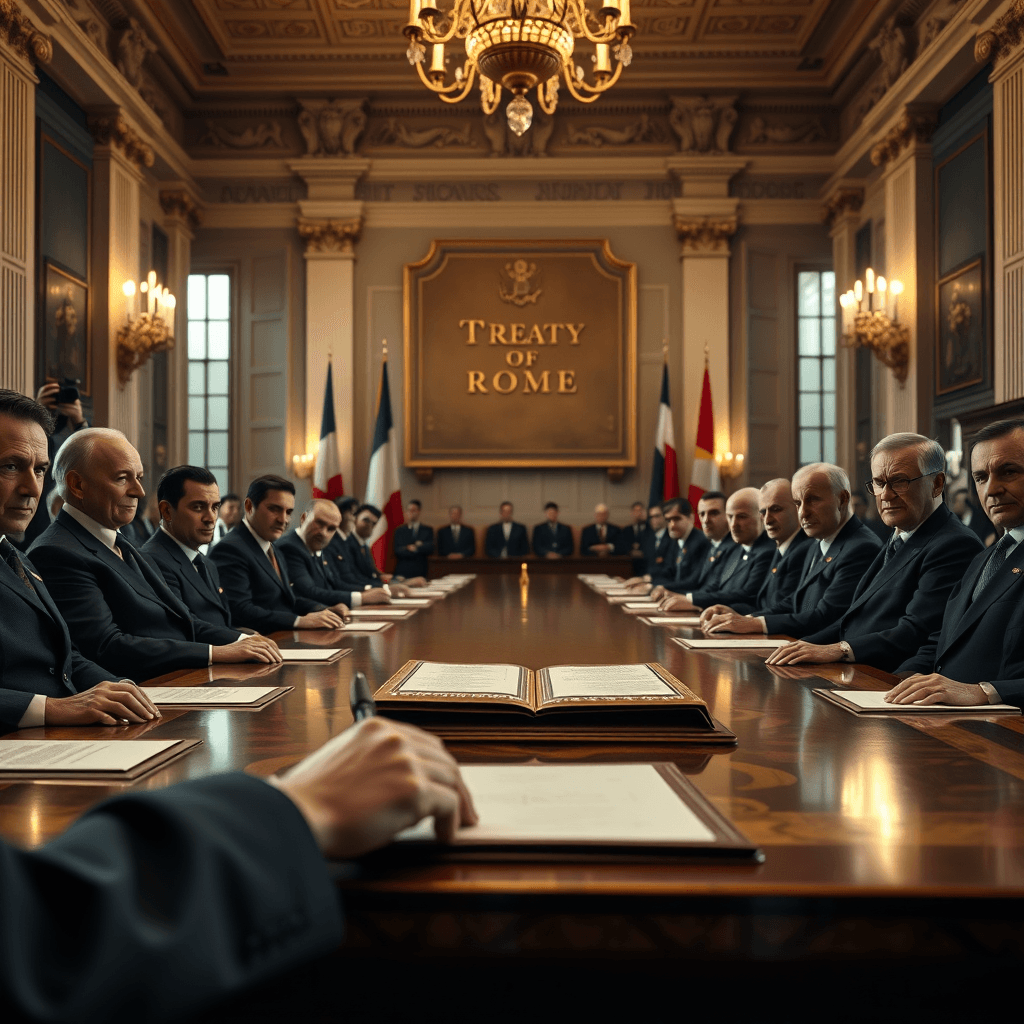
The day of the signing was electric with solemnity and celebration. Delegates from Belgium, France, Italy, Luxembourg, the Netherlands, and West Germany met in the Palazzo dei Conservatori on the Capitoline Hill—a symbolic site underscoring continuity with a legacy of governance and law.
The Treaty was signed amid media attention and public curiosity. It was hailed as a new chapter for Europe, a beacon shifting away from zero-sum politics to mutual gain. Yet many knew this was only the beginning of a long journey to integration.
8. The Treaty’s Core: Establishing the European Economic Community (EEC)
At its heart, the Treaty of Rome established the European Economic Community, aiming to create a customs union ensuring free movement of goods, services, capital, and labor. It also envisaged common policies in agriculture and transport, institutions to oversee integration, and courts to resolve disputes.
Remarkably ambitious for its time, the treaty sought to weave economies into a fabric so interdependent that war, with its costs and divisions, would become unthinkable.
9. The Euratom Treaty: Safeguarding Peaceful Atomic Energy Sharing
Companion to the EEC treaty, the Euratom Treaty facilitated cooperation in nuclear research and energy, ensuring atomic power was developed for peaceful purposes and shared fairly.
This foresight recognized atomic energy’s dual potential for progress and destruction—seeking to harness it safely within a united framework.
10. The Vision of a Common Market: Breaking Down Barriers
The treaty’s promise of a common market ignited hopes across industries and citizens alike. Tariffs would be lowered, customs controls dismantled, and labor mobility enhanced.
This was not only a dream of economic efficiency but also a profound social experiment—integrating peoples, laws, and institutions beyond mere commerce.
11. The Early Ambitions and Controversies: Skepticism and Hope
Although celebrated by many, the Treaty faced skepticism. Some feared loss of sovereignty; others doubted the feasibility of integrating diverse economies. Agricultural lobbies worried about competition; trade unions were cautious about labor mobility.
Still, the overriding ethos was hope—hope that centuries of conflict could yield to cooperation, propelled by a belief in shared destiny.
12. Public Reception and National Responses Across Europe
Reactions varied. In the founding countries, elites largely supported the treaty as a vehicle of modernization. Yet popular awareness was limited; mass understanding and approval would grow only slowly.
In other European nations, curiosity mingled with envy or exclusion, as Britain, for example, initially stayed outside, hesitating to join until later decades.
13. The Treaty’s Immediate Impact on Trade, Industry, and Diplomacy
The EEC’s creation was a powerful signal to global markets and political actors. It fostered increased internal trade, coordination of policies, and diplomatic clout. By harmonizing standards and reducing trade costs, it accelerated economic growth.
Diplomatically, it enhanced Western Europe’s position within the Atlantic alliance, bolstering stability during turbulent Cold War years.
14. Challenges in Implementation: Economic Disparities and Political Hurdles
Implementation was no simple feat. Economies differed greatly in scale and structure, requiring delicate adjustments. The need for common policies clashed sometimes with national interests, and bureaucratic complexity slowed some decisions.
Despite difficulties, the institutions proved resilient, adapting to challenges and progressively deepening cooperation.
15. The Cold War Dimension: East-West Tensions and the Western Bloc’s Solidarity
The Treaty of Rome also had a profound geopolitical undercurrent. It reinforced a Western bloc united both economically and politically, contrasting starkly with the Soviet sphere.
This integration was seen by some as a fortress of democracy and market economy—a bulwark against communist influence.
16. A Foundation Stone for the European Union: The Treaty’s Enduring Legacy
More than six decades later, the Treaty of Rome remains a foundational pillar of the European Union. It laid the constitutional and institutional groundwork from which the EU has grown into a political and economic union handling complex challenges.
Its spirit of integration against the backdrop of conflict is a testament to the transformative power of shared vision.
17. Cultural and Social Shifts Sparked by the Treaty of Rome
The treaty’s effects went beyond economics. It facilitated cultural exchanges, mobility of citizens, and a growing sense of European identity.
Universities, youth programs, and cooperation in arts and sciences flourished, gradually knitting together diverse cultures into a unified narrative.
18. The Treaty of Rome in Global Perspective: Influence Beyond Europe
The institution-building of the Treaty of Rome inspired other regional blocs around the world—from Mercosur in South America to ASEAN in Asia.
Its model provided lessons on sovereignty sharing, supranational governance, and the potential rewards of economic integration.
19. Commemorations and Reflections: How the Treaty is Remembered Today
Each year, Europe honors March 25 as Europe Day, commemorating the Treaty’s signing. It is a moment for reflection on achievements and challenges, a reminder of the promise of unity amid diversity.
Museums, educational programs, and debates keep its legacy alive for new generations.
20. Lessons from 1957: Unity, Sovereignty, and the Quest for Peace
The Treaty of Rome teaches that unity is work, fraught with compromises yet capable of profound rewards. It embodies the balance between national sovereignty and collective decision-making, illustrating how shared interests can redefine power.
It champions peace as a daily achievement, not a given.
21. Conclusion: The Treaty of Rome, A Dream Anchored in Reality
March 25, 1957, marked a turning point—not by erasing all differences, but by offering a framework where differences could coexist productively. The Treaty of Rome was an ambitious testament to hope, courage, and the human drive for connection.
Its legacy persists, reminding us that history is made by those daring enough to envision a better, shared future.
Conclusion
The Treaty of Rome, signed in the shadow of ancient ruins on a hopeful spring day, was far more than a legal document. It was a leap of faith, a collective vow by six nations to transform a war-ridden continent into a community of peace, prosperity, and shared destiny. The treaty seeded the European Economic Community, which would grow into the modern European Union—an entity unique in the annals of history for its bold experiment in supranational governance.
The challenges were immense, from economic disparities to political skepticism, yet the project endured. It reshaped economies, politics, and societies—rekindling a sense of European identity and offering a blueprint for peace through unity.
As Europe grapples with new trials today, the Treaty of Rome stands as a poignant reminder: progress demands courage, and unity requires persistent effort. It teaches that history’s weight can be lifted not by isolation, but by the bonds forged in common purpose. The Treaty of Rome was a dream anchored in reality, and its resonance continues to shape the contours of our shared future.
FAQs
Q1: What was the primary purpose of the Treaty of Rome?
The Treaty of Rome aimed to establish the European Economic Community, creating a common market with free movement of goods, services, capital, and labor among member countries, fostering economic integration and political cooperation to prevent future conflicts in Europe.
Q2: Which countries signed the Treaty of Rome?
Six countries signed the treaty on March 25, 1957: Belgium, France, Italy, Luxembourg, the Netherlands, and West Germany.
Q3: How did the Treaty of Rome relate to the European Coal and Steel Community?
The Treaty of Rome expanded on the ECSC, which was a sectoral integration focused on coal and steel. The Treaty created a broader economic community covering multiple sectors, deepening integration beyond just key industries.
Q4: What role did the Cold War play in the Treaty’s creation?
The growing political and military tensions with the Soviet Union motivated Western European countries to strengthen their unity economically and politically, making the Treaty part of a broader strategy to secure democratic stability and resist communist influence.
Q5: How has the Treaty of Rome influenced today’s European Union?
It laid the foundations for the EU’s institutions, principles, and policies. Many of the EEC’s core objectives, such as free trade and common regulations, remain central to the EU’s functioning today.
Q6: What were some challenges faced in implementing the Treaty?
Differences in national economies, fears over sovereignty loss, complex policy coordination, and resistant interest groups posed significant hurdles during the treaty’s early implementation.
Q7: Why is March 25 celebrated as Europe Day?
March 25 commemorates the signing of the Treaty of Rome, marking it as a symbol of European unity and cooperation.
Q8: Did all European countries join the EEC immediately?
No. Notably, the United Kingdom chose not to join initially and only became a member in 1973, reflecting different political and economic calculations.