Table of Contents
- June 4, 1920: The Day the World Shifted
- The Great War’s Shadow: A Prelude to Versailles
- The Austro-Hungarian Empire: A Fragmented Giant
- Hungary on the Brink: National Identity and Despair
- The Paris Peace Conference: A Stage for Power Plays
- The Treaty of Versailles and Its Siblings
- The Trianon Palace: Setting the Scene of the Treaty
- Negotiating Hungary’s Fate: Voices and Visions
- Territorial Losses: The Cartographer’s Ruthless Pen
- Population Displacement: A Human Tragedy Unfolds
- Economic Devastation and Social Upheaval
- The Political Fallout: From Monarchy to Turmoil
- International Reactions: Sympathy, Indifference, and Resentment
- Hungarian Revisionism: The Long Road to Grievance
- Cultural Trauma and National Mythmaking
- The Treaty’s Role in the Interwar Period’s Boiling Pot
- World War II: The Shadow of Trianon Returns
- Post-War Borders and the Treaty’s Legacy Today
- Memory and Commemoration: June 4 in Hungarian Consciousness
- Conclusion: The Price of Peace and the Echoes of Trianon
- FAQs
- External Resource
- Internal Link
June 4, 1920: The Day the World Shifted
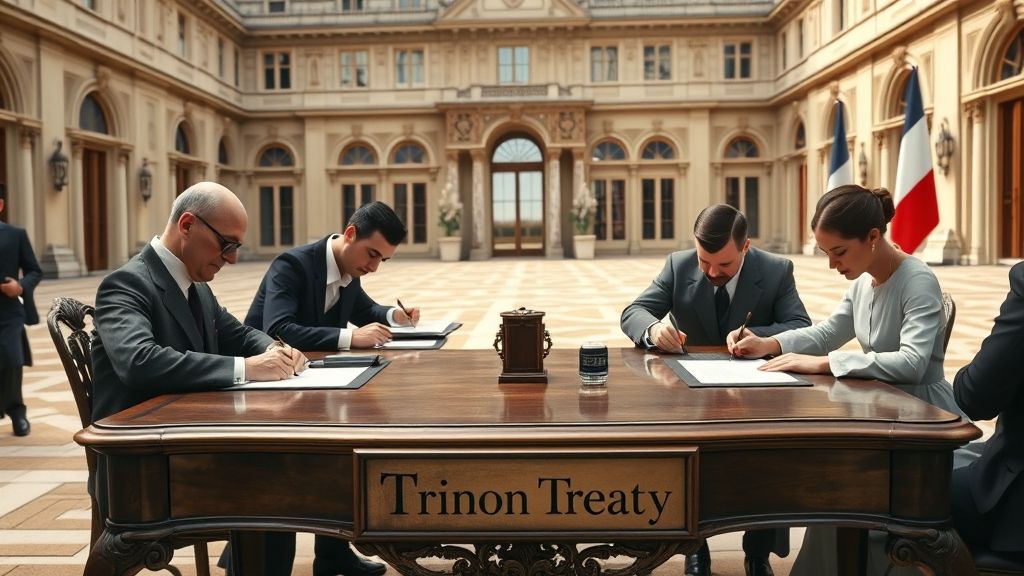
The summer sun was merciless on the grand halls of the Trianon Palace in Versailles, France. Inside, a gathering of politicians, diplomats, and military officers sat in tense silence, their faces a mixture of triumph, resignation, and quiet fury. On June 4, 1920, the Treaty of Trianon was signed—a document that would redraw the map of Central Europe, shatter a nation, and sow seeds of unrest that would echo for a century. Hungarians would come to see this treaty not as a mere political agreement, but as a wound inflicted on the body of their country, an event steeped in anguish and national identity trauma. The ink on that treaty marked a crossroads where the old world order met the ruthless sweep of postwar realpolitik—a pivot point that still defies closure.
Yet, at the moment of signing, no one could fully grasp the enormity of what had just transpired. The silence in the room spoke volumes, but beyond these walls, millions of lives were about to be irrevocably changed.
The Great War’s Shadow: A Prelude to Versailles
To comprehend why the Treaty of Trianon wrought such devastation, one must first understand the cataclysmic backdrop of the First World War. The war, ignited in 1914, tore apart empires, toppled monarchies, and scattered millions. The Austro-Hungarian Empire—once a formidable political and military force—was among the defeated powers. Its collapse was not just military but existential, the dismantling of centuries-old structures and identities.
The Paris Peace Conference of 1919 was meant to tame the chaos and create a durable peace. It was a forum for victors and the vanquished, for new nations and old powers to redraw the European order. Among the many treaties born here, the Trianon Treaty stood out for its brutal terms toward Hungary.
The Austro-Hungarian Empire: A Fragmented Giant
For over four centuries, the Habsburg-led Austro-Hungarian Empire had been a multiethnic mosaic—hundreds of languages, faiths, and cultures under one sprawling crown. Hungary was a core and proud part of that empire, with a rich tradition of sovereignty and national pride despite shared governance.
But beneath its facade of unity, tensions simmered. Nationalistic desires flared among minority groups—Slovaks, Romanians, Serbs, Croats—each yearning for self-determination. The war’s devastation laid bare these fractures. The empire dissolved, and new nations emerged like Czechoslovakia, the Kingdom of Serbs, Croats and Slovenes (later Yugoslavia), and Romania expanded dramatically, absorbing territories with sizable Hungarian populations.
Hungary on the Brink: National Identity and Despair
For Hungary itself, the end of the war spelled disaster. The country lost about two-thirds of its territory and more than half of its population due to the Treaty of Trianon. Imagine a nation told abruptly that lands once part of its heartland were no longer its own—regions such as Transylvania, Slovakia, Vojvodina, and Croatia were handed over to neighbors.
This blow shattered the Hungarian sense of identity and unity. Economically crippled, diplomatically isolated, and socially traumatized, Hungary entered a period of deep uncertainty and political turmoil.
The Paris Peace Conference: A Stage for Power Plays
In the grand marble palaces of Paris, the victors negotiated their demands. France, Britain, the United States, and Italy wielded considerable influence, weaving their visions of a safer Europe—though often at the expense of smaller nations. Hungary was represented, but its voice was weak, its pleas for fairness overshadowed by strategic calculations and the fervor to punish the Central Powers.
The principle of “self-determination,” championed by President Woodrow Wilson, was selectively applied—rarely aligned with Hungary’s wishes. The claim to ethnic autonomy was dismissed when it contradicted the geopolitical aims of the Allies.
The Treaty of Versailles and Its Siblings
Though the Treaty of Versailles, signed in 1919, focused mainly on Germany, its sibling treaties—Saint-Germain with Austria, Neuilly with Bulgaria, Sèvres with the Ottoman Empire, and, crucially, Trianon with Hungary—contributed collectively to the reconfiguration of Europe’s map. Each carved away old empires into nation-states with sometimes arbitrary borders, leading to complex ethnic entanglements.
The Treaty of Trianon was particularly severe, seen by many historians as punitive, inflaming future conflicts and wave of discontent across Hungary.
The Trianon Palace: Setting the Scene of the Treaty
Ironically, the place where Hungary’s loss became official was itself a symbol of opulence and power. The Grand Trianon, used often by French royals, seemed an incongruous setting for such a grim moment. Tables groaned under stacks of maps and documents while silent soldiers in powder-blue uniforms flanked the rooms, witnesses to the birth of a new, fractured geopolitical reality.
On June 4, 1920, delegates signed the Treaty under close watch. The lead Hungarian delegate, Count Albert Apponyi, had tried valiantly to defend Hungarian interests but was largely ignored.
Negotiating Hungary’s Fate: Voices and Visions
Count Apponyi’s eloquent speeches—lamenting the severe terms and forewarning the consequences—echo in history with haunting clarity. He pleaded for respect for ethnic minorities and cautioned against injustice, but the Allied Powers were unwavering.
For Hungary, the treaty dictated a loss of 72% of its territory and 64% of its population. It forbade conscription above a limited number, severely restricted its military, and imposed reparations—all under the watchful eyes of the League of Nations.
Territorial Losses: The Cartographer’s Ruthless Pen
Mapping the new Hungary was a painful exercise—a nation cut down by borders that left millions of ethnic Hungarians stranded outside of their motherland. Transylvania, rich in resources and history, enriched Romania; Slovakia expanded under Czechoslovakia; the south became part of the Kingdom of Serbs, Croats, and Slovenes.
The consequences were geopolitical poison pills: pockets of irredentism, interethnic tension, and bitterness festered in the shadow of these new lines.
Population Displacement: A Human Tragedy Unfolds
Beyond maps and statistics, the human cost was staggering. Approximately three million ethnic Hungarians suddenly found themselves minorities in foreign states, fundamentally changing their lives, identities, and loyalties. Families were divided, communities uprooted, and cultural ties frayed.
Stories of despair abound—of villages waking up to find their country had changed overnight, of forced relocations, and the daily struggle to maintain identity amid political marginalization.
Economic Devastation and Social Upheaval
The Treaty did more than redraw borders; it crippled Hungary’s economy. Loss of vital mining regions, agricultural lands, and industrial centers plunged the country into poverty and instability. Trade routes fractured, markets vanished, and economic recovery staggered.
Socially, the trauma fueled a rise in nationalism and extremism, seeding fertile ground for radical politics and a craving for national restoration.
The Political Fallout: From Monarchy to Turmoil
Hungary’s political landscape was transformed overnight. The monarchy had collapsed, and attempts at stabilizing governance faltered under the weight of national humiliation. The short-lived Hungarian Soviet Republic, conservative counter-revolutions, and eventually the regency of Miklós Horthy emerged against the backdrop of a country struggling to survive and reclaim.
International Reactions: Sympathy, Indifference, and Resentment
Outside Hungary, responses ranged from pragmatic acceptance to sympathy among some voices, but also indifference or outright hostility by others. France and its allies prioritized security over justice, wary of a resurgent Hungary or Central European instability.
Meanwhile, the nations benefiting territorially gnashed their teeth at Hungary’s wounded pride, wary of future revisionism but unable to heal the profound human scars.
Hungarian Revisionism: The Long Road to Grievance
In the decades following, “revisionism” became the watchword for Hungarian foreign and domestic policy. The Treaty of Trianon was seen as an injustice to be undone. Politicians and intellectuals alike pursued alliances and policies aimed at restoring lost lands—a policy that dangerously intersected with the turbulent rise of fascism and the events leading to World War II.
Cultural Trauma and National Mythmaking
The “Trianon trauma” entered Hungarian collective memory as a defining wound. Literature, art, and popular culture absorbed its trauma: the event became mythologized in songs, poems, monuments, and public discourse.
June 4th remains a day of mourning in Hungary, symbolizing loss, resilience, and the ongoing quest for identity.
The Treaty’s Role in the Interwar Period’s Boiling Pot
The treaty contributed to instability in Central Europe, creating tensions between Hungary and its neighbors, fostering ethnic conflicts, and unsettling the fragile balance of peace.
The inability to resolve grievances left the region a powder keg, with Trianon’s legacy entwined in the complex politics of the interwar years.
World War II: The Shadow of Trianon Returns
The legacy of the treaty helped shape Hungary’s alliances during World War II, notably its collaboration with Axis powers in hopes of regaining lost territory.
Though partially successful in reclaiming some lands during the war, Hungary’s fate would again be reshaped post-1945, as the new order punished wartime actions and imposed further political realignment.
Post-War Borders and the Treaty’s Legacy Today
After World War II, the borders established by Trianon were largely reaffirmed, perpetuating many of the original treaty’s injustices and tensions.
Even today, debates about minority rights, territorial claims, and national memory keep the Treaty of Trianon alive in political discourse across Central Europe.
Memory and Commemoration: June 4 in Hungarian Consciousness
June 4 has become a poignant national day in Hungary—a day marked by ceremonies, public reflections, and somber remembrances. Schools teach its history; artists evoke its spirit; historians debate its lessons.
It stands as a testament to the enduring power of historical memory, shaping identity and politics nearly a century on.
Conclusion: The Price of Peace and the Echoes of Trianon
The Treaty of Trianon was at once a peace settlement and a profound wound. It highlights the brutal realities of postwar diplomacy where the demands of order and winners’ justice sometimes trample the hopes and lives of millions. The treaty’s legacy—loss, trauma, and fractured identity—reminds us of the human cost behind every line drawn on a map.
In remembering Trianon, we confront the complexities of nationhood, justice, and reconciliation. It is a tale of a nation diminished but not defeated—a warning and a call to listen to history’s deep, ever-resonant echoes.
FAQs
Q1: Why was the Treaty of Trianon signed?
A1: It was part of the post-World War I peace settlements aiming to dismantle the Austro-Hungarian Empire and redraw national boundaries to prevent future conflict, though it imposed harsh terms on Hungary.
Q2: What were the main territorial losses Hungary suffered under Trianon?
A2: Hungary lost about 72% of its territory, including important regions like Transylvania to Romania, Slovakia to Czechoslovakia, and southern territories to Yugoslavia.
Q3: How did the Treaty affect ordinary Hungarians?
A3: Millions of ethnic Hungarians found themselves minorities in new countries, suffering cultural marginalization, economic hardship, and social dislocation.
Q4: What role did Count Albert Apponyi play during the negotiations?
A4: He was Hungary’s chief delegate who passionately tried to defend Hungarian interests but ultimately failed to change the strict terms imposed by the Allies.
Q5: How did Trianon influence Hungary’s politics in the interwar years?
A5: It sparked a national revisionist agenda, political instability, and contributed to alignment with Axis powers during WWII in hopes of reversing territorial losses.
Q6: Is Trianon still relevant in Central Europe today?
A6: Yes, it remains a significant historical grievance in Hungary and influences minority rights debates, regional diplomacy, and national identity discussions.
Q7: How is June 4 commemorated in Hungary?
A7: It is a day of mourning and remembrance featuring ceremonies, educational programs, and cultural events reflecting on the treaty’s impact.
Q8: Did the treaty achieve lasting peace?
A8: While it ended one war, the treaties sowed seeds of resentment and instability that contributed to tensions leading up to World War II.