Table of Contents
- The Tense Prelude: Europe on the Brink of Conflagration
- The Inflamed Conflict: Pope Alexander III versus Emperor Frederick Barbarossa
- The Year 1176: The Humbling Defeat at Legnano
- Venice’s Rising Star: A Republic Poised Between Empire and Papacy
- The Diplomatic Web: Crafting a Path to Peace in a War-Torn Europe
- Venice, the Chosen Mediator: The City of Canals Becomes a City of Peace
- Summer of 1177: The Assembly of Powers Under the Venetian Sun
- Frederick’s March to Venice: Defiance and Diplomacy Intertwined
- The Arrival of Pope Alexander III: Returning from Exile to the Heart of Christendom
- The Moment of Reconciliation: Handshakes and Humble Gestures in San Marco
- Terms of the Treaty: A Fragile Balance Restored
- The Role of the Venetian Doge Sebastiano Ziani: Architect and Mediator
- Reactions Across Europe: Relief, Skepticism, and Hope
- The Treaty’s Political Ripples: Redefining Imperial and Papal Authority
- Venice’s Elevated Status: From Merchant Power to Diplomatic Hub
- Beyond Politics: The Treaty’s Religious and Cultural Reverberations
- The Peace’s Fragility: What Followed in the Coming Decades
- Anecdotes and Testimonies: Voices from the Venetian Crowd
- The Legacy of 1177: A Defining Moment in Medieval Diplomacy
- Conclusion: Peace Forged on Venetian Waters, Echoing Through Time
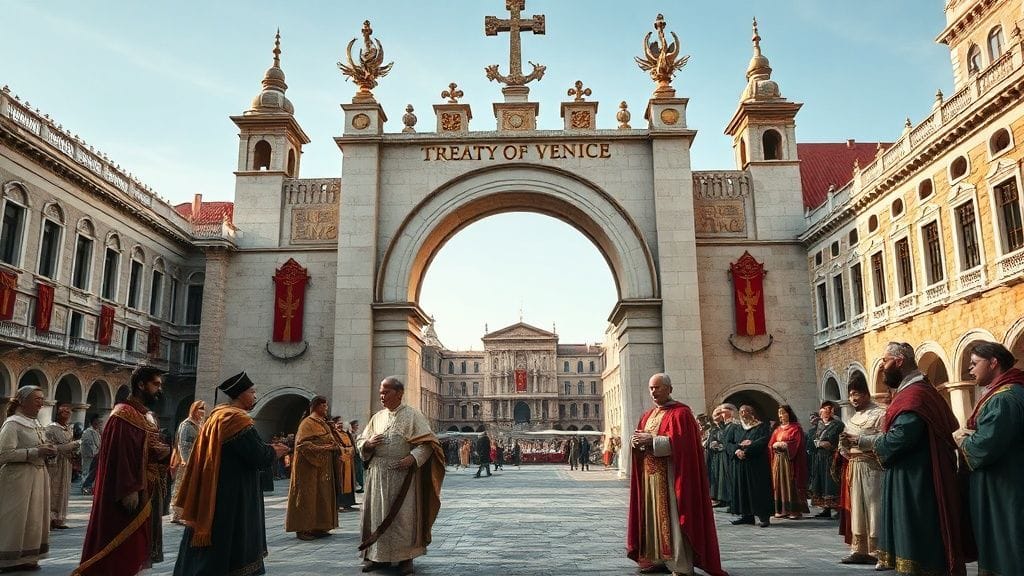
The summer sun glared mercilessly over the glistening canals of Venice, illuminating the marble grandeur of St Mark’s Basilica as an extraordinary scene unfolded on its steps. Two titans of medieval Europe—Emperor Frederick Barbarossa, the formidable Germanic sovereign, and Pope Alexander III, the spiritual champion battling exile and schism—approached one another in a moment heavy with symbolic weight. This was no mere meeting; it was a reconciliation that promised to alter the very fabric of Christendom. The Treaty of Venice, signed in 1177, was a truce born from war, persistence, and the delicate art of diplomacy. At a time when Europe simmered with conflict between secular and spiritual authorities, Venice stood as a beacon of mediation, a city whose canals now bore witness to a fragile peace that would resonate through centuries.
The Tense Prelude: Europe on the Brink of Conflagration
The mid-12th century roared with turbulence. The Holy Roman Empire, under Frederick Barbarossa—“Redbeard,” a warrior emperor with imperial ambitions—strove to assert dominance over the fractious Italian City-States and fiercely independent Papacy. Meanwhile, Pope Alexander III, elected amidst controversy and multiple antipopes, sought to safeguard his spiritual supremacy against imperial encroachments. The stage was set for a showdown that transcended mere politics: it was a contest for the soul of medieval Europe.
The papal-imperial conflict was not just about religious doctrine or territorial control. It symbolized the protracted struggle between two poles of power—the sacred and the secular. Emperors wished to control investitures and church lands, while Popes demanded spiritual autonomy and authority that could, conceivably, translate into worldly influence. This tug of war fractured alliances, spawned wars of succession, and plunged large swaths of Italy and Germany into bloody strife.
The Inflamed Conflict: Pope Alexander III versus Emperor Frederick Barbarossa
The rivalry escalated when Frederick backed antipopes—claimants to the papal throne installed by imperial decree rather than ecclesiastical election—challenging Alexander III’s legitimacy. This split the Christian world: some kingdoms and principalities sided with the Emperor, others with the Pope. Alexander, forced into exile multiple times, found refuge in France and later in Venice, even as Frederick marched his armies relentlessly into Papal territories.
Alexander’s persistence became emblematic of the Church’s resistance to imperial imposition. Despite military setbacks, the papacy’s ideological position was strong, championed by figures who saw the Pope as the vicar of Christ on earth, above all earthly rulers. Yet, Frederick’s campaigns threatened to obliterate this influence entirely—until the unexpected happened at Legnano.
The Year 1176: The Humbling Defeat at Legnano
The Battle of Legnano, fought on May 29, 1176, proved to be a turning point in this conflict. A confederation of Northern Italian City-States, known as the Lombard League, allied against Frederick’s imperial ambitions, delivered a shocking defeat to the Emperor’s forces. Medieval chronicles describe how the urban militias, once thought weaker than noble armies, courageously held their ground amid thunderous clashes.
This defeat shattered Frederick’s aura of invincibility. It demonstrated the rising power of communes and cities who resisted imperial authority and challenged hierarchical feudal norms. Yet, instead of igniting a prolonged war, Legnano opened a door towards negotiation—a chance for the Emperor and Pope to reconsider their stances.
Venice’s Rising Star: A Republic Poised Between Empire and Papacy
Venice, the illustrious maritime republic, thrived by navigating both seas and politics with exceptional skill. By the late 12th century, its wealth, naval power, and diplomatic finesse ranked it among Europe’s great powers. The city’s Doge, Sebastiano Ziani, was renowned for his measured statesmanship and a vision that extended beyond mere commercial interests.
Situated between the warring factions and benefiting from the Empire’s commercial routes and the Papacy’s spiritual prestige, Venice was the perfect neutral ground—and mediator. Its cosmopolitan society, blending Latin, Byzantine, and Muslim influences, cultivated a diplomatic culture capable of hosting delicate negotiations.
The Diplomatic Web: Crafting a Path to Peace in a War-Torn Europe
The path to the Treaty of Venice was neither simple nor linear. Behind closed doors, envoys tensed and deliberated for months. The Pope and Emperor traded embassies, while local Italian powers maneuvered for influence. The allure of commerce and regional stability pushed Venice to extend an olive branch. To them, peace meant open trade routes, fewer military disruptions, and a rare moment to elevate their city’s standing on the international stage.
Crucially, Venice proposed itself as more than a mediator; it vowed to guarantee the treaty’s terms, leveraging its prestige to hold both parties accountable. This promise was revolutionary—a city-state positioning itself as guardian of peace in a Europe fractured by feudal allegiances and spiritual wars.
Venice, the Chosen Mediator: The City of Canals Becomes a City of Peace
When Frederick and Alexander finally agreed to meet in Venice during the summer of 1177, the city transformed. Marketplaces buzzed with traders and soldiers alike; flags fluttered alongside gondolas gliding under shimmering bridges. This spectacle was more than a diplomatic event—it was a theater of power, symbolism, and suspense.
Venetians watched eagerly as their Doge hosted the summit in the imposing Doge’s Palace—a structure of red bricks and white Istrian stone that symbolized Venetian resilience and grandeur. The city orchestrated welcoming ceremonies blending ceremony and subtle messages about unity and peace.
Summer of 1177: The Assembly of Powers Under the Venetian Sun
Delegates from across Italy and the Empire’s realms gathered. Nobles rubbed shoulders with clergy, and emissaries whispered urgent counsel. Among these figures, the anticipation was palpable—could these decades of conflict really conclude on Venetian soil?
The arrival of Frederick and Alexander was a scene etched in memory: an Emperor stripped of his martial armor’s usual swagger, facing a Pope whose serene confidence belied years of exile. The lighting of candles and prayers set the tone for a moment that would ripple far beyond the lagoon-lined city.
Frederick’s March to Venice: Defiance and Diplomacy Intertwined
Frederick’s entry into Venice was a complex display of duality. He was a warrior accustomed to commandeering lands by force, yet here he came to negotiate and concede. Contemporary chroniclers noted his mixed emotions—pride warring with necessity.
His acceptance to meet Alexander was itself a reluctant nod to reality after Legnano. But more than surrender, Frederick sought to reset relations on terms that preserved his dignity and imperial claims, even if curbed.
The Arrival of Pope Alexander III: Returning from Exile to the Heart of Christendom
For Alexander, the Venetian treaty was a triumphant homecoming. From a precarious exile shadowed by antipopes and war, he returned to the heart of Christian politics with legitimacy renewed. His presence in Venice signaled a spiritual victory as much as a political one.
His deep connection with the city—warmed by Venetian hospitality and robust ecclesiastical support—reinforced his authority. His speeches and prayers here were celebrated as affirmations of the papacy’s unyielding resolve.
The Moment of Reconciliation: Handshakes and Humble Gestures in San Marco
It was on the steps of St Mark’s Basilica that the culmination arrived. In a rare spectacle of medieval diplomacy, Frederick knelt before Alexander, a gesture loaded with meaning—acknowledging the Pope not only as spiritual head but as mediator in earthly affairs. The Pope granted forgiveness; the Emperor accepted papal supremacy in ecclesiastical matters.
This moment, captured in later frescoes and poems, resonated with humility, hope, and the weight of centuries-long conflict finally eased. The two men symbolized a fragile peace woven from exhaustion and pragmatism, courage and ceremony.
Terms of the Treaty: A Fragile Balance Restored
The Treaty of Venice did not settle all disputes, but it set critical terms: Frederick recognized Alexander’s papal legitimacy and agreed to cease support for antipopes; in return, the Pope acknowledged the Emperor’s temporal authority over imperial territories. Italy’s cities, including Venice, retained their rights to self-governance without immediate imperial interference.
This compromise reflected centuries of unresolved tension: a peace brokered not by total victory but by mutual concessions. It allowed both the papacy and empire to recalibrate power without further bloodshed—at least for a time.
The Role of the Venetian Doge Sebastiano Ziani: Architect and Mediator
Behind the scenes, Doge Sebastiano Ziani’s hand guided the proceedings with remarkable skill. He leveraged Venice’s reputation and resources to facilitate dialogue, while ensuring the city’s interests were safeguarded. His speeches emphasized harmony, justice, and mutual respect.
Ziani’s success elevated Venice’s diplomatic profile at a Europe-wide level—proof that even amid titanic struggles, negotiation and statesmanship could shape history.
Reactions Across Europe: Relief, Skepticism, and Hope
The news of the treaty sent ripples across courts and monasteries. Relief came, for years of warfare had drained coffers and destabilized societies. Yet skepticism simmered—many questioned whether the treaty could endure, wary of renewed hostilities or opportunistic breaches.
Chroniclers documented mixed emotions: celebrations in Venice and Rome; cautious optimism in the imperial cities; wary silence in contested regions. Nevertheless, the treaty’s immediate consequence was a much-needed pause in a protracted war.
The Treaty’s Political Ripples: Redefining Imperial and Papal Authority
The Treaty of Venice recalibrated the medieval balance of power. It affirmed that papal authority could not be easily overridden by imperial fiat and that the emperor’s reach—while profound—met real limits in Italy.
It accelerated recognition of city-states’ autonomy and paved the way for more complex political arrangements across Europe. Moreover, the treaty enhanced the role of diplomacy and international mediation in settling disputes traditionally resolved by force.
Venice’s Elevated Status: From Merchant Power to Diplomatic Hub
Venice’s role in brokering peace augmented its prestige beyond trade and military might. The city emerged as a neutral ground whose reputation for impartiality and order attracted delegations, enhancing its political influence.
This status accelerated Venice’s integration as a key player in Italian and European politics, foreshadowing centuries of diplomatic engagement that would shape Renaissance and early modern Europe.
Beyond Politics: The Treaty’s Religious and Cultural Reverberations
The Treaty was not merely secular politics; it bore deep religious resonance. Alexander’s return fortified the papal vision of a unified Church capable of standing firm against secular overreach. Pilgrimages, religious festivals, and art commemorated this moment as a divine affirmation of the Church’s role.
Artists, poets, and chroniclers immortalized Venice’s canals as a witness to reconciliation, embedding the treaty in Europe’s cultural memory.
The Peace’s Fragility: What Followed in the Coming Decades
However, this peace was uneasy. Conflicts rekindled in subsequent decades—antipapal factions persisted, further disputes over investiture and territorial claims emerged, and Frederick’s successors pursued their own ambitions.
Yet, the Treaty of Venice marked a pivotal template: negotiation and mutual recognition could prevent all-out war. Future treaties would echo its blend of pragmatism and symbolism.
Anecdotes and Testimonies: Voices from the Venetian Crowd
Local chronicles and oral traditions capture the treaty’s human dimension. Venetian merchants wrote of crowded streets and feast preparations; clergy recounted prayers and blessings; soldiers described tension dissolved in celebrations.
One anecdote tells of a gondolier whispering to a nobleman: “If peace rides my waters, may it flow forever.” Such voices give texture and immediacy to a grand historical moment.
The Legacy of 1177: A Defining Moment in Medieval Diplomacy
The Treaty of Venice remains a landmark in medieval history. It underscored the importance of diplomacy amid ideological conflict, the power of city-states, and the complexity of church-state relations.
Its echoes are heard in the gradual emergence of the Renaissance political order and in the perennial interplay between spiritual and temporal power—a drama as old as Europe itself.
Conclusion
The Treaty of Venice in 1177 was more than a political settlement; it was a transformative event that encapsulated the hopes, fears, and complexities of medieval Europe. Against the backdrop of war, exile, and ambition, Venice emerged as a beacon for peace, proving that even seemingly irreconcilable foes can find common ground. The image of Frederick Barbarossa humbling himself before Pope Alexander III on Venetian steps is not just a historical vignette—it is a timeless symbol of the human capacity for reconciliation. This treaty did not end all conflicts, but it forged a path of dialogue and compromise, laying foundations for the evolving dance between empire and church, between power and principle. It is a story of resilience, strategy, and above all, a shared vision for a future where peace, however fragile, was possible.
FAQs
Q1: What were the main causes of the conflict between Emperor Frederick Barbarossa and Pope Alexander III?
A1: The conflict stemmed from competing claims to authority—Frederick sought to assert imperial control over Italian territories and church appointments, while Alexander defended papal spiritual supremacy. The use of antipopes and military interventions deepened the crisis.
Q2: Why was Venice chosen as the venue for the 1177 treaty negotiations?
A2: Venice’s strategic neutrality, wealth, and diplomatic reputation made it an ideal mediator. Its geographic location and maritime power allowed it to host delegations safely and impartially.
Q3: What role did the Doge Sebastiano Ziani play in the Treaty of Venice?
A3: As Venice’s leader, Ziani skillfully negotiated terms, facilitated dialogue, and ensured the city’s interests were protected, elevating Venice’s status as a diplomatic power.
Q4: Did the Treaty of Venice end the rivalry between the Empire and Papacy?
A4: It brought a temporary peace and mutual recognition but did not end the broader struggle. Future conflicts and disputes continued, though the treaty established a precedent for negotiation.
Q5: How did the Treaty of Venice affect Italian city-states?
A5: The treaty acknowledged their autonomy, particularly the Lombard League cities, reducing direct imperial interference and empowering communal self-governance.
Q6: What cultural or religious impact did the treaty have?
A6: It strengthened the papacy’s spiritual authority and inspired artistic and literary commemorations, embedding the treaty in European religious and cultural memory.
Q7: Was the peace established by the treaty long-lasting?
A7: The peace was fragile. While it temporarily halted open war, renewed tensions arose in following decades, reflecting the enduring challenges of papal-imperial relations.
Q8: How is the Treaty of Venice remembered today?
A8: It is celebrated as a milestone of medieval diplomacy, illustrating the power of mediation and the complex interplay between secular and spiritual power in shaping Europe’s history.