Table of Contents
- The Final Dawn: Shadows Over Pretoria
- The Boer War: A Long and Grim Struggle
- Roots of Conflict: Imperial Ambitions and Afrikaner Identity
- The Siege of Pretoria: The War’s Decisive Terrain
- War Fatigue and the Human Toll: When Hunger Became a Weapon
- The Road to Negotiations: From Battlefield to Conference Table
- The Delegations Assemble: Divergent Voices, Shared Desperation
- The Terms of Peace: Compromise or Capitulation?
- The Signing: A Moment Frozen in Time
- Immediate Aftermath: Relief, Resentment, and Rebuilding
- Political Ramifications: The British Empire and the Boer Republics
- Social and Economic Fallout: The Scars Beneath the Surface
- The Legacy of the Treaty: Unity and Division in South Africa’s Future
- International Reactions and the End of Colonial Illusions
- Remembering Vereeniging: Memory, History, and Identity
- Lessons from the Treaty: Peace, Justice, and the Limits of Power
- Conclusion: From War’s End to a New Beginning
- FAQs: Understanding the Treaty of Vereeniging
- External Resource
- Internal Link
The Final Dawn: Shadows Over Pretoria
On a bright but tense day in late May 1902, the city of Pretoria stood silent, its streets heavy with the exhausted footsteps of soldiers and civilians alike. The Second Boer War, a brutal contest between British imperial forces and the fiercely independent Boer republics, had drained its last reserves of blood and hope. Anxiety and cautious relief intermingled as emissaries from both sides gathered in a stately building, ready to ink a document that would shape South Africa’s destiny. The Treaty of Vereeniging was about to be signed—an act not merely of legal formality but of weary reconciliation and strategic necessity.
The air was thick with the scent of gunpowder long extinguished, yet its legacy whispered from every corner—scorched farms, shattered families, and dreams deferred. This was more than a peace treaty. It was the fragile foundation for a nation reborn from the ashes of conflict and division.
The Boer War: A Long and Grim Struggle
The Boer War, also known as the South African War, did not simply erupt out of nowhere in 1899; it was the culmination of decades of tension between the British Empire and the Boer settlers, descendants of Dutch colonists who had carved out independent republics amid the rugged South African terrain. The discovery of vast gold and diamond reserves in the late 19th century intensified the conflict, transforming a local dispute into a struggle for control over an invaluable and strategically crucial region.
The war unleashed unprecedented violence and hardship. British forces, better equipped but initially unprepared for guerrilla tactics, found themselves bogged down in a war of attrition against highly mobile Boer commandos. Civilians suffered terribly, caught between the sabers and bullets of war machines giant and small.
Roots of Conflict: Imperial Ambitions and Afrikaner Identity
At its heart, the war was a clash of visions: British imperial ambition versus Boer self-determination. The Boers saw themselves as guardians of a unique culture, language, and autonomy, fiercely proud of their Calvinist heritage and rural independence. Meanwhile, the British viewed control over the region as essential to maintaining their global dominance.
The South African landscape witnessed not only battles of rifles and canons but also a cultural confrontation. The tension was intangible yet palpable—between two worlds vying for legitimacy and survival.
The Siege of Pretoria: The War’s Decisive Terrain
Pretoria, the administrative capital of the South African Republic, became a pivotal battleground. The city’s fall in 1900 to British troops marked a turning point but did not end the war. Boer commandos retreated into the countryside, employing guerrilla warfare tactics that stretched British resources and patience.
The siege was as much psychological as physical—a battle of wills over dominance and survival. Pretoria, scarred yet defiant, symbolized the resilience of a people unwilling to surrender the ideals upon which their republic was founded.
War Fatigue and the Human Toll: When Hunger Became a Weapon
As the war progressed, the British adopted increasingly ruthless measures—most notably, the establishment of concentration camps to control Boer civilians. These camps became notorious for their harsh conditions and high mortality rates, particularly among women and children. Hunger, disease, and despair stalked the internees, revealing the darkest dimensions of the conflict.
Both sides suffered exhaustion and loss. Families were torn apart; farms were burned; livelihoods destroyed. The human cost became a pressing factor pushing both combatants towards negotiating peace.
The Road to Negotiations: From Battlefield to Conference Table
By early 1902, it was clear that the war could neither be won outright by the Boers nor prolonged endlessly by the British without unacceptable costs. Military stalemate and increasing public pressure in Britain, coupled with the horrendous humanitarian crisis, compelled both parties to consider a diplomatic resolution.
Negotiations began cautiously—full of suspicion but driven by a common desire to end the bloodshed. The choice was stark: continue fighting at an ever-growing human cost or seek a compromise that could lay the groundwork for future coexistence.
The Delegations Assemble: Divergent Voices, Shared Desperation
The Boer side comprised leaders deeply invested in their people’s sovereignty: Louis Botha and Jan Smuts, formidable generals respected by friend and foe alike. The British delegation was led by Lord Kitchener and the political representative Alfred Milner, men embodying imperial authority and pragmatism.
Despite profound ideological differences, there was an undercurrent of mutual respect—and an acute recognition that the war had to end. Their negotiations unfolded amid tense moments, personal appeals, and the shadow of ongoing skirmishes beyond the conference room.
The Terms of Peace: Compromise or Capitulation?
The Treaty of Vereeniging, signed on May 31, 1902, reflected a uneasy equilibrium. The Boers would submit to British sovereignty, but with promises of amnesty, eventual self-government, and preservation of cultural and language rights. The British agreed to provide financial aid to rebuild the devastated Boer territories.
It was neither a total victory nor an outright defeat. For the Boers, it was a reluctant acceptance of reality; for the British, a pragmatic concession to secure lasting peace—a peace that acknowledged the limits of power and the necessity of reconciliation.
The Signing: A Moment Frozen in Time
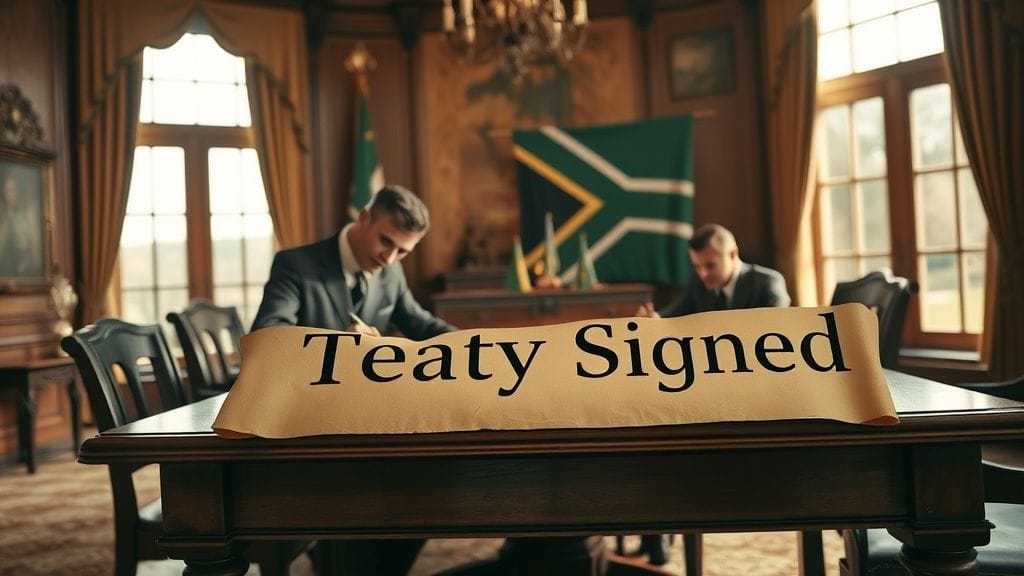
The historic signing in Pretoria was a somber affair. Delegates voted amidst hushed tension, aware that their consent would alter the lives of millions. The handshake that sealed the treaty was at once symbolic and somber—a gesture of peace forged through suffering and sacrifice.
Witnesses recorded the gravity of the moment, the weight of history pressing down on those who dared hope for a new South Africa, emerging from conflict into an uncertain but hopeful future.
Immediate Aftermath: Relief, Resentment, and Rebuilding
For many, the war’s end brought relief. Soldiers returned home, families reunited, and reconstruction efforts began. Yet beneath the surface lay bitterness and mistrust.
The scars of war—the destroyed land, displaced populations, and emotional wounds—would take decades to heal. Political tensions simmered, economic disparities persisted, and social divisions remained stark.
Political Ramifications: The British Empire and the Boer Republics
The treaty marked a critical moment in the consolidation of the British Empire in southern Africa. The Boer republics were incorporated into British colonial administration, setting the stage for the formation of the Union of South Africa in 1910, a dominion within the Empire.
This political realignment reshaped power dynamics, embedding Afrikaner participation in governance while maintaining British supremacy—a delicate balance fraught with future challenges.
Social and Economic Fallout: The Scars Beneath the Surface
Beyond politics, the treaty impacted society profoundly. Economically, the destruction wrought by war required massive reconstruction, often funded by British loans but reliant on Boer labor and resilience.
Socially, the war deepened divisions between the Boer and British populations and intensified racial inequalities. Indigenous African peoples, largely sidelined during and after the conflict, bore their own heavy burdens.
The Legacy of the Treaty: Unity and Division in South Africa’s Future
The Treaty of Vereeniging laid the groundwork for reconciliation yet also sowed seeds of future discord. It facilitated Afrikaner cultural preservation but also entrenched a system that would eventually evolve into apartheid.
The unity it fostered was complex, a fragile political and social accord balancing between inclusion and exclusion, cooperation and opposition.
International Reactions and the End of Colonial Illusions
The treaty reverberated beyond South Africa, signaling shifts in colonial power dynamics worldwide. It exposed the limitations of imperial force and highlighted the human costs of colonial conquest.
Observers in Europe and beyond saw in Vereeniging a cautionary tale about nationalism, empire, and the pursuit of power, influencing colonial policies and anti-colonial movements in the decades to come.
Remembering Vereeniging: Memory, History, and Identity
Over a century later, the Treaty of Vereeniging remains a pivotal chapter in South African history. Commemorations, historical debates, and cultural narratives continue to grapple with its significance—balancing acknowledgement of suffering with recognition of political pragmatism.
The treaty is both a symbol of peace and a reminder of conflict, shaping collective memory and identity across generations.
Lessons from the Treaty: Peace, Justice, and the Limits of Power
Vereeniging teaches us about the complexities of peace-making—how war’s end is not merely a cessation of violence but a delicate process involving recognition, reparations, and reconciliation.
It reminds us that power, while essential, is limited without justice and understanding. The treaty was a start but not an end—a foundation upon which future struggles and hopes would be built.
Conclusion: From War’s End to a New Beginning
The signing of the Treaty of Vereeniging in Pretoria closed a brutal chapter in South Africa’s history. It embodied the human cost of empire and the resilience of a people who, though battered, refused to be broken.
From the ashes of conflict rose a complex nation striving to forge unity from division, peace from war. The treaty was both an end and a beginning—a fragile promise of coexistence in a land marked by struggle, identity, and hope.
FAQs: Understanding the Treaty of Vereeniging
Q1: What were the main causes of the Second Boer War leading to the Treaty of Vereeniging?
A1: The war stemmed from imperial rivalries between Britain and the Boer Republics, sparked by conflicts over political rights, control of rich mineral resources, and competing national identities.
Q2: Who were the key figures involved in negotiating the Treaty of Vereeniging?
A2: Important negotiators included Boer leaders Louis Botha and Jan Smuts, and British officials Lord Kitchener and Alfred Milner.
Q3: What were the main terms agreed upon in the treaty?
A3: The Boers accepted British sovereignty but were promised amnesty, preservation of cultural rights, eventual self-government, and financial aid for reconstruction.
Q4: How did the treaty affect the future political landscape of South Africa?
A4: It paved the way for the creation of the Union of South Africa in 1910, integrating Boer republics under British dominion while allowing Afrikaner political participation.
Q5: What was the human impact of the war and how did it influence the peace process?
A5: The war caused immense suffering, including deaths from combat, disease, and concentration camps, which pressured both sides toward peace negotiations.
Q6: How is the Treaty of Vereeniging remembered today in South Africa?
A6: It remains a symbol of both reconciliation and division, remembered for ending the war but also for the complexities it introduced in racial and political relations.
Q7: What lessons does the treaty offer for modern conflict resolution?
A7: It illustrates that lasting peace requires negotiation, compromise, recognition of cultural identities, and addressing humanitarian consequences.
Q8: Did the treaty address the rights or status of indigenous African populations?
A8: Unfortunately, the treaty largely ignored indigenous populations, who remained marginalized in the political settlements that followed.