Table of Contents
- The World on the Brink: Europe in 1940
- The Rise of the Axis Powers: Setting the Stage
- Germany's Ambitions Under Hitler
- Italy’s Entry into the Global Conflict
- Japan’s Expansion and Strategic Outlook
- The Diplomatic Maneuvering Before the Pact
- The Significance of the Date: September 27, 1940
- The Signing Ceremony in Berlin: A Moment Frozen in History
- The Content and Clauses of the Tripartite Pact
- Immediate Reactions from the Allied Powers
- The Pact’s Psychological Impact on the War
- Military and Strategic Consequences of the Alliance
- How the Tripartite Pact Affected Neutral Nations
- Public Perception and Propaganda around the Pact
- The Pact’s Role in Shaping the Second World War’s Global Scope
- Behind the Scenes: Tensions and Rivalries Within the Axis
- The Pact’s Longevity and Subsequent Developments
- The Downfall of the Axis and the Pact’s Legacy
- Reflections from Key Figures: Voices from Berlin, Rome, and Tokyo
- How Historians View the Tripartite Pact Today
- The Tripartite Pact in Popular Memory and Culture
- Conclusion
- FAQs
- External Resource
- Internal Link
The World on the Brink: Europe in 1940
September 27, 1940. A crisp autumn day shadowed by the deepening storm of global conflict. In a grand hall in Berlin, beneath the austere gaze of towering banners emblazoned with the swastika, rising sun, and fasces, three powers—Germany, Italy, and Japan—came together to etch their commitment into the annals of history. The air was thick with anticipation, ambition, and the cold calculation of dictators whose visions would embroil the world in devastation.
Europe was no stranger to upheaval by then. Just over a year earlier, World War II had erupted following Germany’s invasion of Poland. A rapid succession of battles had redrawn the continent’s borders and unsettled its fragile balances. France had already fallen to the Nazis in June 1940, and Britain stood alone, preparing for the onslaught. Meanwhile, in the Far East, Japan was aggressively expanding its empire, eyeing territories rich in resources to fuel its military machine. The stage was set for a formal alliance, an “Axis” to challenge the democratic and colonial powers that opposed them.
This was not merely a treaty of convenience, but an ideological and strategic pact that promised global repercussions. The Tripartite Pact—also known as the Berlin Pact—would intertwine the fates of three totalitarian regimes, shaping the trajectory of the war and the balance of power for years to come.
The Rise of the Axis Powers: Setting the Stage
To understand the Tripartite Pact, one must embark on a journey through the tumultuous 1930s—a decade defined by economic collapse, nationalist fervor, and imperialist ambitions. The victorious powers of World War I had imposed the Treaty of Versailles, which left Germany humiliated and economically shattered. In this fertile ground of discontent rose Adolf Hitler, promising restoration and revenge. The Nazis aimed to dismantle the post-war order and restore Germany’s preeminence.
Italy, under Benito Mussolini, was embarking on its own quest for greatness, inspired by a romanticized vision of the Roman Empire and supported by an aggressive fascist ideology that rejected democratic governance. Mussolini would invade Ethiopia in 1935, exposing the weakness of the League of Nations and asserting Italy's intention to expand its domain in Africa.
Meanwhile, Japan was engaged in its imperial march throughout East Asia, fueled by militarism and natural resource scarcity. The invasion of Manchuria in 1931 and the escalation of conflict in China highlighted Japan’s determination to dominate the region.
Against this backdrop, the axis powers found not only ideological commonality but strategic necessity in forging a formal bond. Each recognized the potential strength of unity in confronting their mutual enemies: the United Kingdom, the Soviet Union, and the United States.
Germany’s Ambitions Under Hitler
Adolf Hitler’s vision was clear: to establish a Greater German Reich extending across Europe and beyond. The Nazi regime systematically dismantled the Weimar Republic, consolidated power, and launched an unprecedented campaign to rearm and remilitarize.
Hitler’s ideological pillars—racial supremacy, anti-Semitism, and territorial expansion—would inform policy decisions that quickly destabilized Europe. The annexation of Austria in 1938, the invasion of Czechoslovakia’s Sudetenland, and ultimately the attack on Poland marked a relentless march towards total war.
Yet, Hitler was acutely aware that a wider conflict with numerous powerful nations required allies. Britain’s resilience in the Battle of Britain, the uncertain allegiance of the United States, and the Soviet Union’s vast resources necessitated a strong coalition.
Hence, allying with Italy and Japan was not just pragmatic; it was crucial to the survival and success of the Reich’s ambitions.
Italy’s Entry into the Global Conflict
Mussolini’s Italy had long played a role as Germany’s co-conspirator, sharing fascist ideology and imperial dreams. Still, the Italian military was far less prepared or effective than its German counterpart.
Nonetheless, Mussolini sought to capitalize on the weakening of European powers to carve out new territories. The invasion of Albania in April 1939 and Italy’s entry into the war in June 1940 alongside Germany were pivotal steps.
Italy’s involvement, however, was often marked by miscalculations, military setbacks, and a less cohesive strategic vision. Yet, the alliance with Germany and Japan gave Italy a veneer of strength and legitimacy, bolstering Mussolini’s regime domestically and internationally.
The Tripartite Pact would formalize this partnership, symbolizing a united front to the world.
Japan’s Expansion and Strategic Outlook
Halfway across the globe, Japan’s military-industrial complex drove the nation towards dominance in Asia and the Pacific. The imperial ambitions centered on creating the Greater East Asia Co-Prosperity Sphere, a concept used to justify aggressive expansion under the guise of Asian liberation, but in reality, an exploitative system serving Japan’s interests.
Japan’s increasingly belligerent approach, including the occupation of Manchuria and the protracted conflict with China, strained relations with Western powers, especially the United States and Britain.
Recognizing Germany and Italy as natural allies against these western colonial empires, Japan pursued formal ties that would guarantee mutual defense, resource sharing, and coordinated military action.
The Diplomatic Maneuvering Before the Pact
The months leading up to September 1940 were a flurry of secret negotiations, intelligence gathering, and diplomatic chess moves. Hitler’s envoys traveled to Rome and Tokyo; Mussolini sent representatives to Berlin; Japan’s diplomats engaged in delicate conversations balancing demands and national pride.
Key figures such as Joachim von Ribbentrop (German Foreign Minister), Galeazzo Ciano (Italian Foreign Minister and Mussolini’s son-in-law), and Yōsuke Matsuoka (Japanese Foreign Minister) played pivotal roles.
While publicly announcing peace and cooperation, behind closed doors they hashed out the terms to ensure that their interests, especially regarding territorial claims and spheres of influence, were guarded.
The final agreement represented a compromise but also a formidable statement of shared purpose—an axis poised to reshape the global order.
The Significance of the Date: September 27, 1940
September 27 was chosen with symbolic and practical considerations. By this date, Germany’s victories in Europe were largely consolidated. France was defeated and divided, Britain stood resilient but isolated, and the Soviet Union maintained a tentative non-aggression pact with Germany.
The signing ceremony symbolized the formal birth of a new power bloc in world affairs—one that would challenge the established global order and invite the participation of other countries in its orbit.
Moreover, the pact’s timing sent a chilling message to the United States, which had so far maintained neutrality but faced increasing pressure to respond to the Axis threat.
The Signing Ceremony in Berlin: A Moment Frozen in History
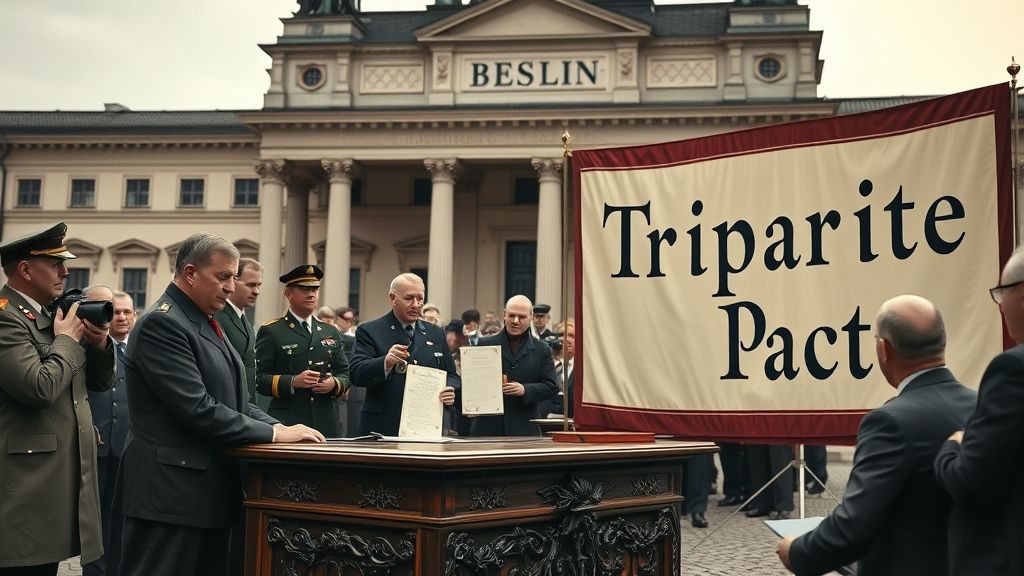
The ceremony was steeped in the cold pomp of authoritarian displays. In the grand halls of the Reich Chancellery, the three powers gathered under a veneer of cooperation and mutual respect. Photographs captured the stiff smiles and resolute expressions of Hitler, Mussolini, and Japan’s ambassador.
The Tripartite Pact was signed by official representatives: von Ribbentrop for Germany; Ciano for Italy; and Matsuoka for Japan. The document itself was succinct, but its implications rippled across continents.
Witnesses later described the tension in the room, the weight of the moment felt by all present. It was a rare moment when three distinct cultures and militaristic states converged, united by a shared vision even as internal distrust simmered beneath the surface.
The Content and Clauses of the Tripartite Pact
At its core, the Tripartite Pact was a defensive agreement. It stipulated that if any of the three signatories were attacked by a country not already involved in the war—clearly an oblique reference to the United States or the Soviet Union—the others would come to their aid.
The text also emphasized mutual respect for territorial possessions and the commitment to further political and economic cooperation. It was a strategic deterrent designed to warn off future American intervention.
Significantly, it recognized Japan’s territorial claims in Asia and the Pacific, accepted Italy’s ambitions in Africa and the Mediterranean, and Germany’s control in Europe.
But beneath the formal clauses lay ambitions far greater: the establishment of a new world order under the Axis’s dominion.
Immediate Reactions from the Allied Powers
News of the Tripartite Pact sent shockwaves through the Western capitals. Winston Churchill, in London, expressed both concern and determination, famously noting that the “forces of tyranny” were strengthening their “dark alliance.”
In Washington, the pact galvanized debates over America’s role in the conflict. While isolationists clung to neutrality, interventionists saw the treaty as confirmation that the Axis powers represented a direct threat to freedom and democracy.
The Soviet Union, watching warily, saw its non-aggression pact with Germany increasingly precarious.
Across occupied Europe and colonies abroad, the Axis alliance filled many with dread and uncertainty.
The Pact’s Psychological Impact on the War
Although the military effects of the pact were not immediate, its psychological weight was immense. It demonstrated a new level of coordination among the world’s most aggressive regimes and signaled a willingness to enforce their interests through combined might.
The notion of facing a unified Axis alliance complicated Allied planning, creating a sense of encirclement and urgency.
The pact also served Axis propaganda, projecting an image of unity and invincibility that was crucial for morale at home and intimidation abroad.
Military and Strategic Consequences of the Alliance
Strategically, the Tripartite Pact formalized military cooperation but also exposed inherent weaknesses. Geographic distances between the three powers challenged coordination. Japan’s vast Pacific campaigns would require years, while Germany’s focus remained on Europe and North Africa.
Nevertheless, the pact facilitated intelligence exchanges, arms sales, and joint military planning, laying groundwork for campaigns such as the attack on Pearl Harbor over a year later.
The alliance also tied the fates of Germany and Japan more closely to each other’s successes and failures, binding their war efforts indisputably.
How the Tripartite Pact Affected Neutral Nations
For neutral countries—from Spain to Sweden, Turkey to Argentina—the pact was a stark signal that neutrality might no longer be a viable refuge. Some nations gravitated closer to either side, calculating risks and potential gains.
The pact influenced diplomacy, trade embargoes, and colonial ambitions, forcing governments worldwide to reassess allegiances.
In particular, the United States began ramping up economic sanctions and military preparedness, inching toward inevitable involvement.
Public Perception and Propaganda around the Pact
In the Axis countries, media hailed the pact as the dawn of a new era, emphasizing shared strength and destiny. Speeches, radio broadcasts, and newspaper articles framed it as a triumph of order over chaos, destiny over weakness.
Conversely, Allied propaganda denounced the pact as proof of the Axis’s malevolence and aggressiveness, rallying populations to support the war effort.
Public emotion oscillated from pride in Axis countries to fear and resolve among Allies and neutrals alike.
The Pact’s Role in Shaping the Second World War’s Global Scope
The formal alliance enlarged the war from a primarily European conflict to a truly global struggle. It made clear that the Axis powers intended to confront not only their immediate neighbors but also overseas empires and the United States.
This reshaping precipitated wider battles, including in the Pacific and North Africa, and set the stage for a war that involved new theaters and unprecedented human and material costs.
Behind the Scenes: Tensions and Rivalries Within the Axis
Despite the outward appearance of unity, tensions simmered. Cultural differences, conflicting strategic interests, and mutual suspicions marked the Axis relationship.
Italy’s military failures frustrated Germany, while Japan’s ambitions sometimes clashed with German plans, particularly regarding the Soviet Union.
These strains foreshadowed cracks that would widen as the war progressed.
The Pact’s Longevity and Subsequent Developments
Though a milestone, the Tripartite Pact was not an unbreakable bond. Over time, ideological divergences, strategic shifts, and the pressures of war tested its strength.
The alliance formally lasted until the Axis defeat in 1945 but saw declining coordination after key battles and leadership changes.
The Downfall of the Axis and the Pact’s Legacy
In retrospect, the Tripartite Pact is seen as a symbol of aggressive totalitarian ambitions and the folly of militaristic nationalism.
Its collapse paralleled the fall of the Axis and ushered in a new international order founded on cooperation and collective security.
Yet, its legacy warns of the fragility of peace and the dangers posed by unchecked authoritarianism.
Reflections from Key Figures: Voices from Berlin, Rome, and Tokyo
Personal diaries, speeches, and memoirs reveal varied perspectives on the pact. Hitler saw it as a strategic necessity; Mussolini, a political triumph; Japan’s leaders, a chance to legitimize expansion.
Their words humanize the epoch, exposing hopes, fears, and miscalculations.
How Historians View the Tripartite Pact Today
Modern scholarship treats the pact as a critical moment in World War II’s evolution—a formal alliance that underscored ideological convergence but also highlighted inherent weaknesses.
Historians debate whether the pact hastened America’s entry into the war or prolonged Axis overreach.
The Tripartite Pact in Popular Memory and Culture
In films, books, and documentaries, the pact features as a symbol of unity among the Axis but also of collaborationist tragedy.
Public memory often contrasts it with Allied cooperation, underscoring themes of freedom versus oppression.
Conclusion
The signing of the Tripartite Pact in Berlin on September 27, 1940, was a defining moment not only in the chronology of World War II but in the broader narrative of 20th-century history. It heralded the union of three distinct nations bound by ambition, ideology, and a hunger for dominance. Yet, the pact was more than a binding contract—it was a statement of challenge to the world order, a spark that intensified worldwide conflict.
As we reflect on this convergence of fascism and militarism, we are reminded of the human cost behind diplomatic ceremonies and grand proclamations. Each signature represented choices with far-reaching consequences, shaping lives and futures across continents.
History teaches us that such alliances, forged in violence and hatred, inevitably sow the seeds of their own destruction. The Tripartite Pact remains a somber reminder of the dangers of radical nationalism and the enduring struggle for peace and justice in the face of tyranny.
FAQs
Q1: Why was the Tripartite Pact signed?
The pact was signed to formalize the alliance among Germany, Italy, and Japan, creating a mutual defense agreement aimed mainly to deter the United States from entering the war and to consolidate their respective territorial ambitions.
Q2: Who were the key figures involved in negotiating the pact?
Key negotiators included Joachim von Ribbentrop (Germany), Galeazzo Ciano (Italy), and Yōsuke Matsuoka (Japan). The leaders—Hitler, Mussolini, and representatives from the Japanese government—also played critical roles.
Q3: How did the pact affect the United States’ position?
The pact increased pressure on the United States, signaling a formal tripartite alliance hostile to American interests. It influenced debates in Washington and contributed to the eventual U.S. entry into the war after Pearl Harbor.
Q4: Was the Tripartite Pact a military alliance?
Yes, it was primarily a military alliance obliging mutual defense if one party was attacked by a non-involved country, effectively deterring attacks from certain nations and coordinating Axis military efforts.
Q5: Did all signatories equally benefit from the pact?
Not entirely. While the pact gave a semblance of strength and cooperation, geographic, cultural, and strategic differences meant the benefits and burdens were uneven. Japan and Italy, for example, at times operated with relative independence.
Q6: How did the pact influence the course of World War II?
The pact expanded the conflict on a global scale, intensifying hostilities in multiple theaters and binding the war efforts of Axis powers, which affected strategy and diplomatic relations worldwide.
Q7: When did the pact end?
The Tripartite Pact lasted until the defeat of the Axis powers in 1945, although its effectiveness declined as internal tensions and military losses mounted.
Q8: How is the Tripartite Pact remembered today?
It is remembered as a symbol of Axis aggression and a cautionary tale about alliances forged in ideologies of hatred and militarism, often studied to understand the dynamics that led to and perpetuated World War II.