Table of Contents
- A Pact Forged in Shadowed Halls: The Birth of the Triple Alliance
- Europe at a Crossroads: The Geopolitical Landscape of the Late 19th Century
- The Austro-Hungarian Empire: Seeking Security Amid Internal Turbulence
- Germany’s Rise and Bismarck’s Vision of Balance
- Italy’s Ambitions and the Quest for Recognition
- The Meeting in Vienna: Signing the Triple Alliance on May 20, 1882
- The Terms of the Agreement: Defensive Pact and Mutual Obligations
- Immediate Reactions Across Europe: Suspicion and Strategic Calculations
- Russia and France: The Silent Observers Turn Toward Each Other
- The Dual Alliance and the Shifting Blocs of Europe
- The Triple Alliance in Practice: Military Coordination and Diplomacy
- Italy’s Complex Position: Loyalty Tested and Shifting Ambitions
- Austria-Hungary’s Balkan Quandary: Alliance as Protection
- Germany’s Strategic Gamble: Maintaining Peace through Power
- The Alliance’s Role in the Prelude to the Great War
- The Human Element: Diplomats, Monarchs, and the Weight of Decisions
- Cultural Echoes: How the Alliance Shaped European Nationalisms
- Economic Underpinnings: Trade, Industry, and Military Spending
- The Fragility of Alliances: Cracks and Controversies Within the Pact
- Legacy of the Triple Alliance: Lessons in Power, Trust, and Betrayal
- Reflections on How One Treaty Redefined an Era of Conflict
1. A Pact Forged in Shadowed Halls: The Birth of the Triple Alliance
The spring sunlight slipped softly through the tall windows of the Hofburg Palace in Vienna on May 20, 1882. Within its grand chambers, a treaty was signed — one that would send ripples across Europe and mold the continent’s fate for decades to come. The Triple Alliance, a pact connecting Germany, Austria-Hungary, and Italy, was more than ink on parchment; it was a calculated move on the intricate chessboard of European power. This alliance promised mutual defense and mutual suspicion—a fragile yet forceful attempt to secure peace by preparing for war.
The air was electric with the fusion of hope and tension. Diplomats and monarchs alike understood the gravity of their commitment. Yet beneath the formal smiles lay doubts, ambitions, and fears. Would this union hold firm against the rising storms of nationalism and imperial rivalry? Or would it dissolve, unleashing the continent into catastrophic conflict? The signing of the Triple Alliance was both a culmination and a beginning, a clear step toward the twilight of old order Europe.
2. Europe at a Crossroads: The Geopolitical Landscape of the Late 19th Century
In the decades following the unification of Germany in 1871, Europe’s political map underwent dramatic transformations. The continent was a mosaic of empires, kingdoms, and nascent nation-states, all jockeying for influence amid a delicate balance of power. The Franco-Prussian War had cemented Germany as a dominant force, but it simultaneously isolated France, fostering deep resentment.
The Austro-Hungarian Empire, a sprawling and diverse realm, struggled to maintain cohesion among its many ethnicities, while Russia sought to reassert its influence in the Balkans, a region teeming with nationalist fervor. Meanwhile, Italy, newly unified but still fragile, was eager to prove itself on the European stage. This volatile mixture of suspicion, rivalry, and ambition formed the background against which the Triple Alliance emerged.
3. The Austro-Hungarian Empire: Seeking Security Amid Internal Turbulence
Austria-Hungary was a patchwork of nationalities — Germans, Hungarians, Slavs, Italians, and others — bound by a fragile dual monarchy under Emperor Franz Joseph I. The empire faced internal fractures, with nationalist movements threatening its integrity. To maintain stability, the Habsburgs needed allies who could deter external threats, especially from Russia and Serbia, whose pan-Slavic ambitions directly challenged Austrian interests in the Balkans.
Diplomacy thus became a lifeline. Austria-Hungary’s foreign ministers saw in Germany a steadfast partner with shared concerns and in Italy a hopeful participant seeking redemption and expansion.
4. Germany’s Rise and Bismarck’s Vision of Balance
The architect of the new German Empire’s diplomatic strategy was Otto von Bismarck, the “Iron Chancellor.” After unifying Germany through war and shrewd diplomacy, Bismarck was determined to maintain Europe’s peace — at least on German terms. He envisioned a system of alliances to isolate France and prevent any two-power coalition from challenging Germany alone.
Bismarck’s policy was cautious and pragmatic. He sought to bind Austria-Hungary and Italy in a defensive pact, locking in their support while keeping France diplomatically marginalized. The Triple Alliance was the centerpiece of this balance-of-power diplomacy, a mechanism designed to avoid conflict but ready to enforce deterrence through strength.
5. Italy’s Ambitions and the Quest for Recognition
Italy’s path to unity had been arduous, with its north and south historically divided and its national identity still forming. Despite unification in 1861, Italy was perceived by the European powers as a secondary state, overshadowed by stronger neighbors. The country sought both security and prestige.
Italy’s government saw the alliance as a chance to gain international respect and to secure support against France, which held colonial ambitions in North Africa and had disputed Italy's claims in Tunisia. Yet Italy’s interests were sometimes at odds with those of its prospective partners, especially over Balkan affairs.
6. The Meeting in Vienna: Signing the Triple Alliance on May 20, 1882
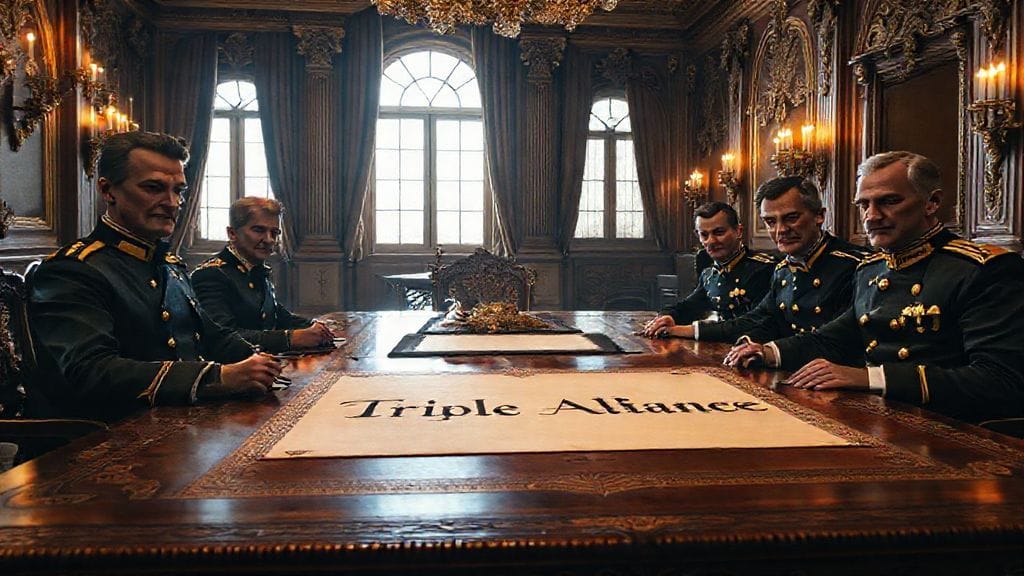
On that day in May, representatives from the three powers convened in Vienna’s stately environs. The atmosphere reflected the intricacy and gravity of the negotiations. Led by Bismarck, Austria-Hungary’s Foreign Minister Count Gustav Kálnoky, and Italy’s Prime Minister Agostino Depretis, the delegates hammered out terms that would bind the trio in mutual defense against attacks by other powers.
The treaty’s signing was more than diplomatic formality; it was a declaration of shared destiny — though one fraught with unspoken doubts. Italy’s inclusion was controversial, given its previous alliances and ongoing territorial ambitions, but it was a calculated risk embraced by all.
7. The Terms of the Agreement: Defensive Pact and Mutual Obligations
The Triple Alliance stipulated that if any one member was attacked by two or more powers, the others were bound to provide military assistance. If attacked by only one power, the other two were to remain neutral, though consultation was required.
This nuanced structure reflected pervasive mistrust, especially regarding Italy’s loyalty. The pact also included clauses for periodic renewal and consultation, underscoring the precarious nature of the alliance.
8. Immediate Reactions Across Europe: Suspicion and Strategic Calculations
News of the Triple Alliance sent shockwaves through European capitals. France, feeling encircled and betrayed, accelerated efforts to strengthen its ties with Russia. Britain watched cautiously, balancing its imperial commitments with the need to maintain continental stability.
Russia viewed the alliance as a direct threat, especially as it intensified its Balkan ambitions. The new three-way partnership seemed to crystallize opposing camps, intensifying the sense of inevitable conflict.
9. Russia and France: The Silent Observers Turn Toward Each Other
Isolated by the Triple Alliance, France sought a counterweight. By 1892, France and Russia concluded their own alliance, the Franco-Russian Alliance, shifting the balance further. This pattern of interlocking agreements forged a highly polarized Europe, where peace rested uneasily on fragile treaties.
The opposition between the two blocs created a tense environment, as smaller crises threatened to ignite the continent.
10. The Dual Alliance and the Shifting Blocs of Europe
The Triple Alliance built on the earlier Dual Alliance of 1879 between Germany and Austria-Hungary. As Italy’s inclusion complicated matters, the alliances evolved dynamically, reflecting changing interests and growing anxieties.
Italy’s ambivalence was a constant factor, giving rise to speculation about the alliance’s durability in times of war.
11. The Triple Alliance in Practice: Military Coordination and Diplomacy
Throughout the 1880s and 1890s, the Triple Alliance facilitated military planning and joint exercises. Yet, coordination was imperfect, hindered by national rivalries and Italy’s mistrust, especially regarding Austria-Hungary’s Balkan policies.
Despite formal ties, the members held diverging priorities. The alliance was as much a political symbol as a practical defensive pact.
12. Italy’s Complex Position: Loyalty Tested and Shifting Ambitions
Italy’s loyalty wavered during crises. In 1911, the Italo-Turkish War revealed Italy’s desire for territorial expansion in Libya, at odds with Austria-Hungary’s interests. Italy’s relationship with France, once strained, gradually improved, setting the stage for future realignments.
By the eve of World War I, Italy ultimately defected to the Entente Powers, highlighting the alliance’s limits.
13. Austria-Hungary’s Balkan Quandary: Alliance as Protection
The Balkans remained Europe’s powder keg. Austria-Hungary used the Triple Alliance as a shield against Slavic nationalism and Russian interference, seeking to preserve its empire’s unity amid mounting unrest.
However, the alliance also trapped Austria-Hungary in its contradictions, unable to address the root causes of instability.
14. Germany’s Strategic Gamble: Maintaining Peace through Power
Bismarck’s policy intended to isolate France and prevent a two-front war. Yet, by binding Germany to Austria-Hungary and Italy, it also rigidified alliances that would later limit diplomatic flexibility.
The Triple Alliance was a double-edged sword — preserving peace in the short term but entangling Germany in commitments that would prove fatal.
15. The Alliance’s Role in the Prelude to the Great War
In 1914, the Triple Alliance was put to the ultimate test. The assassination of Archduke Franz Ferdinand unleashed a chain reaction among these interlocking powers. Italy, hesitating, declared neutrality despite its treaty obligations, before joining the Allies in 1915.
The alliance’s collapse exposed the dangers of entangled diplomacy, nationalism, and militarism, culminating in the Great War.
16. The Human Element: Diplomats, Monarchs, and the Weight of Decisions
Behind every clause and military plan stood individuals grappling with immense responsibility. Bismarck’s genius, Kálnoky’s pragmatism, Depretis’s ambitions — their personalities shaped decisions with profound consequences.
Letters, diaries, and memoirs reveal the mixture of patriotism, fear, and uncertainty that colored their choices.
17. Cultural Echoes: How the Alliance Shaped European Nationalisms
The Triple Alliance influenced national narratives. Germany’s sense of encirclement fed militarism. Austria-Hungary’s diverse peoples reacted with a mixture of loyalty and resistance. Italy’s fragile unity was tested against competing foreign loyalties.
These cultural undercurrents fed into the broader political tensions that ignited war.
18. Economic Underpinnings: Trade, Industry, and Military Spending
The alliance was not only military but economic. The connected powers engaged in trade agreements supporting industrial growth, arms production, and infrastructure development.
Arms races fueled by fear and competition strained budgets but also modernized armies, preparing them for a conflict looming just over the horizon.
19. The Fragility of Alliances: Cracks and Controversies Within the Pact
From the start, doubts lingered. Italy’s secret negotiations with France, Austria-Hungary’s mistrust of Italian intentions, and Germany’s shifting interests created tensions.
The alliance’s fragility was exposed repeatedly, foreshadowing its eventual demise.
20. Legacy of the Triple Alliance: Lessons in Power, Trust, and Betrayal
The Triple Alliance exemplifies the paradox of alliances — instruments of security that can breed insecurity. Its history teaches the limits of relying on rigid entanglements and the importance of understanding allies’ priorities.
The pact’s legacy is inseparable from the tragedy of World War I, a cautionary tale etched into global memory.
21. Reflections on How One Treaty Redefined an Era of Conflict
The signing of the Triple Alliance stands as a pivotal moment in European history. It encapsulated aspirations for stability but also accelerated rivalries that fractured the continent. Its story is a reminder of how diplomacy, strategy, and human ambition can intertwine to both prevent and provoke conflict — a timeless lesson resonating in today’s global challenges.
Conclusion
The Triple Alliance, signed quietly yet decisively in the ornate halls of Vienna, was more than a defensive pact; it was a mirror reflecting the hopes and fears of an age teetering on the edge of tumultuous change. As Germany, Austria-Hungary, and Italy pledged mutual support, they wove a complex web of power relations, fraught with contradictions and fragile loyalties.
This alliance charted a course that shaped the political landscape of Europe for over thirty years — a course that led inexorably toward world war. Through the lens of this treaty, we grasp not only the mechanics of diplomacy but also the deeply human dimensions of fear, ambition, and trust. The lessons of the Triple Alliance echo still, reminding us that the bonds forged between nations can either secure peace or ignite conflict, depending on the wisdom and goodwill that accompany them.
FAQs
Q: What were the main reasons for the formation of the Triple Alliance?
A: The alliance was formed primarily to provide mutual defense against France and to counterbalance Russian influence, especially in the Balkans. Germany sought to isolate France diplomatically, Austria-Hungary needed security amid internal and external threats, and Italy sought recognition and protection against French colonial ambitions.
Q: Why did Italy join the alliance despite having conflicting interests?
A: Italy joined to secure its position as a great power and to gain support for its territorial ambitions. However, its interests occasionally conflicted, particularly regarding Austria-Hungary’s role in the Balkans and colonial competition with France, resulting in Italy’s eventual defection during World War I.
Q: How did the Triple Alliance influence the Franco-Russian Alliance?
A: The Triple Alliance’s formation isolated France, pushing it toward Russia in a counter-alliance. This Franco-Russian partnership further polarized Europe into two antagonistic blocs, increasing tensions that contributed to the outbreak of World War I.
Q: What role did the Triple Alliance play in the lead-up to World War I?
A: The Triple Alliance formalized military commitments that tied the signatories into obligations that contributed to the escalation of conflict. However, Italy’s neutrality and later switch to the Allies reveal the alliance’s fragility.
Q: Were there any significant disagreements among the allies within the Triple Alliance?
A: Yes, Italy’s loyalty was often questioned due to conflicting territorial ambitions. Austria-Hungary mistrusted Italy’s intentions, and Germany occasionally had to mediate these tensions. These cracks undermined the cohesion of the alliance.
Q: How did the public in member states react to the signing of the alliance?
A: Public awareness was limited initially, but nationalist and militarist circles often supported it as a safeguard against enemies. Conversely, in Italy, some viewed the alliance skeptically due to historical rivalries with Austria-Hungary.
Q: Can the Triple Alliance be seen as a cause of World War I?
A: While not a direct cause, the alliance contributed to the rigid system of entangled commitments and distrust that made peaceful conflict resolution difficult, thus playing a significant role in the war’s outbreak.
Q: What lessons does the Triple Alliance offer for modern diplomacy?
A: It highlights the risks of rigid alliance systems lacking flexibility and trust. Diplomatic engagement must prioritize communication, understanding of mutual interests, and conflict prevention to avoid escalation.