Table of Contents
- Awakening in the Mediterranean: The Dawn of Tunisian Nationalism
- Tunisia under Colonial Shadow: The French Protectorate Era
- The Seeds of Discontent: Social, Economic, and Political Tensions
- Habib Bourguiba: The Architect of a New Tunisia
- Neo Destour and the Rise of Organized Resistance
- The Postwar Context: Global Winds Favoring Decolonization
- Negotiations and Struggles: The Path to Sovereignty
- March 20, 1956: The Dawn of Tunisian Independence
- The Proclamation: Symbolism, Ceremony, and Significance
- Reactions at Home: Jubilation and Uncertainty
- French Response: Relinquishment and Resistance
- Regional Implications: Tunisia Sparks North African Liberation
- The Challenges of State-Building: Nationhood Beyond Independence
- Bourguiba’s Vision: Modernization, Secularism, and Reform
- Tunisia’s New Identity: Balancing Tradition and Modernity
- Women and Society: The Birth of Progressive Reforms
- Economic Transformation: From Protectorate to Self-Reliance
- Tunisia on the Global Stage: Diplomacy and Alignment
- Legacy of Independence: Memory, Commemoration, and Narratives
- Tunisia Today: The Long Shadow of 1956
- Conclusion: The End of Empire, the Birth of a Nation
- FAQs About Tunisian Independence
- External Resource
- Internal Link
On a radiant spring morning in Tunis, as sunlight spilled over the Mediterranean’s turquoise expanse, a collective heartbeat quickened throughout the city’s narrow streets and sprawling plazas. It was March 20, 1956, a day inscribed forever in the annals of history—not through the thunder of guns or the fury of revolution, but by the calm yet resolute proclamation of Tunisia’s independence. The air was thick with emotion: relief, pride, hope, and the deep promise of self-determination. Tunisians, after more than seven decades under the weight of French colonial rule, were finally turning the page to a new chapter, writing their own destiny on the parchment of history.
Yet, this moment was not sudden. It was the culmination of decades of struggle, of political maneuvering, of cultural resilience, and of dreams that survived repression. It was, above all, the triumph of a people’s unwavering desire to reclaim their sovereignty, identity, and future. To understand the significance of that crisp March morning, one must journey back into the intricate tapestry of Tunisia’s colonial history, the fervent nationalist movements, and the charismatic figures who embodied the nation’s aspirations.
Tunisia under Colonial Shadow: The French Protectorate Era
The story begins in 1881, when the French government imposed a protectorate over Tunisia, inaugurating a period marked by gradual but profound transformation—both painful and transformative. Unlike outright colonization with systematic settlement and direct rule as found elsewhere, the French employed a façade of traditional authority by keeping the Beylical monarchy, which became little more than a ceremonial institution. In reality, Tunis was governed by the French Resident-General who controlled the political, military, and economic levers.
This protectorate period reshaped Tunisian society. The colonial administration favored French settlers and businesses, built infrastructure mainly serving colonial interests, and marginalized the native population’s political rights. Economic policies primarily aimed at resource extraction and export-oriented agriculture deepened disparities. Meanwhile, social stratification hardened, as indigenous Tunisians often found themselves trapped in poverty, forced to labor under harsh conditions on lands expropriated or administered by colonists.
By the early 20th century, Tunisian national consciousness began to emerge—initially weak and fragmented, it gained strength during and after the First World War. The eloquence of reformist intellectuals and activists sowed the seeds of resistance, calling for constitutional reforms, educational improvements, and eventual autonomy. However, the French administration repeatedly rebuffed these demands, strangling nationalist ambitions with force and legal restrictions. The tensions simmered, punctuated by brief uprisings and political arrests.
The Seeds of Discontent: Social, Economic, and Political Tensions
The aftermath of World War II proved pivotal. The war had shattered the myth of European invincibility and emboldened colonized peoples. Tunisia was no exception. Returning Tunisian soldiers who fought alongside French troops came back determined to claim the freedoms they believed they had earned. Urban workers rallied for better wages and conditions, while the educated middle class pushed political boundaries.
Economic disparities grew starker. While French settlers controlled most of the prime lands and urban businesses, the majority of Tunisians remained marginalized. Rural peasants faced high taxes and limited access to education; the urban working classes suffered from unemployment and political repression. These compounded grievances crystallized into organized political action.
Habib Bourguiba: The Architect of a New Tunisia
No figure embodies the story of Tunisia’s independence more than Habib Bourguiba. Born in 1903 into a modest Tunisian family, Bourguiba emerged as a charismatic leader—an intellectual with a firm grasp on modernist ideas and nationalist fervor. Educated in law both in Tunisia and in France, he combined his legal acumen with a pragmatic vision for Tunisia.
In 1934, he co-founded the Neo Destour party, which became the vehicle of nationalist agitation. Unlike earlier fragmented movements, Neo Destour pursued disciplined political campaigns and mass mobilization. Bourguiba’s strategy was unique: he advocated a gradualist approach, combining diplomacy and internal pressure rather than violent resistance—a stance that invited criticism but ultimately proved effective.
Neo Destour and the Rise of Organized Resistance
Neo Destour metamorphosed from a small group of intellectuals into a powerful movement galvanizing all segments of Tunisian society. In addition to protesting political disenfranchisement, the party championed modernization efforts and social reforms, including women’s rights and education. Bourguiba’s speeches inspired thousands, blending nationalist passion with promises of a secular future.
But the French administration saw them as a threat. In 1938 and following years, leaders were arrested, party offices shuttered, and protests violently suppressed. Bourguiba himself endured imprisonment and exile. Yet, the movement’s resilience only grew; in these trials, a collective Tunisian identity strengthened, fueled by collective suffering and aspirations.
The Postwar Context: Global Winds Favoring Decolonization
World War II marked a turning point globally. The defeat of Axis powers, the establishment of the United Nations, and the growing international rhetoric on human rights challenged colonial empires. Moreover, the Cold War context made European powers more sensitive to colonial unrest, fearing communist influence in anti-colonial movements.
In Tunisia, the postwar period saw increased activism, strikes, and demands for independence. Neo Destour leaders skillfully navigated this new environment, appealing to both Tunisian masses and the international community. The French Fourth Republic initially promised reforms but hesitated to relinquish control.
Negotiations and Struggles: The Path to Sovereignty
The early 1950s brought rising tensions and more violent clashes. French repression intensified, resulting in casualties and mass arrests. International observers increasingly criticized France’s hardline policies. Yet diplomacy gradually opened space for negotiations.
Bourguiba was released from prison in 1951 and capitalized on his freedom to engage in talks. The stalemate broke in 1955 when French Prime Minister Edgar Faure signaled willingness to grant Tunisia internal autonomy. This moment, however, remained precarious, as conservative colonial factions and settler interests resisted.
March 20, 1956: The Dawn of Tunisian Independence
Then came March 20, 1956—the day the French government formally recognized Tunisia as an independent kingdom, ending 75 years of protectorate status. Bourguiba’s Neo Destour had triumphed.
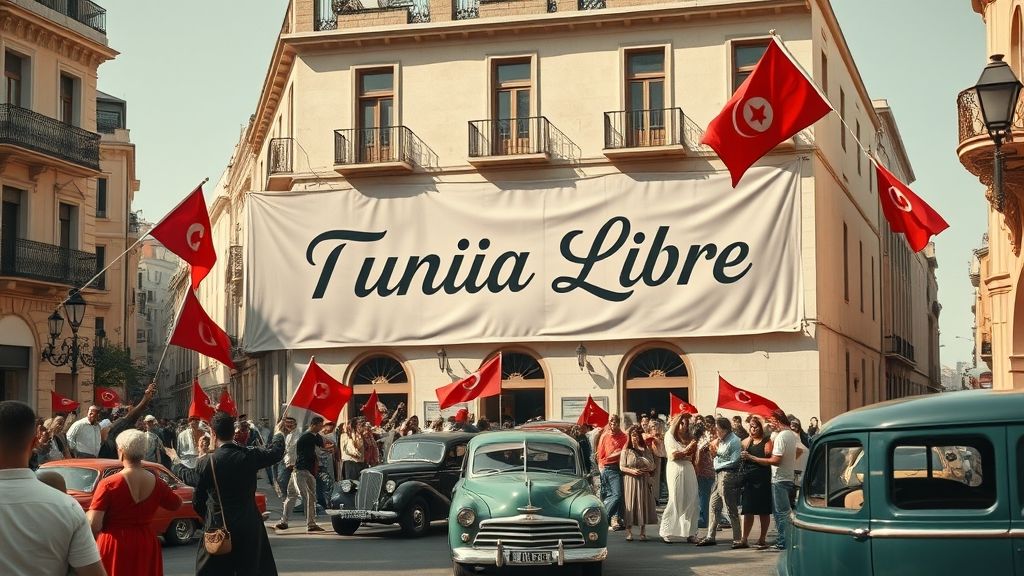
The declaration was more than diplomatic paperwork; it was a culmination of sacrifice and perseverance, a dream fulfilled. Celebrations erupted across Tunis and the country. Citizens flooded the streets, waving the red-and-white flag featuring the crescent and star, symbols of a sovereign Tunisia reclaiming its narrative.
The Proclamation: Symbolism, Ceremony, and Significance
The ceremony took place in the Ministry of Foreign Affairs in Tunis, with Bourguiba present alongside French officials. The symbolic repeal of the protectorate treaty echoed the dismantling of colonial constraints.
Intriguingly, even the Bey of Tunis, Muhammad VIII al-Amin, was part of the transitional period, though his role diminished rapidly as Bourguiba consolidated power. The new state had to navigate the complex legacy of monarchy, colonialism, and republican aspirations.
Reactions at Home: Jubilation and Uncertainty
For many Tunisians, it was a moment of profound joy, a long-sought “return” to self-rule. Streets filled with music, poetry readings, and spontaneous parades. Yet, beneath the jubilation lay uncertainty. The new leaders faced immense tasks: ending French economic dominance, crafting institutions, unifying a diverse society, and navigating Cold War geopolitics.
The memory of colonial oppression was fresh; the trauma would shape politics and societal dynamics in the decades to come.
French Response: Relinquishment and Resistance
Although France formally granted independence, many French settlers and vested interests resisted the new reality. Negotiations over military bases, economic terms, and citizenship rights proved tense. Some settler communities feared displacement and loss of privileges.
Nonetheless, France was weary from multiple colonial wars—most notably in Indochina and Algeria—and pragmatically accepted Tunisian sovereignty.
Regional Implications: Tunisia Sparks North African Liberation
Tunisia’s independence reverberated across the Maghreb and the broader Arab world. It inspired other anti-colonial movements in Algeria, Morocco, Libya, and beyond. The political momentum shifted; French colonialism showed cracks, and new alliances based on shared liberation agendas emerged.
Tunisia became a symbol—an example of a successful, relatively peaceful transition.
The Challenges of State-Building: Nationhood Beyond Independence
But independence was merely the opening act. Tunisia confronted formidable challenges constructing a modern nation-state. Governing institutions were fragile, infrastructure prioritized colonial extraction rather than internal development, and political factions differed on the nation’s direction.
Bourguiba’s leadership proved crucial in steering Tunisia toward stability, implementing reforms, and managing dissent.
Bourguiba’s Vision: Modernization, Secularism, and Reform
Bourguiba envisioned Tunisia as a secular, progressive republic in a predominantly Arab and Muslim region. His policies promoted education, women's emancipation, and strict state control over religion. The Code of Personal Status in 1956 revolutionized women’s rights, banning polygamy and raising marriage age—one of the boldest moves in the Arab world.
This vision was both celebrated and contested, laying foundations for Tunisia’s unique identity.
Tunisia’s New Identity: Balancing Tradition and Modernity
Tunisia sought to reconcile its deep Islamic and Arab traditions with modern nationalist ideals inspired by Europe. Architecture, education, and cultural policies blended these elements to forge a distinct national identity.
This balancing act continues to resonate in Tunisia’s political discourse today.
Women and Society: The Birth of Progressive Reforms
Few countries in the Arab world matched Tunisia’s progressiveness regarding gender equality during this period. Bourguiba’s reforms empowered women in unprecedented ways, enabling greater education participation and legal protections.
These reforms sparked debate but became a defining feature of the post-independence era.
Economic Transformation: From Protectorate to Self-Reliance
Economically, Tunisia grappled with dismantling colonial structures that favored French settlers and companies. Diversification, investment in agriculture, and industrial development became priorities. Although foreign aid and investment remained significant, Tunisia charted a cautious path towards economic sovereignty.
Tunisia on the Global Stage: Diplomacy and Alignment
Internationally, Tunisia pursued a non-aligned posture during the Cold War, engaging with the United Nations and fostering relations across Africa, the Arab world, and Europe. Tunisian diplomacy blended pragmatism and commitment to pan-Arab ideals.
Legacy of Independence: Memory, Commemoration, and Narratives
Today, Tunisia’s independence is commemorated annually as a national holiday. It marks a turning point celebrated in literature, music, and public memory. Yet, interpretations of independence’s legacy vary—tensions between authoritarianism and democracy, modernization and tradition continue shaping discourse.
Tunisia Today: The Long Shadow of 1956
The spirit of independence continues influencing Tunisia’s political evolution. The Jasmine Revolution of 2011 recalled the values of freedom and dignity long aspired to in 1956, showing the enduring power of that day’s legacy.
Conclusion
March 20, 1956, remains not only a date but a beacon—a powerful reminder of Tunisia’s resilience and courage. It was the moment when a nation, weathering decades of colonial domination, collectively reclaimed its voice and future. The road that followed was neither easy nor linear but forged by determination, vision, and an unyielding quest for dignity.
Tunisia’s independence embodies the universal human desire for freedom, identity, and self-rule—a story as relevant today as it was seventy years ago. As we look back, we honor not only the leaders but the ordinary men and women whose dreams and sacrifices propelled a nation into the light.
FAQs About Tunisian Independence
Q1: What were the main causes leading to Tunisia’s independence in 1956?
Tunisia’s independence stemmed from long-standing grievances related to French colonial political domination, economic exploitation, and social marginalization. The rise of nationalist movements, particularly Neo Destour under Habib Bourguiba, combined with post-WWII decolonization pressures, catalyzed the push for sovereignty.
Q2: Who was Habib Bourguiba, and why is he central to this story?
Bourguiba was the charismatic nationalist leader and founder of Neo Destour. His pragmatic political strategy—favoring negotiation over armed struggle—along with his vision for a modern, secular Tunisia, made him the primary architect and symbol of Tunisian independence.
Q3: How did the French government respond to the Tunisian independence movement?
Initially resistant to granting full independence, the French government used repression but eventually negotiated autonomy, influenced by international pressures and other colonial conflicts. The formal recognition came with the signing of agreements in early 1956.
Q4: What role did international context play in Tunisia’s independence?
Global decolonization trends post-World War II, including the creation of the United Nations and Cold War dynamics, exerted pressure on colonial powers to reconsider their holdings. Tunisia's independence was part of a broader wave of African and Asian nations seeking sovereignty.
Q5: What were the immediate challenges Tunisia faced after independence?
Building state institutions, establishing economic independence, managing political factions, and balancing modernization with tradition were immediate challenges. The transition required crafting a unifying national identity while dealing with residual colonial structures.
Q6: How did Tunisia’s independence influence other North African countries?
Tunisia’s peaceful transition inspired nationalist movements across the Maghreb, including Algeria and Morocco. It signaled the vulnerability of French colonialism and encouraged other nations to intensify their efforts for self-rule.
Q7: What societal changes accompanied independence in Tunisia?
The post-independence era introduced reforms such as women’s rights expansion, secular education, and legal modernization. These shaped Tunisia’s unique path in the Arab world, though not without internal tensions.
Q8: How is Tunisian independence commemorated today?
March 20 is a national holiday — celebrated with ceremonies, parades, and cultural events. Independence Day honors both historical achievements and ongoing aspirations for freedom and democracy.