Table of Contents
- A Winter Morning in Nagasaki: The Hill of Execution
- An Island Opens to the West: The First Jesuits in Japan
- Faith and Power: How Christianity Took Root in a Samurai World
- Toyotomi Hideyoshi’s Calculations: From Curiosity to Suspicion
- The Night of Arrest in Kyoto: Singing on the Road to Death
- The Long March to Nagasaki: Blood, Frost, and Silent Crowds
- Children Among the Condemned: The Youngest Martyrs of Japan
- The Hill Above the Harbor: Preparing the Crosses in Nagasaki
- The Twenty Six Martyrs Crucifixion: Nails, Salt Wind, and Final Prayers
- Witnesses, Tears, and Echoes: How News of the Execution Spread
- Hidden Seeds: The Birth of the Kakure Kirishitan Tradition
- From Tolerance to Persecution: The Tokugawa Shogunate and the Ban on Christianity
- Memory Written in Blood: Letters, Reports, and Early European Reactions
- Nagasaki Transformed: From Martyr City to Closed Port
- Canonization and Global Memory: The Martyrs in Catholic Imagination
- Interpreting the Martyrs: Faith, Empire, and Japanese Sovereignty
- On the Hill Today: Pilgrims, Silence, and Modern Nagasaki
- Lessons from the Crosses: Religious Freedom, Power, and Conscience
- Conclusion
- FAQs
- External Resource
- Internal Link
Article Summary: On a cold February morning in 1597, a hill overlooking the Nagasaki harbor became the stage for a story that would echo across centuries: the twenty six martyrs crucifixion, ordered by Toyotomi Hideyoshi at the twilight of his power. This article traces how Christianity arrived with Portuguese ships, intertwined itself with Japanese politics and trade, and raised hopes among converts from peasants to samurai. It follows the arrests in Kyoto, the frozen march across Japan, and the haunting presence of children among the condemned. Through eyewitness accounts and letters, we step into the final hours on the crosses, hearing hymns carried by the sea wind. The narrative then turns to the hidden Christians who kept their faith in secret for generations after the twenty six martyrs crucifixion, and to the tightening grip of the Tokugawa shogunate that sought to erase the religion altogether. Moving forward in time, we examine how the Church, historians, and modern Japan have remembered or reinterpreted the twenty six martyrs crucifixion, weaving it into global Catholic memory and Japanese national history. Ultimately, this long view reveals how the twenty six martyrs crucifixion is not only a story of death, but a lens on power, conscience, and the fragile space between foreign influence and local identity in early modern Japan.
A Winter Morning in Nagasaki: The Hill of Execution
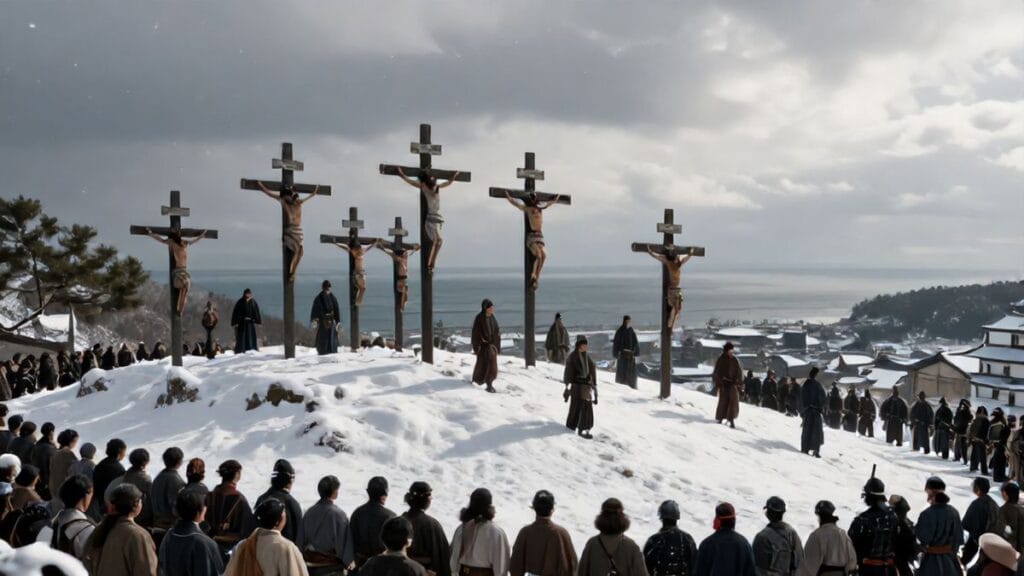
On the morning of February 5, 1597, Nagasaki did not yet know that it was becoming a city of memory. The sea lay grey and unsettled, the winter wind sweeping in from the bay and climbing the hill that rose just outside the town. Along that hill, carpenters and soldiers had worked through the previous days, raising a rigid forest of crosses—twenty-six of them—set into the earth like stakes in a boundary line. Below, in the streets thick with the smell of salt fish, smoke, and damp wood, word had spread in fragments: prisoners were coming, Christians would die, the ruler Hideyoshi had given an order that could not be refused.
Those who climbed the hill that morning came for many reasons. Some were curious, for public executions, though grim, were also a kind of spectacle. Some were afraid, hoping merely to see without being seen, to understand what line must not be crossed in this tightening world of decrees and edicts. Others were there out of hidden solidarity, their hearts beating faster whenever they caught a glimpse of a rosary-bead, a whispered Ave, a familiar face among the condemned. On the ground, the crosses stood ready, their beams raw and splintered. Rope and iron nails lay nearby, instruments chosen to make the twenty six martyrs crucifixion both spectacular and unmistakable: a warning nailed into the skyline of Nagasaki itself.
From a distance, one could see the procession approach—a thread of movement amid the winter landscape. Twenty-six figures, guarded by soldiers, moved slowly toward the hill. Wounds from a long, bitter march across Japan were half-hidden beneath their garments. Some wore the coarse habit of the Franciscan order; others were Jesuit brothers or Japanese lay Christians. Among them walked children, so small that onlookers had to strain to see them past the shoulders of the crowd. The condemned were not silent. Hymns rose up, carried by that same wind that scoured the hillside, their Latin and Japanese syllables weaving together in defiant song.
For the authorities overseeing the execution, this was theater as much as punishment. To crucify twenty-six in one synchronized act, in a port city known across seas for trade with the Portuguese, was to send a message far beyond Nagasaki’s narrow streets. It set the tone for relations between Japan and a newly arrived faith, one that seemed to bring both spiritual fervor and foreign cannons in its wake. Yet for those on the crosses, this winter morning was not about geopolitics. It was the final scene of lives that had been quietly, and sometimes dramatically, drawn into the orbit of Christianity, a faith that had traveled halfway around the world in the holds of ships and the pockets of missionaries.
As the twenty six martyrs crucifixion unfolded, the hill became a crucible in which competing visions of Japan’s future collided. Would these deaths shut the door on Western religion and influence, or would they carve deeper channels of belief into the hearts of those who watched? The answer would not be clear for generations. But on that day, the crosses stood stark against the sky, embodying both an ending and a beginning, a moment when human courage and state power confronted each other in the cold light of a Nagasaki winter.
An Island Opens to the West: The First Jesuits in Japan
The story of the Nagasaki martyrs begins decades earlier, far from the execution hill, on the decks of Portuguese carracks that bobbed in Asian waters like floating fortresses. When Francis Xavier, the Basque Jesuit often called the “Apostle of the Indies,” landed in Japan in 1549, he found a society unlike any other he had encountered. Here was a land steeped in refined aesthetics, complex social hierarchies, and an intellectual tradition that took debate and doctrine seriously. It was, in his eyes, fertile soil for Christian teaching, though the ground was anything but simple.
Portuguese traders had reached the Japanese archipelago in the 1540s, attracted by copper, silver, and the possibility of a new market at the eastern edge of Asia. With them came firearms—the arquebus, in particular—which quickly changed the calculus of warfare among competing daimyo, the feudal lords who controlled territories amid ongoing conflicts. Jesuit missionaries, sailing on the same routes, understood that their work would always be entwined with these commercial and military threads. To gain access to people, they would need the goodwill of local rulers, which often meant aligning themselves, even uneasily, with the networks of trade and power emerging around the Portuguese presence.
Japan in the mid-16th century was not a closed monolith but a patchwork of domains. Some daimyo looked favorably on the newcomers, drawn by the promise of firearms and foreign trade. Others eyed them with suspicion, seeing in the cross a possible spearhead of foreign domination, reminiscent of Iberian conquests in other parts of Asia. Francis Xavier and later Jesuit missionaries learned quickly that conversion might begin in a lord’s castle, with careful diplomacy and gifts, before it filtered down to peasants and townspeople.
Letters from missionaries of the period, preserved in archives in Rome and Lisbon, show a mixture of awe and calculation. They describe Japanese customs, tea ceremonies, the discipline of samurai, and the structured logic of Buddhist monks who challenged Christian doctrine in public debates. One Jesuit, Luís Fróis, famously compared European and Japanese habits in a sort of cultural ledger, noting contrasts in everything from eating to clothing; this, too, was part of the larger process of mutual appraisal. The Jesuits were learning Japan even as Japan was learning to read these strange men in black robes.
By the 1570s, tens of thousands of Japanese, perhaps more, had been baptized, especially in Kyushu, where Christian influence was strongest. Nagasaki itself would, in time, become a kind of Christian stronghold, donated by a local Christian daimyo to the Jesuits. Churches rose, bells tolled, and liturgies were celebrated in a blend of Latin and Japanese. From the perspective of many converts, Christianity offered not only new rituals, but a new sense of universal belonging, a link to distant lands and a story that stretched back to ancient Jerusalem.
Yet even in these early decades, the fragile nature of Christian success in Japan was apparent. The faith’s expansion depended heavily on the favor of a handful of powerful warlords. Should a single national unifier emerge—someone strong enough to override the semi-autonomous power of the daimyo—that person’s stance toward Christianity would be critical. The hill at Nagasaki in 1597 would ultimately become an answer to this open question, but in the beginning, when Xavier and his successors preached in market squares and castle halls, the future seemed uncertain but promising, as if a world-historical encounter between Japan and Christianity was only just beginning to take shape.
Faith and Power: How Christianity Took Root in a Samurai World
Christianity’s growth in Japan did not follow a simple pattern of spiritual hunger met by missionary zeal. It unfolded instead amid the interlocking realities of war, trade, and social ambition. In many parts of Kyushu, daimyo who converted did so in part because aligning with the Portuguese and their Jesuit chaplains brought tangible advantages. With Christianity came guns, and with guns came leverage against rivals still fighting with swords and bows. The new religion, therefore, flowed along the channels of political calculation as much as along the paths of private conviction.
For samurai, the appeal of Christianity could be layered. Some found in its disciplined moral code and honor-infused narratives—stories of martyrs, saints, and a crucified yet triumphant Christ—a resonance with their own ethos. Confessions and catechisms were translated into Japanese; catechists, often themselves Japanese converts, taught in village chapels and roadside shelters. In port cities like Nagasaki, new communities emerged where merchants, fishermen, samurai, and peasants stood shoulder to shoulder at Mass, collapsing, at least for an hour, the rigid distinctions of class.
At the same time, the presence of competing religious traditions meant that Christianity entered into a crowded field. Buddhism and Shinto shaped rituals of birth, marriage, and death; they connected people to the land and to their ancestors. Christian missionaries offered a different narrative: one God, one salvation, a linear history that began with creation and moved toward a final judgment. They challenged the reading of the dead, the veneration of kami, and many longstanding practices. This made them not only spiritual competitors but also potential disruptors of local authority structures, particularly where temples served as administrative as well as religious centers.
Among the common people, conversion stories were as diverse as Japan itself. Some were drawn by the promise of an afterlife in a paradise distinctly different from Buddhist Pure Lands—an eternity in the presence of a loving God who knew them individually. Others were attracted by the humanitarian works the missionaries sometimes carried out, caring for the sick and aiding the poor. A few may have embraced baptism in imitation of their lords, understanding conversion as another form of loyalty in a world where allegiance to the local daimyo was almost an instinct.
The Jesuits, careful to adapt, wore garments closer to Japanese dress at times, learned the language, and debated Buddhist monks in public forums. Their success, though uneven, was undeniable in certain regions. By the late 16th century, Christian communities could be found clustered along trade routes and around key ports, forming webs of faith that connected castle towns to fishing villages. In Nagasaki, the skyline itself bore witness: crosses crowned churches, and the sound of church bells mingled with temple gongs across the water.
Yet beneath the surface, cracks were forming. Some Japanese officials warned that the missionaries’ ultimate loyalty lay not with Japanese rulers but with the Portuguese crown and, indirectly, the Pope in distant Rome. Rumors circulated of Spanish conquests in the Philippines and Latin America, where cross and crown had advanced together. Books and maps quietly passed among learned circles, illustrating how Christianization in other parts of the world had preceded political domination. It was in this atmosphere—admiring yet cautious, open yet watchful—that Toyotomi Hideyoshi, the man who would largely unify Japan, began to fix his gaze on the Christian presence within his emerging realm.
Toyotomi Hideyoshi’s Calculations: From Curiosity to Suspicion
Toyotomi Hideyoshi’s rise from low-born foot soldier to the de facto ruler of Japan is one of the most dramatic arcs in Japanese history. A shrewd strategist, master of alliances, and relentless campaigner, he had by the 1580s largely brought the chaotic era of warring states under his control. For a time, he observed the Christian phenomenon with a mixture of indulgence and opportunism. Jesuit accounts describe meetings in which he listened to missionaries, accepted gifts, and issued permissions that allowed Christian activity to continue, especially where it aligned with his priorities.
Hideyoshi’s primary concern, however, was not theology; it was control. His ambition extended beyond Japan; he launched invasions of Korea in a bid to expand his influence on the continent. In that context, any internal force that seemed to recognize an authority beyond his own—especially a foreign, universal authority like the Roman Church—posed potential trouble. His early edict of 1587, which ordered the expulsion of missionaries, was only sporadically enforced, a political gesture that signaled concern without fully disrupting a profitable relationship with Portuguese traders.
Over time, several factors sharpened his suspicion. Reports reached him that in some Christian domains, traditional rituals had been suppressed and Buddhist temples destroyed or repurposed. The sight of peasants and samurai alike giving primary allegiance to a crucified foreign god unnerved conservative elements at court. A famous, perhaps apocryphal, anecdote tells of Hideyoshi gazing at a map of the world and being struck by how regions marked as Christian overseas had often fallen under European rule. Even if the story is embellished, it captures a real fear: that missions were advance scouts of conquest.
Complicating matters further were the rivalries among different Catholic orders. While the Jesuits had dominated mission work in Japan for decades, Spanish Franciscans began arriving from the Philippines, often more bold and more willing to defy Japanese caution. They built churches in Kyoto, paraded openly, and cared for the sick in ways that drew attention. Where Jesuits sometimes preferred quieter diplomacy, the Franciscans emphasized visible witness. To Hideyoshi, already wary, the proliferation of clerical robes and crosses in his capital must have looked like the spread of an unruly foreign influence he had not invited.
In 1596, the spark was lit that would turn mistrust into lethal resolve. A Spanish galleon, the San Felipe, shipwrecked off the coast of Shikoku. Its cargo, valuable and extensive, became the subject of dispute between local authorities and the Spanish crew. During tense negotiations, a Spanish pilot allegedly boasted—perhaps under pressure, perhaps intoxicated—that missionaries prepared the way for Spanish rule, as they had elsewhere. Whether fully accurate or twisted in retelling, the remark struck like a bolt in an already stormy sky.
When word reached Hideyoshi, it confirmed his darkest suspicions. Here, he thought, was proof that the Church and Iberian crowns walked hand in hand, that cross and sword were twin blades. If missionaries were the thin end of the wedge, then their growing success in Japan was intolerable. The edict that followed was swift and brutal in its clarity: certain Christian leaders were to be arrested, humiliated, and executed; the faith was to be warned, if not yet wiped out. On parchment, it was a decree. On the winter hill at Nagasaki, it would become flesh.
The Night of Arrest in Kyoto: Singing on the Road to Death
The first knock came in Kyoto, in the cool of December 1596. Franciscan friars, Japanese brothers of the Society of Jesus, and lay believers were gathered in their modest houses and churches when soldiers arrived with orders in Hideyoshi’s name. The arrests were not chaotic; they were methodical. Names had been selected: priests who had preached boldly, brothers who had taught catechism, and laymen whose devotion had made them visible symbols of this foreign faith.
Among those seized were three Japanese Jesuit brothers—most famously, Paul Miki, a gifted preacher of noble birth; six Franciscan missionaries, mostly Spaniards and Mexicans; and a cluster of Japanese laymen drawn from different walks of life: a cook, a doctor, a carpenter, catechists, and three boys scarcely in their teens. They were dragged from their homes and dragged through the streets, their ears cut off in a prelude of humiliation. The mutilation was meant to broadcast their condition: these were not honored envoys of a powerful foreign religion, but criminals marked for death.
Yet even in this brutality, a different kind of theater took place. The prisoners, bleeding and stunned, began to sing. Hymns rose in Latin and Japanese, drawing on melodies they had learned in candlelit chapels and open squares: the Te Deum, perhaps, or simple chants praising Christ and the Virgin Mary. Eyewitnesses later recalled how the sound echoed down the narrow Kyoto streets, startling residents from their homes. The spectacle of men singing as they were paraded as criminals did not simply terrify; it puzzled and, for some, stirred admiration.
That night, in makeshift confinement, those marked for execution learned of Hideyoshi’s intent. They were not to be beheaded in some secluded courtyard, as might be expected for criminals of lesser note. They would be taken to Nagasaki, marched across the breadth of Japan in the deep of winter, and there crucified. The journey itself was to be part of the punishment, a living proclamation of the consequences of embracing an alien creed against the will of the realm’s unifier.
In letters later carried to Europe, mission chroniclers described the calm that descended upon many of the condemned. Paul Miki, in particular, emerged as a central figure. He preached even in chains, gently encouraging his companions and answering questions from those who watched them pass. His very presence refuted Hideyoshi’s suspicion that Christianity was merely a foreign import. Here was a Japanese, of noble line, speaking his own language, ready to die for a crucified carpenter from Nazareth whom he called Lord.
But this was only the beginning. The real ordeal was not the night of arrest; it was the long, cold road to Nagasaki, where the hill and the crosses waited like a horizon of wood and iron. The condemned could not yet see that distant city, but the logic of power that drove them there had already been set in motion, and there would be no turning back.
The Long March to Nagasaki: Blood, Frost, and Silent Crowds
The march from Kyoto to Nagasaki measured more than distance. It measured the weight of empire and the endurance of conviction. Over roughly 600 kilometers, the twenty-six prisoners—soon to be known collectively as the martyrs—were driven like a mobile warning through villages, towns, and fields. The winter of 1596–1597 was not gentle. Bitter winds cut through thin clothing, and nights spent in crude shelters or open spaces left joints stiff and wounds throbbing.
Their captors did not rush. The pace was deliberate, ensuring maximum visibility. In each settlement where they passed, local officials were informed: these were Christians, condemned by Hideyoshi himself. People emerged from their homes, crowding the road, straining to see. Children clung to their mothers’ robes as the prisoners filed by, guards at their flanks. Some bystanders jeered, spitting or throwing stones. Others watched in uneasy silence, their eyes lingering on the smallest figures in the group—the boys, Luis Ibaraki, Antonio, and the young Thomas, whose presence puzzled and distressed even hardened observers.
Yet amid the pain, the march became an unexpected pilgrimage. The condemned continued to sing, to pray, and, when allowed, to speak with those who approached them cautiously at the edges of the route. Stories circulated of small acts of kindness: a woman slipping a cloth to bind a wounded foot, an old man bowing in a subtle mark of respect, an anonymous hand tossing a rosary bead onto the road. The guards, perhaps moved, perhaps merely pragmatic, did not always crush these fleeting gestures.
Eyewitness writings—later collected and disseminated among European Christians hungry for news from the far “Indies”—describe the prisoners’ resilience. At one point, a soldier is said to have asked why they did not renounce their faith to save their own lives. The reply, echoing across centuries, was simple: their lives, they insisted, had already been given to Christ; what remained was only the manner of their dying. It is astonishing, isn’t it, how such words could resonate from the frozen roads of Japan to the candlelit chapels of Lisbon, Seville, and Rome?
As they approached Kyushu, where Christianity had deeper roots, the reaction of the populace grew more complex. Here, hidden Christians lurked among the crowds, recognizing friars and catechists they had once known. For them, each step of the prisoners toward Nagasaki was a step toward their own testing. If their leaders could be crucified, what safety could ordinary believers expect in the months and years ahead?
By the time the battered column finally neared Nagasaki, the prisoners’ feet were torn and fever burned in some of their veins. Yet reports suggest that spirits were strangely high. To many of them, Nagasaki was not simply a place of execution; it was a city of Christian memory, a place where Mass had once rung unhindered and where their final witness would be most keenly felt. The long march had stripped away comfort, but it had also stripped away illusion. They knew, with painful clarity, who held power in Japan—and to whom they had ultimately given their allegiance.
Children Among the Condemned: The Youngest Martyrs of Japan
In every list of the twenty-six martyrs, the eye is drawn to three names marked not by titles but by age: Luis Ibaraki, just thirteen; Antonio, perhaps thirteen or fourteen; and the even younger Thomas Kozaki, around eleven or twelve. Their presence in the group complicates any simple reading of the twenty six martyrs crucifixion as a straightforward clash between political authority and clerical defiance. Here, very literally, were children caught in the crossfire of a global religious encounter.
Luis Ibaraki, a Franciscan tertiary, had grown up in a Christian environment. Accounts from the time describe him as cheerful and eager, a boy who sang with enthusiasm and served in the friars’ houses with seriousness beyond his years. Antonio and Thomas similarly belonged to families already entwined with Christian networks; their parents or relatives had embraced the new faith, and the boys, in a sense, inherited both its comforts and its dangers. When the arrests came in Kyoto and surrounding areas, the authorities did not distinguish sharply between adult leaders and devout youths. All were swept into the same net.
On the march to Nagasaki, witnesses often singled out the children, describing their songs, their limp from cold and fatigue, their surprising courage. One report preserved by Jesuit chroniclers recounts how Luis, upon hearing that death awaited them in Nagasaki, cried not in fear but in a kind of victorious joy. He spoke of longing to see Christ, repeating catechism lines about heaven with a conviction that stung listeners who had expected terror. The child’s unwavering demeanor became, for European readers, a powerful testament to the depth of Christian formation in Japan—proof that the faith had sunk roots even into its youngest believers.
For Japanese onlookers, the sight was more ambiguous and perhaps more troubling. In a society that valued filial piety and the protection of children, the inclusion of boys among the condemned might have seemed excessive, even for those who distrusted Christianity. Did they truly pose a threat to Hideyoshi’s order? Or were they symbols, meant to show that no age could shelter someone from the consequences of aligning with a suspect foreign belief?
On the day of the execution, these boys would take their places on smaller crosses, their bodies dwarfed by the wood behind them. Later hagiographies would highlight their words on the crosses, their final prayers for their parents, their assurances that they did not regret the path that had brought them here. Whether every recorded phrase is exact or polished by retelling, the core truth is hard to evade: children died that day on the hill above Nagasaki, and their blood mingled with that of priests and laymen, foreign missionaries and Japanese natives.
In the centuries that followed, especially after their canonization, the stories of these young martyrs would be told and retold in Catholic classrooms and sermons around the world. They embodied a poignant paradox: in an act intended to frighten the Japanese away from Christianity, Hideyoshi’s agents had forged some of its most compelling witnesses. The twenty six martyrs crucifixion, far from silencing the faith, had given it child-voiced heroes whose innocence cut through the complexities of politics and empire.
The Hill Above the Harbor: Preparing the Crosses in Nagasaki
While the prisoners trudged step by agonizing step toward Nagasaki, preparations on the hill moved steadily forward. The chosen site, a slope overlooking the harbor, was no accident. Nagasaki’s bay had become a gateway to the world, its waters reflecting the masts of Portuguese ships and the silhouettes of warehouses stuffed with silk, copper, and porcelain. To stage the execution there was to inscribe Hideyoshi’s will onto the very landscape of international exchange.
Carpenters, likely drafted from the town’s laborers, set to work erecting twenty-six sturdy crosses. The design was simple but effective: tall enough to be visible from a distance, strong enough to hold a body for hours. Heavy beams were dragged up the hillside, holes dug, and posts planted deep to withstand both weight and wind. Ropes and nails were readied, iron glinting dully in the winter light. Some local Christians, still hidden, might have watched from afar in sickened disbelief as the instruments of their leaders’ death took shape where once processions and festivals had proclaimed joy.
Nagasaki’s authorities operated under the shadow of Hideyoshi’s power but also with their own concerns. The city depended on foreign trade; too harsh a display could unsettle Portuguese merchants and risk economic repercussions. Yet defying Hideyoshi, or even softening his decree, was unthinkable. The solution, if it could be called that, was to perform the sentence with grim efficiency while maintaining a surface of official composure. Orders were issued, guards stationed, and rumors of the coming execution allowed to flow just enough to ensure a crowd.
On the eve of February 5, as dusk settled over the harbor, Nagasaki must have felt tense, charged. No ordinary execution awaited at dawn, but a spectacle that would bring together townspeople, sailors, hidden Christians, and perhaps curious Buddhists and Shinto devotees, all drawn by the strange convergence of foreign faith and Japanese authority. The crosses stood as dark outlines against the reddening sky, silent yet eloquent.
In some homes, rosaries were clutched tightly, their beads passing through trembling fingers as families prayed for the condemned—and for themselves. In others, people spoke in low voices about what this would mean. Would Hideyoshi now crush all Christian practice? Would churches be burned, priests hunted down? The hill, in its mute readiness, seemed to hold those questions in its rising curve.
By morning, when the prisoners finally arrived, the scene was set for the twenty six martyrs crucifixion to become not only a local event but a turning point in the relationship between Japan, Christianity, and the broader world that watched from across the seas.
The Twenty Six Martyrs Crucifixion: Nails, Salt Wind, and Final Prayers
On that cold February morning, the march ended where the sky met the hillside and twenty-six crosses waited like unblinking sentinels. The prisoners, exhausted from the journey yet strangely resolute, were led one by one to the places marked for them. In later accounts, both Japanese and European, the scene is described with a clarity that feels almost cinematic: the cries of gulls circling overhead, the briny tang of the harbor air, the murmur of the gathered crowd blending with the chants of the condemned.
Each martyr was bound to his cross with ropes; then nails were driven through hands and feet, anchoring flesh to wood. The pain must have been searing, yet the chronicles emphasize not the screams but the prayers. Paul Miki, his body fixed to the beam, used his final strength to preach from the cross. Speaking in clear Japanese, he forgave his executioners, affirmed that he died for Christ, and urged the onlookers to seek the truth he had found. “I am a Japanese,” he is remembered as saying, “and I die for having preached the Gospel of Christ.” These words, preserved in mission letters, echo the fusion of local identity and global faith that so unnerved Hideyoshi.
Nearby, the children’s crosses bore lighter bodies but equally heavy meaning. Luis Ibaraki reportedly gazed toward the sky with a calm that unsettled even some soldiers. He encouraged one of the adults beside him, insisting that they would soon be in paradise. The crowd, compelled and horrified, watched as the smallest voices among the condemned spoke with a conviction that seemed beyond their years. Here, on this hillside, the twenty six martyrs crucifixion merged the innocence of youth with the stern resolve of adult faith.
The executions were not over in a moment. Crucifixion was cruel precisely because it stretched death over hours. The martyrs, suspended between earth and sky, had time to pray aloud, to sing, to exchange words while their strength held. Hymns rose—snatches of the Sanctus, fragments of the Credo—blending Latin liturgy with Japanese inflections. Some in the crowd wept openly; others turned away, unable to watch. A few, perhaps emboldened by emotion, muttered prayers under their breath, risking denunciation.
Soldiers watched for any sign of defiance among the onlookers, ready to quell disturbances. But the resistance that day was not physical; it was spiritual. Every whispered amen, every hand raised furtively to make the sign of the cross, was an act of quiet rebellion against the message of fear the execution was meant to convey. The hill held both terror and transcendence, and in that tension, history tilted.
As hours passed and bodies sagged, voices grew faint. One after another, the martyrs slipped into death. The wind, the same wind that had dried the carpenters’ sweat and carried the approach of the condemned, now carried their last breaths out over the harbor. Nagasaki, its streets and alleys, had been given a spectacle meant to solidify obedience to Hideyoshi’s will. Yet the very dramatization of the twenty six martyrs crucifixion ensured that it would not be easily forgotten. It planted images in the minds of witnesses that would surface in dreams, stories, and secret prayers long after the crosses were taken down.
When the final body hung lifeless, the hill grew quieter. Orders were given, guards relaxed their stances, and some in the crowd began to drift away, shaken and subdued. But beneath the outward dispersal, something had coalesced: a narrative of martyrdom that would travel along trade routes and through hidden meetings, crossing not only the waters to Europe but also the generations of Japanese who would live under regimes determined to erase the faith whose witnesses had just died so publicly.
Witnesses, Tears, and Echoes: How News of the Execution Spread
The crosses on the hill above Nagasaki were not only visible to those who stood beneath them. Through the testimony of survivors, letters of missionaries, and the astonished reports of foreign sailors in the harbor, the story of the twenty six martyrs crucifixion spread rapidly beyond Kyushu. In the immediate aftermath, Christian communities throughout Japan were gripped by shock and grief. Secret gatherings were held where believers recounted, with trembling voices, what they had heard or seen.
Some had watched from a distance, afraid to be recognized as sympathizers. Others had mingled with the crowd, catching fragments of the martyrs’ final words. A few, emboldened by sorrow and faith, managed to retrieve relics—shreds of clothing, drops of dried blood, splinters of wood—that they guarded as treasures. These relics would circulate clandestinely, tangible links to those who had suffered and died for what many called “the Way” (Kirishitan no michi).
News traveled quickly along maritime routes as well. Portuguese merchants and sailors who had witnessed the events or heard detailed accounts from local Christians carried the story back to Macao, Manila, Goa, and eventually to Europe. In Rome and Madrid, missionaries’ letters were read aloud with a mixture of horror and exaltation. Here was proof, to many European Catholics, that Japan had produced martyrs of extraordinary courage, willing to die on crosses reminiscent of their Lord’s. The Jesuit historian Daniello Bartoli later wrote about these events, weaving them into a larger tapestry of Christian heroism in Asia.
The narrative that took shape overseas sometimes simplified the local complexities, casting Hideyoshi as a tyrant and the martyrs as pure symbols of resistance. In reality, the situation had been entangled with that leader’s fears of foreign domination, the rivalry of Catholic orders, and the intricate politics of a newly unified Japan. Yet even when distorted, the core image remained: twenty-six crosses on a hill in a distant land, children and adults alike nailed to them, singing as they died.
Within Japan, reactions among non-Christians were diverse. Some saw the execution as a necessary assertion of sovereignty against potential colonial infiltration, a harsh but sensible act in a dangerous world. Others were disturbed by the extremity of the punishment and the inclusion of youths. In a culture that valued honorable death, the martyrs’ composure under torture and crucifixion could not be easily dismissed as mere fanaticism. Their behavior resonated with existing ideals of loyalty and courage, even if directed toward an alien deity.
In the months that followed, Hideyoshi would die, his own grand ambitions collapsing amid the larger tides of Japanese history. But the echoes of his order on that February day in Nagasaki would endure, giving both inspiration and cautionary fuel to those who would shape Japan’s policies toward Christianity in the next century.
Hidden Seeds: The Birth of the Kakure Kirishitan Tradition
After the crosses came down, after the bodies were disposed of and the hillside resumed its ordinary silence, life for Japanese Christians did not simply return to what it had been. The twenty six martyrs crucifixion had drawn a fiery line through their history. From that point onward, the practice of the faith in Japan would increasingly move underground, sliding from public churches into private homes, from open confession into coded gestures and whispered prayers.
In Nagasaki and across Kyushu, believers began to gather in secret. Meetings that had once been advertised by church bells now took place behind shuttered windows, under the watchful gaze of neighbors whose loyalties were uncertain. Objects that had been proudly displayed—a crucifix on a wall, a statue of Mary—were hidden or disguised. Some households buried their religious items, digging them up only on special days. Others transformed their devotional art, blending Christian imagery with Buddhist or Shinto forms so that an outsider’s eye would not recognize them.
These hidden Christians, known as Kakure Kirishitan, developed an elaborate culture of concealment. Prayers in Latin were passed down orally, their words often garbled over generations into Japanese-sounding syllables, yet still carried reverently as sacred sound. Baptismal rites continued in secret, performed by lay leaders in the absence of priests, who were increasingly scarce as persecution intensified. Christian festivals were synchronized with existing local holidays, cloaking Christian observance in the familiar rhythms of Japanese life.
Families became the primary custodians of faith. In some regions, entire villages maintained a shared identity as hidden Christians, enforcing strict rules about marriage and transmission of belief to keep their community intact. In others, Christian households were isolated, surrounded by non-Christian neighbors, relying on subtle signals and long-remembered contacts to find and encourage one another. The memory of the Nagasaki hill, and of those who had died there, acted as both a warning and a beacon. If discovered, believers knew, they might join the martyrs in suffering; yet that very suffering had also shown that fidelity to Christ, even to death, was possible on Japanese soil.
It is a profound irony that the effort to eradicate Christianity after 1597 instead pushed it into forms that could endure centuries of suppression. Without priests, without regular access to the sacraments as formally defined by Catholic doctrine, hidden Christians nonetheless preserved a core narrative: the life, death, and resurrection of Christ; the saving power of baptism; the intercession of Mary; and the example of the martyrs who had died on the crosses at Nagasaki. When Japan finally reopened in the 19th century, and foreign missionaries returned, they were stunned to find communities that had kept the Christian story alive in this clandestine way.
In a sense, the twenty six martyrs crucifixion had planted seeds in the dark. Deprived of light, these seeds did not wither; they adapted, sending roots deeper into family structures and cultural forms. The resulting plants, when at last exposed to open air centuries later, looked different from European Christianity in some respects, but they bore undeniable marks of continuity—a quiet testimony to the resilience of faith under the harshest of political climates.
From Tolerance to Persecution: The Tokugawa Shogunate and the Ban on Christianity
The execution at Nagasaki, carried out under Toyotomi Hideyoshi’s authority, was a dramatic prelude rather than the final act of Japan’s confrontation with Christianity. After Hideyoshi’s death in 1598, power struggles culminated in the rise of Tokugawa Ieyasu, who emerged victorious from the Battle of Sekigahara in 1600 and established a shogunate that would rule Japan for over two and a half centuries. Ieyasu’s initial stance toward Christianity was more pragmatic than Hideyoshi’s. He recognized the economic benefits of trade with Portugal and Spain and, for a time, tolerated missionary activity insofar as it did not openly threaten his political order.
But the structural tensions remained. The Tokugawa regime’s foundational principle was stability: social classes were fixed, movement was regulated, and potential sources of dissent were carefully monitored. Christianity, with its allegiance to a universal spiritual authority and its transnational networks, remained under suspicion. As long as it served as a conduit for profitable trade and as a manageable minority practice, it could be watched. Yet as reports of conversions among samurai and rumors of foreign designs continued, patience eroded.
By the 1610s and 1620s, the atmosphere had shifted dramatically. New edicts tightened controls, ordering the expulsion of missionaries and the registration of all households with Buddhist temples—a bureaucratic innovation that served both religious and political ends. Systematic inspections sought to root out Christians. One notorious tool was the fumie, an image of Christ or the Virgin Mary that suspected Christians were forced to trample. Refusal could bring imprisonment, torture, or death; compliance was meant to signal renunciation. The policy turned private devotion into a test of loyalty to the state.
The climax of anti-Christian measures came after the Shimabara Rebellion of 1637–1638, an uprising of mostly peasants in Kyushu driven by heavy taxation, local grievances, and, in many cases, Christian identity. Although the rebellion was more complex than a simple “Christian revolt,” the participation of many Christians allowed the shogunate to cast it as proof that Christianity fostered sedition. The response was ruthless: rebel strongholds were crushed, survivors executed, and the association between Christianity and treason solidified in official ideology.
In this tightening vise, the memory of the twenty six martyrs crucifixion gained renewed relevance for those who still clung to the faith. The crosses of Nagasaki stood, in memory if not in wood, as precursors to the sufferings now visited on hidden Christians across Japan. Martyrdom, once a distant story imported from Roman arenas and European persecutions, had become an ongoing Japanese reality. Political edicts and secret baptisms, shogunal decrees and clandestine prayers, now coexisted uneasily in the same villages and households.
By the mid-17th century, Christianity was officially banned, missionaries largely expelled or executed, and Japan sealed under the policy later dubbed sakoku, or “closed country.” Yet, as we have seen, the very thoroughness of the crackdown demanded equally resilient forms of survival from believers. The hill of 1597 had been an early, public gesture; now, persecution moved into prisons, torture chambers, and bureaucratic registries. Still, the cross, once raised openly at Nagasaki, remained an inner symbol for those who refused to renounce their faith, even at the cost of everything else.
Memory Written in Blood: Letters, Reports, and Early European Reactions
While Japan’s shoguns labored to erase Christianity from their domain, across oceans in Europe, the story of the Nagasaki martyrs was being inscribed into a different kind of memory—one made of ink and parchment, sermons and printed books. The first detailed reports of the twenty six martyrs crucifixion reached Rome and other European centers within a few years of 1597, carried by Jesuit and Franciscan networks that linked Asia to Europe in an intricate web of communication.
Missionary letters from Japan, often written under the shadow of censorship and danger, nonetheless found ways to relay vivid accounts. They described the arrests in Kyoto, the long march, the courage of the children, and the scene on the hill overlooking Nagasaki’s harbor. These letters were not neutral chronicles; they were consciously framed to stir support—financial, political, and spiritual—for missionary efforts in Asia. As historian George Elison and others have noted, the martyr narratives served both devotional and institutional purposes, galvanizing European Catholics by presenting Japan as a new theater of heroic faith.
In cities like Lisbon and Seville, these stories were read aloud in religious houses and lay confraternities. Painters and engravers began to depict the scene: twenty-six figures suspended on crosses, often against a stylized backdrop of Japanese rooftops and mountains. In these images, the martyrs’ faces shone with an almost serene light, their sufferings transmuted into signs of divine favor. Some prints circulated alongside maps of Asia, locating Nagasaki for European eyes as both a trade port and a site of sanctity.
The ecclesiastical process of recognizing the martyrs began relatively early. Beatification—an official declaration by the Catholic Church that a person is “blessed” and worthy of veneration—came in 1627, under Pope Urban VIII, only three decades after the execution. Canonization, which would declare them saints, would take longer, but even before that final step, the twenty-six were already woven into the liturgical and devotional life of Catholic communities. Feast days, special prayers, and hagiographic collections ensured that their story endured in collective memory.
Yet the European reception, while fervent, inevitably filtered the events through its own lenses. The complex interplay of Japanese politics, economic anxieties, and inter-order rivalries that had led to the execution often receded in favor of a simpler narrative: bold missionaries and courageous converts crushed by a hostile pagan ruler. Even when Jesuit historians attempted nuance, popular imagination gravitated toward stark contrasts of light and darkness, Christ and persecution. In doing so, it risked turning real Japanese men and women into almost mythic figures, their individual histories flattened into archetypes.
Nonetheless, these written and visual records possess immense historical value. They preserve names, dates, dialogues, and atmospheric details that, while sometimes embellished, offer a window into how contemporaries understood the stakes of the encounter between Japan and Christianity. Without them, the hill at Nagasaki might have faded into obscurity beyond Japanese shores. Instead, through these letters and books, the twenty six martyrs crucifixion became a global story, binding together port city and papal court, Japanese catechists and European artisans, in a shared narrative of suffering and faith.
Nagasaki Transformed: From Martyr City to Closed Port
Nagasaki’s role in this saga did not end with the removal of the twenty-six crosses. In the decades that followed, the city underwent a transformation that mirrored Japan’s broader journey from tentative openness to controlled isolation. Once a semi-autonomous Christian enclave under the influence of Jesuit patrons and local Christian lords, Nagasaki was gradually brought under direct shogunal control. The very city that had witnessed the most famous Christian martyrdom in Japan would become a tightly managed window onto the outside world.
After Christianity was banned and foreign missionaries expelled, the Tokugawa regime did not entirely sever ties with all Westerners. Instead, it carefully curated its connections. Portuguese influence, deeply associated with aggressive missionizing, was curtailed. In their place, the Dutch, more focused on trade than proselytization, were allowed a strictly circumscribed presence. They were confined to Dejima, an artificial island in Nagasaki’s bay, where their movements and interactions with Japanese were closely regulated.
The irony is stark. The harbor that had once reflected the sails of ships carrying priests and catechists now primarily welcomed vessels whose crews were explicitly forbidden to spread their faith. The cross had been driven out of public space, replaced by the ledger and the cargo manifest. Yet the memory of the twenty six martyrs crucifixion haunted the city. Local tales, carefully told, kept the story alive, even as official policy sought to ensure that no new martyrs would arise by denying Christianity a visible foothold.
Within Nagasaki’s neighborhoods, hidden Christian communities continued their furtive practices. Some households kept small, disguised altars; others revered statues of the Bodhisattva Kannon that, to their eyes, secretly represented the Virgin Mary. The city’s hills and backstreets became a delicate palimpsest of faith and fear, where Christian memory was layered beneath Buddhist forms and Tokugawa bureaucracy. Every year, as the anniversary of the 1597 execution approached, some believers would recall the hill, even if only in the silence of their hearts.
Externally, Nagasaki became a symbol of Japan’s selective engagement with the world: a port open to limited trade with tightly controlled partners, in a country otherwise determined to limit foreign influence. Internally, however, it remained a city of unresolved tensions, where the legacy of the martyrs clashed with the needs of a regime that based its legitimacy on a seamless ideological order. That order required amnesia about certain inconvenient pasts; the martyrs’ crosses were among those inconvenient memories.
Centuries later, when Japan would reopen to the world and Nagasaki would again become a focal point of global attention—this time for reasons linked to industrialization and, tragically, atomic warfare—the ghosts of 1597 would re-emerge, demanding a fresh reckoning with the city’s layered identity as both a site of suffering and a gateway between cultures.
Canonization and Global Memory: The Martyrs in Catholic Imagination
The journey from execution hill to altar of sainthood is long, measured not in miles but in years of prayer, debate, and devotion. For the twenty-six martyrs of Nagasaki, this path culminated formally in 1862, when Pope Pius IX canonized them as saints of the Catholic Church. By then, nearly three centuries had passed since their crucifixion, and Japan was on the cusp of a new era, its long isolation ending under the shock of Western gunboats and diplomatic pressure.
The timing was significant. In the mid-19th century, Catholic missions were resuming in East Asia, and the rediscovery of hidden Christian communities in Japan astonished European clergy. The canonization of the Nagasaki martyrs came to symbolize not only the heroism of past believers but also the resilience of a faith that had endured underground for generations. The ceremony in Rome, with its Latin chants and incense, may have seemed far removed from the cold wind that had blown over the crosses in 1597, yet the two moments were connected by an unbroken thread of memory.
In Catholic imagination worldwide, the twenty six martyrs crucifixion assumed a place alongside earlier martyrdoms in ancient Rome and more recent ones in Reformation-era Europe. Their story entered catechisms, schoolbooks, and popular devotional literature. Children in Spain, France, the Philippines, and Mexico learned about the Japanese boy Luis Ibaraki and the noble preacher Paul Miki, about friars who traveled across oceans and Japanese laymen who embraced baptism at great personal risk. Stained glass windows in far-flung churches began to show scenes of Japanese figures on crosses, a visual reminder that the Church’s story was not confined to Europe and the Mediterranean.
Yet this globalized memory often reflected the perspectives and priorities of the broader Catholic world. The martyrs were celebrated primarily as exemplars of unwavering faith, their Japanese cultural context sometimes reduced to exotic backdrop. Only gradually did more nuanced historical studies emerge, seeking to understand how their martyrdom intersected with Japan’s own evolving sense of statehood, sovereignty, and identity in the face of foreign contact.
Meanwhile, within Japan—especially after the Meiji Restoration and the eventual legalization of Christianity in the late 19th century—Catholic communities built shrines and churches dedicated to the martyrs. The hill in Nagasaki where they had died was marked and memorialized, transforming from a site of state intimidation into one of pilgrimage and prayer. Japanese Catholics could now publicly claim these martyrs as both co-religionists and compatriots, bridging the divide that Hideyoshi’s edict had tried to enforce between Japanese identity and Christian allegiance.
Through all of this, the twenty six martyrs crucifixion remained a flexible symbol. For some, it illustrated the heroism of missionaries; for others, the courage of Japanese converts who integrated a foreign faith into their own lives. For still others, especially in more recent decades, it has raised questions about the entanglement of religion and empire, of the cross and the cannon. The martyrs themselves, fixed forever in our imagination on their crosses above Nagasaki, invite both veneration and reflection, their story at once uplifting and unsettling.
Interpreting the Martyrs: Faith, Empire, and Japanese Sovereignty
Modern historians, faced with the charged legacy of the Nagasaki martyrs, navigate a landscape shaped by both piety and politics. On one side stand centuries of Catholic devotion that see the twenty six martyrs crucifixion as a pure drama of faith versus persecution. On the other side lie critical questions about how Christianity entered Japan alongside European imperial ambitions, and how Japanese rulers like Hideyoshi perceived and responded to that entanglement.
It would be simplistic to cast Hideyoshi merely as a villain driven by religious hatred. He was, above all, a political architect attempting to unify a fractured archipelago and to protect it from the fate he saw befalling territories in the Philippines and the Americas. From his vantage point, missionaries often arrived on the heels of traders and soldiers, their preaching intertwined with the languages of profit and power. The San Felipe incident, with its fateful boast about spiritual conquest preceding political domination, crystallized fears that had long simmered beneath the surface.
At the same time, to reduce the martyrs to pawns of European expansion would be equally misleading. Many of them were Japanese, operating within their own cultural and social frameworks. Their choice to embrace Christianity and to die rather than renounce it reflects genuine religious conviction, shaped but not wholly determined by foreign influence. The hill at Nagasaki can thus be seen as a collision point where two universal claims met: the shogun’s claim to absolute loyalty within his realm, and the Christian claim that allegiance to God could supersede any earthly authority.
Citation of primary sources helps illuminate this complexity. For instance, Luís Fróis, the 16th-century Jesuit chronicler, records in his letters how carefully missionaries negotiated with daimyo, aware that any misstep could provoke a backlash not only against themselves but against their converts. In these letters, we glimpse both the strategic dimension of mission work and the deep sincerity of those who believed they were bringing salvific truth to Japan. Similarly, Japanese documents, including edicts and local records, reveal an evolving anxiety about maintaining social harmony in the face of what officials saw as an exclusive and disruptive creed.
Contemporary Japanese scholars and Christian thinkers have increasingly approached the martyrs as a shared heritage that belongs not only to the Catholic Church but also to Japan’s broader historical tapestry. Their story intersects with debates about religious freedom, the handling of cultural difference, and the ethics of state power. Were the martyrs dangerous subversives, as Hideyoshi feared, or early pioneers of a multi-religious Japan, as some modern interpreters suggest? The answer depends, in part, on how one weighs the rights of conscience against the imperatives of political unity.
In this sense, the twenty six martyrs crucifixion remains a live question rather than a closed chapter. It forces us to consider how any society—whether 16th-century Japan or our own—responds when global religions cross borders, when loyalties overlap, and when individuals claim a higher law than the one inscribed in their state’s codes. The crosses on the Nagasaki hill may be centuries old, but the dilemmas they represent remain painfully current.
On the Hill Today: Pilgrims, Silence, and Modern Nagasaki
Walk today up the slope in Nagasaki where the twenty-six martyrs once hung, and you encounter a landscape at once changed and haunted. The wooden crosses of 1597 are long gone, replaced by stone monuments, a museum, and a church dedicated to their memory. The harbor still spreads below, but the ships that dot its waters carry containerized goods rather than the silk, silver, and Jesuit letters of the 16th century. Above, the city’s skyline tells its own layered story, marked not only by Christian sites but also by memorials to the atomic bomb that devastated Nagasaki in 1945.
Pilgrims come in small groups and large tours. Some are Catholics from Japan and abroad, clutching rosaries and prayer booklets. Others are students, foreign visitors, or curious locals, drawn less by faith than by a desire to understand this fragment of their city’s past. In the museum, artifacts and displays reconstruct the world of late-16th-century Japan: maps of trade routes, replicas of missionary vestments, portraits and statues of the martyrs. Panels explain the events leading up to the execution, contextualizing the twenty six martyrs crucifixion within the tangled web of politics, commerce, and religion.
Outside, in the open air, the hill itself does most of the speaking. Standing there, one can imagine the cold wind of February 1597, the clamor of a gathered crowd, the line of crosses rising against the sky. The modern city’s sounds—traffic, ship horns, the murmur of conversation—fade for a moment as visitors read the names inscribed on plaques: Paul Miki, John of Goto, James Kisai, Luis Ibaraki, and the others whose lives converged here. Some visitors light candles; others simply stand in silence, sensing a gravity that transcends doctrinal boundaries.
The coexistence of this Christian memorial with the nearby Peace Park and Atomic Bomb Museum creates a poignant dialogue. Nagasaki carries multiple layers of suffering and resilience: the blood of martyrs under Hideyoshi’s regime, the incineration of civilians under a totally different kind of power nearly three and a half centuries later. In both cases, the city has had to reckon with how violence, justified as necessary or inevitable, leaves scars that demand remembrance and reflection.
Modern Nagasaki is also a place of interreligious encounter. Catholic churches, Buddhist temples, and Shinto shrines stand within walking distance of one another. Festivals animate streets that once saw processions of condemned believers. In this context, the hill of the martyrs no longer functions as a warning against Christianity; it serves instead as an invitation to consider the cost of intolerance and the value of conscience. Whether approached as a site of religious devotion or historical curiosity, it asks visitors to see beyond labels—“Japanese,” “Christian,” “foreigner”—to the human beings whose choices and sufferings have shaped the city’s story.
For some Japanese Christians, especially those whose families trace their faith back to the hidden communities of earlier centuries, visiting the hill is like returning to a family grave. It is a place to honor ancestors in faith, to give thanks that what was nearly extinguished has endured. For others, the hill is a mirror held up to Japan’s past, reflecting both moments of cruelty and the capacity for reevaluation and healing. In the quiet that settles at dusk, as city lights flicker on and the harbor glows softly below, the crosses—now symbolic, yet no less powerful—seem to stand at the threshold between history and present, asking what we will do with the memory they preserve.
Lessons from the Crosses: Religious Freedom, Power, and Conscience
Looking back from our contemporary world, with its international human rights instruments and pluralistic societies, the events of February 5, 1597, speak with a disquieting clarity. The twenty six martyrs crucifixion was, in its essence, a confrontation between a nascent idea of religious conscience and an emerging centralized state’s demand for unambiguous loyalty. The martyrs did not take up arms; they did not plot rebellion. Their “crime” lay in adherence to a faith whose transnational allegiances and exclusive claims on truth made rulers uneasy.
We can understand why Hideyoshi and, later, the Tokugawa shoguns felt threatened. They lived in an age when empires expanded behind the banner of universal religions, when missionaries and merchants traveled together, and when the word “Christian” often appeared alongside stories of European conquest. From their vantage point, allowing Christianity to flourish unchecked might have seemed tantamount to inviting foreign powers to carve up Japan’s sovereignty. Their response—harsh bans, torture, execution—was an attempt, however brutal, to preserve what they saw as the integrity of the realm.
Yet, seen from the perspective of the martyrs and the hidden Christians who followed them, the story looks different. Here we see individuals and communities asserting, implicitly if not in modern legal language, that the interior space of conscience belongs to a higher authority than any temporal ruler. They accepted the consequences of that stance—including crucifixion, prison, and social ostracism—not because they despised Japan, but because they believed that the truth they had encountered required their total allegiance.
In the centuries since, international norms have evolved toward an ideal that would have seemed revolutionary in Hideyoshi’s court: the recognition that people should be free to choose, change, or reject religious beliefs without coercion from the state. Of course, reality seldom matches this ideal perfectly; religious persecution persists in many parts of the world. In that sense, the crosses of Nagasaki are not relics of a bygone issue but a stark reminder of ongoing struggles.
They also raise uncomfortable questions for religious institutions themselves. The same Catholic Church that venerates the Nagasaki martyrs has, at times in its own history, aligned with political powers that suppressed dissenting beliefs. The story of the martyrs thus invites self-examination as much as commemoration. It challenges all communities—religious and secular alike—to ask how they wield power, how they handle minority voices, and what they are willing to endure or inflict in the name of truth or order.
Ultimately, the lesson of the twenty six martyrs crucifixion is not that faith and politics can be neatly separated—they never fully can—but that the dignity of conscience must be protected, even when it complicates the smooth functioning of the state. The hill above Nagasaki shows what happens when that dignity is denied, when fear of foreign influence and the desire for control eclipse the humanity of those who believe differently. It invites us, across cultures and centuries, to imagine a different response: one where differences of faith are negotiated through dialogue rather than nailed into wood.
Conclusion
From a distance, the crosses of Nagasaki can look like distant, almost abstract symbols, reduced by time and retelling to icons in stained glass or footnotes in history books. But as we have traced the story from the first Jesuit landings to the winter morning of February 5, 1597, and onward through Tokugawa persecutions, hidden Christian perseverance, and modern reinterpretations, the twenty six martyrs crucifixion emerges as something more concrete and more challenging. It is a human story, rooted in particular faces and places: a port city facing the sea, children lifted onto crosses, a preacher speaking in his native tongue as he dies for a faith that came from far away yet took root in his own soil.
The crucifixion of the twenty-six martyrs marks a turning point in the encounter between Japan and Christianity, but also in Japan’s engagement with the broader world. Hideyoshi’s order to execute priests and lay believers was not simply an act of religious intolerance; it was a declaration about sovereignty, about who would define the terms of cultural exchange and allegiance in a rapidly changing world. The decades that followed would see that declaration hardened into isolationist policy, even as Christianity retreated into shadowed houses and encoded rituals, kept alive by ordinary Japanese who refused to let the story end on the hill.
Over time, the meanings attached to the martyrs have multiplied. For European Catholics of the 17th and 18th centuries, they were heroic witnesses from a mysterious East, proofs that the Church’s universality extended to the furthest islands. For modern Japanese Christians, they are ancestors in faith, men and boys whose courage helped sustain hidden communities through centuries of persecution. For historians and contemporary observers, they are lenses through which to examine the entangled histories of religion, empire, and national identity.
Standing on the hill today, one can feel the overlapping layers of these interpretations—and also something simpler: the solemn impact of human beings who chose fidelity over survival. Whether one shares their beliefs or not, it is difficult to remain unmoved by their steadfastness. Their story asks uncomfortable questions: How far would we go for our deepest convictions? How do we respond when power demands that we betray what we hold most sacred?
In the end, the twenty six martyrs crucifixion does not offer easy answers. It offers, instead, a stark tableau of courage and fear, calculation and compassion, cruelty and grace. It invites us to remember not only the martyrs but also the rulers who condemned them, the crowds who watched, and the hidden Christians who carried their memory forward. In that remembering, we are called to consider how our own societies treat those whose loyalties straddle borders, whose faith or conscience leads them down paths the majority may not understand.
The crosses above Nagasaki, though long vanished in wood, remain standing in history. They mark a place where worlds met and clashed, where an island nation negotiated its place in a wider world, and where ordinary people faced extraordinary choices. To listen to their story is to step onto that hillside once more, feeling the winter wind and hearing, somewhere beneath the noise of politics and fear, the persistent, fragile, and enduring song of human conscience.
FAQs
- Who were the Twenty-Six Martyrs of Nagasaki?
The Twenty-Six Martyrs of Nagasaki were a group of Catholic believers—both foreign missionaries and Japanese converts—who were arrested under Toyotomi Hideyoshi’s orders, marched from Kyoto to Nagasaki in the winter of 1596–1597, and crucified on a hill overlooking Nagasaki’s harbor on February 5, 1597. They included Franciscan and Jesuit religious, lay catechists, artisans, and three boys as young as eleven or thirteen. - Why did Toyotomi Hideyoshi order their execution?
Hideyoshi, concerned about maintaining political control and protecting Japan from potential European colonial ambitions, grew increasingly suspicious of Christianity. The shipwreck of the Spanish galleon San Felipe and boasts that missionaries prepared the way for conquest convinced him that the Christian presence could undermine his authority. The execution was intended as a dramatic warning to deter further spread of the faith and assert Japanese sovereignty. - How did the twenty six martyrs crucifixion affect Christianity in Japan?
The execution marked the beginning of a harsher era. While Christianity was not immediately eradicated, persecution increased, especially under the subsequent Tokugawa shogunate. Public Christian practice was eventually banned, missionaries expelled or killed, and many believers forced to renounce their faith or go underground. This led to the emergence of the hidden Christians (Kakure Kirishitan), who preserved elements of the faith in secret for more than two centuries. - Were all the martyrs foreigners?
No. Of the twenty-six, the majority were Japanese: catechists, lay brothers, and ordinary believers, including children. Only a smaller number were foreign missionaries from Spain, Portugal, and Mexico. The prominence of figures like Paul Miki, a Japanese Jesuit brother and gifted preacher, underscores that Christianity had taken root among Japanese themselves, not just among foreign residents. - How is the site of the execution commemorated today?
The hill in Nagasaki where the twenty-six were crucified is now home to the Twenty-Six Martyrs Monument and a museum, as well as a church dedicated to their memory. It is a place of pilgrimage for Catholics and a historical site visited by people of many backgrounds who wish to learn about Japan’s early encounter with Christianity and the persecution that followed. - When were the Twenty-Six Martyrs officially recognized as saints?
They were beatified in 1627, only three decades after their deaths, and canonized as saints by Pope Pius IX in 1862. Their feast is celebrated in the Catholic Church on February 6, and they are honored worldwide as the protomartyrs of Japan. - What is the significance of the children among the martyrs?
The inclusion of boys as young as eleven and thirteen highlights both the depth of Christian penetration into Japanese families and the severity of Hideyoshi’s crackdown. Their calm and courage in the face of crucifixion became especially powerful symbols in Catholic devotion, demonstrating that the faith had shaped even the youngest believers in Japan. - How did hidden Christians maintain their faith without priests?
Hidden Christians relied on oral tradition, family structures, and lay leaders. Prayers were memorized and passed down, often in distorted forms, baptisms were performed by laypersons, and Christian symbols were disguised as Buddhist or Shinto images. Festivals and rituals were carefully synchronized with local practices to avoid detection, allowing communities to preserve core elements of Christian belief in secret for centuries. - How do historians today interpret the twenty six martyrs crucifixion?
Historians see it as a complex event at the intersection of faith, politics, and global contact. While recognizing the martyrs’ genuine religious conviction, they also emphasize Hideyoshi’s fears of European colonial expansion and the disruptive potential of a transnational religion in a unifying state. The event is studied as both a case of religious persecution and a key moment in Japan’s negotiation of its relationship with the outside world. - What broader lessons does this episode offer about religious freedom?
The execution of the twenty-six martyrs illustrates the dangers that arise when states treat religious difference primarily as a security threat and respond with coercion and violence. It highlights the importance of protecting freedom of conscience and belief, even when those beliefs are linked to transnational communities. Their story continues to be invoked in discussions about how modern societies can balance concerns about cohesion and security with respect for individual and communal religious rights.
External Resource
Internal Link
Other Resources
- Encyclopaedia Britannica – general search for the exact subject
- Google Scholar – academic search for the exact subject
- Internet Archive – digital library search for the exact subject

