Table of Contents
- A Morning Shrouded in Fog: The Battle of Kappel am Albis
- Ulrich Zwingli: The Reformer Who Challenged the Old World
- The Swiss Confederation on the Brink of Religious Schism
- Tracing the Roots of Reformation in Zurich
- The Growing Rift: Catholics versus Protestants in Switzerland
- Political Alliances and Religious Loyalties: The Swiss Patchwork
- The Road to War: Failed Negotiations and Rising Tensions
- The Cavalry’s Clash: The Battle Unfolds at Kappel am Albis
- Ulrich Zwingli’s Final Stand: The Soldier-Reformer’s Death
- Eyewitness Accounts: Voices from the Battlefield
- Immediate Aftermath: Shockwaves Through the Confederation
- The Treaty of Kappel: A Fragile Peace Built on Compromise
- The Impact on the Swiss Reformation: A Turning Point
- Zwingli’s Legacy in Theology and Swiss Identity
- The Battle’s Echo Through Europe’s Religious Wars
- Remembering Kappel: Memorials and Historical Memory
- Lessons from Kappel: Religion, Politics, and Civil Conflict
- Conclusion: The Unfinished Revolution of Faith and Nationhood
- Frequently Asked Questions
- External Resource
- Internal Link
1. A Morning Shrouded in Fog: The Battle of Kappel am Albis
October 11, 1531. A gray dawn blanketed the rolling hills near Kappel am Albis, a quiet village perched in the heart of the Swiss plateau. The mist swirled like a portent as men in armor readied themselves for a battle that would transcend its immediate stakes—a conflict that would decide not only borders on a map but the soul of a Confederation divided by faith. Amidst fluttering banners and the clatter of hooves, Ulrich Zwingli mounted his horse, fully aware that this day might be his last. The air was heavy with tension, with prayers, and with the inexorable march of history.
2. Ulrich Zwingli: The Reformer Who Challenged the Old World
Ulrich Zwingli was more than a religious leader; he was a beacon of intellectual rigor and radical reform. Born in 1484 in Wildhaus, Switzerland, Zwingli had come of age during an era ripe for challenge. Unlike Martin Luther, whose iconoclastic stance honed in Germany, Zwingli’s reforms found fertile ground in the Swiss cantons—especially in Zurich, where he became the people's pastor and spiritual guide. His sermons sparked a renaissance of biblical humanism, calling for a Church stripped of its medieval excesses, an end to indulgences, and a profound return to scripture’s authority.
Yet, Zwingli was stubbornly tied to his homeland’s politics—a factor that would define his ultimate fate. As the Swiss cantons embraced divergent confessions, Zwingli found himself leading a faction not only religiously reformed but politically aggressive. His death in Kappel would mark the violent collision of these religious and political forces.
3. The Swiss Confederation on the Brink of Religious Schism
Switzerland in the early 16th century was a mosaic of semi-autonomous cantons, bonded by a loose confederation forged in medieval treaties. Each canton’s loyalty oscillated between allegiance to the Catholic Church and burgeoning Protestant reform movements. The divisions were not merely theological; they reflected social, economic, and political disparities.
By 1531, the Confederation had split into two opposed camps: Catholic cantons intent on preserving tradition, and Protestant cantons, chiefly Zurich under Zwingli’s leadership, pushing for sweeping changes. The tension was suffocating. The fragile alliances that held the Confederation together were crumbling under the strain of religious discord and rivalries fueled by centuries-old jealousies.
4. Tracing the Roots of Reformation in Zurich
Zwingli's reforms began in earnest in 1519 when he was appointed people’s priest at the Grossmünster Cathedral in Zurich. His sermons, delivered in the vernacular, challenged Catholic dogma. He condemned pilgrimages, monastic vows, and the veneration of saints. He introduced the Lord’s Supper as a symbolic remembrance, rejecting the transubstantiation doctrine fiercely defended by Catholics.
Zurich rapidly became a bastion of Protestant thought. Zwingli’s reforms went beyond religion, touching social practices and governance. Yet, this religious fervor was not universally welcomed—the conservative rural cantons viewed these changes with suspicion and hostility, setting the stage for conflict.
5. The Growing Rift: Catholics versus Protestants in Switzerland
Swiss society was fractured along confessional lines. Cantons like Lucerne, Uri, Schwyz, Unterwalden, and Zug remained staunchly Catholic. They saw Protestantism not just as heresy but as a political threat undermining their traditional autonomy and privileges within the Confederation.
On the other side, Zurich, Bern, Basel, and other Protestant cantons pushed for religious reform and a reorganization of alliance structures favoring their beliefs. Religious disputes often spilled into everyday life—bans on marriage within mixed confessional families, economic boycotts, and escalating propaganda campaigns hardened mutual animosities.
6. Political Alliances and Religious Loyalties: The Swiss Patchwork
The Swiss Confederation’s decision-making depended on consensus, a system ill-equipped to manage irreconcilable religious and political demands. Protestant cantons formed defensive leagues, while Catholic cantons bolstered their alliances with the Habsburgs and nearby conservative powers.
The failure of peace talks forced both sides to prepare for war. The question was not only theological supremacy—but the control of trade routes, influence on regional governance, and survival of confessional identity.
7. The Road to War: Failed Negotiations and Rising Tensions
In the months leading to October 1531, diplomatic emissaries crisscrossed the cantons. Every effort toward peaceful resolution collapsed amid mutual suspicion and public outcry on both sides.
Zwingli, ever the intellectual warrior, advocated for reformation but recognized the necessity of defending his movement’s gains. His role extended from pulpit to battlefield, underscoring the lethal stakes where ideas fused with sword and gunpowder.
8. The Cavalry’s Clash: The Battle Unfolds at Kappel am Albis
The battle began in the early hours, under the lifting fog. Catholic forces, better prepared and numerically superior, engaged the Protestant troops near Kappel, a strategic crossroads between Zurich and Lucerne.
The fighting was brutal but brief—hours, not days. Protestant forces were overwhelmed in a decisive assault. The terrain, muddy and uneven, thwarted effective maneuvers. The carnage was brutal; the air weighed down not just by smoke but by the cries of the fallen.
9. Ulrich Zwingli’s Final Stand: The Soldier-Reformer’s Death
Zwingli fought alongside his men, uniquely embodying the dual role of spiritual guide and soldier. Accounts vary, but it is widely accepted that he was killed in action, struck down on the battlefield, his body identified by a distinctive garment or scarf.
His death sent shockwaves through the Protestant cause. Unlike Luther, who survived his conflicts, Zwingli’s martyrdom became both a symbol of costly conviction and a cautionary tale about religious warfare.
10. Eyewitness Accounts: Voices from the Battlefield
Survivors’ letters and chronicles offer haunting glimpses. One soldier wrote of the surreal moment seeing their pastor, normally reserved, take up arms amid the chaos, "his face resolute but calm as the heavens above." Another recalled the confusion mixed with grief as bodies lay unattended under cold skies.
These voices humanize a conflict often abstracted into theological debate, reminding us of the blood and sacrifice behind historical turning points.
11. Immediate Aftermath: Shockwaves Through the Confederation
Zwingli’s death catalyzed both despair and determination. Protestant leaders scrambled to maintain unity, while Catholic cantons seized the moment to assert dominance. The fight for Switzerland’s soul was far from over, but Kappel had decisively shifted its trajectory.
The psychological impact was profound: for many Protestants, it underlined the existential threat they faced, hardening their resolve to institutionalize reforms and protect territories.
12. The Treaty of Kappel: A Fragile Peace Built on Compromise
Later in 1531, the Treaty of Kappel attempted to stem further bloodshed. It reinstated peace between the Catholic and Protestant cantons but preserved their religious differences—allowing both confessions to coexist, albeit uneasily.
This uneasy truce set the precedent for what would become Switzerland’s famed confessional coexistence and direct democracy—fragile, pragmatic, and complex.
13. The Impact on the Swiss Reformation: A Turning Point
Zwingli’s martyrdom marked a watershed moment. His ideas did not die with him but were carried forward by followers like Heinrich Bullinger, who tempered Zurich's movement toward a more conciliatory and institutionalized Protestantism.
The movement grew less radical but more resilient. The Swiss Reformation influenced neighboring regions and contributed to the broader Protestant landscape that reshaped Europe over the following decades.
14. Zwingli’s Legacy in Theology and Swiss Identity
Zwingli’s theological contributions, especially his views on the Eucharist and church-state relations, left an indelible imprint on Reformed theology. His insistence that civil authorities support church reform laid groundwork for the modern Swiss confederation’s fusion of civic and religious identity.
Today, Zwingli is regarded as a national hero in Switzerland—his life and death emblematic of struggle for conscience, governance, and identity.
15. The Battle’s Echo Through Europe’s Religious Wars
The defeat at Kappel and Zwingli’s death foreshadowed the violent religious conflicts that would engulf Europe—culminating in the Thirty Years’ War a century later.
Kappel was a microcosm of faith’s potential to unite and divide, to inspire reform or justify war, a warning of the fragile balance between conviction and coexistence.
16. Remembering Kappel: Memorials and Historical Memory
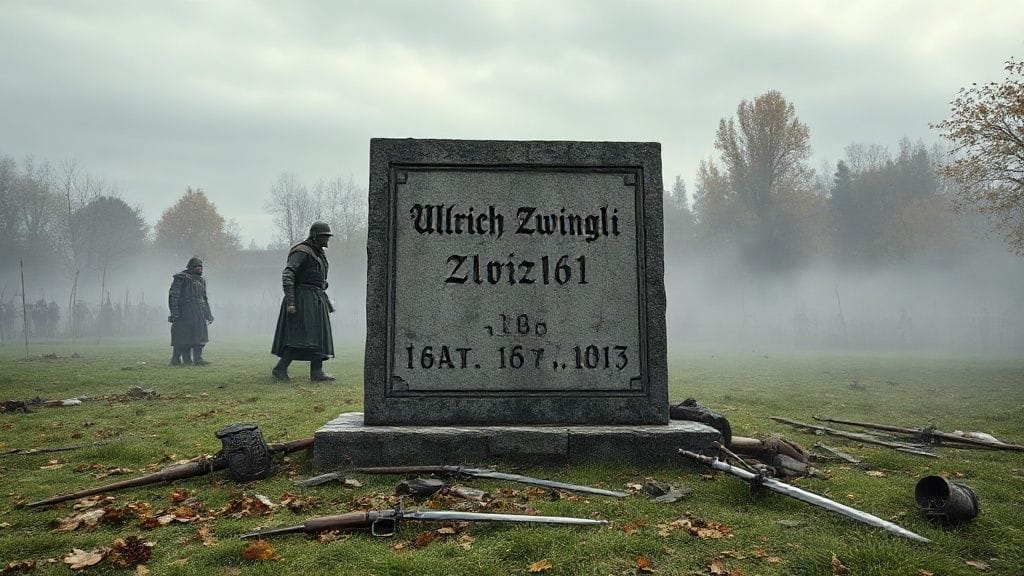
Monuments around Kappel commemorate the fallen, including a modest but poignant memorial to Zwingli marking the spot near where he died. Annual commemorations evoke not just a remembrance of a battle but a celebration of Swiss pluralism and peaceful religious coexistence.
Historians continue to debate the battle’s significance, viewing it through lenses of theology, politics, and national identity, reflecting evolving interpretations of Swiss history.
17. Lessons from Kappel: Religion, Politics, and Civil Conflict
Kappel’s bloodshed reminds us that religious schisms are often inseparable from political power struggles. It illustrates the dangers when ideological fervor meets fractured governance, but also the human capacity to rebuild, reconcile, and learn.
The Swiss model that emerged—while imperfect—offers enduring lessons on tolerance forged in the crucible of conflict.
Conclusion
Ulrich Zwingli’s death at Kappel am Albis was not merely the passing of a man but a symbolic crucible for the Swiss Reformation and European religious transformations. His martyrdom revealed the intimate entanglement of faith and politics, illuminating the high cost of ideological revolution.
Yet from ashes of defeat grew a legacy of resilience and pluralism. The battle was a tragic rupture—painful and bloody—but it forged a new path for a Confederation able, centuries later, to embody coexistence where division once threatened to rend it apart.
The story of Kappel continues to echo, a solemn reminder of the stakes when conscience clashes with tradition, of the courage needed to press forward in pursuit of conviction and peace.
FAQs
Q1: Who was Ulrich Zwingli and why was he important?
Ulrich Zwingli was a Swiss reformer who led a Protestant movement in Zurich that challenged Catholic traditions. His ideas profoundly impacted the Reformation and helped shape Swiss political and religious identity.
Q2: What caused the Battle of Kappel am Albis?
The battle arose from escalating religious tensions within the Swiss Confederation, where Protestant and Catholic cantons clashed over faith, governance, and political alliances after failed negotiations.
Q3: What happened during the battle?
Catholic forces defeated the Protestants in a swift and brutal engagement. Zwingli, actively participating as both a pastor and combatant, was killed on the battlefield.
Q4: What were the consequences of Zwingli’s death?
His death was a severe blow to the Swiss Reformation movement but also a catalyst for further consolidation and institutionalization of Protestantism in Switzerland, carried on by his successors.
Q5: How did the Battle of Kappel affect the Swiss Confederation?
The battle intensified confessional divides but also led to the Treaty of Kappel, which attempted an uneasy peace by allowing coexistence of Catholic and Protestant cantons, shaping Swiss pluralism.
Q6: What is Ulrich Zwingli’s legacy today?
Zwingli is remembered as a pivotal reformer and symbol of courage and conviction. His theological ideas and role in Swiss history continue to influence Protestantism and Swiss cultural identity.
Q7: Are there memorials commemorating the battle and Zwingli?
Yes, there are monuments near Kappel marking the battle site and honoring Zwingli’s sacrifice, along with annual commemorations celebrating his role in Swiss history.
Q8: How does the Battle of Kappel relate to the wider European Reformation?
Kappel exemplified the violent conflicts bred by Reformation ideals, presaging larger religious wars across Europe. The Swiss experience influenced Protestant developments and ideas about church-state relations.

