Table of Contents
- The Dawn of a New Threat: The Umayyad March into Gaul
- A Continent on Edge: Europe at the Beginning of the 8th Century
- The Rise of the Umayyad Caliphate: Ambitions Beyond the Iberian Peninsula
- Aquitaine: A Land Between Powers and Possibilities
- The Preparations for Conflict: Political and Military Context in Gaul
- Duke Odo of Aquitaine: The Reluctant Hero
- The Landing of the Umayyad Forces in Southern Gaul
- The Clash at Toulouse: Battle Setup and Strategies
- The Heat of Battle: The Turning Points of the Fight
- The Unexpected Victory: How Odo’s Troops Repelled the Invaders
- Consequences in the Muslim World: The Limits of Expansion
- Political Reverberations in Aquitaine and Frankish Territories
- The Battle’s Role in Shaping Medieval Christendom
- From Toulouse to Tours: A Prelude to Poitiers
- The Human Cost and Stories From the Battlefield
- Historical Narratives and Myths Born from the Battle
- The Legacy of the Battle in French Identity and Memory
- Archaeological Discoveries and Historical Debates
- Lessons on Cultural Encounters and Conflict in Early Medieval Europe
- Conclusion: The Battle That Shaped Western Europe’s Future
- FAQs
- External Resource
- Internal Link
The Dawn of a New Threat: The Umayyad March into Gaul
It was the year 721 when the ominous rumble of foreign banners unfurled over the rolling landscapes of southern Gaul. From the hot, arid lands of the Iberian Peninsula, an unstoppable force had surged northwards, its ambitions clear and resolute. The Umayyad Caliphate, at the height of its power, had already seized nearly all of the Iberian Peninsula and now looked beyond the Pyrenees towards the fragmented realms of Gaul. The invasion was not just a military incursion; it was a clash of worlds, faiths, and destinies. In the shadowed alleys and on the sun-drenched fields of Toulouse, Aquitaine, a monumental confrontation was about to unfold—one that would stop this Umayyad tide in its tracks, reshaping the future of Europe in the process.
A Continent on Edge: Europe at the Beginning of the 8th Century
Europe of the early 700s was a tapestry of feudal lords, emerging kingdoms, and fragile borders. The Frankish realms, fragmented and still consolidating political power under the Merovingians and their powerful mayors of the palace, lived with constant internal struggles. To the south, the remnants of Visigothic Spain lay in ruins, having succumbed to swift Arab and Berber conquests. The balance of power was fragile, and the sense of unease was palpable in the courts and battlefields.
The arrival of the Umayyads in Gaul was perceived not simply as another wave of invaders but as a direct existential threat. The stakes were immense; control over Gaul meant command of the vital trade routes, access to the Atlantic, and a foothold deep into Christian Europe. But the continent was not yet prepared to fall without resistance.
The Rise of the Umayyad Caliphate: Ambitions Beyond the Iberian Peninsula
Seizing power in the mid-7th century, the Umayyad Caliphate rapidly transformed from a regional Arab dynasty to a sprawling empire stretching from the Indus River to the Atlantic Ocean. Their conquest of the Iberian Peninsula in 711 had been meteoric, jolting the status quo and putting them on a collision course with the Christian kingdoms of the north.
Beyond simply territorial expansion, the Umayyads heralded a new cultural and religious dynamic in Western Europe. Their armies were a complex mosaic—Arab commanders, Berber tribesmen, and various mercenaries—relentless in their drive to consolidate power. The conquest of Gaul was but the natural next step in this grand design.
Aquitaine: A Land Between Powers and Possibilities
Nestled south of the Frankish heartlands, Aquitaine was a rugged and expansive territory characterized by sprawling forests, large rivers, and fortified cities. Its leadership was unique—Duke Odo, also called Eudes, ruled Aquitaine with a combination of pragmatism and fierce autonomy from the Frankish kings.
Aquitaine’s strategic position made it both a prize and a bulwark. For the Umayyads, it was a land of promise—a gateway to unlocking Northern Gaul’s riches. For the Aquitanians, it was home, and its defense would be a test of their will and resilience.
The Preparations for Conflict: Political and Military Context in Gaul
The early 720s were a time of uncertainty. The Frankish kingdom was experiencing internal divisions and could not immediately project reliable military support to its southern border. Aquitaine, thus, was largely on its own to respond to the growing threat.
Odo’s military forces were drawn from local levies, feudal warriors, and remnants of Visigothic fighters, seasoned in mountain warfare but comparatively few in number and equipment. Meanwhile, the Umayyad commanders prepared an incursion designed to spark swift conquest and demoralize any opposition.
Duke Odo of Aquitaine: The Reluctant Hero
Few names from this era echo as powerfully as Odo’s, yet even his legend was complex and fraught with challenges. A keen diplomat and warrior, Odo’s reign had been marked by efforts to maintain Aquitaine’s independence amid the Franco-Frankish ambitions.
Though some saw him as a usurper resisting rightful Frankish kings, history remembers Odo as the courageous leader who stood firm when all seemed lost. His decision to face the Umayyads at Toulouse was one born of desperation but executed with remarkable skill and resolve.
The Landing of the Umayyad Forces in Southern Gaul
The year 721 saw the arrival of a formidable Umayyad army, reportedly numbering around 20,000 men, led by Al-Samh ibn Malik al-Khawlani, the governor of Al-Andalus. They crossed the Pyrenees with the momentum of previous victories.
Their initial assaults were rapid and violent, targeting smaller towns and positions to destabilize the defense network. The city of Toulouse, rich in resources and steeped in history, was the jewel they sought to claim—the natural hub to control Aquitaine.
The Clash at Toulouse: Battle Setup and Strategies
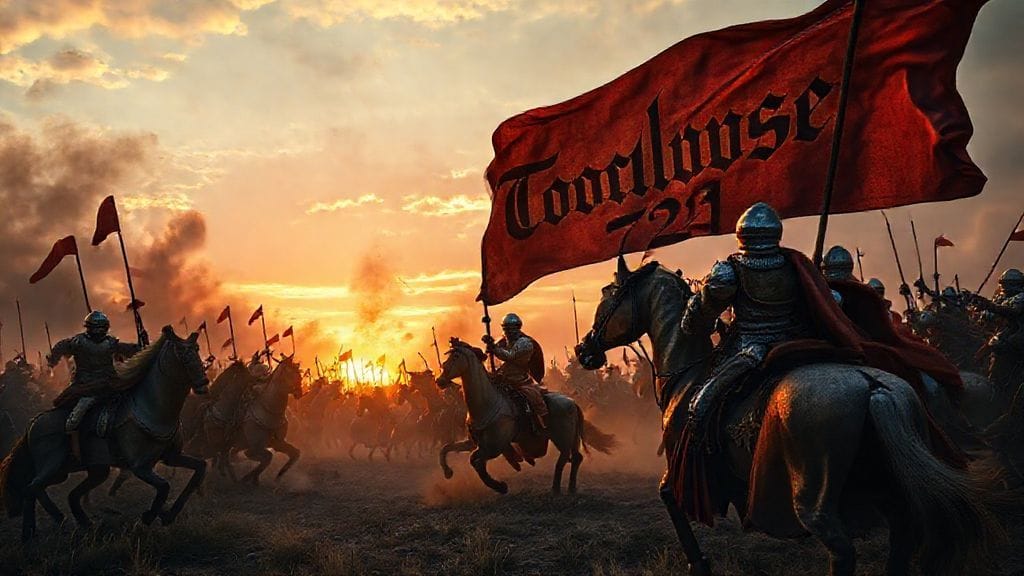
As the Umayyad forces laid siege to Toulouse, Duke Odo quickly marshaled his defense. Although outnumbered, Odo’s troops benefited from their knowledge of the terrain and fortified positions within the city walls.
The battle itself was a complex dance of siege tactics, raids, and open field engagements. Odo’s forces used guerrilla tactics, ambushes, and forced the Umayyads into protracted combat far from their supply lines. The layers of defense at Toulouse tested the resolve and discipline of the invading army.
The Heat of Battle: The Turning Points of the Fight
The siege dragged on for weeks. It was a grueling contest marked by moments of hope and despair. According to chroniclers, one pivotal moment came when Odo launched a bold sortie against the Umayyad camps, catching them by surprise and breaking the siege lines.
Heavy losses and stretched logistics began to sap the strength of the Muslim forces. The defenders’ relentless vigor and the arrival of Frankish reinforcements—though limited—helped tip the balance. The Umayyad army was forced into a retreat, marking a rare defeat in their expansionist campaign.
The Unexpected Victory: How Odo’s Troops Repelled the Invaders
The victory at Toulouse was stunning considering the odds. What made this triumph extraordinary was not just military might but a combination of fierce local resistance, tactical ingenuity, and the limitations of the Umayyad supply chain.
Odo had harnessed the loyalty of local nobility and peasants alike, creating a coalition that resisted one of the era’s most feared armies. In doing so, he preserved Aquitaine’s autonomy, bought critical time for Frankish forces to regroup, and set an important precedent for continued Christian resistance.
Consequences in the Muslim World: The Limits of Expansion
For the Umayyad Caliphate, the defeat at Toulouse was a sobering moment. It exposed the logistical challenges and overextension risks inherent in pushing too far beyond their established bases.
The loss forced a reevaluation of their strategy in Gaul, preventing them from fully consolidating control and dampening the momentum behind their northern invasion. Though the Caliphate remained powerful, Toulouse marked the beginning of a slower push northward.
Political Reverberations in Aquitaine and Frankish Territories
Odo’s success elevated his status and complicated the political landscape in Gaul. Frankish kings, notably Charles Martel, took note of Odo’s leadership and the necessity of unified response to external threats.
The battle also magnified tensions between Aquitaine and the Frankish crown, as both vied for influence and control. Yet, the shared threat of Umayyad encroachment would eventually foster alliances that shaped the future of the region.
The Battle’s Role in Shaping Medieval Christendom
The victory at Toulouse was more than a military event; it was a defining moment in the defense of Christian Europe against Muslim expansion. It set the stage for subsequent battles—most famously, the Battle of Tours in 732—that would further shape the continent’s religious and cultural trajectory.
Toulouse symbolized resistance and the preservation of Christendom’s heartlands, becoming a rallying point for medieval European identity and politics.
From Toulouse to Tours: A Prelude to Poitiers
While Toulouse halted the initial Umayyad advance into Gaul, it was merely the prologue to the larger, more decisive confrontation at Tours-Poitiers a decade later. The lessons learned and alliances forged during the siege directly influenced Charles Martel’s legendary victory.
The chain of events from Toulouse onwards underscores how local resistance intersected with broader geopolitical currents to redirect the course of European history.
The Human Cost and Stories From the Battlefield
Behind the epic narratives lie the stories of common soldiers, townspeople, women, and children caught in the turmoil. Chroniclers speak of sieges suffering famine and disease, of families torn apart, and heroics that never made the official records.
The human cost was immense, with thousands losing their lives or livelihoods. Yet, those sacrifices laid the groundwork for communities that would endure through the turbulent centuries ahead.
Historical Narratives and Myths Born from the Battle
Like many battles of the Middle Ages, Toulouse became fertile ground for legend-making. Some accounts inflate numbers or portray Odo as a saintly figure fighting for divine justice. Others weave tales of betrayal and miraculous deliverance.
These narratives, while not always historically accurate, enrich the cultural memory and have inspired countless retellings in medieval chronicles and later histories.
The Legacy of the Battle in French Identity and Memory
In the centuries that followed, the Battle of Toulouse occupied a place of pride within French history. It symbolized resistance, valor, and the beginnings of unification.
The city itself cherishes this past, with monuments and annual commemorations shielding the memory of those who stood firm. Today, Toulouse’s defense is seen as a foundational moment in the making of modern France.
Archaeological Discoveries and Historical Debates
Modern archaeology has sought to unearth remnants of the battle—fortifications, weaponry, burial sites—painting a more nuanced picture of the event. Though physical evidence remains limited, new techniques continue to shed light on the scale and nature of the conflict.
Historians debate the exact size of forces, motivations of leaders, and the broader implications, reminding us that history is an ever-evolving dialogue with the past.
Lessons on Cultural Encounters and Conflict in Early Medieval Europe
The events surrounding Toulouse highlight the complexities of cultural encounters during the early Middle Ages. The Umayyad advance was not merely a clash of armies but a collision of civilizations, faiths, and ways of life.
Understanding these dynamics offers valuable lessons on coexistence, conflict, and the fluid nature of identity that resonate to this day.
Conclusion: The Battle That Shaped Western Europe’s Future
The Battle of Toulouse in 721 stands as a pivotal moment—when the tide of Umayyad expansion was halted not by overwhelming force but by unity, courage, and strategy. It set in motion a chain of events that defined the borders of medieval Europe and safeguarded the cultural heritage of the West.
In remembering this battle, we honor the resilience of those who, facing insurmountable odds, chose to fight for their land, beliefs, and future. Their story remains a testament to the enduring human spirit amid the tides of history.
FAQs
Q1: What were the primary causes of the Umayyad advance into Gaul?
The Umayyad push northward was driven by ambitions to expand their territory beyond Iberia, access the wealth of Gaul, and spread Islamic rule. Political fragmentation in Gaul and previous successful conquests in Spain made this expansion viable.
Q2: Who was Duke Odo, and why was he significant?
Duke Odo was the ruler of Aquitaine and the commander who organized the defense of Toulouse. His leadership was pivotal in halting the Umayyad advance and preserving Aquitaine’s autonomy.
Q3: How did the Battle of Toulouse influence later events in medieval Europe?
The battle set a precedent for resistance against Muslim expansion and directly influenced alliances and military strategies that culminated in the famous Battle of Tours (732). It helped define the cultural and religious boundaries of Europe.
Q4: What were the consequences for the Umayyad Caliphate after their defeat?
The defeat limited their ability to expand further into Gaul, highlighted logistic difficulties, and forced a recalibration of their northern military campaigns.
Q5: How is the battle remembered in French historical memory?
It is celebrated as a symbol of resistance and regional pride, particularly in Toulouse and Aquitaine, highlighting the role of local leadership in shaping broader historical outcomes.
Q6: Are there archaeological remains related to the battle?
While physical evidence is scarce, ongoing archaeological studies have uncovered fortifications and artifacts near Toulouse that provide insight into the period’s military conflict.
Q7: What was the role of the Frankish kingdom during the battle?
At the time, the Frankish kingdoms were fragmented and did not provide direct support to Toulouse, though later leaders like Charles Martel would emphasize unity against such threats.
Q8: How did the battle reflect cultural and religious tensions of the time?
It epitomized the broader clash between Christian Europe and the expanding Islamic world, with faith, identity, and political power all intertwined in the conflict.

