Table of Contents
- November 22, 1967: A Landmark in the Halls of the United Nations
- The Aftermath of the Six-Day War: A World in Turmoil
- The Geopolitical Chessboard: Middle East Before Resolution 242
- Key Actors and Their Stakes: Israel, Arab States, and Global Powers
- The Genesis of Resolution 242: Drafting Amid Tensions
- The Ambiguities of Language: The Power of Semantics in Diplomacy
- Adoption of Resolution 242: Votes, Voices, and Verdicts
- The Core Provisions: Withdrawal, Sovereignty, and Peace
- The Voice of the United States: Diplomacy Between Idealism and Realpolitik
- The Soviet Union’s Position: Cold War Shadows on the Middle East
- Arab States’ Reception: Between Defiance and Pragmatism
- Israel’s Response: Contestation and Conditional Acceptance
- The Role of the United Nations: Peacekeeper or Spectator?
- Immediate Reactions: Hope, Skepticism, and Strategic Maneuvers
- The Unfolding Peace Process: From Resolution to Negotiations
- The Missing Elements: Refugees, Borders, and Jerusalem
- Resolution 242's Long Shadow: Influence on Subsequent Treaties
- Controversies and Critiques: The Endless Debate Over Interpretation
- The Human Dimension: Lives Affected Amid Diplomatic Rhetoric
- Legacy in International Law: Resolution 242 as a Precedent
- Modern Perspectives: The Resolution in Today’s Middle Eastern Conflicts
- What If? Alternative Paths Not Taken in 1967
- Conclusion: The Enduring Quest for Peace in a Fractured Land
- FAQs: Demystifying Resolution 242
- External Resource: Wikipedia Link to UN Security Council Resolution 242
- Internal Link: Visit History Sphere
November 22, 1967: A Landmark in the Halls of the United Nations
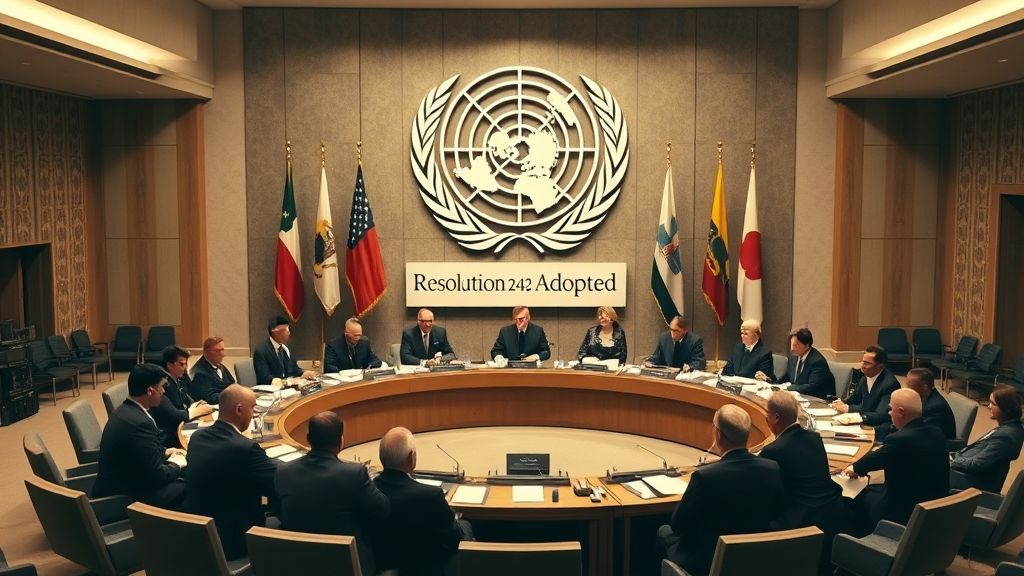
In the cold air of that November day in New York City, the atmosphere inside the United Nations Security Council chamber was electric, heavy with the hopes and fears of a world grappling with a sudden and violent upheaval in the Middle East. The echoes of gunfire and the swift territorial advances of only months before had set the stage for a resolution that many believed might chart a new course toward lasting peace—or at least a pause in the relentless cycle of conflict that had plagued the region. As delegates from fifteen nations gathered, their voices mingled in a unique blend of sharply divergent agendas and an almost desperate longing for order amid chaos. It was into this crucible that the Security Council cast its vote on Resolution 242, an uneasy compromise that would become both a cornerstone of Middle Eastern diplomacy and a source of endless debate.
The Aftermath of the Six-Day War: A World in Turmoil
The backdrop to Resolution 242 was the incendiary conflict of June 1967, known as the Six-Day War. In the blink of an eye, Israel had routed the armies of Egypt, Jordan, and Syria, seizing control of the Sinai Peninsula, the Gaza Strip, the West Bank, East Jerusalem, and the Golan Heights. The consequences were seismic. More than a million Palestinians found themselves under Israeli military occupation, while the Arab world reeled from the shock of swift defeat. The Cold War powers—United States and Soviet Union—wrestled over influence and strategic advantage, their rivalry playing out like a deadly drama on this ancient land. The stage was perilous; political wounds were fresh, and the international community was tasked with preventing another explosion.
The Geopolitical Chessboard: Middle East Before Resolution 242
To understand the magnitude of Resolution 242, one must peer into the tangled web of competing claims and historical grievances long rooted in that region. Since the establishment of the state of Israel in 1948, tensions had simmered relentlessly. Arab states refused to recognize Israel's legitimacy, and wars had already punctuated the decades with destruction and displacement. The territorial gains in 1967 upended the military balance and redrew maps, but more importantly, they redefined the impossible task of creating peace in a land where national identity, religion, and history both embraced and fought one another. British and French colonial legacies, Cold War proxy rivalries, and the unresolved displacement of Palestinian refugees compounded the complexity. Suddenly, the international community faced an urgent demand: how to balance Israel’s security aspirations with the legitimate claims and sovereignty concerns of its neighbors?
Key Actors and Their Stakes: Israel, Arab States, and Global Powers
Israel, having survived against the odds in 1948 and again triumphantly in 1967, emerged emboldened but vulnerable. While in control of significant new territories, its leaders were acutely aware of the diplomatic quagmires that lay ahead. The Arab states—Egypt under Nasser, Syria, Jordan—were coerced into rethinking strategies but remained implacably opposed to Israel’s territorial acquisitions. Meanwhile, the superpowers played their part: the United States seeking to secure an ally and maintain stability, the Soviet Union backing Arab nationalism while also wary of escalating confrontation. These competing agendas translated into intense lobbying and diplomatic pressure in the United Nations, revealing the interplay of ideology, power, and principle that would forever mark Resolution 242.
The Genesis of Resolution 242: Drafting Amid Tensions
Behind the closed doors of New York’s UN headquarters, the drafting of Resolution 242 was a delicate exercise in balancing diverging interests. British Ambassador Lord Caradon, a key architect, sought a text vague enough to satisfy the requirements of both sides, yet robust enough to address the core issues of security and territorial adjustment. It was a diplomatic high-wire act, where each word was weighed not only for legal meaning but the potential to appease or inflame. The resolution’s drafters battled over terms—primarily the contentious phrase “withdrawal of Israeli armed forces from territories occupied in the recent conflict” which lacked the definitive “all” that Arab nations insisted upon. This absence would prove to be a critical fault line in the document’s future interpretation.
The Ambiguities of Language: The Power of Semantics in Diplomacy
Perhaps paradoxically, it was the vagueness that granted Resolution 242 its staying power. Terms like “secure and recognized boundaries,” “territorial inviolability,” and “just settlement” were intentionally elastic. This semantic ambiguity allowed Israel and its neighbors to each derive differing conclusions. To many Israelis, it implied possible border adjustments to accommodate security realities; to Arab states, it meant total withdrawal to pre-war boundaries. This purposeful obscurity, while frustrating to scholars and peace advocates alike, is a testament to diplomatic pragmatism in an era where outright confrontation seemed the only alternative. Yet, this very fuzziness also sowed the seeds for decades of disputes and eroded trust.
Adoption of Resolution 242: Votes, Voices, and Verdicts
On November 22, 1967, after impassioned debate, the Security Council adopted Resolution 242 unanimously, with 15 votes in favor and no abstentions. The unanimous vote itself appeared as a signal of international consensus, a collective plea for peace. But beneath the surface, fierce disagreements simmered. The Soviet Union, while voting in favor, issued statements underscoring its insistence on complete Israeli withdrawal and the rights of Palestinians. The United States, pushing for a moderate approach, hailed the resolution as a foundation for future negotiations without imposing contradictory demands. Israel’s cautious endorsement announced the beginning of a protracted engagement with the resolution's terms, fraught with interpretation and political exchange.
The Core Provisions: Withdrawal, Sovereignty, and Peace
Resolution 242’s heart beat in two seminal principles: the withdrawal of Israeli armed forces from territories occupied in the Six-Day War, and the acknowledgment of every state’s right to live in peace within secure and recognized boundaries. No explicit reference to “all” occupied territories in the withdrawal clause left room for interpretation. Additionally, the resolution emphasized the inadmissibility of the acquisition of territory by war, effectively rebuking the status quo of expansion through conflict. Crucially, it called for a just settlement of the refugee problem, a thorny issue that remained largely unaddressed in explicit terms. The resolution’s dual demand—land for peace—became a diplomatic mantra, echoing through subsequent peace negotiations.
The Voice of the United States: Diplomacy Between Idealism and Realpolitik
The United States played an instrumental role in shaping and championing Resolution 242. The American government, led by the Johnson administration, balanced public advocacy for peace with the strategic alliance it held with Israel. Its diplomats navigated a narrow path: promoting stability while hedging against Soviet influence, signaling support to Israel without alienating Arab nations whose oil and geopolitical position were vital. US Ambassador Arthur Goldberg articulated the resolution’s intention as a ‘framework’ for negotiations rather than a prescriptive mandate, reflecting a belief in diplomacy over coercion. This stance reverberated through decades of American foreign policy, positioning the US as a central, if often controversial, mediator.
The Soviet Union’s Position: Cold War Shadows on the Middle East
The Cold War backdrop gave the conflict an additional layer of complexity. The Soviet Union’s partial support for Egypt and other Arab states translated into fierce pushback against what it perceived as Western bias. Moscow demanded unequivocal Israeli withdrawal and recognition of Arab rights, framing the conflict in ideological terms of anti-imperialism and national liberation. Yet, despite its hard line, the USSR voted for the resolution, signaling a preference for diplomatic engagement over military escalation. This delicate balance echoed the broader Cold War tactic of proxy engagement and restraint to avoid direct superpower confrontation.
Arab States’ Reception: Between Defiance and Pragmatism
For Egypt, Jordan, Syria, and their allies, Resolution 242 represented both a disappointment and an opportunity. The absence of explicit language mandating total Israeli withdrawal was a bitter pill, perceived as recognition of Israel’s territorial gains and a potential legitimization of occupation. Nevertheless, the resolution provided a channel for diplomacy, one that some leaders cautiously embraced as a pragmatic step to halt hostilities and stabilize the region. Arab opinion was far from monolithic, with factions debating whether to accept negotiation frameworks or maintain calls for outright liberation through force. This division would influence subsequent peace efforts and intra-Arab political dynamics.
Israel’s Response: Contestation and Conditional Acceptance
Israel’s official stance on Resolution 242 was one of cautious acceptance, yet it emphasized the need for realignment of borders to ensure “secure and recognized” boundaries that would guarantee Israeli security. From Jerusalem to Tel Aviv, political leaders highlighted the omission of the word "all" before the withdrawal clause to justify retaining some territories, especially the newly reunified East Jerusalem and strategically valuable highlands. This approach reflected a deeply-rooted security concern born of historic vulnerability and recent conflict trauma. Israeli public opinion was divided, with some viewing the resolution as an affirmation of state legitimacy, while others feared diplomatic isolation.
The Role of the United Nations: Peacekeeper or Spectator?
The United Nations, though convoked as the arena for peaceful resolution, found itself constrained by political realities. Resolution 242 was a diplomatic attempt to impose a framework but without enforcement mechanisms or a defined path to implementation. The UN’s peacekeeping forces, such as UNEF, faced continual challenges monitoring ceasefires and maintaining calm amid ongoing hostilities and provocations. The Security Council would revisit the Middle East issue repeatedly in the following years, but the structural limitations of the UN, as a body reliant on member consensus and diplomatic goodwill, became starkly apparent.
Immediate Reactions: Hope, Skepticism, and Strategic Maneuvers
Across Middle Eastern capitals and beyond, the adoption of Resolution 242 met with a mixture of guarded optimism and deep skepticism. International diplomats hailed it as the first comprehensive attempt at peace since the 1948 Arab-Israeli war, while activists and frontline citizens waited to see whether rhetoric would translate into reality. Meanwhile, military leaders and intelligence services on all sides interpreted the resolution vis-à-vis strategic advantage, preparing for either diplomatic engagement or resumed conflict should negotiations falter. The 1967 conflict’s aftermath lingered palpably in the air, and Resolution 242 was seen as a fragile bridge over a chasm of distrust.
The Unfolding Peace Process: From Resolution to Negotiations
Resolution 242 did not end conflict, but it launched the diplomatic journey that would see multiple negotiations, treaties, and, sadly, wars. It became the reference point for the 1978 Camp David Accords and the Egypt-Israel Peace Treaty of 1979, as well as later proposals between Israel and its neighbors. Each negotiation wrestled with the interpretation of “withdrawal," the status of Jerusalem, and the fate of refugees. The resolution became a diplomatic lingua franca, a tool wielded both sincerely and opportunistically. The elusive dream of “land for peace” remained central to all diplomatic overtures.
The Missing Elements: Refugees, Borders, and Jerusalem
Notably, while Resolution 242 laid out broad principles, it conspicuously skirted detailed solutions to the most contentious issues: Palestinian refugees' right of return, definitive borders, and the status of Jerusalem sacred to Jews, Muslims, and Christians alike. These absences allowed the resolution to pass but left critical questions unresolved. For the displaced Palestinians, the resolution was either a beacon of hope or a symbol of unfulfilled promises. Jerusalem’s division and later reunification under Israeli control remained a flashpoint in the decades that followed, underscoring the limits of diplomatic texts divorced from on-the-ground realities.
Resolution 242's Long Shadow: Influence on Subsequent Treaties
The legacy of Resolution 242 stretches far beyond its adoption. It has been referenced in countless UN resolutions, served as a basis for peace negotiations, and remained a touchstone for diplomatic discourse on the Israeli-Palestinian conflict and broader Arab-Israeli relations. Its language, ambiguous yet binding to many, embodies the contradictory nature of international diplomacy—offering hope while entangling decades of disputes. Even today, the principles of Resolution 242 resonate in debates over settlements, borders, and peace frameworks, underscoring its enduring significance.
Controversies and Critiques: The Endless Debate Over Interpretation
Critics of Resolution 242 focus heavily on the semantic ambiguities, accusing it of enabling indefinite occupation and failing to explicitly affirm Palestinian rights. Some see it as a product of Cold War politics rather than genuine peacemaking, a compromise that satisfied superpowers more than regional justice. Others argue that its vagueness was necessary to break stalemates and create dialogue opportunities. The debate over the “all or some” withdrawal clause is emblematic of the broader challenges in balancing legality, power, and diplomacy in conflict resolution.
The Human Dimension: Lives Affected Amid Diplomatic Rhetoric
Beyond politics and law, Resolution 242 marked a turning point for millions whose daily lives hung in the balance. Palestinian families uprooted, Jewish settlers establishing new communities, soldiers returning home and preparing for future conflict—each lived the consequences of decisions made thousands of miles away. Stories of loss, hope, resilience, and despair weave through the historical narrative, reminding us that beyond ink and votes lies the immensity of human experience. The resolution’s legacy is thus not merely political but deeply personal.
Legacy in International Law: Resolution 242 as a Precedent
In the annals of international law, Resolution 242 stands as a complex precedent. It affirmed principles like the inadmissibility of territorial acquisition by war, which have anchored later conventions and court rulings. Its emphasis on “secure and recognized boundaries” has influenced international norms on sovereignty and conflict cessation. Yet it also reveals the limits of international law when political will is absent. Its ambiguous language is studied extensively as an example of diplomatic drafting aimed at fostering consensus amid irreconcilable positions.
Modern Perspectives: The Resolution in Today’s Middle Eastern Conflicts
Fifty-plus years on, Resolution 242 remains a vital reference point amid continuing unrest, renewed conflicts, and shifting alliances in the Middle East. Whether in discussions about Israeli settlements, Palestinian statehood, or broader Arab-Israeli relations, the resolution’s principles are invoked to argue legitimacy and rights. It serves as a reminder of both the potential and pitfalls of international interventions. As new actors emerge and old wounds persist, 242 challenges negotiators and historians to reconcile past promises with present realities.
What If? Alternative Paths Not Taken in 1967
Could a clearer, more forceful resolution have averted decades of conflict? Might insistence on explicit terms have led to earlier peace, or instead sparked more immediate war? The historical “what ifs” surrounding Resolution 242 invite reflection on the delicate balance of diplomacy. The choice to favor ambiguity over clarity reflected a desperate search for compromise amid impossible conditions. Yet those choices also illustrate how international actors grapple with the tension between idealism and pragmatism when peace is at stake.
Conclusion
Resolution 242 was never just a document; it was a defining moment in history when words did battle for peace in a region torn by war. Its adoption symbolized an international yearning to impose order on chaos but at the same time revealed the immense challenges in reconciling conflicting national narratives and claims. For all its ambiguities and controversies, the resolution provided a framework—imperfect and contested but enduring—that continues to shape diplomacy and hopes for peace. It reminds us that history is not merely a ledger of events but a living conversation between past and present, where each phrase and vote carries the weight of human dreams and sorrows. In the quest to understand peace in the Middle East, Resolution 242 stands as both a beacon and a cautionary tale, urging empathy, clarity, and courage in pursuit of justice.
FAQs
Q1: What was the primary purpose of UN Security Council Resolution 242?
A1: Its main goal was to provide a framework for peaceful resolution following the Six-Day War by calling for the withdrawal of Israeli forces from territories occupied during the conflict and the acknowledgment of the sovereignty, territorial integrity, and political independence of every state in the region.
Q2: Why is the wording in Resolution 242 considered ambiguous?
A2: Key phrases, especially about withdrawal, lack terms like “all,” enabling different interpretations by Israel and Arab states. This vagueness was a deliberate diplomatic choice to secure broad support.
Q3: How did Israel react to Resolution 242?
A3: Israel accepted the resolution conditionally, emphasizing the need for secure and recognized borders and interpreting the withdrawal clause as not necessarily requiring complete withdrawal from all captured territories.
Q4: Did Resolution 242 address the Palestinian refugee issue?
A4: It referenced “a just settlement of the refugee problem” but did not provide detailed solutions, leaving this a contentious unresolved issue.
Q5: What role did the Cold War play in the adoption of Resolution 242?
A5: The US and USSR, the two superpowers, influenced the resolution’s content and diplomacy, balancing their interests and ideologies to prevent escalation in the strategically vital Middle East.
Q6: Has Resolution 242 been effective in ending the Arab-Israeli conflict?
A6: While it has influenced numerous peace efforts and treaties, Resolution 242 alone has not ended the conflict, which continues to evolve with complex political dynamics.
Q7: Why is Resolution 242 still relevant today?
A7: Its principles of land-for-peace and territorial sovereignty continue to underpin diplomatic negotiations and international discussions on Middle Eastern peace.
Q8: What were the main criticisms against Resolution 242?
A8: Critics argue it lacks clarity, enables prolonged occupation, and insufficiently addresses Palestinian rights, reflecting compromises influenced by Cold War politics more than regional justice.