Table of Contents
- The Dawn of a New Nation: The Union of South Africa Act Passed
- Shadows over London: The Empire’s Role in Shaping a Dominion
- South Africa in the Early 20th Century: A Land Divided and Uneasy
- The Architects of Union: Key Figures Behind the 1909 Act
- From Conflict to Compromise: The Aftermath of the Second Boer War
- Political Pressures and Racial Realities: The Push for Unification
- The Legislative Journey: Debates and Tensions in the British Parliament
- The Act’s Core Provisions: A Constitutional Blueprint
- The Union’s Foundation: Symbolism and Ceremony on May 31, 1910
- The New Political Order: The Birth of the Union Parliament and Government
- Exclusion and Entrenchment: Race, Rights, and the Franchise Question
- Economic Motives and Consequences: Building a Unified Market
- Cultural Identities and National Imaginaries: Afrikaners, English-speaking South Africans, and Others
- Provincial Autonomy vs Central Power: Balancing Diverse Interests
- International Repercussions: South Africa’s Place in the British Empire
- The Union’s Troubled Legacy: Seeds of Apartheid and Further Divisions
- Reflections from the Voices of the Time: Political Speeches and Personal Letters
- The Union Act through the Eyes of Historians: Interpretations and Debates
- How South Africans Remember 1909 today: Memory, Commemoration, and Critique
- Lessons from 1909: The Challenge of Unity Amid Diversity
- Conclusion: Between Empire and Nation – The Enduring Impact of the Union of South Africa Act
- FAQs about the Union of South Africa Act
- External Resource
- Internal Link
On a crisp September day in 1909, far from the rugged plains and gold-laden hills of southern Africa, a momentous decision was being shaped within the venerable walls of the British Parliament in London. The Union of South Africa Act, quietly passed amid the political rituals of the imperial capital, would set into motion a transformation profound enough to reverberate across decades and continents. But beneath the formal legislative language lay the aspirations, anxieties, and contradictions of a land struggling to reconcile its fractured peoples — Afrikaners and English settlers, indigenous African communities, and other minorities — into a single nation-state.
The sun had begun its descent, casting long shadows over Westminster, as lawmakers debated a future that promised unity yet entailed exclusion. The passing of the Union Act would birth the Dominion of South Africa, a political entity seeking to knit together former British colonies and Boer republics after decades of war, rivalry, and uneasy coexistence. It was a phoenix arising not from harmonious rebirth but from the ashes of imperial conquest and bitter civil strife.
This article embarks on a journey through that pivotal year of 1909 and beyond. It delves deep into the geopolitical and social fault lines that necessitated union, unpacks the personalities and ideals behind the Act, and traces how the promised "peace and prosperity" unraveled into new tensions and injustices. The Union of South Africa Act stands as both a monument to political compromise and a portent of decades of struggle — fluent testimony to the complex dance between empire, identity, and power.
1. The Dawn of a New Nation: The Union of South Africa Act Passed
The Union of South Africa Act officially received Royal Assent on September 20, 1909. Though the text-signing was a formality, the event symbolized the culmination of years of negotiation. The act merged four disparate colonies — Cape Colony, Natal, Transvaal, and Orange River Colony — which had formerly borne the brunt of the Anglo-Boer Wars (1899–1902). This unification promised internal peace and a stronger position within the British Empire. Yet the act also codified racial exclusions that would haunt South Africa for generations.
To contemporaries, the creation of the Union was both a pragmatic victory and a fragile step toward national coherence. Lord Selborne, former High Commissioner for South Africa and an influential voice in the union debate, depicted the act as “a framework for peace — a new chapter for self-rule under the Crown, binding old adversaries under one banner.” Yet the vast majority of indigenous Africans were sidelined; the franchise, under the new constitution, restricted the vote mainly to white men, with only limited exceptions in regions like the Cape.
2. Shadows over London: The Empire’s Role in Shaping a Dominion
London’s role was far from a neutral arbiter or mere rubber stamp. The imperial government viewed the union as a strategic masterstroke, a way to stabilize a volatile region rich in mineral wealth, and to integrate it seamlessly into the British commonwealth of nations.
Prime Minister H.H. Asquith’s administration saw the South African question through the lens of imperial unity and economic interests rather than social justice. London’s architects of the Union Act balanced local South African desires for autonomy with the motherland’s need for influence. The act thus created a Dominion that was autonomous in domestic affairs but remained firmly attached to British sovereignty, represented symbolically by the Governor-General as King George V’s representative.
3. South Africa in the Early 20th Century: A Land Divided and Uneasy
The decades before 1909 painted a tumultuous portrait of South Africa. The discovery of diamonds in Kimberley and gold on the Witwatersrand transformed the region into an economic prize coveted by Britain and the Boers alike. The devastating Anglo-Boer Wars decimated communities and softened nationalist fervor into a grudging willingness to negotiate unity.
Yet the even deeper fractures ran along racial lines. The indigenous African majority, numbering in millions, faced systemic dispossession of land, political marginalization, and economic exploitation. Colonial administrations reinforced segregationist policies, while the white minority juggled fierce divisions among themselves — mainly between English-speaking settlers and the Afrikaners, descendents of Dutch colonists who had fiercely resisted British control.
4. The Architects of Union: Key Figures Behind the 1909 Act
At the heart of the process stood several towering figures whose leadership was instrumental in the formation of the Union. Louis Botha, the former Boer general and first Prime Minister of the Union of South Africa, epitomized the drive for reconciliation mixed with strategic pragmatism. His vision of a united white South Africa was underpinned by wartime experience and post-war political acumen.
Parallel to Botha was Jan Smuts, a brilliant lawyer, soldier, and statesman, whose intellect and international perspective helped shape the legal foundation of the new state. Botha and Smuts, former commanders during the Boer War, now cast themselves as builders of peace and architects of a new political order.
From the British side, leaders such as Lord Selborne and Secretary of State for the Colonies, Lewis Harcourt, exerted significant influence, ensuring that imperial interests aligned with South African self-government—the delicate dance of autonomy within empire.
5. From Conflict to Compromise: The Aftermath of the Second Boer War
The scars of the Anglo-Boer War were still raw as South Africa approached 1909. The war, which devastated Boer farms and towns, left an enduring bitterness among Afrikaners and hardened British attitudes. Yet the experience of brutal conflict became a crucible for compromise.
The war’s conclusion in 1902 had set terms for British suzerainty, Boer disarmament, and economic rehabilitation. But at what cost? Afrikaner leaders sought political power to protect their culture and identity; English settlers desired economic and political supremacy. The Union Act attempted to reconcile these conflicting desires, embedding protections for Afrikaner language and education alongside English institutions.
6. Political Pressures and Racial Realities: The Push for Unification
Two realities dominated the union movement: the pressing need for political stability among whites, and the tragic sidelining of the black majority.
For white settlers, unification promised efficiency, a coherent military structure amid fears of African uprisings, and economic coordination—no longer would separate colonies impose conflicting tariffs or policies.
Yet, most indigenous South Africans found no place in this new political order. Despite earlier hopes for inclusion — notably some Cape Colony voters of color retained suffrage — the union codified exclusionary policies, setting a road that would harden into formalized apartheid decades later.
7. The Legislative Journey: Debates and Tensions in the British Parliament
The Union Act’s passage was far from a mere procedural event. British parliamentarians wrestled with issues of race, governance, sovereignty, and economic consolidation.
The debates revealed competing visions: some MPs called for greater African inclusion; others prioritized white settler dominance. The final act reflected a political compromise: an “autonomous” South Africa where British control was curtailed but racial hierarchies were entrenched.
8. The Act’s Core Provisions: A Constitutional Blueprint
The 1909 Union of South Africa Act laid down the constitutional groundwork for the new entity:
- It united the four colonies into one Dominion, self-governing but under the Crown.
- Established a bicameral Parliament (House of Assembly and Senate).
- Set up a Governor-General as King's representative.
- Provided for the maintenance of existing laws, except where overridden.
- Crucially, disenfranchised the majority black population but permitted limited franchise retention for some coloureds in the Cape.
9. The Union’s Foundation: Symbolism and Ceremony on May 31, 1910
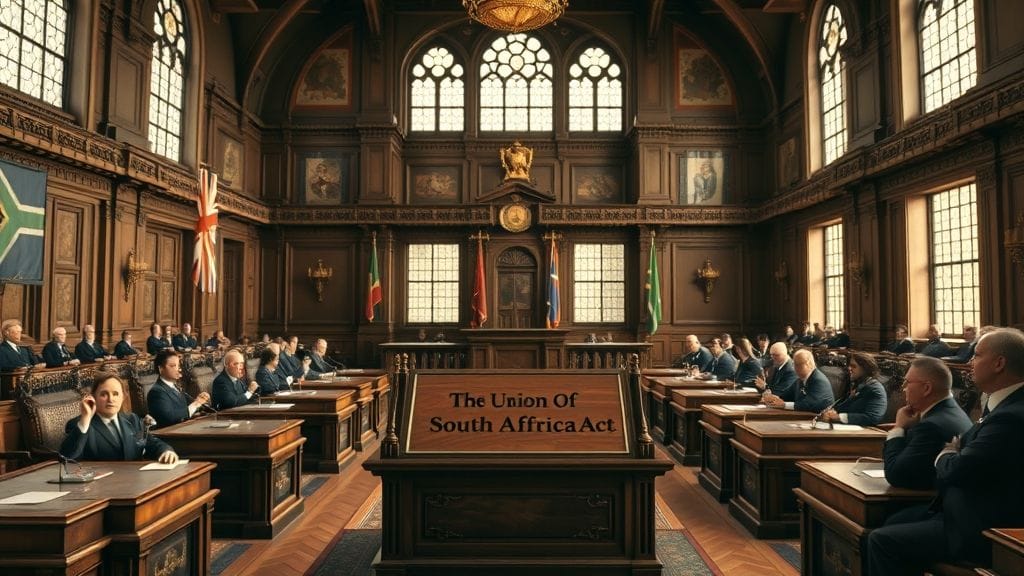
Although the act was passed in 1909, the Union came into official existence on May 31, 1910. In Cape Town’s grand parliament building, amidst banners and speeches, South Africa took its first collective breath.
The celebration was bittersweet — an accomplishment for many whites, but a reminder of exclusion for many millions who had no voice in the new nation’s birth. The ceremony symbolized hope and a promise of peace, yet this promise awaited true fulfillment.
10. The New Political Order: The Birth of the Union Parliament and Government
The Union Parliament embodied the delicate balance of power. While it united the colonies under one federal government, provinces retained significant autonomy.
Louis Botha became the first Prime Minister, promoting policies designed to heal old wounds — or at least to integrate the white electorate. The government’s initial years were marked by efforts to stabilize the economy, regulate mining interests, and create a basis for future development.
11. Exclusion and Entrenchment: Race, Rights, and the Franchise Question
One of the Union’s darkest legacies began here. Black South Africans, comprising the vast majority, were excluded from political representation and rights.
The act’s implicit recognition of white political supremacy institutionalized racial segregation, a foundation later used to justify the apartheid system. Though some limited black representation existed in the Cape, it was insufficient, marginalized, and steadily eroded in subsequent decades.
12. Economic Motives and Consequences: Building a Unified Market
South Africa’s vast mineral wealth made economic unity a prime objective. The Union enabled standardized tariffs, consolidated railways, and coordinated infrastructure investment.
The barely healed wartime economy found footing in renewed mining expansion and agricultural development. Yet these gains were primarily at the expense of black laborers, who remained under harsh conditions and legal restrictions.
13. Cultural Identities and National Imaginaries: Afrikaners, English-speaking South Africans, and Others
The Union reinforced the cultural self-perceptions of white South Africans. Afrikaners worked to preserve their language, religion, and collective trauma from British imperialism, while English speakers pushed for alignment with Britain.
For others—coloreds, Indians, and indigenous peoples—these new national imaginaries often meant marginalization, forced assimilation, or exclusion.
14. Provincial Autonomy vs Central Power: Balancing Diverse Interests
The Union’s federal structure was a political tripwire. Provinces like Natal and the Cape jealously guarded local power, while Pretoria (Transvaal) and Orange Free State sought greater central control.
This push and pull shaped South African politics and foreshadowed future tensions between regional and national identities.
15. International Repercussions: South Africa’s Place in the British Empire
As a Dominion, South Africa gained a semi-autonomous status akin to Canada or Australia. This placed it firmly within the British Commonwealth, obligated to imperial policies but increasingly asserting independent positions.
The Union’s formation influenced British colonial policy elsewhere, showcasing the Empire’s evolving model of governance in the 20th century.
16. The Union’s Troubled Legacy: Seeds of Apartheid and Further Divisions
Though the Union initially promised peace, the exclusionary foundation it established sowed the seeds of systemic apartheid.
The political and legal structures marginalized black South Africans, setting the stage for decades of resistance and repression that culminated in the apartheid era after 1948.
17. Reflections from the Voices of the Time: Political Speeches and Personal Letters
Louis Botha once declared, “We have buried the weapons of war and must now bind the wounds of a divided people.” This hope was echoed in speeches by Jan Smuts and British officials.
Yet letters from African leaders like Sol Plaatje reveal the growing disillusionment and warnings that the new Union risked exclusion and injustice.
18. The Union Act through the Eyes of Historians: Interpretations and Debates
Historians debate whether the Union was inevitable or a missed opportunity for inclusivity. Some view it as a pragmatic solution to settler conflict; others, a tragic enshrinement of racial hierarchy.
The act remains a case study in the complexities of colonial federation and nationalism.
19. How South Africans Remember 1909 today: Memory, Commemoration, and Critique
Centuries after 1909, the Union’s legacy inspires both commemoration and critical reexamination. Celebrations mark the birth of a nation; protests highlight the inherent exclusions.
South African memory grapples with reconciliation, justice, and national identity — continuing the dialogue begun in 1909.
20. Lessons from 1909: The Challenge of Unity Amid Diversity
The history of the Union Act teaches difficult lessons about balancing unity with diversity, inclusion with power, and reconciliation with justice.
It asks us how nations can build cohesion without trampling the rights and identities of minorities.
Conclusion
The passage of the Union of South Africa Act on that September day in 1909 was more than legislative protocol; it was a defining moment rich with possibility and paradox. It forged together bitter enemies into a new political entity, a Dominion built on shared histories and ambitions. Yet this union was fragile and deeply flawed — its foundation laid unevenly upon racial exclusions and competing identities.
As South Africa today continues to confront the echoes of division from that era, the story of the 1909 Act remains a testament to the promise and peril of political compromise. It reminds us that the creation of nations is as much about the voices left out as those embraced, and challenges us to imagine unity that honors justice and diversity alike. In the shadows of empire and the dreams of a new nation, the Union of South Africa Act endures as both a milestone and a mirror — reflecting human complexity across time.
FAQs about the Union of South Africa Act
Q1: Why was the Union of South Africa Act passed in 1909?
The act was passed to unify the four separate British colonies into one self-governing Dominion within the British Empire, fostering political stability and economic integration after years of conflict.
Q2: Which territories were united under the Union?
Cape Colony, Natal, Transvaal, and Orange River Colony were brought together to form the Union of South Africa.
Q3: Who were the key figures behind the union?
Notable leaders include Louis Botha and Jan Smuts, Afrikaner statesmen, and British officials such as Lord Selborne.
Q4: How did the Union Act affect the political rights of indigenous Africans?
The act largely disenfranchised black South Africans, limiting voting rights predominantly to whites and some colored citizens in the Cape, setting the stage for systemic racial exclusion.
Q5: What was the significance of the Union within the British Empire?
It marked the creation of a semi-autonomous Dominion, balancing local self-government with imperial oversight, exemplifying the British strategy of governance over settler colonies.
Q6: How did the Union Act influence later South African history?
It created political and legal frameworks that entrenched racial hierarchies, which eventually led to apartheid policies and decades of racial conflict and resistance.
Q7: Was the Union Act universally supported in South Africa?
While many white settlers supported it, indigenous Africans and many non-white communities were excluded from political processes and opposed the limitations imposed on their rights.
Q8: How is the Union Act remembered today?
It is simultaneously commemorated as the birth of modern South Africa and critiqued as the beginning of institutionalized racial discrimination.