Table of Contents
- The Dawn of a Trembling Empire: London, September 3, 1939
- Shadows over Europe: The Road to War
- From Munich to Molotov: Diplomatic Failures and Broken Promises
- Chamberlain’s Last Stand: The Illusion of Peace
- The Invasion of Poland: The Spark Igniting the World
- London Listens: The BBC’s Historic Announcement
- Voices of the Nation: Public Reaction in the United Kingdom
- The War Cabinet’s Crucible: Decisions at Downing Street
- Mobilization and Marching Boots: The Home Front Awakens
- The Empire Joins the Fray: Dominion and Colonial Responses
- The Blitzkrieg Begins: Early Military Engagements
- Churchill in Waiting: Leadership and Legacy
- The Psychological War: Propaganda and Morale
- Economic Shifts: Preparing for a Total War Effort
- The Global Ripple: Allied and Axis Reactions Worldwide
- The Human Cost: Stories from the Front and Home
- The War’s Promise and the Nation’s Resolve
- Conclusion: A Nation Transformed at the Crossroads of History
- FAQs: Understanding Britain’s Entry into World War II
- External Resource: Wikipedia Link to United Kingdom Declaration of War
- Internal Link: Visit History Sphere
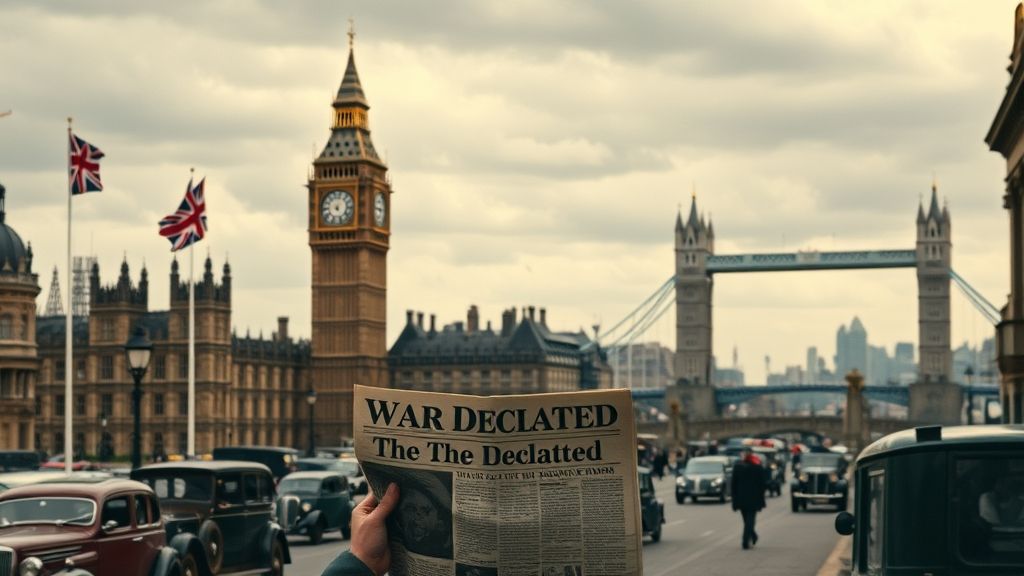
September 3, 1939. The atmosphere over London was charged with a tension that seemed almost palpable, like a storm about to break. The great city, with its familiar cobblestone streets and grand Victorian façades, stood at the cusp of history—its skyline marked by the Parliament’s iconic clock tower, Big Ben, now counting the final hours before a new and terrifying chapter would begin. Within the walls of 10 Downing Street, Prime Minister Neville Chamberlain faced the gravest moment of his political career, weighed down by the decisions of the past and the relentless approach of an aggressive Germany. As the hour struck late morning, the British voice rang out from the airwaves, carrying a mix of solemnity and resolve… "This country is at war with Germany."
The Dawn of a Trembling Empire: London, September 3, 1939
From the foggy banks of the Thames to the bustling pools of Piccadilly, the city hummed with an anxious anticipation. Shops closed early; streets emptied; families huddled around radios in cramped living rooms and smoky pubs alike. The war that Britain had sought so desperately to avoid was now an undeniable reality.
The announcement was not just the start of a conflict spanning continents—it was the shattering of a fragile peace, the ritual farewell to hope for a diplomatic solution, and the dawning of a shared resolve. For millions, the declaration was both terrifying and galvanizing.
Shadows over Europe: The Road to War
Europe’s descent into chaos did not happen overnight. It was a long unraveling, a tapestry of broken treaties, economic turmoil, and rising nationalist fervor. The scars of the First World War were still raw, leaving a continent scarred and fragile, desperately seeking stability but too afraid to confront rising threats.
The Treaty of Versailles had sought to bind Germany with heavy reparations and territorial losses, but its harshness planted seeds of resentment. The global economic depression of the 1930s deepened divisions, fueling extremist politics. Adolf Hitler’s rise embraced nationalism and the revision of Europe’s borders as a rallying cry.
From the remilitarization of the Rhineland to the annexation of Austria (Anschluss), Germany’s moves went largely unchecked as much of Europe clung to appeasement strategies. But the invasion of Czechoslovakia’s Sudetenland and then the rest of the country in March 1939 peeled away illusions of peace piece by piece.
From Munich to Molotov: Diplomatic Failures and Broken Promises
The Munich Agreement of 1938, signed by Britain, France, Italy, and Germany, promised “peace for our time,” yet it only postponed conflict. It symbolized the high cost of concession. Shortly thereafter, closer scrutiny revealed darker shadows: the secret protocols of the Molotov-Ribbentrop Pact in August 1939 sealed Hitler’s pact of convenience with Stalin’s Soviet Union, dividing Eastern Europe into spheres of influence and clearing the path for an invasion of Poland.
For Britain, this pact was a slap in the face of diplomacy and a clear act of aggression that could no longer be ignored. Guarantees had been extended to Poland, pledging military support if invaded.
Chamberlain’s Last Stand: The Illusion of Peace
Neville Chamberlain, the architect of appeasement, bore both the hopes and the failures of this generation. His 1938 return from Munich, waving a piece of paper claiming peace, was a moment immortalized in history—a naive, desperate attempt to prevent another war.
Yet by 1939, Chamberlain had acknowledged that Hitler’s ambitions could not be curbed by diplomacy alone. His tone shifted from optimism to steely determination, culminating in the famous speech from the House of Commons on that September morning, where he declared “the task of waging war had now devolved upon us.”
In those dark hours, Chamberlain became the reluctant harbinger of national resolve, advocating not surrender but endurance.
The Invasion of Poland: The Spark Igniting the World
On September 1, 1939, German forces poured seamlessly across Poland’s borders in a swift and brutal campaign—the first test of Blitzkrieg, or “lightning war.” Tanks, aircraft, and infantry overwhelmed the defenders within days.
For London, this was the undeniable act of aggression that could no longer be tolerated. The guarantees extended to Poland compelled Britain to act, despite lingering fears of a war that would engulf a whole generation.
London Listens: The BBC’s Historic Announcement
At 11 a.m. on September 3, the nation’s foremost voice, the British Broadcasting Corporation, brought the war into every household. The announcer’s calm, measured voice contrasted with the gravity of his message: war had been declared.
From local pubs to royal estates, from factories to tea shops, people absorbed the words in stunned silence. Later, patriotism mingled with fear; the memory of the First World War’s horrors was fresh for many—yet so was the resolve to resist tyranny.
Voices of the Nation: Public Reaction in the United Kingdom
The British public greeted the declaration with a complex cocktail of emotions. In London’s East End, dockworkers spoke in hushed tones about another fight for survival; in Scotland, miners wondered if the sacrifices would be worth it.
Yet, amidst anxiety, a strong sense of unity emerged. People gathered, volunteered, and sought ways to contribute. The “Phoney War” phase would soon test this resolve, as the nation braced itself for a conflict whose true cost lay hidden but looming.
The War Cabinet’s Crucible: Decisions at Downing Street
The immediate challenge was enormous. The War Cabinet, including figures like Winston Churchill, then First Lord of the Admiralty, and Anthony Eden, Foreign Secretary, convened relentlessly to shape Britain's military and domestic strategy.
The debate was fierce: how to balance offensive and defensive postures, how to maintain supply lines, and how to prepare a country still clawing its way out of Great Depression economics.
Mobilization and Marching Boots: The Home Front Awakens
The declaration signaled the beginning of mass mobilization. Conscription was extended, factories repurposed for war production, and rationing plans devised. The civilian population would soon endure blackouts, air-raid drills, and the strain of loved ones sent to the front.
London itself became a fortress and a target—its citizens learning to live under the shadow of bombers and sirens.
The Empire Joins the Fray: Dominion and Colonial Responses
More than the British Isles were involved. The British Empire stretched across continents, and dominions from Canada to Australia pledged immediate support. India’s vast population tuned into London’s decision with mixed feelings, caught between loyalty and burgeoning calls for independence.
Imperial resources and manpower would prove crucial, turning what began as a European conflict into a truly global war.
The Blitzkrieg Begins: Early Military Engagements
By late 1939, although Britain and France had declared war, the anticipated large-scale fighting had yet to erupt on Western fronts—a period known as the “Phoney War.” However, beneath this quiet, the gears of total war ground steadily onwards.
British naval forces began imposing blockades, while air squadrons trained relentlessly for the coming battles that would soon reshape Europe.
Churchill in Waiting: Leadership and Legacy
Though Chamberlain led Britain into war, Winston Churchill’s rise would soon define the nation’s wartime spirit. His speeches, determination, and unyielding courage galvanized a weary population through darkest days.
His wartime premiership, beginning in 1940, would transform not only British politics but the very narrative of resistance against fascism.
The Psychological War: Propaganda and Morale
Government ministries launched campaigns to bolster morale, with posters, films, and radio broadcasts reinforcing themes of resilience and duty. The Ministry of Information took charge of controlling news and shaping public perception, knowing that onto morale so much else depended.
Songs like “We’ll Meet Again” and slogans such as “Keep Calm and Carry On” would become iconic symbols of British fortitude.
Economic Shifts: Preparing for a Total War Effort
War demanded total economic transformation. Industries once dedicated to peacetime manufacturing switched to weapons, munitions, and transport production. Women entered factories in unprecedented numbers, marking a profound social shift.
The Treasury struggled to finance the conflict, leading to loans from the United States before full American engagement. The war’s economic cost was staggering but necessary.
The Global Ripple: Allied and Axis Reactions Worldwide
Britain's declaration was more than a message to Germany—it sent shockwaves around the world. France pledged its commitment, while the United States maintained neutrality, watching cautiously.
Axis powers, emboldened yet wary, recalibrated strategies, with Japan eyeing expansion and the Soviet Union moving through Eastern Europe. The stage was set for a protracted, complex global war.
The Human Cost: Stories from the Front and Home
Behind the grand narratives were thousands of personal stories—families torn apart, soldiers writing love letters from foxholes, children evacuated to countryside safety, and civilians sheltering amid bombed-out ruins.
These human threads remind us that history is not merely date and event, but the sum of countless lives dramatically altered.
The War’s Promise and the Nation’s Resolve
As the first gunshots of what would become World War II echoed, Britain chose to stand against aggression and tyranny. September 3, 1939, was not just a date; it was a pledge—a testament to a nation’s unwillingness to surrender the principles of freedom.
The months and years that followed would test that resolve in ways no one could imagine then.
Conclusion
The United Kingdom’s declaration of war on Germany was a moment forged in a crucible of shattered diplomacy, rising tyranny, and urgent moral choice. London on that blustery September morning became the heart of a nation poised between its past and an uncertain, tumultuous future.
Yet through fear, sacrifice, and overwhelming odds, Britain’s stand signaled a profound and enduring human truth: when confronted with darkness, courage, unity, and hope can light the way. This decision echoed far beyond British shores, shaping the course of global history and reminding us forever of the fragile, fierce nature of peace.
FAQs
Q1: Why did the United Kingdom declare war on Germany in 1939?
A1: The UK declared war in response to Germany’s invasion of Poland on September 1, 1939, honoring its guarantee to protect Polish sovereignty and to resist German aggression.
Q2: Who was the British Prime Minister when war was declared?
A2: Neville Chamberlain was Prime Minister at the time, having led the country through a policy of appeasement until deciding war was unavoidable.
Q3: How did the British public react to the declaration of war?
A3: The reaction was mixed but generally characterized by shock, fear, and a rising sense of national unity and determination.
Q4: What role did the British Empire play in the war effort following the declaration?
A4: The dominions and colonies provided troops, resources, and logistical support, making the conflict truly global.
Q5: How did the declaration of war affect Britain’s economy?
A5: It triggered a transition to a wartime economy, increasing industrial production, rationing, and major social changes such as increased workforce participation by women.
Q6: What was the international reaction to Britain’s declaration of war?
A6: Allied countries like France supported the declaration; neutrals like the United States remained cautious, and Axis powers recalibrated their strategies accordingly.
Q7: How did this declaration set the stage for Winston Churchill’s leadership?
A7: Churchill’s earlier government role positioned him as a key wartime figure who would succeed Chamberlain and become synonymous with British resistance.
Q8: In what ways is the declaration remembered in British history?
A8: It is seen as a pivotal moment of moral courage and national unity, marking the definitive stand against fascism.