Table of Contents
- A Nation Shaken: The Morning After Pearl Harbor
- December 7, 1941: The Day That Changed America
- The Calm Before the Storm: Tensions in the Pacific
- Japan’s Strategic Calculus: Why Attack Now?
- American Isolationism and the Road to War
- The Immediate Fallout: Public Reaction in Washington, D.C.
- President Franklin D. Roosevelt’s Infamy Speech: Words that Galvanized a Nation
- Congress Responds: The Formal Declaration of War
- Mobilizing the Giant: America’s War Machine Awakens
- The Allies Rally: A Global Response to the Pacific Attack
- The Impact on American Society: Unity and Sacrifice
- Political Ramifications: Shifting Power Dynamics in Washington
- Economic Transformation: From Depression to Wartime Boom
- Propaganda and Public Opinion: Building Support for the War Effort
- Voices from the Frontline: Soldiers’ Early Experiences
- The Role of Intelligence and Communication in Declaring War
- Japan’s Perspective: The Aftermath on Tokyo’s Decision Makers
- The Broader Axis Response: Germany and Italy’s Declarations
- The Uneasy Alliance: Shaping U.S. Foreign and Military Policy
- Lessons from December 8: War, Memory, and Historical Reflection
A Nation Shaken: The Morning After Pearl Harbor
On December 8, 1941, the United States of America awoke to a nation transformed. The tension of global conflict, once simmering at the edges of American consciousness, exploded into full awareness. The sun rose over Washington, D.C., but the shadows cast by the previous day’s assault on Pearl Harbor stretched long across the capital. The mood was somber, tense, yet resolute—the country stood on the precipice of war.
Voices echoed through the marble halls of Congress; telegrams flew between the White House and military commands. Citizens gathered around radios, tuning in for the President’s speech, their hearts pounding with a mixture of fear, anger, and unprecedented unity. The air was thick with the urgent pulse of history as the United States prepared to declare war on Japan.
December 7, 1941: The Day That Changed America
The surprise attack on Pearl Harbor was not just a military strike; it was a jolt—an earthquake underneath the American psyche, shaking decades of isolationism and cautious global engagement. Japanese carrier planes had descended, unleashing devastation on the U.S. Pacific Fleet. More than 2,400 Americans had perished, battleships sank or burned, and aircraft were destroyed on the ground.
The news spread like wildfire that Sunday evening, reaching Washington hours later. The impact was less about the physical damage and more about the symbolic rupture—the realization that the United States could no longer stay out of the maelstrom engulfing the world. The phrase "a day that will live in infamy," coined by Roosevelt, would soon resonate in the hearts of millions.
The Calm Before the Storm: Tensions in the Pacific
For years prior to the attack, tensions between the United States and Japan had been escalating. The Pacific was a stage set for conflict—ambitions clashed over territories and influence, from China to Southeast Asia. Japan's imperial expansion threatened Western economic interests and colonial holdings.
Sanctions, embargoes, and diplomatic brinkmanship punctuated the dialogue between Washington and Tokyo. America's freezing of Japanese assets and refusal to supply oil severely strained relations. Meanwhile, Japan calculated that war might be the only way to secure its resource needs and assert dominance.
Yet, for many Americans, the Pacific felt distant. The memory of World War I lingered, and isolationist voices preached caution. Few imagined the international crisis would so violently impose itself on American shores.
Japan’s Strategic Calculus: Why Attack Now?
Japan’s leadership believed the strike on Pearl Harbor was a necessary gamble. Admiral Yamamoto and his strategists hoped to incapacitate the U.S. Pacific Fleet, thereby buying time to consolidate territory and fortify gains in Asia. It was a plan of calculated surprise, designed to neutralize America’s naval power before it could effectively respond.
The decision was fraught with risk. War with a nation as industrially powerful as the United States was no light matter. But Japan’s leaders, feeling cornered by economic strangulation and emboldened by prior successes in China and Indochina, decided swift, shocking action was imperative.
This fateful calculus would draw the U.S. into the most devastating conflict in its history.
American Isolationism and the Road to War
In the 1930s, the United States had invested heavily in isolationism—a policy dictated by a desire to avoid the mistakes of World War I. The Neutrality Acts reflected this keen reluctance to become entangled in foreign wars. The general public and many lawmakers believed the ocean would protect them from the madness unfolding abroad.
However, Roosevelt understood that American security and economic interest were increasingly imperiled. Lend-Lease support to Britain and diplomatic warnings to Japan hinted at a nation inching toward conflict, though still not fully committed.
The attack on Pearl Harbor shattered this illusory shield. The isolationist dogma was swept away in a tidal wave of urgency.
The Immediate Fallout: Public Reaction in Washington, D.C.
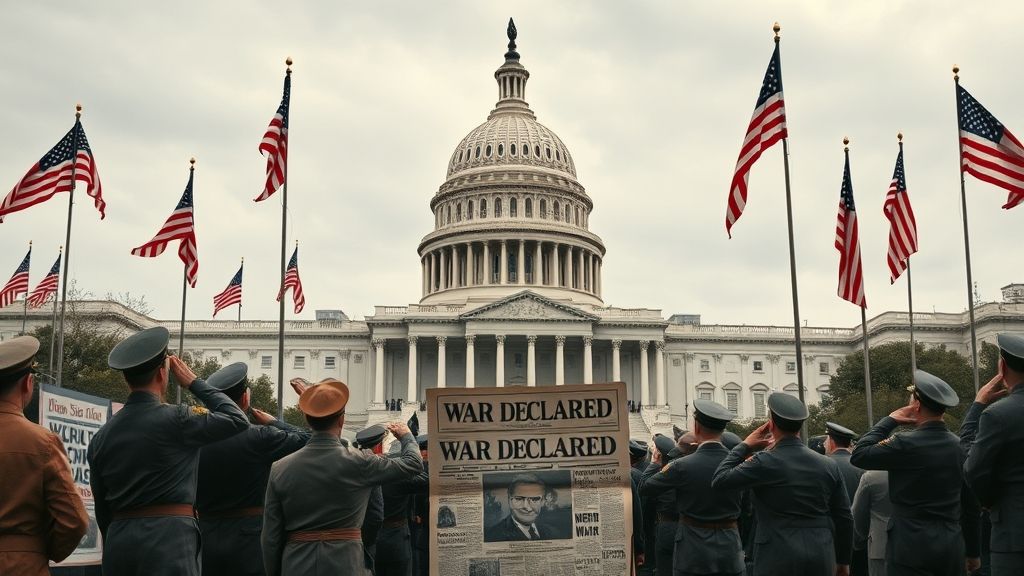
In the capital, news bulletins interrupted the regular flow of life. Phone lines buzzed with urgent calls. Capitol Hill was abuzz; members of Congress gathered to assess this blow to national pride and security. Across town, crowds filled the streets, their faces reflecting disbelief and fury.
Newspapers blared headlines, radios broadcast Roosevelt’s address live, and ordinary Americans, from workers to schoolchildren, felt the weight of a new reality. The attack galvanized a deeply felt need for action; patriotism surged alongside a grim awareness of the sacrifices ahead.
President Franklin D. Roosevelt’s Infamy Speech: Words that Galvanized a Nation
On the morning of December 8th, at precisely 12:30 pm, President Franklin D. Roosevelt addressed a joint session of Congress in what would become one of the nation’s most iconic speeches. His quiet, measured tone belied the explosive message:
“Yesterday, December 7, 1941—a date which will live in infamy—the United States of America was suddenly and deliberately attacked…”
Every word echoed the nation’s shock but also its resolve. Roosevelt’s speech did more than inform; it rallied an entire population. His call to action was unambiguous: the United States would fight back, and the war would not be half-hearted.
Congress Responds: The Formal Declaration of War
Within hours of Roosevelt’s speech, Congress convened to vote on the declaration of war against Japan. The response was virtually unanimous—only one dissenting vote—reflecting an overwhelming consensus that the nation must act decisively.
The House of Representatives ratified the declaration with a stirring sense of purpose, and by afternoon, the Senate echoed the verdict. The United States was officially at war, opening a new, perilous chapter in its history.
Mobilizing the Giant: America’s War Machine Awakens
With the declaration made, the machinery of war shifted into gear. Factories that once produced consumer goods now churned out tanks, planes, and weapons. Millions of Americans registered for the draft; economic planners reoriented the workforce toward military needs.
Washington became a hive of strategic activity, with military leaders, scientists, and politicians collaborating on an unprecedented scale. The attack at Pearl Harbor had sparked not only outrage but an industrial and technological mobilization that would eventually tip the scales of global conflict.
The Allies Rally: A Global Response to the Pacific Attack
America’s entry into World War II galvanized the Allied powers. Britain, the Soviet Union, and China welcomed America’s participation, aware that the war’s tide might turn with such a formidable new partner.
Diplomatic communications accelerated, strategies multiplied, and joint operations began to take shape. However, the global nature of the war posed immense challenges in coordination and logistics, testing alliances and resolve.
The Impact on American Society: Unity and Sacrifice
The war’s declaration also reshaped everyday life across the United States. Men and women enlisted in large numbers, some joining the armed forces directly, others supporting the war effort through labor and conservation on the home front.
Civil liberties were complicated by wartime measures, including the controversial internment of Japanese Americans—one of the most painful chapters in American democracy. Yet, the collective spirit of sacrifice and unity prevailed, with communities rallying behind the cause.
Political Ramifications: Shifting Power Dynamics in Washington
The war accelerated a shift in political power, emphasizing executive authority and military leadership. Roosevelt’s administration expanded its reach, coordinating war production, intelligence, and diplomacy in a manner unprecedented in peacetime.
Congress, while still vital, deferred heavily to the executive branch’s wartime prerogatives. This realignment had lasting impacts on American governance in the post-war era.
Economic Transformation: From Depression to Wartime Boom
The economic impact of declaring war was seismic. The depression-era unemployment rates plummeted as factories reopened to meet war demands. Federal government spending soared, stimulating industries and reviving communities battered by years of economic hardship.
The intensity of war production fostered innovations that would ripple across the economy, reshaping industries and laying the groundwork for a postwar American renaissance.
Propaganda and Public Opinion: Building Support for the War Effort
The government launched extensive propaganda campaigns to maintain public morale and encourage enlistment and conservation. Posters, films, and radio broadcasts emphasized themes of patriotism, sacrifice, and vigilance.
Public opinion, initially varied, soon coalesced around a fierce commitment to victory. Civic organizations, religious groups, and media outlets played critical roles in this national mobilization of spirit.
Voices from the Frontline: Soldiers’ Early Experiences
For the soldiers heading into the Pacific theatre, the declaration of war marked the beginning of an arduous journey. Letters, diaries, and later interviews reveal a blend of fear, determination, and a profound sense of duty.
The initial months of conflict would prove brutal and uncertain, testing both military strategy and human endurance.
The Role of Intelligence and Communication in Declaring War
The rapid transition from surprise attack to declaration was facilitated by burgeoning intelligence networks and communication systems. Despite the failure to anticipate Pearl Harbor, once the attack occurred, information flowed swiftly, shaping political decisions and military planning.
This period marked early lessons in the value—and limits—of intelligence in modern warfare.
Japan’s Perspective: The Aftermath on Tokyo’s Decision Makers
Across the Pacific, Japan’s government grappled with the consequences of their bold strike. Initial celebrations soon gave way to sobering assessments of the American industrial capacity and the formidable challenge now confronting them.
Internal debates surfaced regarding strategy, diplomacy, and the inevitable length of the conflict they had provoked.
The Broader Axis Response: Germany and Italy’s Declarations
Following America’s declaration of war on Japan, Germany and Italy honored their alliance with Japan by declaring war on the United States. This expansion of the conflict solidified the global scale of World War II.
Washington now faced enemies on multiple fronts, necessitating a vast strategic pivot and synergy with its allies.
The Uneasy Alliance: Shaping U.S. Foreign and Military Policy
The war against Japan and the Axis powers more broadly pushed the United States into forging strong international military and political alliances. The formation of the United Nations and postwar planning were seeded during this tumultuous time.
Diplomatic balancing acts, ideological divides, and the pressing demands of war shaped policy that would endure long after the guns fell silent.
Lessons from December 8: War, Memory, and Historical Reflection
The declaration of war on Japan on December 8, 1941, remains a defining moment in American history. It underscores the fragility of peace and the profound consequences of global tensions left unchecked.
The memory of that day continues to evoke reflection on vigilance, leadership, and the costs of conflict—not only in lives lost but in decisions made under the weight of existential threat.
Conclusion
December 8, 1941, was far more than a mere date stamped into the annals of history—it was the moment America shed its isolation like a second skin, revealing a warrior’s resolve beneath. The declaration of war on Japan was born in the crucible of shock and sorrow but fueled by a nation’s unyielding spirit.
From the marble halls of Washington, D.C., to the distant shores of the Pacific, this day forever altered the course of the 20th century. It brought out both the best and the most difficult aspects of the American character: courage, innovation, sacrifice—and the heavy burden of global leadership.
Yet, from that somber morning rose a determination to fight not just for survival, but for a world where freedom and justice could endure. History’s gaze remains fixed on that decisive moment, reminding us that peace, no matter how cherished, sometimes demands the grimmest of actions.
FAQs
Q1: What prompted the United States to declare war on Japan on December 8, 1941?
A1: The immediate catalyst was Japan’s surprise attack on Pearl Harbor the previous day, which inflicted massive damage and casualties on the U.S. Pacific Fleet, prompting a unified call for war.
Q2: How did President Roosevelt’s speech influence the declaration of war?
A2: Roosevelt’s “Infamy Speech” captured the nation’s outrage and resolve, galvanizing Congress and the American people, helping to secure near-unanimous support for declaring war.
Q3: Was the U.S. prepared for war prior to December 7, 1941?
A3: While the U.S. had begun modest military build-up and aid to allies, it largely remained isolationist and unprepared for immediate, large-scale conflict.
Q4: What effect did the declaration of war have on American society?
A4: It unified the country’s population, spurring mass enlistments, economic mobilization, and significant social changes, including wartime sacrifices and increased roles for women and minorities.
Q5: How did this declaration affect the wider Allied strategy in World War II?
A5: It integrated the U.S. as a principal force alongside Britain and the Soviet Union, dramatically shifting the war’s momentum against the Axis powers.
Q6: What was Japan’s strategic goal in attacking Pearl Harbor?
A6: Japan aimed to neutralize the U.S. Pacific Fleet to secure unchallenged expansion in Asia and buy time to fortify its territorial gains.
Q7: How did Germany and Italy respond to the U.S. declaration of war on Japan?
A7: They declared war on the United States soon after, expanding the conflict into a truly global war.
Q8: How is December 8, 1941, remembered today?
A8: It is commemorated as a pivotal moment symbolizing the end of American isolationism and the beginning of its emergence as a global superpower and defender of democracy.