Table of Contents
- A City on the Edge: Prague, November 17, 1989
- The Spark from a Student’s March
- Shadows of Oppression: Life Under Communist Czechoslovakia
- Seeds of Dissent: The Growing Unrest of the 1980s
- The Role of Intellectuals and Dissidents
- The Student Movement: A Catalyst for Change
- The Night of November 17: From Protest to Crackdown
- The Sudden Transformation: From Suppression to Solidarity
- The Birth of Civic Forum and New Political Voices
- Mass Demonstrations and the Eruption of Public Will
- Václav Havel: The Moral Conscience Emerges
- The Fall of the Regime: Negotiations and Resignations
- The Last Days of Communist Rule: A Peaceful Coup
- The Symbolism of Velvet: Why This Revolution Was Different
- Regional Ripples: Czechoslovakia and the Wave of 1989
- Women and Youth: The Unsung Champions
- The Cultural Renaissance After the Revolution
- The Economic Challenges of Transition
- Legacy of the Velvet Revolution: Democracy Rooted in Nonviolence
- The Memory of November 17 in Contemporary Czech Republic
- Velvet Revolution in Global Context: A Beacon for Peaceful Change
- Conclusion: A Triumph of Courage and Silent Strength
- FAQs: Unraveling the Velvet Revolution
- External Resource: Wikipedia Link
- Internal Link: Visit History Sphere
1. A City on the Edge: Prague, November 17, 1989
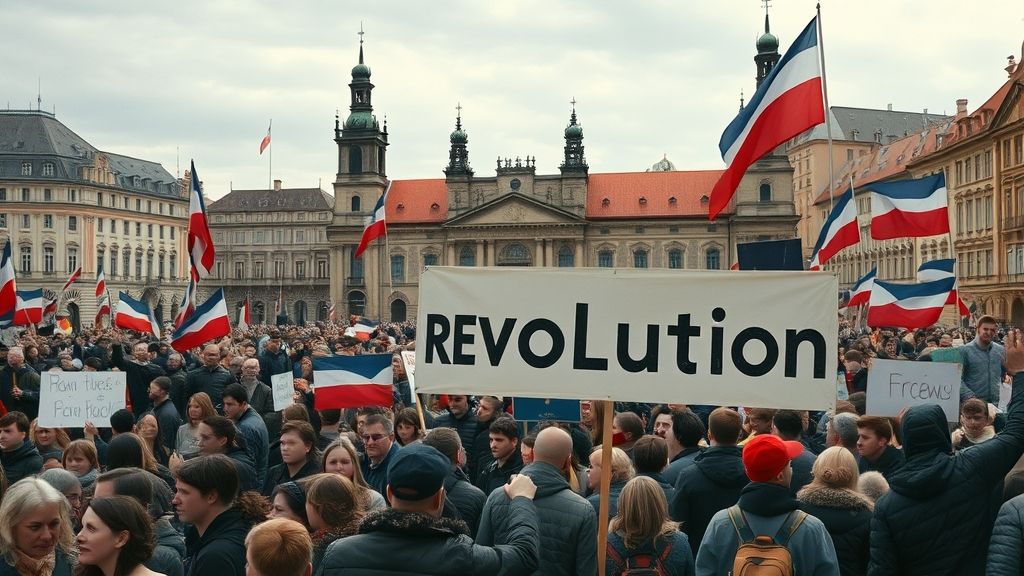
The bitter November wind swept through the cobbled streets of Prague, harrying autumn leaves past centuries-old facades. The usually bustling city center pulsed with a different energy that evening—a tension thick enough to touch, carried by a crowd of students gathering with banners and determined gazes. Here, in the heart of Czechoslovakia, history was on the precipice of a momentous transformation. The streets were quiet but charged with a silent promise: an unyielding quest for freedom was about to awaken.
The date, November 17, 1989, might have seemed unremarkable at first glance—a routine day in late autumn—yet it marked the inception of an extraordinary sequence of events now etched into the annals of history as the Velvet Revolution. This was no haphazard uprising but a meticulously woven tapestry of courage, intellect, and nonviolent resistance that would, in mere weeks, dismantle a regime that had gripped the nation for over four decades.
2. The Spark from a Student’s March
What started as a commemoration of International Students' Day—marking the brutal suppression of Czech students by Nazis in 1939—rapidly transformed into something far larger. Hundreds of young people, vibrant with hope and frustration, gathered to honor the past and challenge the present. Their peaceful march was intent on affirming rights long denied under communist rule; instead, it faced violent crackdown and tear gas.
This clash between youth and state police was not an isolated act of repression but rather the proverbial spark in a powder keg of simmering discontent. News of police brutality traveled fast, spreading outrage among ordinary citizens. Furniture stores, tram stations, cafes—whispers turned to discussions, and discussions turned to resolve. The students’ courage would ripple beyond their ranks, igniting a nationwide movement that demanded far-reaching change.
3. Shadows of Oppression: Life Under Communist Czechoslovakia
To grasp the magnitude of the revolution, one must understand the weight under which Czechoslovakia labored in 1989. Since the 1948 Communist coup, the country had been under the iron fist of a regime dictated from Moscow, characterized by censorship, a secret police apparatus (StB), and economic stagnation masked by socialist ideology.
The years since the Prague Spring of 1968—when hopes of “socialism with a human face” were crushed by Soviet tanks—had been defined by cautious compliance and fatalism. The state controlled everything: the press, education, travel, even thought. Underneath the outward calm, fear simmered, but so did a persistent yearning for liberty.
4. Seeds of Dissent: The Growing Unrest of the 1980s
Yet, the 1980s brought winds of change. Glass cracks began to show in the Communist monolith. Economic inefficiencies grew glaring, basic goods became scarce, and the Soviet Union itself was teetering under Mikhail Gorbachev’s reforms: glasnost and perestroika. For Czechoslovakians, these policies were both inspiration and aggravation—proof that change was possible, but also stark reminders of their own oppression.
Underground movements fostered debate; samizdat literature circulated, smuggling ideas of freedom and democracy. Entire circles of writers, artists, and intellectuals dared to envision a different future, challenging the narratives imposed by the regime. This growing unrest, though often subdued, was the fertile ground from which the Velvet Revolution blossomed.
5. The Role of Intellectuals and Dissidents
Among the many figures shaping the growing opposition, one name stood out: Václav Havel. A playwright and outspoken critic of the regime, Havel symbolized the moral and intellectual heart of dissent. Formerly imprisoned multiple times for his activism, he had become a beacon of hope for thousands who believed that culture and thought could be forms of resistance.
Dissident groups like Charter 77 had laid the groundwork for a civic awakening by documenting human rights abuses and calling for change, despite risking imprisonment. Their quiet but persistent work fostered a spirit of resilience and solidarity that framed the revolution’s discourse and strategy.
6. The Student Movement: A Catalyst for Change
The students themselves were not mere foot soldiers but architects of a new reality. Highly organized, deeply informed, and inspired by global movements for democracy—including the recent fall of the Berlin Wall—they represented a fresh generational voice confronting an aging regime.
Their demands, initially cultural and political, soon escalated toward fundamental systemic reform. Youth organizations that had once been state-controlled began to fracture, with courageous young activists risking arrests to speak out. Their processions became increasingly visible, an electric current coursing through the city.
7. The Night of November 17: From Protest to Crackdown
When the police violently dispersed the student march on November 17, 1989, it was intended to intimidate and silence. But the opposite occurred.
Video footage of brutality flooded homes through clandestine networks, sparking widespread indignation. Among the crowds, tears mingled with chants of defiance: “Truth and courage! Freedom!” The regime’s attempt to reinforce control instead broke the dam.
That night, underground comm circles buzzed with a question no one dared ask aloud days before: What if this time, the people don’t back down?
8. The Sudden Transformation: From Suppression to Solidarity
Within days, the tragic repression of November 17 galvanized a coalition of students, workers, intellectuals, and everyday citizens. Petitions flooded the Ministry of Interior. Strikes paralyzed factories. The public square erupted with nightly demonstrations that refused to disperse, marked by courage not weapons.
This unexpected solidarity cut through demographic and societal divisions, uniting rich and poor, young and old, Czech and Slovak in a shared dream. The regime, for once, found itself isolated – its usual apparatus of fear and coercion faltering against mass, peaceful resistance.
9. The Birth of Civic Forum and New Political Voices
In this crucible emerged Civic Forum, a new political platform born from the grassroots, led by prominent dissidents including Havel. The Forum embodied the collective will to negotiate, to seek reform through dialogue rather than violence.
Its formation signified a turning point—no longer content with secret petitions and underground pamphlets, the opposition stepped into the light, demanding not only change but participation. Civic Forum’s leadership, combining pragmatism with visionary idealism, provided the regime a face with which it had to reckon.
10. Mass Demonstrations and the Eruption of Public Will
Throughout November and early December, Prague’s Wenceslas Square became a stage of historic proportions. Every evening, masses gathered, swelling to hundreds of thousands. Singing, chanting, holding candles – the crowds filled the city with an unbreakable aura of hope.
A tapestry of voices came together: workers demanded economic reform; intellectuals sought free speech; families prayed for peace. This human mosaic defied the regime’s narrative, showing the world that change could be joyous and inclusive.
11. Václav Havel: The Moral Conscience Emerges
Václav Havel’s role transcended that of political leader; he became the moral conscience of a nation. His speeches, imbued with humility and intellect, appealed to universal human rights and dignity.
“When the power of love overcomes the love of power, the world will know peace,” he famously stated — words that resonated deeply amidst fear and uncertainty. Havel’s blend of wit, wisdom, and integrity drew not only Czechoslovaks but international admiration, shaping the new narrative.
12. The Fall of the Regime: Negotiations and Resignations
By December, the Communist Party was reeling. The regime’s once-vaunted security forces began to turn a blind eye to protests. Internal fractures widened as reformist elements within the party recognized the inevitable.
Negotiations between Civic Forum and government officials unfolded, cautious yet determined. On December 10, the Communist government resigned en masse. A new cabinet began forming, marking the practical end of authoritarian control.
13. The Last Days of Communist Rule: A Peaceful Coup
What makes the Velvet Revolution exceptional is the absence of bloodshed. Unlike many historical overthrows marred by violence, the transition in Czechoslovakia was remarkably peaceful.
Citizens reclaimed public institutions, media outlets threw open their doors, and political prisoners were released. The phrase “velvet” encapsulated not only the smoothness but the softness of change — a profound testament to the power of peaceful resistance.
14. The Symbolism of Velvet: Why This Revolution Was Different
The term “Velvet” conjures images of softness and refinement, but also resilience and depth. This revolution unfolded without tanks or gunfire, relying instead on civility, creative defiance, and an unyielding moral compass.
In a world habituated to violent revolution, this was astonishing: a paradigm shift emphasizing dialogue over destruction, unity over chaos, and courage over hatred.
15. Regional Ripples: Czechoslovakia and the Wave of 1989
The Velvet Revolution did not occur in isolation. Across Eastern Europe that year, chains were breaking. Poland’s Solidarity, Hungary’s reforms, the fall of the Berlin Wall—these events created an unstoppable momentum.
Czechoslovakia’s peaceful rise was both product and inspiration of this broader movement, contributing to the collapse of the Soviet sphere and a redefinition of Europe’s political landscape.
16. Women and Youth: The Unsung Champions
Though often overshadowed by prominent leaders, countless women and young people propelled the revolution forward. Activists, artists, nurses, and students worked tirelessly, organizing demonstrations, disseminating information, and sustaining morale.
Their energy underscored the inclusivity of the movement — a society reborn through the collective strength of those often marginalized.
17. The Cultural Renaissance After the Revolution
With political chains broken, cultural expression blossomed. Theatre, literature, music—previously stifled by censorship—exploded with new life. Prague’s streets were again canvases for free thought.
Exiled artists returned home. Media flourished. Intellectual debates filled cafes. This renaissance was not mere celebration but an essential healing and reaffirmation of identity.
18. The Economic Challenges of Transition
Yet the euphoria of freedom brought complex realities: transitioning from a centrally planned economy to a market democracy proved difficult. Factories closed, unemployment rose, inflation bit deep.
The government grappled with privatization and integration into global markets, all while nurturing nascent democratic institutions. The road ahead was uncertain, fraught with hardship, but anchored in the newfound hope of self-determination.
19. Legacy of the Velvet Revolution: Democracy Rooted in Nonviolence
More than thirty years on, the Velvet Revolution remains a striking example of nonviolent revolution. It inspired movements worldwide, reaffirming the potential for peaceful political change.
Democratic institutions, civil society, and the rule of law, nurtured by the revolution’s ethos, shaped Czech and Slovak societies after their peaceful split in 1993. Its principles continue to inform struggles for freedom and justice everywhere.
20. The Memory of November 17 in Contemporary Czech Republic
Every November 17, Czechs observe a national holiday honoring the revolution’s origins and those who sacrificed to secure liberty. Monuments, museums, and educational programs remind younger generations of the power dormant in unity and courage.
Yet, the memory also serves as caution—a reminder that freedom is fragile, requiring vigilance and participation.
21. Velvet Revolution in Global Context: A Beacon for Peaceful Change
On the global stage, the revolution stands as a beacon against violence and repression. Leaders from Nelson Mandela to the architects of the Arab Spring have echoed its lessons.
It reshaped geopolitics, hastened the Cold War’s end, and humanized the narrative of liberation, proving that even in the darkest regimes, the human spirit can prevail softly but indomitably.
22. Conclusion: A Triumph of Courage and Silent Strength
The Velvet Revolution began with a group of students marching through Prague’s streets on a chilly November day, propelled by memory and hope. What followed was an orchestration of courage, solidarity, intellect, and heart that dismantled a dictatorship without a single shot fired.
This extraordinary story reveals not just political change but a profound human truth: that when people find their voice and stand united, even the most entrenched powers must yield. It is a testament to the extraordinary potential locked within ordinary citizens and the quiet power of dreams made real.
FAQs: Unraveling the Velvet Revolution
Q1: What triggered the Velvet Revolution?
The immediate trigger was the violent crackdown on a peaceful student demonstration on November 17, 1989, which commemorated International Students' Day but turned into a protest against the regime.
Q2: Who was Václav Havel and why was he important?
Václav Havel was a playwright, dissident, and central figure in the Velvet Revolution, later becoming Czechoslovakia’s president. His leadership was crucial in articulating the revolution’s moral and political vision.
Q3: Why is it called the ‘Velvet’ Revolution?
Because the revolution was remarkably smooth and peaceful, without violence or bloodshed, akin to the softness and richness of velvet fabric.
Q4: How did the Velvet Revolution influence other countries?
It was part of a broader wave of peaceful revolutions in Eastern Europe and offered a powerful example that nonviolent political change was possible even under authoritarian regimes.
Q5: What role did students play in the revolution?
Students were the initial organizers and visible leaders of protests, bringing energy and new ideas that mobilized wider sections of society against the regime.
Q6: Did the Velvet Revolution immediately solve economic problems?
No, transitioning from a socialist to a market economy brought significant economic challenges including unemployment and inflation, which took years to address.
Q7: How is the Velvet Revolution remembered today?
It is commemorated annually, celebrated as a national holiday emphasizing freedom, democracy, and the power of peaceful resistance.
Q8: What were the main outcomes of the Velvet Revolution?
The overthrow of the Communist government, establishment of democratic institutions, and ultimately the peaceful split of Czechoslovakia into the Czech Republic and Slovakia.