Table of Contents
- The Dawn of a Cosmic Quest: Introducing Vera Rubin
- Childhood beneath the Stars: Early Life and Curiosity
- The Scientific Landscape of the 1930s and ’40s
- Breaking Barriers: A Woman in the World of Men
- Academic Pursuits and the Path to Astronomy
- From Hypothesis to Observation: Early Work in Astronomy
- The Dark Puzzle: Galactic Rotation Curves and the Birth of a Mystery
- 1970s Breakthrough: Vera Rubin’s Pivotal Observations
- The Invisible Mass: Unearthing the Evidence for Dark Matter
- Scientific Resistance and the Challenge of a New Paradigm
- Collaborations and Contemporaries: A Network of Discovery
- Broadening the Horizon: Impact Beyond Astronomy
- Vera Rubin’s Legacy in Science and Society
- Honors, Recognition, and the Elusive Nobel Prize
- The Personal Side of a Pioneer: Family, Passion, and Persistence
- The Science of Darkness: Dark Matter and Modern Cosmology
- Inspiring Generations: Vera Rubin’s Role as a Trailblazer for Women
- The Cultural Impact: How Dark Matter Captivated Public Imagination
- The Continuing Quest: Modern Research Rooted in Rubin’s Findings
- Remembering Vera Rubin: A Life Written in Stars
The Dawn of a Cosmic Quest: Introducing Vera Rubin
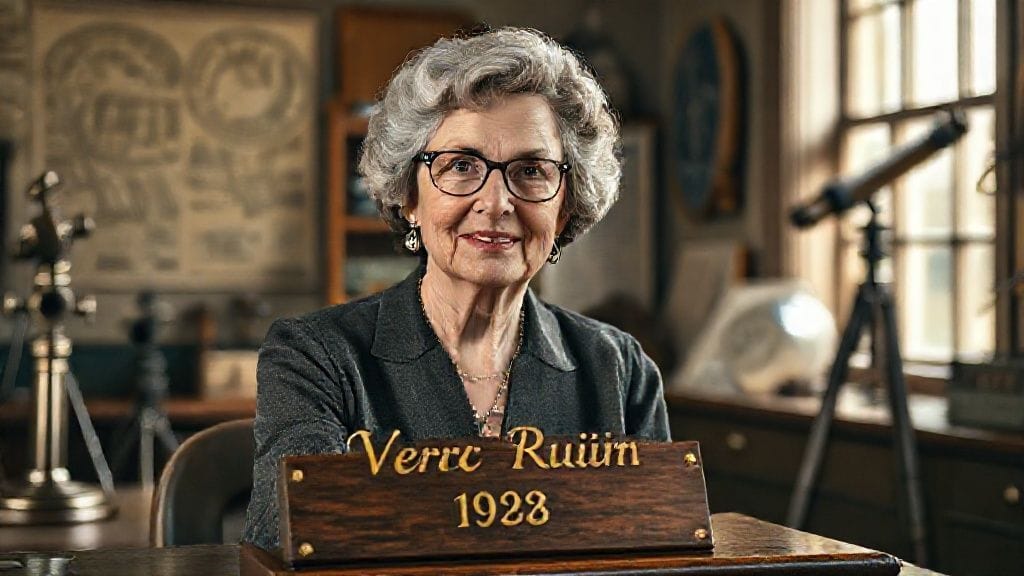
Under the vast, infinite sky of the American Northeast, in 1928, a star was born—not just in the heavens, but here on Earth. Vera Rubin, an unassuming girl from Philadelphia, would grow up to challenge the way humanity understood the universe. Her story is not simply one of scientific achievement but one of courage, dogged persistence, and the quiet power of curiosity. It is incredible, isn’t it, how a single life’s passion can illuminate the darkest mysteries of the cosmos?
This is the story of Vera Rubin—whose groundbreaking work would fundamentally alter our conception of the universe by revealing the invisible mass that cloaks galaxies: dark matter. It is a journey through time and space, gender barriers and scientific revolutions, from the dust of childhood dreams to the forefront of astrophysical discovery. But this wasn’t just science; it was a human odyssey.
Childhood beneath the Stars: Early Life and Curiosity
Born on July 23, 1928, Vera Florence Cooper was raised in an era when science and women seldom shared the same stage. Yet from a young age, she exhibited an insatiable appetite for the stars. Her father, Fred Cooper, a stenographer, would take young Vera and her sister to the Franklin Institute’s planetarium in Philadelphia. Those visits were transformative. Looking up at the swirling galaxies projected against the dome, Vera imagined not just the stars but the stories they might tell.
She was a shy, bookish child with a keen intellect. “I wanted to know everything,” she later recalled. Nature, physics, celestial bodies—all sparked in Vera a restless curiosity that outgrew what schoolbooks could provide. Her parents nurtured this thirst, a rare luxury for girls in 1930s America where science was considered “a man’s field.” The seeds of a radical future had been planted.
The Scientific Landscape of the 1930s and ’40s
During Vera Rubin's formative years, astronomy was predominantly a male domain. The giants of the field—Edwin Hubble, Cecilia Payne-Gaposchkin, George Gamow—had paved the way in mapping cosmic distances, classifying stars, and hypothesizing about the universe’s origin. However, women were limited largely to “computers” or assistants, rarely recognized as principal investigators.
The cosmos was full of unanswered questions. The expanding universe was confirmed, but its composition remained mysterious. The idea of “missing mass” was proposed sporadically but lacked solid evidence. Groups at Caltech and Princeton debated this “dark matter,” but it would take a new generation to turn whispers into revelation.
Breaking Barriers: A Woman in the World of Men
Vera Rubin’s journey in this world was anything but easy. The 1940s and ’50s offered few female role models in physical sciences, especially at universities. Rubin pursued her undergraduate degree at Vassar College, an institution known for cultivating women’s education. Yet even there, she encountered skepticism.
After marrying Robert Rubin, she attended Cornell University for graduate studies, but was discouraged from pursuing astronomy because of lab policies restricting married women’s roles. Undeterred, she transferred to Georgetown University, where she earned her M.A., and later, to the University of Chicago for her Ph.D. Despite the era’s obstacles, Rubin’s determination was relentless.
“Science is not just for men,” she once declared. This conviction echoed throughout her work, inspiring many women after her.
Academic Pursuits and the Path to Astronomy
At Georgetown, Rubin’s thesis focused on galaxy spectroscopy—a relatively niche field at the time. She began to craft a skillset that would prove crucial: understanding the movement of stars and gas in galaxies by analyzing their light spectrum.
Later, Rubin joined the Carnegie Institution and worked at the Palomar Observatory where telescopes captured the cosmos in unprecedented detail. It was in this environment that she met Kent Ford, an engineer whose innovations in photometry would be pivotal in her research.
Together, they forged a partnership blending theoretical curiosity with technical mastery, ready to push existing boundaries.
From Hypothesis to Observation: Early Work in Astronomy
Before Rubin’s breakthrough, astronomers grappled with puzzling data. Studies of the Andromeda galaxy and others showed stars at the outskirts of galaxies moving faster than they should if only visible matter exerted gravitational pull.
But these findings were often ignored or considered errors. Rubin, however, saw a pattern. She began meticulously measuring rotational velocities in spiral galaxies, carefully noting that stars far from galactic centers revolved at unexpected speeds.
Her observations demanded an explanation that the visible mass alone could not provide—a cosmic enigma that challenged the Newtonian paradigm.
The Dark Puzzle: Galactic Rotation Curves and the Birth of a Mystery
The core of Rubin’s scientific drama unfolded in the 1970s. The gravitational laws predicted that stars at a galaxy’s edge should orbit slower than those near the dense center—the way planets orbit closer to the sun faster than distant ones.
Yet Rubin’s data showed flat rotation curves: stars far from galactic centers moved just as fast as those nearby. This defied conventional wisdom and implied an unseen mass exerting gravity: dark matter.
“We had seen something we couldn’t explain,” Rubin recounted. “It forced the community to face the idea that most matter in the universe was invisible.”
1970s Breakthrough: Vera Rubin’s Pivotal Observations
Armed with Kent Ford’s new sensitive spectrometer, Rubin surveyed dozens of spiral galaxies. She confirmed that the unexpected speed of stars was not an anomaly but a universal feature.
In 1978, Rubin presented her findings at the American Astronomical Society meetings. The data were compelling and could not be dismissed. Slowly, the astronomical community had to wrestle with an uncomfortable truth: the astrophysical textbooks needed rewriting.
The concept of dark matter wasn’t entirely new, but Rubin’s observations provided the strongest empirical evidence to date that dark matter was real and dominant.
The Invisible Mass: Unearthing the Evidence for Dark Matter
What exactly was this “missing mass”? Rubin’s work suggested that about 85% of matter in the universe was unseen, detectable only through its gravitational effects. It wasn’t gas, dust, or stars—it was something else entirely.
This dark matter shaped the dynamics of galaxies and the large-scale structure of the cosmos. It became a cornerstone for models of the universe's evolution, including the Big Bang.
Without Vera Rubin’s precise measurements and indefatigable advocacy, dark matter might have remained a fringe idea, or at best, a speculative footnote.
Scientific Resistance and the Challenge of a New Paradigm
As with all paradigm shifts, Rubin’s findings were met with skepticism. Challenging Newtonian mechanics and conventional cosmology invited conservative resistance. Some dismissed her observations as errors or artifacts.
Moreover, the invisibility of dark matter made it difficult to study directly, complicating acceptance. Yet Rubin persisted, engaging in meticulous observation and open dialogue.
Her calm certainty gradually won over critics. The mystery of dark matter began shifting in status, from theoretical oddity to empirical reality.
Collaborations and Contemporaries: A Network of Discovery
Rubin did not work in isolation. She was part of a vibrant community—scientists like Fritz Zwicky who first suggested “missing mass” in the 1930s, and Jim Peebles whose cosmological theories integrated dark matter.
Kent Ford’s instrumental role in refining observational technology was crucial as well. Together, these pioneers constructed a collaborative framework that advanced the dark matter paradigm.
This narrative is as much about human relationships as cosmic phenomena—a reminder that science is a social endeavor.
Broadening the Horizon: Impact Beyond Astronomy
Dark matter’s discovery reverberated beyond academic circles. Physics, cosmology, and even philosophy grappled with the existence of invisible mass shaping reality. It posited a universe far stranger than previously imagined.
Astrophysics turned to particle physics, searching for candidate dark matter particles—WIMPs, axions—and dark energy studies expanded cosmological horizons.
Rubin’s work catalyzed interdisciplinary inquiry, demonstrating how observation fuels theory and vice versa.
Vera Rubin’s Legacy in Science and Society
Vera Rubin emerged as a role model for women in science, breaking barriers and inspiring generations. She championed equal opportunities and mentored young scientists, particularly women.
Her legacy transcends scientific discoveries; it is also a testament to perseverance in the face of systemic biases. The Vera Rubin Observatory, named in her honor, continues to illuminate the cosmos.
Her story is woven into the larger narrative of science’s human dimension.
Honors, Recognition, and the Elusive Nobel Prize
Though Vera Rubin received numerous accolades—the National Medal of Science among them—she never won a Nobel Prize. Many consider this one of the greatest oversights in the history of science.
Her contributions were fundamental to cosmology’s major advances, yet the Nobel Committee has traditionally hesitated on observational astronomy.
This controversy spurred debates about gender bias and the valuation of collaborative scientific work.
The Personal Side of a Pioneer: Family, Passion, and Persistence
Behind the telescopes and data lay a woman devoted to her family and community. Rubin balanced motherhood and a demanding career during times few women dared to pursue science.
She often recounted childhood memories and the thrills of discovery with warmth and humor. “Science was my passion, but so was being a mother,” she said.
This duality humanizes her story and reminds us of the individuals behind historic progress.
The Science of Darkness: Dark Matter and Modern Cosmology
Today, dark matter remains at the frontier of astronomy and physics. Observatories worldwide hunt elusive dark matter candidates; particle colliders probe physics beyond the Standard Model.
Rubin’s pioneering measurements laid the foundation for these explorations. Without her, modern cosmology’s quest to decode the universe’s composition and fate would be impossible to imagine.
Inspiring Generations: Vera Rubin’s Role as a Trailblazer for Women
Vera Rubin’s story inspires countless women and minorities in STEM fields. She shattered glass ceilings and provided a blueprint to navigate systemic barriers.
Her advocacy for women scientists made her a beloved figure and role model. She proved that passion and skill transcend artificial societal limits.
The Cultural Impact: How Dark Matter Captivated Public Imagination
Dark matter has permeated popular culture—from documentaries to science fiction—capturing imaginations about the invisible forces shaping existence.
Rubin’s story is central to this narrative, making her both a scientific legend and a cultural icon.
The Continuing Quest: Modern Research Rooted in Rubin’s Findings
Current projects, including the Vera Rubin Observatory, continue to delve into cosmic mysteries she first uncovered. The exploration of dark matter stands on the shoulders of her work, pushing human knowledge ever outward.
Her legacy propels us forward, reminding us that the universe still holds many secrets waiting to be revealed.
Remembering Vera Rubin: A Life Written in Stars
Vera Rubin passed away in 2016, but the cosmos she illuminated will forever echo her name. From a little girl mesmerized by planetarium lights to a scientific pioneer who changed how we see the universe, Vera Rubin’s life is a testament to the power of observation, courage, and relentless curiosity.
Her story invites us all to look up—to wonder, to question, and to chase the invisible threads that bind the cosmos.
Conclusion
Vera Rubin’s journey from a young girl with starry-eyed dreams to the forefront of astrophysical discovery is a narrative of resilience, brilliance, and transformation. She ventured into the unknown, unveiling the invisible backbone of galaxies—dark matter—and in doing so, cracked open a window into the universe’s deepest mysteries.
Her legacy is a beacon, illuminating not only scientific inquiry but also human tenacity in breaking barriers. Vera Rubin reminds us that the universe’s greatest truths often lie hidden in shadows, waiting for those brave enough to seek them.
As we gaze upward tonight, we owe a debt to her fearless pursuit of knowledge—an enduring testament to the human spirit that dares to understand the cosmos beyond the visible.
FAQs
Q1: Who was Vera Rubin and why is she important?
A1: Vera Rubin was an American astronomer whose detailed observations of galaxy rotation curves provided the first concrete evidence of dark matter—the invisible mass that dominates the universe. Her work fundamentally reshaped cosmology and astronomy.
Q2: What is dark matter and how did Rubin discover it?
A2: Dark matter is a type of matter that does not emit or absorb light but exerts gravitational influence. Rubin discovered it by measuring star velocities in galaxies, revealing that stars moved faster than expected, indicating unseen mass.
Q3: What challenges did Vera Rubin face as a woman in science?
A3: Rubin confronted significant gender bias throughout her career, including institutional barriers to women’s participation in graduate programs and unequal recognition of her work. Despite this, she persevered and became a role model for women in STEM.
Q4: Did Vera Rubin win a Nobel Prize?
A4: No, despite her crucial discovery, Vera Rubin never received a Nobel Prize, sparking debates over gender bias and the Nobel Committee’s criteria, especially regarding observational astronomy.
Q5: How did Rubin’s work influence modern cosmology?
A5: Rubin’s work forced scientists to include dark matter in their models of the universe, influencing theories about galaxy formation, cosmic structure, and the overall evolution of the cosmos.
Q6: What is the Vera Rubin Observatory?
A6: Named in her honor, the Vera Rubin Observatory is a next-generation astronomical facility dedicated to mapping the cosmos to better understand dark matter, dark energy, and cosmic phenomena, continuing her legacy.
Q7: How is Vera Rubin remembered today?
A7: Vera Rubin is celebrated as a pioneering astronomer and advocate for women in science. Her discoveries remain foundational in astrophysics, and she is remembered for her relentless curiosity and barrier-breaking spirit.
Q8: What does Vera Rubin’s story teach us?
A8: Her story teaches the power of persistence, the importance of questioning accepted knowledge, and the value of inclusive opportunities in science to harness all human potential.