Table of Contents
- The Dawn of Liberation: May 8, 1945, London Awakens to Victory
- Europe in Flames: The Road to Unconditional Surrender
- The War’s Shattered Face: Britain’s Turmoil and Resolve
- Churchill’s Voice: The Historic Broadcast that Echoed Hope
- London’s Streets Transformed: From Blackout to Radiance
- Ordinary Citizens, Extraordinary Moments: Tales from the Crowd
- The Sound of Celebration: Music, Dance, and Joy on the Airwaves
- The Weight of Loss: Remembering the Fallen Amidst Jubilation
- The Allies’ Triumph: A United Front Against Tyranny
- Nazi Germany’s Capitulation: Inside the Surrender Documents
- Women at the Forefront: The Changing Role of British Society
- The Empire and Its Subjects: Diverse Voices in the Victory Chorus
- From War to Peace: Britain’s Political and Economic Challenges Ahead
- The Shadow of the Atomic Age: A New World Emerges
- Victory in Europe and Its Global Echoes: The World Reacts
- The Memory of VE Day: Commemoration and Legacy in Britain
- Lessons Learned: How VE Day Shaped Europe’s Future
- Conclusion: The Human Spirit Triumphant in London’s Victory
- Frequently Asked Questions About Victory in Europe Day
- External Resource: Wikipedia Link
- Internal Link: History Sphere Portal
Victory in Europe Day, London 1945: a morning punctuated by whispered rumors, then roaring certainty. The air, thick with anticipation, suddenly exploded into a jubilant symphony as the war in Europe drew to a decisive close. In that city, scarred by years of bombings and rationing, strangers embraced with tears, laughter, and hope. The streets that had known fear and blackout descended into celebrations that would echo across generations. But this day was more than just the end of conflict: it was the rebirth of a continent, a testament to human endurance and the fierce yearning for peace.
The Dawn of Liberation: May 8, 1945, London Awakens to Victory
The morning of May 8, 1945, dawned on a London still bearing the wounds of the Blitz and years of relentless war effort. Yet, beneath the gray skies, a wave of something new and electrifying swept through the city: hope. News had filtered through that Germany was surrendering unconditionally. At 3 p.m., the definitive moment came when Prime Minister Winston Churchill addressed the nation in a tone that balanced triumph and solemn remembrance. His voice carried over the airwaves, stitching together an empire fatigued but unbowed.
Europe in Flames: The Road to Unconditional Surrender
To understand VE Day’s profound resonance, one must traverse the fiery landscape of Europe from 1939 to 1945. The continent, once a mosaic of cultures and sovereignties, had fallen under the shadow of Nazi aggression. The relentless blitzkrieg had swept through Poland, France fell within weeks, and Churchill’s Britain had stood alone during the cruel Battle of Britain. But the tide began to shift with the Soviet counteroffensive at Stalingrad, the D-Day landings on Normandy’s beaches, and relentless Allied bombing campaigns. Each grueling step inexorably led to Germany’s collapse.
The War’s Shattered Face: Britain’s Turmoil and Resolve
London was no stranger to devastation. The city’s architectural skyline had been carved and repaired through courage and necessity. Underground shelters were sanctuaries by day and homes by night. Coal and food were rationed meticulously, yet morale remained unbroken. Families had bid farewell to sons and fathers, often never to see them return. This collective trauma forged a unity that found its crescendo on VE Day—a day where grief and celebration intertwined.
Churchill’s Voice: The Historic Broadcast that Echoed Hope
Winston Churchill’s broadcast after the surrender was more than a political speech—it was a conduit of collective relief and reflection. With measured gravity, he praised the valor of soldiers and civilians alike while mourning those who would never come home. His words—“This is your victory”—became the voice of a nation that had endured, suffered, and ultimately prevailed. The radio became the hearth around which Britain gathered to share tears and smiles.
London’s Streets Transformed: From Blackout to Radiance
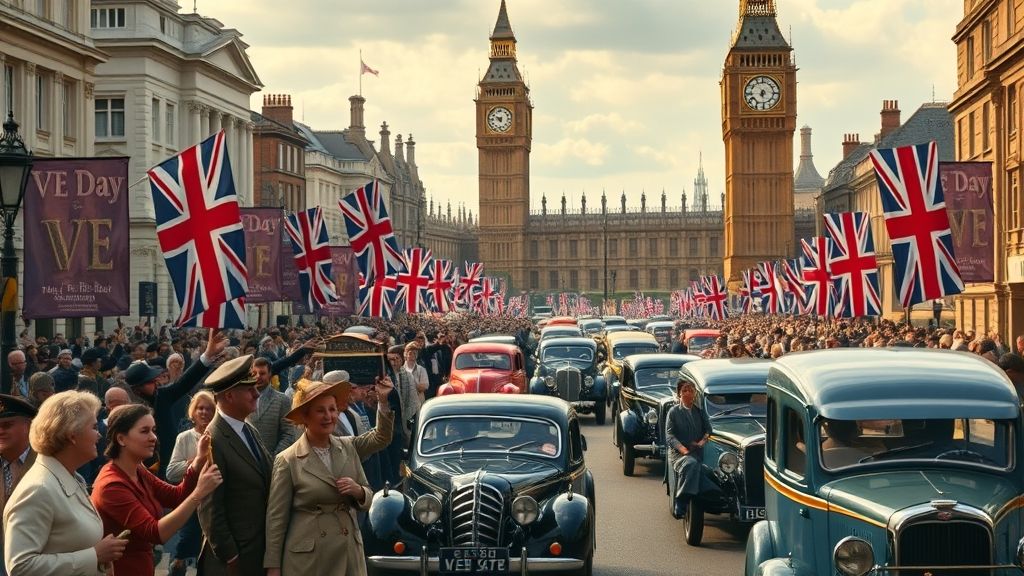
As Churchill’s message faded into the evening air, London erupted. The blackout restrictions that had veiled the city’s skies lifted, revealing a canopy of stars mirrored by the gleam of candles held by jubilant crowds. Streets filled with singing and dancing; Union Jacks waved triumphantly amid the rubble. Bonfires were lit in parks and courtyards, while children chased each other with sparklers, their laughter piercing the night.
Ordinary Citizens, Extraordinary Moments: Tales from the Crowd
Among the multitudes were stories of personal deliverance. Mary Parker, a factory worker from East London, recalled how she hugged a stranger in the street, their tears mingling as both shared relief and wonder. Sailors home from war embraced mothers and wives who had prayed in silence. The shared experience erased social barriers; for one night, Londoners breathed together a collective sigh of freedom.
The Sound of Celebration: Music, Dance, and Joy on the Airwaves
The BBC transformed its programming overnight. Vera Lynn’s “We’ll Meet Again” played with new meaning, as veterans and civilians danced in their kitchens and basements. Jazz clubs—some reborn from wartime blackout coolness—slammed open their doors. The sound of saxophones mixed with cheers; drums and laughter harmonized with the hum of the city’s liberation.
The Weight of Loss: Remembering the Fallen Amidst Jubilation
Yet amidst the revelry was a sober acknowledgment. For every celebration, shadows of loss lingered. Memorial services were held, with “The Last Post” and poignant speeches honoring the more than 300,000 British lives lost. Graves overseas remained silent markers of sacrifice. “Victory was not free,” a nurse named Agnes Hughes would say, “and we carry their memory into our future.”
The Allies’ Triumph: A United Front Against Tyranny
VE Day was emphatically not just British. The victory was a shared triumph among Allies: Soviet soldiers hoisted their flags in Berlin, American GIs celebrated in Paris, and Canadian troops took their bow. Though political tensions simmered beneath the surface, it was a moment of unity against fascism’s crushing force. The dynamics of cooperation and conflict that had steered the alliance defined the postwar world yet to come.
Nazi Germany’s Capitulation: Inside the Surrender Documents
The surrender itself was the culmination of days of negotiation, fraught with hesitation and pride. On May 7, Generals Jodl and Keitel signed the unconditional surrender in Reims, France, followed by a formal ratification in Berlin on the 8th. The documents bore the weight of defeat but contained language shaped carefully by legal minds aware they were scripting history. The meticulous nature of the surrender symbolized both finality and the dawn of reconstruction.
Women at the Forefront: The Changing Role of British Society
VE Day also marked a turning point in social dynamics. Women, who had taken on roles as factory workers, nurses, and auxiliary forces, now found their contributions publicly acknowledged. The war had fast-forwarded social changes, pressing Britain toward a new era where gender roles began evolving. For many women, VE Day was both an end and a beginning.
The Empire and Its Subjects: Diverse Voices in the Victory Chorus
Beyond London, the British Empire sang its complex victory song. Soldiers from India, Africa, the Caribbean, and beyond had fought and died in the empire’s name. Their narratives, often marginalized, were integral to the war’s tapestry. However, the day also sowed seeds of decolonization, as promises of freedom struggled to hide colonial grievances.
From War to Peace: Britain’s Political and Economic Challenges Ahead
Victory did not erase challenges. Britain faced an exhausted economy, massive debt, and a population yearning for peace but confronting austerity. The Labour government soon pushed sweeping reforms, including the foundation of the National Health Service. VE Day was both a triumph and a threshold—ushering Britain from wartime hardship toward rebuilding a fractured society.
The Shadow of the Atomic Age: A New World Emerges
While citizens danced, a new and ominous reality unfolded in secret. The United States had unleashed the atomic bomb in July 1945, months after VE Day, signaling an unprecedented shift in warfare and geopolitics. The Victory in Europe was therefore also the beginning of a precarious peace, one shadowed by nuclear dawn and ideological rivalry.
Victory in Europe and Its Global Echoes: The World Reacts
Around the world, VE Day was a beacon. Across continents, people celebrated the end of the European war while anxiously eyeing ongoing conflicts in the Pacific. From Australia to Latin America, crowds echoed London’s joy, marking a turning point in a devastating global crisis. Diplomatic cables, newspapers, and broadcasts reveal a shared breath held and then exhaled in relief.
The Memory of VE Day: Commemoration and Legacy in Britain
In Britain, VE Day became a cornerstone of national memory. Annual parades, remembrance ceremonies, and educational programs sought to transmit the day’s meaning to new generations. Yet, the narratives have evolved, reflecting contemporary debates on warfare, empire, and peace. The day remains a canvas on which Britain projects resilience and reconciliation.
Lessons Learned: How VE Day Shaped Europe’s Future
VE Day’s implications rippled far beyond the 1945 moment. It heralded the start of European integration efforts, the foundation for peace organizations, and a commitment to prevent such devastation from recurring. It also underscored the cost of totalitarianism and the urgent necessity of democratic values. The day’s legacy is a vivid reminder of the fragile but enduring human drive toward freedom.
Conclusion
Victory in Europe Day was more than a cessation of gunfire—it was a profound affirmation of human spirit amid darkness. In London, battered but unbroken, ordinary citizens became participants in history, their celebrations a baptism into peace’s fragile bloom. The day encapsulated joy and sorrow, triumph and loss, world-changing shifts and personal stories. It reminds us today that victory is multi-faceted: it demands sacrifice, resilience, hope, and the relentless pursuit of a better tomorrow. VE Day remains a luminous beacon, illuminating the capacities of courage and unity when the world stands divided by war.
FAQs
Q1: What exactly was Victory in Europe Day?
Answer: VE Day marks May 8, 1945, when Nazi Germany formally surrendered to the Allied forces, effectively ending World War II in Europe.
Q2: Why was London particularly significant on VE Day?
Answer: London had endured devastating bombings and was a symbolic heart of Allied resistance. Its celebrations embodied a nation's relief and hope after years of hardship.
Q3: Who was Winston Churchill, and what role did he play on VE Day?
Answer: Churchill was the British Prime Minister whose leadership symbolized defiance against Nazism. His radio address on VE Day unified and inspired the British people.
Q4: How did ordinary citizens experience VE Day?
Answer: Citizens rushed into the streets, singing, dancing, and embracing strangers in collective joy, blending relief with remembrance of losses.
Q5: What were some lingering challenges Britain faced after VE Day?
Answer: Despite victory, Britain grappled with economic austerity, social rebuilding, and political shifts. The war’s toll would resonate for decades.
Q6: Did all parts of the British Empire view VE Day the same way?
Answer: VE Day was celebrated widely, but many colonial subjects faced complex feelings, as their contributions were often overlooked amid growing calls for independence.
Q7: How did VE Day influence post-war Europe?
Answer: It catalyzed cooperative efforts to rebuild and unify Europe, laying groundwork for institutions like the European Union.
Q8: Is VE Day still commemorated today?
Answer: Yes, VE Day remains a major commemorative event in Britain and across Europe, blending solemn remembrance with celebration of peace.